Travel connectivity guide
Apple iPad 10th generation 5G 64GB eSIM
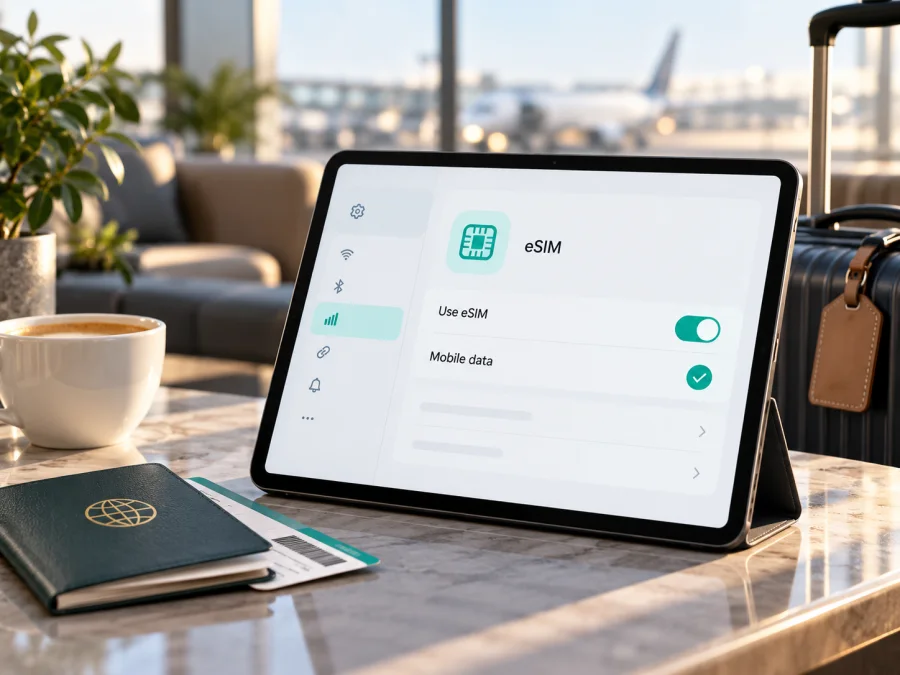
Apple iPad 10th generation 5G 64GB eSIM: compatibility and setup
The Apple iPad 10th generation 5G 64GB can use an eSIM when it is a supported Wi‑Fi + Cellular regional model. Apple lists eSIM for the 10th-generation Wi‑Fi + Cellular iPad, but the product name alone does not reveal the model number or where its cellular service is intended to work. Check the model number before you buy a plan: A2757 is the international Wi‑Fi + Cellular model listed with eSIM, while mainland China has separate model numbers and operator rules. A Wi‑Fi-only iPad cannot use an eSIM for cellular data, and storage capacity does not change cellular compatibility.
An eSIM is a digital SIM profile stored by the device. It can be installed without inserting a plastic SIM, but it still needs a compatible iPad, an unlocked device, a provider that supports eSIM on iPad, and a data plan that works in the place you are visiting. For a trip, treat the hardware check and the destination-plan check as two separate steps.
Quick specifications
| Item | What to know |
|---|---|
| Product name | Apple iPad 10th generation 5G 64GB |
| Generation | 10th generation, introduced in 2022 |
| Storage in this variant | 64GB; storage does not determine eSIM support |
| Cellular configuration implied by “5G” | Wi‑Fi + Cellular, if the seller’s description is accurate |
| eSIM | Supported on qualifying Wi‑Fi + Cellular versions; verify the A-number and settings |
| Physical SIM | Apple lists a nano-SIM tray on Wi‑Fi + Cellular models |
| Data use | Cellular data plans are sold separately; availability and network compatibility depend on the provider and market |
| Important regional note | Mainland China models and eSIM service have separate restrictions and support lists |
The retail description is not a complete hardware identifier. Listings may omit the model number or country of sale, so do not infer eSIM capability from “5G,” a SIM tray, or 64GB alone. Identify the model and verify its eSIM controls.
Does the Apple iPad 10th generation 5G 64GB support eSIM?
Usually yes for the international Wi‑Fi + Cellular version, but confirm the exact regional model. Apple’s current technical specifications list eSIM and nano-SIM for the iPad (10th generation), and describe its Wi‑Fi + Cellular configuration as data-only cellular. The Apple specification footnote names model A2757 and says to check with the carrier; it also says the A2757 eSIM feature is not available in mainland China. The same specifications list 64GB as an available storage size. These facts support eSIM use on an eligible cellular version, but they do not establish that every 10th-generation 5G iPad sold in every market can install every provider’s profile.
The Wi‑Fi-only model is a separate configuration. It has no cellular modem for mobile data, even if a shop’s title or product filters are unclear. A Wi‑Fi-only unit cannot be made eSIM-compatible by a software update, an adapter, or a travel data plan. If the seller cannot confirm Wi‑Fi + Cellular, use the model number and Settings screen to resolve the question before paying.
Regional and operator versions
Apple identifies the following model numbers for the 10th-generation iPad: A2696 for Wi‑Fi; A2757 for Wi‑Fi + Cellular; and A2777 and A3162 for Wi‑Fi + Cellular models sold for mainland China. Apple’s international technical specifications list eSIM, with the availability caveat for A2757 in mainland China. Its current mainland China support information separately identifies A3162 as a mainland model that supports eSIM there, and says China Unicom is the only supported iPad eSIM provider in that market. Apple’s current mainland China list does not name A2777 as a model that can install a mainland carrier eSIM profile. Check the exact device and operator rules for the market where you will activate the plan; do not assume that the names “China model” or “5G” settle the question.
The hardware version and geographic service are separate checks. A device may support travel eSIMs outside mainland China but not profiles from a mainland carrier. Apple says A3162 can install non-mainland eSIM data plans while travelling outside mainland China, with Location Services enabled. For mainland service, use Apple’s current model list and contact China Unicom. Do not assume an international A2757 can install a mainland carrier profile because its Settings app shows eSIM controls.
The modem must also match the network. Apple recommends checking carrier compatibility and plan availability for the specific model. “5G” does not guarantee 5G service, a particular speed, or acceptance by a provider in every country. Confirm the destination, network, and device conditions before checkout.
Check your iPad before buying a plan
Use these checks on the iPad itself and, if it is not yet in your hands, ask the seller to provide clear photos or written confirmation.
- Confirm the configuration. In Settings, open General > About and look for a model number. Apple identifies A2696 as Wi‑Fi only and A2757, A2777, and A3162 as cellular variants. Tap the part number shown beside “Model Number” to reveal the A-number. Confirm the same number on the rear casing or original box if possible.
- Check for EID. In Settings > General > About, scroll through the device identifiers. On a cellular iPad with eSIM capability, an EID should normally appear. Apple describes EID as an identifier available in the iPad’s About screen, Finder, Apple Devices/iTunes, Apple Account device details, or the original packaging. You do not need to share the EID publicly. It is a device identifier, not a QR code or activation code.
- Look for the eSIM control. Open Settings > Cellular Data (the menu can be called Mobile Data in some regions or iPadOS versions). Look for an option such as Add eSIM, Add Cellular Plan, or a provider plan setup option. Menu wording can vary. The presence of the control is a useful check, but it does not prove that a specific operator or travel plan will accept this iPad.
- Check the region-specific Apple information. If the model number is A2777 or A3162, or the device was sold for mainland China, review Apple’s current guidance for that market. For a mainland China activation, Apple currently lists A3162 and China Unicom. A2757’s published eSIM caveat excludes mainland China activation.
- Confirm the device is not carrier-locked or managed in a way that blocks adding a plan. Ask the seller or the organization that manages the iPad. A locked or supervised device may restrict cellular settings. A missing menu can also result from a restriction or software issue, so do not diagnose from a screenshot alone.
- Check the destination plan’s conditions. Confirm that the plan is for your destination, supports iPad or the relevant cellular device class, and includes the amount of data and validity period you need. Check whether activation starts at purchase, at installation, or on first connection, and whether the provider requires data roaming.
- Have a reliable internet connection for installation. The iPad needs Wi‑Fi or another working connection to download the profile. Install it before departure when practical, but follow the plan’s activation timing so you do not start validity earlier than intended.
For a quick compatibility check, check your device. Use the result together with the exact model number and plan terms; a generic device-family match does not replace the region and operator checks above.
Preparing the iPad for eSIM setup
Before installation, update iPadOS if possible, connect to stable Wi‑Fi, and keep the iPad charged. Open the plan details and display the QR code on another screen or use a provider-supported app or link. A QR code may be single-use; do not delete an installed profile or repeat an attempt without checking the provider’s instructions.
Kaspersky eSIM Store is an app and website for choosing, arranging, and activating an eSIM data plan for an international trip. Check the destination, data allowance, validity, activation timing, and device requirements. A plan should be treated as data-only unless its specific terms say otherwise.
How to install and activate an eSIM on iPad
The exact screens can vary with iPadOS, the country, and the provider. Apple supports several setup methods on eligible iPad Wi‑Fi + Cellular models. The general QR-code sequence is:
- Open the installation details. Find the provider’s QR code or setup option in the account, app, email, or purchase confirmation. Read any activation or roaming instructions before continuing.
- Go to Cellular Data settings. On the iPad, open Settings > Cellular Data or Mobile Data. Choose Add eSIM, Add Cellular Plan, or the equivalent option shown on your version of iPadOS.
- Scan the QR code. Choose the QR-code option and scan the provider’s code from another device or printed copy. If a supported version of iPadOS detects a QR code in an email or on a webpage, it may also offer an Add eSIM action when you touch and hold the code. Follow the on-screen steps.
- Enter a confirmation code if requested. Some providers require an additional code or sign-in. Use only the details supplied through the provider’s official purchase channel.
- Name the plan. Choose a label that makes it easy to distinguish the travel eSIM from your usual mobile plan, such as “Travel data” and the destination. Labels are for your own convenience and do not change the plan.
- Choose which plan uses cellular data. In Cellular Data settings, select the travel eSIM as the data line when you want to use it. If you use another line for account-related services, confirm that the iPad is not using that line’s roaming data by mistake.
- Set data roaming as instructed. Some travel eSIMs require Data Roaming to be enabled for that eSIM. Follow the plan instructions. This is a setting for the selected profile; it does not mean you should enable roaming on every other line. Review your home provider’s charges and turn off its data line or data roaming if you want to avoid unintended home-plan use.
- Wait for registration. Give the iPad a few minutes to download and register the profile. Keep it connected to Wi‑Fi until setup finishes. The profile may only connect to a supported network when you are in its destination.
- Test with Wi‑Fi turned off. When the plan should be active, turn off Wi‑Fi briefly, confirm that the travel eSIM is selected for cellular data, and load a simple webpage. Turn Wi‑Fi back on afterward if you do not need cellular data.
Some providers allow installation through their app or a direct activation link instead of QR. Follow that provider’s current instructions and do not add an unknown profile from an unsolicited message. The Kaspersky eSIM Store guides explain the iOS-style setup flow and include iOS installation instructions and Android installation instructions. Android instructions are included as a general reference for travelling companions; this iPad uses iPadOS, so use the iOS guide for the tablet itself.
Installation and activation are related but not always simultaneous. A profile can be downloaded while you are still at home, then connect to the destination network later. The plan’s validity may begin at purchase, at a scheduled time, or when it first connects, depending on the plan. Check this before installation and do not rely on a general rule. If a plan is intended for immediate use, avoid installing it too early unless its terms confirm that this will not consume the validity period.
Using the iPad for mobile data on a trip
On a trip, the iPad’s cellular data can support maps, booking details, messaging apps, and work when Wi‑Fi is unavailable. Store essential travel details offline. Select the travel profile for cellular data on arrival and confirm the home plan’s roaming rules. A 64GB storage capacity is separate from the plan’s data allowance. If you want to share data by Personal Hotspot, confirm that the iPad, plan, and local network allow it.
For a multi-country route, check that every stop is covered by the plan’s terms. Available networks, speeds, and 5G depend on the local network, device bands, and plan. Disable automatic downloads or large cloud backups if you need to manage data use. Travel data plans should be treated as data-only unless the individual terms explicitly include voice or SMS; internet calling and messaging apps may work over data.
Common problems and what to check
“Add eSIM” or “Add Cellular Plan” is missing
Confirm the iPad is Wi‑Fi + Cellular, check its A-number and EID in Settings > General > About, and compare the model with Apple’s regional guidance. Restart and update iPadOS, then check Screen Time or organization restrictions. For mainland China devices or profiles, verify the exact model and provider rules.
The QR code will not scan
Increase brightness on the screen showing the full code, clean the camera lens, and avoid glare. A code shown on the iPad itself needs to be displayed on another screen or printed. Check whether the code was already used; ask the provider about a reissue rather than repeatedly scanning it.
The profile downloads but does not connect
Make sure it appears in Cellular Data settings, is enabled, and is selected for data. Check destination coverage, Airplane Mode, and whether this eSIM requires data roaming. Restart and allow time for registration. Enter an APN only if the provider gives one, exactly as supplied.
Signal appears but webpages do not load
Check the selected data line, remaining allowance, plan validity, and activation date. Test with Wi‑Fi off, confirm cellular data is enabled, and apply any provider-supplied roaming or APN instructions. Signal alone does not confirm active data.
There is no network in the destination
Check the country coverage, validity start, Airplane Mode, and selected eSIM. Move to a clearer-signal location and allow registration. Use Automatic network selection unless the provider names a manual option. The provider must accept the device and its supported bands; “5G” does not guarantee service everywhere.
The plan starts too early or data uses the wrong line
Check the plan’s start rule; some begin at purchase or a scheduled time, others at first connection. Confirm the selected data line before switching off Wi‑Fi. Turn off data switching if appropriate and review the home line’s data roaming to avoid unintended charges.
You need support for an installed profile
Do not delete it unless the provider asks; some activation codes cannot be reused. Note the model, iPadOS version, destination, and error message. Share the EID only through a trusted support channel when requested. Contact the plan provider about plan status and Apple about hardware or Settings issues.
Frequently asked questions
Does the 64GB version have eSIM?
Storage does not determine eSIM support. Check that it is Wi‑Fi + Cellular, identify its A-number, and confirm that the destination provider accepts it.
Is “5G” enough to prove eSIM support?
No. Verify the A-number, EID, and Add eSIM control, then check the provider and destination conditions.
Can I install an eSIM on the Wi‑Fi-only model?
No. The Wi‑Fi-only iPad does not have cellular hardware for a mobile data plan. It can connect to Wi‑Fi or use a separate hotspot, but it cannot add a cellular eSIM profile itself.
Can I use this iPad for voice calls and text messages?
Treat the travel plan as data-only unless its terms say otherwise. Internet calling and messaging apps may work over data, but eSIM does not automatically provide a standard phone number or SMS.
Can I move the eSIM to another iPad?
Do not assume so. Check transfer and replacement rules before deleting a profile; a code may be single-use or device-bound.
Can I keep the home SIM and travel eSIM together?
Cellular models have a nano-SIM tray and eligible versions can also use eSIM, but active-line options depend on device, software, and provider. Check home roaming rules and select the intended data line.
Will eSIM provide 5G abroad?
Not necessarily. Bands, local network service, and plan conditions determine whether the iPad connects to 5G, LTE, or another supported network.
Before your trip: check first, then choose a plan
For the Apple iPad 10th generation 5G 64GB, the practical answer is: an eligible Wi‑Fi + Cellular version can support eSIM, but the retail name does not identify its regional variant. Confirm the A-number, check for an EID and an Add eSIM option, verify that the iPad is unlocked, and match the model to the provider’s rules for the destination. Mainland China has distinct model and operator requirements, including a current Apple listing for A3162 and China Unicom for mainland eSIM service.
Once compatibility is clear, choose a data plan that covers every stop on your route and suits the way you use the iPad. Read the allowance, validity, activation timing, roaming, and network terms before confirming. If you want to browse current destinations and plan details, visit the Kaspersky eSIM Store. It is an app and website for choosing, arranging, and activating an eSIM data plan for an international trip; availability and plan conditions should be checked for your destination at the time of travel.


