Travel connectivity guide
Apple iPhone 16 Pro 128GB eSIM
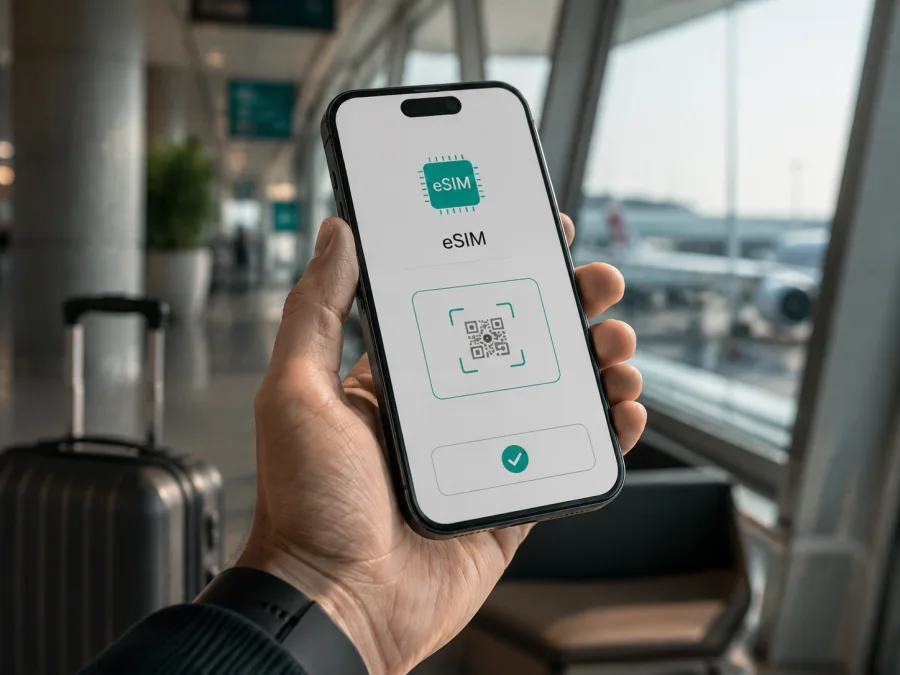
Apple iPhone 16 Pro 128GB eSIM: compatibility and setup
If you have an Apple iPhone 16 Pro 128GB and want mobile internet abroad, the answer is yes: this model family supports eSIM. Apple’s current official specifications list eSIM, multiple stored profiles and two active eSIMs on supported configurations. The 128GB storage capacity does not remove that capability.
The sales region and carrier status still matter. A U.S. handset can be eSIM-only; many other markets supply a nano-SIM tray alongside eSIM; and iPhone 16 Pro units for mainland China, Hong Kong or Macao can follow different dual-SIM rules. Verify the actual phone before buying a travel tariff.
Does Apple iPhone 16 Pro 128GB support eSIM?
Yes, the Apple iPhone 16 Pro 128GB supports eSIM when it is an eligible regional version and is not carrier-locked. Apple describes the iPhone 16 Pro as supporting dual eSIM on compatible configurations and storing eight or more profiles. In many non-U.S. markets it can use a nano-SIM and eSIM together; U.S. iPhone 14 and later models activate with eSIM rather than a physical SIM. Storage does not determine whether the eSIM menu appears.
Key characteristics
| Item | What applies to Apple iPhone 16 Pro 128GB |
|---|---|
| Exact device variant | Apple iPhone 16 Pro 128GB |
| Generation | iPhone 16 Pro, introduced in 2024 |
| Internal storage | 128GB |
| eSIM | Supported on eligible regional versions |
| Active lines | Up to two active eSIMs on supported configurations; the exact combination depends on the regional version and carrier |
| Saved profiles | Apple states that eight or more eSIMs can be stored |
| Physical SIM | A nano-SIM tray is available on models sold outside the United States; some regional versions differ |
| Network access | 5G and LTE availability depends on the model, local network and tariff |
| Carrier status | The phone must show “No SIM restrictions” to use a different carrier’s eSIM |
This describes the model family, not a guarantee for an imported handset. The model number, country of sale and carrier settings remain important.
Regional and carrier differences
The same retail name can hide differences. Apple lists a physical SIM tray on models purchased outside the United States, while U.S. iPhone 16 Pro devices are designed around eSIM activation. A tray is only a clue, not proof of the eSIM method. Apple also documents iPhone 16 Pro units purchased in mainland China, Hong Kong or Macao in connection with dual SIM using two nano-SIM cards. These versions may not behave like European, Canadian or U.S. phones when adding a travel eSIM. Verify the exact handset rather than relying on the seller’s title.
Carrier locking is a second, separate issue. A phone can have the eSIM hardware and still refuse a profile from another provider if it is locked to its original carrier. On the iPhone, open Settings > General > About and find Carrier Lock. The message No SIM restrictions means the phone is unlocked. If another message appears, ask the original carrier about unlocking before you buy or install a travel plan. Apple notes that only the current carrier can remove a carrier lock.
The provider must also support eSIM activation and data service for the destination. Phone compatibility alone does not guarantee coverage or roaming permission; a profile may need current carrier settings and data roaming enabled.
How to verify compatibility on the phone
The most reliable check is the phone in your hand. Menus vary with iOS language and version, but these signs are useful.
- Open Settings.
- Tap Cellular or Mobile Data.
- Look for Add eSIM, Set Up Cellular or a similar option.
- If the option is available, look for Use QR Code, Transfer From Nearby iPhone or manual entry. You do not need to finish installation just to confirm the menu.
- Open Settings > General > About and look for EID, the identifier for the embedded SIM. Then check Carrier Lock and look for No SIM restrictions. EID confirms the component, but region and carrier support still control activation.
If Add eSIM and EID are both absent, pause before buying. Confirm the exact Apple iPhone 16 Pro 128GB, update iOS, restart and ask the seller or carrier for the model number and country of sale. A missing menu can indicate a regional, software or activation issue.
Compatibility checklist before purchase
- Confirm that the phone is the exact Apple iPhone 16 Pro 128GB, not another iPhone 16 model or storage variant.
- Confirm that Add eSIM or Set Up Cellular is present in Settings > Cellular.
- Confirm that an EID is shown in Settings > General > About, when the regional software exposes it.
- Confirm No SIM restrictions under Carrier Lock.
- Identify the country or region where the handset was sold, especially if it came from mainland China, Hong Kong or Macao.
- Install pending iOS and carrier-settings updates over reliable Wi-Fi.
- Check that the eSIM tariff covers the country or countries on your route.
- Check the tariff’s data allowance, validity period, activation conditions and hotspot rules.
- Keep Wi-Fi available because downloading an eSIM profile requires an internet connection.
Check your device before you commit to a tariff, and repeat the check if the phone was bought second-hand or imported.
What an eSIM tariff does for a trip
An eSIM is a digital SIM profile. For travel, it can provide mobile data without removing your everyday SIM. It can support maps, transport, translation, messaging and work tools. It does not automatically provide a regular phone number, voice calls or SMS; those are included only when the tariff says so.
Kaspersky eSIM Store is an application and website where you can choose, arrange and activate an eSIM with a tariff for mobile internet during an international trip. It helps you prepare the profile and select a destination or region; it is not the mobile operator, network owner or provider of the underlying mobile service. The available countries, network access and conditions are determined by the selected tariff and its participating network arrangements.
After checking compatibility, choose a tariff for the route, not only the largest data allowance. A country plan may suit one destination; a regional plan may suit a multi-country itinerary. Confirm every destination, data allowance, validity period and activation rule. Some plans start at installation and others at first connection, so follow the conditions shown at purchase.
How to install and activate eSIM on Apple iPhone 16 Pro 128GB
Before starting, charge the phone, connect it to Wi-Fi, update iOS and confirm that it is unlocked. Keep the QR code or activation details on another screen; use a provider link or manual entry if the code is displayed on the same iPhone.
1. Open the eSIM menu
Open Settings, tap Cellular or Mobile Data, then tap Add eSIM or Set Up Cellular. The wording can vary by iOS version, language and regional configuration.
2. Choose the activation method
Select Use QR Code when the provider supplied a QR code. If a link, app or manual SM-DP+ details were supplied, use that method instead.
3. Scan or enter the profile details
Point the camera at the QR code, follow the prompts and enter a confirmation code if requested. Use only the code from your order. If it was already used or expired, ask the provider for the next activation step.
4. Add and label the line
Confirm the plan, then give the line a label such as Travel data or the destination. Installation and data activation are separate, so the profile can remain off until needed.
5. Select the line for mobile data
When iOS asks which line should provide mobile data, select the travel eSIM when ready. Review the default voice line and automatic data switching so your home line does not use roaming data accidentally.
6. Configure roaming and connect
Open the travel line’s settings and turn on Data Roaming if required. A travel eSIM may connect through a partner network. Keep roaming off for the home line unless you accept those charges. Turn Airplane Mode off, wait a few minutes and test data.
These project instructions may also help: Android eSIM installation instructions and iOS eSIM installation instructions. The iOS guide is the relevant companion, but labels depend on iOS and the provider.
Using the eSIM during a journey
Before departure, install the profile over stable Wi-Fi if the tariff permits it. Keep the eSIM stored even if it is not active. If validity starts on installation, wait for the right time; if it starts on first connection, installing at home may be convenient. Follow the tariff’s rule.
When you land, open Settings > Cellular, turn on the travel line and select it under Cellular Data. Verify Data Roaming if required and check that the home line is not selected for data. Test a website or messaging app before relying on navigation. For a multi-country plan, use automatic network selection unless instructed otherwise.
For a short business trip, keep the home line for important calls and use the travel eSIM for data. On a longer holiday, monitor the allowance and limit cloud backup, high-resolution streaming and automatic updates. An eSIM can reduce dependence on open Wi-Fi but does not replace normal device security.
If you use Personal Hotspot, check that the tariff allows tethering. The 5G or LTE icon is not a speed guarantee; performance depends on coverage, congestion, partner network, regional bands and tariff conditions.
Common problems and checks
The Add eSIM option is missing
Confirm the device and region, then look for EID in Settings > General > About. Update iOS and carrier settings, then restart. Ask the seller or carrier about the exact SIM configuration for a handset from mainland China, Hong Kong or Macao. A tray is not proof of eSIM support.
The QR code does not scan
Increase the other screen’s brightness, clean the camera lens and show the full code. If the code is on the same iPhone, use another screen or a provider link. If it was already installed or expired, contact the provider.
The profile installs but there is no service
Check that the travel line is on and selected under Cellular Data. Check Data Roaming, toggle Airplane Mode, restart and wait for registration. Open Settings > General > About for a carrier-settings update. Use manual network or APN values only when supplied for the tariff.
The phone says the plan is not supported
Check Carrier Lock. A message other than No SIM restrictions can prevent another provider’s eSIM. Contact the original carrier; Apple does not unlock it on the carrier’s behalf. Also verify destination, activation window and regional requirements.
Data is going through the wrong line
Open Settings > Cellular > Cellular Data and select the travel eSIM. Review Allow Cellular Data Switching, turn off unnecessary app data and keep home-line roaming disabled if charges may apply.
The eSIM works but the allowance disappears quickly
Review remaining data in the provider’s app or profile and inspect Settings > Cellular for app usage. Video, cloud backup, photo sync, hotspot use and updates can consume data quickly. Match the allowance to the route and habits.
Frequently asked questions
Is the 128GB version different from other iPhone 16 Pro storage versions for eSIM?
No storage-based eSIM difference is listed by Apple. Availability depends on the regional model, iOS, carrier support and lock status, so verify the actual phone.
Can two eSIMs be active at once?
Apple states that iPhone 16 Pro supports two active eSIMs on supported configurations and stores eight or more profiles. The combination depends on region and carrier; a stored profile need not be the data line.
Can I keep my regular number while using travel data?
Usually, yes: keep the regular line enabled and select the travel eSIM for data if the regional version supports both. Calls, SMS and charges remain governed by the home carrier.
Does the travel eSIM include calls and SMS?
Not by default. A travel eSIM normally provides data only. Use internet messaging or keep a voice-capable line active; check the tariff for exceptions.
Can I move the installed eSIM to another phone?
Do not assume that you can. Profiles may be tied to first activation or have provider transfer rules. Check conditions before deleting the profile or resetting the Apple iPhone 16 Pro 128GB.
What if I bought the phone abroad?
Check country of sale, model number, EID, Add eSIM and Carrier Lock. Imported units, especially those associated with mainland China, Hong Kong or Macao, can use different configurations. A seller’s title is not enough evidence.
Final device check and travel eSIM plan
Before buying, confirm that your exact Apple iPhone 16 Pro 128GB shows EID and Add eSIM, and that Carrier Lock says No SIM restrictions. Confirm the region of an imported device, update iOS and carrier settings, and have Wi-Fi ready. Then choose a tariff for the countries on your itinerary, checking data, validity, activation, roaming and hotspot conditions.
Once those checks are complete, Kaspersky eSIM Store can help you choose, arrange and activate an eSIM for mobile internet in your overseas trip through its website or application. Install the profile at the right time, select it as the data line when you arrive and keep your home line’s roaming settings under control. This short preparation gives you a clear answer about compatibility before payment and a practical way to stay connected while travelling.


