
Travel connectivity guide
eSIM Austria: mobile connection and internet
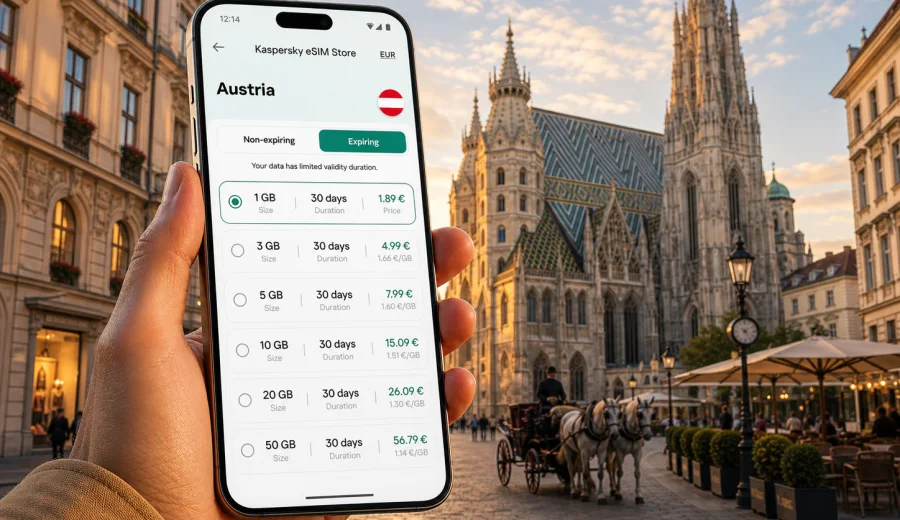
eSIM in Austria: mobile connection and internet for your trip
Austria is an easy country to underestimate when you plan mobile internet. The distances can look short on a map, but a real trip may include Vienna streets, Alpine valleys, train routes to Salzburg or Innsbruck, lakeside hotels, ski resorts, business meetings, museum tickets, digital boarding passes, and navigation between German-speaking towns where you do not want to guess at every sign. A practical eSIM setup helps you keep mobile connection and internet ready without looking for a physical SIM card after arrival.
This guide explains how to prepare an eSIM for Austria, estimate data needs, check your device, and choose an eSIM tariff for mobile internet during your trip. The focus is the whole country, not only Vienna: the same logic applies whether you land in the capital, cross the border by train, drive through Tyrol, or spend a weekend in Salzburg.
Why eSIM is useful for Austria
Austria is highly travel-friendly, but that does not mean every online task should depend on hotel Wi-Fi or a roaming package from your home operator. In the first hour after arrival, mobile internet can be the difference between a smooth transfer and a chain of small delays: opening a transport app, checking the address of your apartment, messaging the host, translating a note, or confirming which train platform you need.
An eSIM is a digital SIM profile installed on a compatible phone or tablet. For travel, it is usually used for mobile data. You choose a tariff for the destination, install the eSIM, and use it as the data line when you need internet abroad. It does not require inserting a physical card, so you can keep your primary SIM for calls, banking messages, or two-factor authentication if your device supports that setup.
For Austria, eSIM is especially useful in common travel moments:
- arrival at Vienna International Airport, Salzburg Airport, Innsbruck Airport, or a railway station;
- city navigation with maps, public transport apps, taxi apps, and hotel check-in details;
- train travel between Vienna, Graz, Linz, Salzburg, Innsbruck, and smaller towns;
- mountain trips where you want offline maps backed by mobile data when coverage is available;
- business travel where email, calendar updates, cloud documents, and messenger calls matter;
- family trips where several bookings, tickets, and route changes are stored online.
The key benefit is preparation. Instead of looking for a physical SIM card in a shop, you can set up a digital profile in advance or shortly after arrival, provided your device supports eSIM and the selected tariff conditions fit the trip.
Austria travel scenarios where data matters
Austria combines city travel and regional routes. A person staying only in central Vienna may use less data than someone driving through the Alps, uploading photos, and streaming music for several hours a day. Before choosing an eSIM tariff, think about your route rather than the country name alone.
| Trip scenario | Typical online tasks | Practical data approach |
|---|---|---|
| Weekend in Vienna | Maps, restaurant bookings, tickets, messengers, light browsing | A smaller data package may be enough if you use hotel Wi-Fi for heavy updates |
| Rail trip across several cities | Navigation, train changes, cloud documents, messaging, photo backup | Choose more data and a validity period that covers the full route |
| Ski or hiking holiday | Weather, maps, messenger calls, emergency contact, route research | Keep offline maps too, because mountain coverage can vary by location |
| Business visit | Email, calendar, calls over apps, files, hotspot for a laptop if allowed | Prioritize stable data allowance and check tethering conditions in the tariff |
| Family vacation | Several phones, shared bookings, video calls, uploads | Estimate data per person and avoid relying on one device for every task |
This table is not a promise about coverage or speed. Mobile performance depends on location, local network conditions, device settings, and the selected tariff. The useful point is planning: match the tariff to the way you will actually use the internet.
eSIM, roaming, public Wi-Fi, or local SIM: what to compare
There is no single option that is best for every traveler. Roaming can be convenient but should be checked for daily fees, fair-use limits, and Austria coverage in your home plan. Public Wi-Fi helps in hotels and cafes but is not enough for transfers, maps, urgent messages, or route changes. A physical local SIM can work for longer stays, but it may require finding a shop and replacing or carrying your existing SIM card.
An eSIM for Austria can be a balanced option when you want mobile internet without a physical SIM card. You can review the data amount, validity period, destination, and price before choosing. Kaspersky eSIM Store helps you choose, arrange, and activate an eSIM tariff for a foreign trip through the app or website, while the actual conditions depend on the selected tariff.
How much mobile data you may need in Austria
Data needs are personal, but you can estimate them from habits. Essential use includes navigation, messaging, tickets, hotel details, banking confirmations, and light browsing. Heavy use includes video streaming, frequent video calls, cloud photo backup, large app updates, and using a phone as a hotspot.
For a short city break, a modest data package may be enough if you keep video and backups for trusted Wi-Fi. For a week with train travel, daily maps, social media, and occasional messenger calls, choose a larger package. For remote work or hotspot use, check the data volume and whether tethering is allowed.
Use this quick checklist before choosing:
- Count the number of travel days in Austria.
- List the cities and regions you will visit.
- Decide whether you will upload photos or video during the trip.
- Check whether you need hotspot use for a laptop or another device.
- Consider whether you cross into neighboring countries such as Germany, Switzerland, Italy, Czechia, Slovakia, Hungary, or Slovenia.
- Choose a validity period that covers the full trip, including arrival and departure days.
If your route includes more than Austria, compare a country-specific tariff with a regional option if available. A regional tariff can be useful for a multi-country rail or road trip if its conditions match your route.
What to check before buying an eSIM for Austria
The most important check is device compatibility. Not every smartphone supports eSIM, and some devices may be locked by an operator. Before you pay, confirm that your model supports eSIM and can use a travel eSIM profile.
Start with these checks:
1. Open your phone settings and look for options such as Add eSIM, Add Cellular Plan, or Add Mobile Plan.
2. Confirm that the device is not carrier-locked.
3. Check that your phone can use your primary SIM and travel eSIM in the way you expect.
4. Read the tariff conditions: data amount, validity period, destination, price, and start rules.
5. Make sure you will have an internet connection for installation if the eSIM is not already installed before travel.
You can also use the internal compatibility window before purchase: check your device. This step is worth doing even if you have used eSIM before, because device models, regional variants, and operator locks can differ.
Also remember what a travel eSIM normally does not include. Unless the specific tariff says otherwise, it is for mobile data and does not include a regular local phone number, voice calls, or SMS. Messengers and calling apps can still work over mobile internet when data is active.
How to choose an eSIM tariff for Austria
Choose by trip shape, not by the largest number on the screen. A bigger data package can be useful, but only if you will use it within the validity period. A smaller tariff can be practical for a weekend if you mostly need maps, messaging, and tickets.
For a calm decision, compare four things:
- Destination: make sure Austria is included in the tariff.
- Data size: choose enough data for navigation, messaging, work, and media habits.
- Validity: match the number of days to your travel dates, including buffer time.
- Usage conditions: check activation rules, possible hotspot use, and any restrictions shown before purchase.
At this stage, you can choose an eSIM tariff for your Austria trip in Kaspersky eSIM Store and compare the options shown for the destination. Review the data amount and validity carefully, then choose the package that fits your travel style rather than assuming that one plan fits every route.
If you are traveling in winter, ski trips often include more time outside city centers. If you are traveling by train, you may use maps, messages, and booking apps throughout the day. If you are attending a conference, you may need calendar sync, email, documents, and messenger calls.
Installing and activating eSIM before or during the trip
The basic installation path is simple, but you should avoid doing it in a rush at baggage claim. Install the eSIM when you have stable internet, battery power, and enough time to follow the prompts. Depending on the tariff, activation or validity may start at purchase, installation, or first connection to a supported local network, so read the conditions before you begin.
Typical steps:
1. Choose the Austria tariff that matches your route and data needs.
2. Complete the order and open the eSIM details in your profile, email, app, or website flow.
3. Install the eSIM using the on-screen instructions or QR code.
4. Name the line clearly, for example Austria data, so you do not confuse it with your main SIM.
5. Set the eSIM as the mobile data line when you are ready to use it.
6. Enable data roaming for the eSIM if the instructions or device settings require it.
7. Keep your primary SIM available for calls or SMS if you need it and your device supports dual SIM use.
For device-specific setup, use the Android installation instructions or the iOS installation instructions. The exact labels in settings can vary by phone model and operating system version, so follow the flow shown on your own device.
Do not delete the eSIM profile unless you are sure you no longer need it. In many cases, an eSIM profile cannot simply be moved to another phone after activation. If something goes wrong, check the installation steps, confirm that mobile data is assigned to the eSIM line, and contact support if needed.
Practical settings after you land in Austria
After arrival, your phone should use the travel eSIM for mobile data and your main line only for the services you still need. A few settings can prevent confusion.
Check these items:
- Set mobile data to the Austria eSIM line.
- Keep data roaming enabled only for the line that requires it.
- Turn off automatic app updates over mobile data.
- Pause cloud photo and video backup unless you have enough data.
- Download offline maps for mountain routes, rural drives, and long train journeys.
- Keep the QR code or installation email accessible until the eSIM works correctly.
- Watch the remaining data balance in the app or profile if that option is available.
If you use messaging apps for calls, test them on mobile data before an important meeting or transfer. If you need hotspot use, check the tariff conditions first.
Austria has excellent travel infrastructure, but no mobile setup can remove every variable. Trains, tunnels, mountain valleys, thick hotel walls, and busy event venues can affect the experience. For important travel documents, keep offline copies as a backup.
One practical rule: complete the calm parts before travel. Check compatibility, choose the tariff, install the eSIM, and read the activation conditions. Use the arrival day only for switching mobile data to the eSIM and checking that the connection works.
Quick preparation checklist
Use this checklist a day or two before departure:
- Your phone supports eSIM and is not locked to one operator.
- Your operating system is up to date enough for eSIM setup.
- You have chosen Austria or the correct regional destination.
- The data amount fits your expected usage.
- The validity period covers the whole stay.
- You know when the tariff validity starts.
- You have saved installation instructions for your device.
- Your primary SIM settings are clear, especially for banking SMS or calls.
- Offline maps and important documents are downloaded.
- Battery pack and charger are packed for long travel days.
This preparation makes eSIM part of the trip plan rather than a technical task to solve under pressure.
FAQ about eSIM for Austria
Can I use eSIM for mobile internet in Austria?
Yes, if your device supports eSIM, is not restricted by an operator lock, and the selected tariff includes Austria. Check the tariff conditions before purchase.
Does a travel eSIM give me an Austrian phone number?
Usually no. Travel eSIM tariffs are commonly designed for mobile data. Voice calls and SMS are not included unless the specific tariff clearly says so.
Can I keep my normal SIM active?
On many dual SIM devices, yes. You can often keep your main SIM for calls or SMS and set the eSIM as the mobile data line. The exact behavior depends on your phone.
Should I install the eSIM before I fly?
It is often more comfortable to install it before departure while you have stable internet. Read the tariff rules first, because validity may start at a specific moment depending on the plan.
What if the connection does not work immediately?
Check that the eSIM is installed, selected for mobile data, and allowed to use data roaming if required. Restarting the phone can help. If the issue remains, use the support channel available in the app or website flow.
Is eSIM always cheaper than roaming?
Not always. It can be a practical alternative because you can see the data amount, validity, and price before choosing, but roaming costs depend on your home operator and contract.
Choose mobile internet for Austria before you travel
An Austria trip is easier when your mobile connection is ready for the small tasks that happen all day: opening maps, checking train times, messaging a host, joining a work call, showing a ticket, or finding the next address. eSIM helps you prepare mobile internet without searching for a physical SIM card after arrival.
Kaspersky eSIM Store helps you choose, arrange, and activate an eSIM tariff for mobile internet in a foreign trip through the website or app. Before purchase, check your device compatibility, read the tariff conditions, and choose the data amount and validity period that match your route.
If Austria is your destination, you can prepare an eSIM tariff for your Austria trip before departure and keep the setup ready for the moments when mobile internet matters most.