
Travel connectivity guide
Bamenda eSIM: mobile internet for your trip
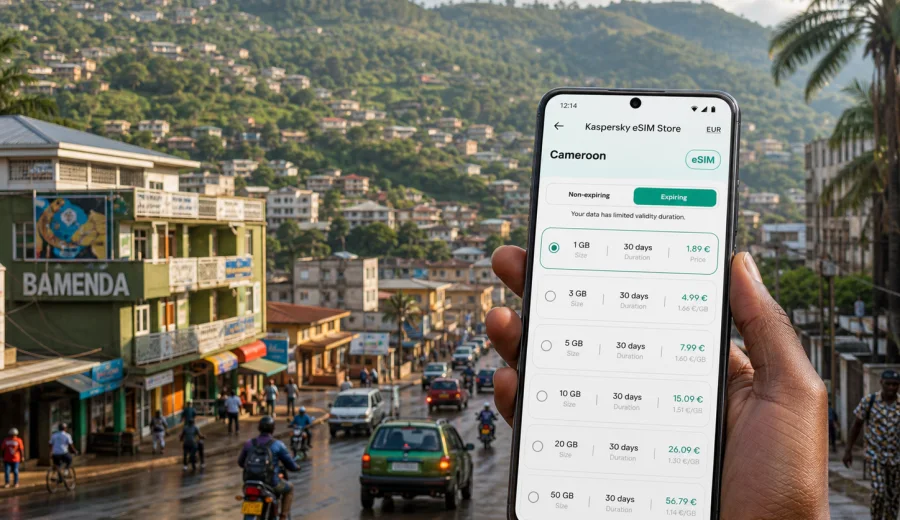
Bamenda eSIM: mobile connection and internet for your trip
Bamenda is a practical city for travelers who rely on maps, messages, ride arrangements, hotel confirmations, and quick route checks. The city sits in Cameroon's North-West highlands, so a trip can involve several different movement patterns in one day: arrival by road, short taxi rides through busy streets, time around commercial areas, hotel check-ins, business meetings, and onward travel toward nearby towns or scenic highland routes.
For that kind of trip, eSIM can be a convenient way to prepare mobile internet before you start moving around Bamenda. Instead of looking for a physical SIM card after arrival, you can choose a suitable data plan for Cameroon, install the eSIM on a compatible device, and use mobile data for the everyday tasks that make a city trip easier to manage.
This guide explains how to think about eSIM for Bamenda specifically: when it helps, how much data you may need, what to check before buying, and how to avoid common setup problems.
Why mobile internet matters in Bamenda
Bamenda is not a city where travelers usually stay in one fixed place all day. Even a short visit may include several practical stops: a hotel, a meeting location, a transport point, a restaurant, a shop, or a family address. Mobile internet helps you keep these small decisions under control.
Typical tasks that need a reliable data connection include:
- checking a route before taking a taxi;
- confirming a hotel or guesthouse location;
- sharing your live location with a colleague, host, or driver;
- translating short messages or address details;
- using messaging apps for calls and updates;
- checking opening hours or appointment changes;
- managing online banking, receipts, and travel documents;
- keeping travel plans available when Wi-Fi is weak or unavailable.
Public Wi-Fi can be useful in hotels or offices, but it should not be your only plan. You may need internet between locations, while waiting for transport, or when a hotel network is slow. eSIM gives you a separate mobile data option on your own device, provided your phone supports eSIM and the selected plan is active for Cameroon.
When eSIM can be useful in Bamenda
eSIM is most useful when your trip has moving parts. Bamenda often involves road arrivals and local movement rather than a single airport-to-resort pattern, so having data on your phone can reduce friction from the first hour.
| Travel moment in Bamenda | Why data helps | What to prepare |
|---|---|---|
| Arrival by road | You may need to message your host, check your drop-off point, or compare the route to your hotel. | Install the eSIM before departure and keep the QR code or app access available. |
| Hotel check-in | Confirm bookings, show reservation details, and contact the property if the entrance is not obvious. | Save booking references offline and keep mobile data ready as backup. |
| Business meetings | You may need maps, document access, email, and messaging during the day. | Choose a data allowance that covers work apps and navigation. |
| Local taxis and errands | Street names, landmarks, and meeting points can be easier to manage with maps and chat. | Share pinned locations instead of relying only on written directions. |
| Trips from Bamenda | Highland routes and nearby towns may require extra planning before you leave the city. | Download offline maps and keep mobile data for updates where available. |
eSIM does not replace local knowledge, careful planning, or common travel precautions. It is a tool for mobile internet. The real advantage is that you can prepare it in advance and use it when you need online access during city movement.
Choosing a data plan for a Bamenda trip
For a city article, the correct destination is the country where the city belongs. Bamenda is in Cameroon, so you should look for an eSIM plan that covers Cameroon rather than a separate city-only product. The details that matter most are data volume, validity period, price, and the conditions of the selected plan.
Start with these questions:
1. How many days will you spend in Bamenda?
2. Will you use data only for maps and messages, or also for work?
3. Will your hotel, office, or host provide dependable Wi-Fi?
4. Will you travel outside Bamenda during the same plan period?
5. Do you need tethering for a laptop or second device, and is it allowed by the plan conditions?
A light traveler who uses messaging, maps, and occasional browsing may need much less data than someone joining video calls, uploading documents, or using the phone as a hotspot. Streaming video, cloud backups, and large app updates can consume data quickly and are better left for trusted Wi-Fi unless your plan allowance is large enough.
Practical data estimates for Bamenda
Data use depends on your apps, phone settings, and habits, but a planning range is useful before you choose a tariff. These examples are not promises; they are practical scenarios to help you compare plan sizes.
| Trip style | Likely usage | Data planning idea |
|---|---|---|
| Short stopover | Maps, messaging, ride coordination, hotel contact | A small data package may be enough if you avoid streaming. |
| Weekend visit | Daily navigation, photos in messengers, restaurant searches, booking checks | Choose a plan with room for repeated map and chat use. |
| Business trip | Email, documents, messaging calls, hotspot in short sessions | Consider a larger package and check hotspot conditions. |
| Family visit | Regular messaging, social apps, photo sharing, local movement | Pick a plan that matches the number of active days. |
| Multi-city Cameroon route | Bamenda plus Douala, Yaounde, Bafoussam, or other stops | Choose coverage for Cameroon and validity that spans the whole route. |
Before the trip, reduce automatic data use. Turn off app auto-updates on mobile data, disable automatic media downloads in messengers, and download offline maps for Bamenda and your onward routes. These small steps help your eSIM data last longer.
How Kaspersky eSIM Store fits into the trip
Kaspersky eSIM Store is an app and website where you can choose, arrange, and activate an eSIM with a suitable data plan for mobile internet during an international trip. For Bamenda, the practical workflow is to choose Cameroon as the destination, compare available plan conditions, and install the eSIM on a compatible phone before you need it.
The important point is control. You can review the data allowance, validity period, destination, and price before selecting a plan. That makes eSIM useful for travelers who prefer to organize mobile internet before reaching a hotel, office, or shop.
If Bamenda is part of a wider route, check whether your selected plan covers only Cameroon or a broader region. A country plan is usually the clearest match for a Bamenda-focused trip. A regional or global option may be relevant only if your route crosses borders or includes several destinations.
When you are ready to compare options, you can choose an eSIM plan for a trip to Bamenda in Cameroon and match the data allowance to your expected time in the city.
What to check before buying an eSIM
The most important check is device compatibility. eSIM requires a phone or tablet that supports eSIM, and some devices may be locked by a mobile carrier. Before you buy a plan, check your device and make sure it can add an eSIM profile.
Review these points before payment:
- your device supports eSIM;
- your device is not locked to one carrier;
- the plan destination includes Cameroon;
- the validity period fits your travel dates;
- the data allowance is enough for your usage style;
- you understand when the validity period starts;
- you know whether tethering is allowed if you plan to use it;
- you can access email or the app to receive setup details;
- your phone has internet access during installation.
Also consider how you use your primary SIM. Many travelers keep their regular SIM active for calls or SMS while using eSIM for mobile data. Your phone settings should make the eSIM the data line when you want to use the purchased plan. If your home operator charges for roaming, check your phone settings carefully before turning on data abroad.
Installing eSIM before Bamenda or after arrival
The safest approach is to install the eSIM while you still have stable internet, then activate or switch to it according to the plan instructions. Some travelers prefer to complete the installation at home or at the hotel; others do it after reaching Cameroon. In either case, do not wait until you urgently need a map or message if you can prepare earlier.
A simple setup sequence looks like this:
1. Check that your phone supports eSIM and is not carrier-locked.
2. Choose Cameroon as the destination and select a suitable data plan.
3. Complete the purchase and open the setup details.
4. Install the eSIM by following the phone prompts or scanning the QR code.
5. Set the eSIM as the mobile data line when you are ready to use it.
6. Enable data roaming for the eSIM if the plan instructions require it.
7. Test a small page or message before relying on the connection for navigation.
For step-by-step setup, use the Android installation guide or the iOS installation guide. The exact screens can vary by device model and operating system version, so follow the prompts on your phone.
Do not delete an installed eSIM profile unless you are sure you no longer need it. In many cases, an eSIM profile cannot simply be moved to another device after activation. If something looks wrong, check the instructions and contact support before removing the profile.
Bamenda travel scenarios where data helps most
First evening in the city
The first evening is often when mobile internet feels most useful. You may be tired from the road, still orienting yourself, and trying to confirm a hotel, guesthouse, or meeting point. With eSIM data available, you can open maps, message your host, check a route, and share your arrival time without depending on a nearby Wi-Fi network.
Business meetings and field visits
Bamenda can be a base for professional meetings, education-related visits, NGO work, supplier meetings, or regional coordination. In these situations, mobile data helps with email, document links, calendar updates, and messaging apps. If you expect to use a laptop, check whether tethering is allowed by the selected plan and keep a backup option for large file transfers.
Local movement across districts
City movement may involve landmarks rather than precise street addresses. Data helps you compare a pinned map location with what a driver or host describes. It also helps when a meeting point changes, when traffic slows you down, or when you need to coordinate pickup after an appointment.
Trips from Bamenda
Bamenda can be a starting point for travel to other places in the highlands or onward routes to larger Cameroonian cities. For these trips, mobile internet is useful for route checks, accommodation messages, weather updates, and contact with people expecting you. Download offline maps before leaving, because mobile coverage and speed can vary by location and network conditions.
How to make your data last longer
Even a well-chosen plan can disappear faster than expected if apps run in the background. Before you reach Bamenda, adjust the settings that consume data silently.
Use this checklist:
- download offline maps for Bamenda and your onward route;
- save hotel addresses, meeting points, and booking confirmations offline;
- turn off automatic app updates over mobile data;
- disable automatic cloud photo backup on mobile data;
- limit video autoplay in social apps;
- download playlists, documents, and boarding passes before the trip;
- use hotel or office Wi-Fi for large files when it is reliable;
- monitor data usage in your phone settings during the first day.
Navigation, messaging, and light browsing are usually manageable. Video calls, streaming, high-resolution uploads, and hotspot use are the activities to watch closely. If you need them for work, choose a plan with more headroom.
eSIM, roaming, and local SIM cards in Bamenda
There is no single best option for every traveler. The right choice depends on trip length, device support, budget, and how much time you want to spend arranging mobile internet after arrival.
| Option | Strengths | Trade-offs |
|---|---|---|
| eSIM | Can be prepared before the trip, no physical SIM swap, useful for short stays and city movement. | Requires compatible device and careful setup. Voice calls and SMS are not included unless the plan says so. |
| Home operator roaming | Uses your existing number and may be simple for short use. | Costs and conditions can vary widely; check your operator before travel. |
| Local physical SIM | May suit longer stays or users who need local calling options. | Requires a physical purchase process and may take time after arrival. |
| Public Wi-Fi | Useful in hotels, offices, and some cafes. | Not available between locations and may be slow, shared, or less convenient. |
For many Bamenda visitors, eSIM works best as the prepared mobile data layer: enough for maps, messages, travel updates, and routine online tasks. If you need a local phone number or traditional voice service, check the conditions of any plan you consider and plan separately.
Common mistakes to avoid
The most common eSIM issues are preventable. They usually come from buying before checking compatibility, installing without stable internet, or using the wrong line for mobile data.
Avoid these mistakes:
- buying a plan before confirming your device supports eSIM;
- assuming every phone model has eSIM in every market;
- deleting the eSIM profile during troubleshooting;
- leaving your home SIM selected for mobile data by accident;
- forgetting to enable data roaming for the eSIM when required;
- starting a large update or cloud backup on mobile data;
- choosing a plan that expires before the end of your route;
- expecting a data-only eSIM to include a local phone number.
After installation, give the phone a few minutes to register on a local network. If data does not work, check the selected data line, roaming setting for the eSIM, airplane mode, and APN instructions if provided. If the issue continues, contact support with your device model, destination, and plan details.
Quick checklist for Bamenda
Use this short list before you leave for Cameroon or before you start the Bamenda part of your route:
- Confirm that your phone supports eSIM.
- Choose a plan that covers Cameroon.
- Match data volume to your planned use in Bamenda.
- Install the eSIM while you have stable internet.
- Keep your setup email or app access available.
- Save hotel and meeting addresses offline.
- Download offline maps for Bamenda and nearby routes.
- Set the eSIM as the mobile data line when you are ready.
- Keep your regular SIM settings under control to avoid unwanted roaming.
This preparation is especially useful if your arrival involves a road transfer, a late check-in, or a meeting soon after you reach the city.
FAQ: eSIM for Bamenda
Is there a separate Bamenda eSIM plan?
For a trip to Bamenda, choose a plan that covers Cameroon. City articles help you plan local use, but the actual destination coverage is normally set at country or regional level.
Can I use eSIM for calls and SMS in Bamenda?
Many travel eSIM plans are focused on mobile data. Regular voice calls and SMS are not included unless the selected plan conditions say so. You can use internet-based messaging and calling apps over mobile data.
Should I install eSIM before I arrive?
It is usually easier to install eSIM before you urgently need it, while you have stable internet. You can then switch the eSIM on or set it as the data line when the plan instructions indicate.
How much data do I need for a short Bamenda visit?
For maps, messaging, light browsing, and booking checks, a smaller package may be enough. For work apps, video calls, hotspot use, or multi-city travel, choose more data and monitor usage during the first day.
Will eSIM replace hotel Wi-Fi?
Not entirely. Hotel Wi-Fi can still be useful for large downloads and video calls. eSIM is most helpful between Wi-Fi locations, during local movement, and when you need a personal mobile data option.
What if my phone does not support eSIM?
Use another connectivity option, such as your home operator's roaming package or a physical SIM where available. Do not buy an eSIM plan until you have confirmed device compatibility.
Prepare mobile internet for Bamenda
Bamenda is easier to manage when your phone is ready for the practical parts of the trip: finding addresses, coordinating transport, checking hotel details, sending updates, and planning onward routes. eSIM gives you a prepared mobile data option for Cameroon without changing a physical SIM card, as long as your device is compatible and the selected plan matches your travel needs.
Before you go, check your phone, estimate your data use, install the eSIM with stable internet, and save key trip details offline. Then you can arrive in Bamenda with a clearer plan for staying connected during local movement, meetings, and short trips from the city.
To prepare ahead, choose an eSIM plan for Cameroon in Kaspersky eSIM Store and select the data allowance and validity period that fit your Bamenda itinerary.