
Travel connectivity guide
Beijing eSIM: mobile internet guide
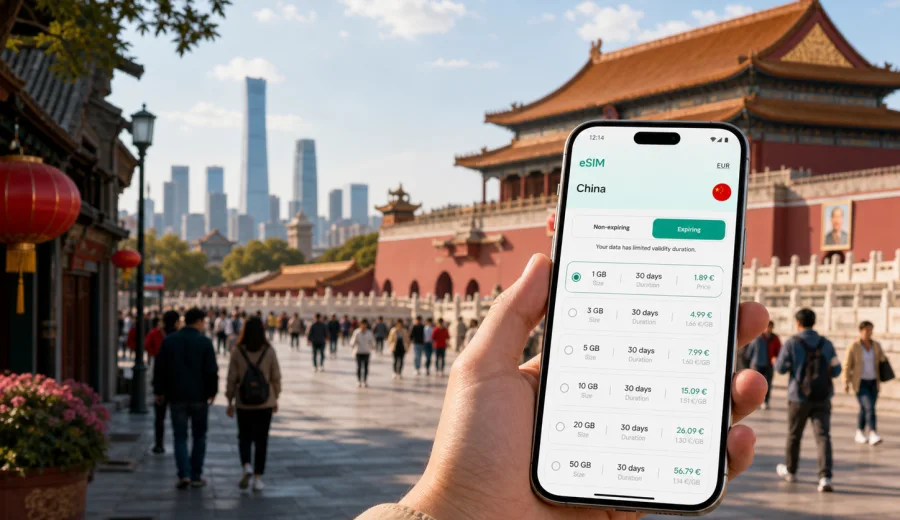
Beijing eSIM: mobile connection and internet for your trip
Beijing is a city where mobile internet quickly becomes part of the travel plan. You may need it before you leave the airport, while finding your hotel near Wangfujing or Sanlitun, when checking a subway route to the Forbidden City, or when coordinating a meeting in Chaoyang. A Beijing eSIM can help you prepare mobile data without buying a physical SIM card after arrival.
This guide focuses on practical city scenarios: landing in Beijing, moving between districts, using maps and translation, handling business trips, planning stopovers, and taking routes from the capital to other parts of China.
Why mobile internet matters in Beijing
Beijing is large, layered, and busy. Distances between key areas can be longer than they look on a map, and a day may include airport transfers, metro rides, hotel check-in, restaurant reservations, museum time slots, and family or work messages.
Typical moments when an eSIM is useful in Beijing include:
- checking the address of a hotel or serviced apartment after landing;
- opening a map before entering the metro or a taxi;
- translating menus, signs, booking details, and messages;
- confirming meeting times in Central Business District or Zhongguancun;
- managing ride-hailing, delivery, or travel apps;
- sending updates from a layover or short business stop;
- keeping travel documents and reservations accessible in cloud storage;
- using messengers for calls and updates over the internet.
An eSIM is especially convenient if you want to prepare before the trip. You can choose a plan for China, install the eSIM on a compatible device, and activate it according to the plan conditions.
Arrival in Beijing: from airport to hotel
Most international visitors arrive through Beijing Capital International Airport or Beijing Daxing International Airport. Both are far enough from central districts that you will probably use your phone before reaching the hotel: terminal map, driver messages, transport options, or accommodation address.
At this stage, mobile internet is about avoiding small delays. If your eSIM profile is already installed, you can switch mobile data to the eSIM line when the plan is ready to use. Depending on your device and the selected plan, connection can take a few minutes and may require data roaming to be enabled for the eSIM profile.
For the first day in Beijing, prepare these items before departure:
- the hotel name and address saved offline;
- booking confirmation available without mobile data;
- a translation of the destination address;
- enough battery for arrival and transfer;
- the eSIM QR code or profile available in your account or email;
- a backup way to connect to Wi-Fi if you need to finish installation.
Treat the eSIM as part of your arrival setup. Install it while you still have a stable connection, check that the profile appears in mobile settings, and read when validity starts.
Beijing districts and common mobile data scenarios
Beijing trips often combine several city rhythms. A morning can start near a historical landmark, continue with a metro ride to a business district, and end in a hotel lobby where you review tomorrow's route.
| Area or scenario | Why mobile data helps | What to prepare |
|---|---|---|
| Dongcheng and Xicheng | Landmarks, museums, hutongs, hotels | Offline pins and reservations |
| Chaoyang | Meetings, restaurants, embassies | Calendar access and ride details |
| Haidian and Zhongguancun | University and technology visits | Extra data for work files |
| Sanlitun and Guomao | Dining, meetings, evening plans | Ride-hailing and shared location |
| Railway stations | Tickets, gate checks, route changes | Screenshots and real-time messages |
The right Beijing eSIM plan is not only about gigabytes. It is also about trip length, districts, and whether you use data mostly for maps or for heavier work tasks.
How much data you may need in Beijing
Data use depends on habits, but travel patterns are predictable enough to plan. Maps, messaging, email, translation, and ticket confirmations are usually light to moderate. Video calls, cloud backups, short-form video, and large file transfers use data much faster.
Use this simple planning model:
- 1-3 days in Beijing: suitable for a layover, conference, or short city break if you mainly use maps, messengers, and email.
- 4-7 days: consider a medium allowance if you will use navigation every day and work from the hotel or conference venue.
- More than a week: choose a plan with enough validity and data for repeated metro routes, restaurant searches, messaging, and possible side trips.
- Business trip: allow extra data for calendar sync, document previews, calls over messengers, and hotspot use if the plan conditions allow it.
- Family trip: each traveler should check whether they need their own eSIM, because sharing one connection may not be comfortable throughout the day.
The safest approach is to match the plan to real use, not to a slogan. If you normally stream, upload photos, or use your phone as a laptop backup connection, choose more data. If you mostly need maps and messages, a smaller plan may be enough.
Choosing an eSIM plan for Beijing
For a city trip to Beijing, choose a plan for China rather than looking for a separate city product. The eSIM plan should match the country, trip duration, and amount of mobile data you expect to use.
Before selecting a plan, check four things:
1. Coverage destination: make sure the plan is for China or for a region that includes China.
2. Data allowance: compare expected map, messaging, work, and media use.
3. Validity period: choose a period that covers arrival day, full travel days, and departure.
4. Activation rules: read when validity starts and whether you need to activate the plan only after arrival.
Kaspersky eSIM Store is an app and website where you can choose, arrange, and activate an eSIM with a suitable data plan for mobile internet in an international trip. For Beijing, you can use it to choose an eSIM plan for your trip to China after you have checked your device and estimated your data needs.
Beijing is the city context; China is the plan destination.
What to check before buying an eSIM
The most important check is device compatibility. Not every smartphone or tablet supports eSIM, and some devices may differ by region of sale. Before you pay for a plan, check your device and make sure it is not locked by a mobile operator.
Also review these points:
- your device supports eSIM and has the feature enabled;
- the device is not carrier-locked;
- you have a stable internet connection for installation;
- you understand whether the selected plan includes mobile data only;
- you know whether regular voice calls and SMS are included, if at all;
- you have read the validity period and activation conditions;
- you understand whether tethering or hotspot use is allowed under the plan terms;
- you know how to switch mobile data between your main SIM and the eSIM profile.
In many travel eSIM scenarios, the plan is mainly for mobile internet. It may not include a local phone number, ordinary calls, or SMS. For calls and messages, use messengers over the internet when suitable.
Installing the eSIM before departure or after arrival
For a smoother Beijing arrival, install the eSIM before you leave home if the plan conditions allow it. Installation usually requires internet access, so it is easier to do it on a stable home or hotel Wi-Fi connection than in an airport queue. Activation and validity timing depend on the selected plan, so always read the instructions before switching the line on.
General installation flow:
1. Check that your device supports eSIM and is not locked by an operator.
2. Choose the destination and the data plan that fits your Beijing trip.
3. Open the eSIM details in your profile or email.
4. Add the eSIM profile to your phone using the QR code or on-screen setup.
5. Keep your primary SIM for calls if needed and set the eSIM for mobile data.
6. After arriving in China, enable the eSIM line according to the instructions.
7. If required by your device or plan, enable data roaming for the eSIM profile.
8. Wait a few minutes for the phone to register on the local network.
For step-by-step device guidance, use the Android installation instructions or the iOS installation instructions. The exact labels in settings can differ by model and operating system version, so follow the prompts on your device carefully.
Beijing transport: metro, taxi, walking, and transfers
Beijing's metro is extensive and often the easiest way to cross the city. Mobile internet helps when you compare routes, check exits, or adjust plans around peak hours. Large stations can have many exits, and choosing the right one can save a long walk.
For taxis and ride-hailing, mobile data helps you confirm pickup points, share your location, and message the driver or host. Save the hotel address in English and Chinese before you leave the lobby.
For walking routes, mobile data is useful but should not be your only layer of preparation. Save key pins, reservation screenshots, maps, and documents that you may need without a connection.
Business trips and remote work in Beijing
Business travel in Beijing often means moving between hotels, office towers, exhibition venues, and restaurants across a very large city. Mobile internet helps with calendar updates, location sharing, document access, and messenger calls while moving.
For business trips, consider more data than for a leisure itinerary of the same length. Email attachments, cloud documents, video calls, and hotspot use can change the calculation quickly.
Practical business checklist:
- install the eSIM profile before the flight;
- keep the meeting addresses saved in local notes;
- make calendar invitations available offline;
- prepare a backup Wi-Fi option for large calls;
- avoid large automatic cloud backups on mobile data;
- monitor remaining data during the trip;
- keep your main SIM active if you need regular calls or bank messages.
An eSIM is not a replacement for careful business travel planning, but it can make the mobile data part easier to control.
Stopovers and routes beyond Beijing
Beijing can be a stopover city as well as a final destination. If you only transfer between flights, airport Wi-Fi may be enough. If you leave the airport, stay overnight, meet someone, or visit one landmark, an eSIM plan can make maps, translation, and messages easier to manage.
For a short stay, prioritize quick activation rules, enough validity for arrival and departure days, and a practical data allowance. Add the eSIM profile before the trip instead of setting it up for the first time at a pickup point or boarding gate.
If Beijing is part of a wider China route, choose a plan for the full trip. You may continue by train or flight to Shanghai, Xi'an, Chengdu, Guangzhou, Shenzhen, or another city. Check whether the plan covers China, stays valid through the last travel day, and includes enough data for station navigation, route changes, and hotel transfers.
FAQ
Is an eSIM useful for a Beijing trip?
Yes, if you want mobile internet for maps, messaging, translation, bookings, and transport without buying a physical SIM card after arrival. Check device compatibility and plan conditions before purchase.
Should I choose a Beijing plan or a China plan?
For a city article, Beijing is the travel context, but the plan destination is China. Choose a plan that covers China or a suitable region including China.
Can I install the eSIM before flying to Beijing?
Usually, you can add the eSIM profile before the trip if you have a stable internet connection. Activation and validity timing depend on the selected plan, so read the instructions before turning it on.
Does a travel eSIM include calls and SMS?
Not always. Many travel eSIM plans are focused on mobile internet and may not include a regular phone number, voice calls, or SMS. Use messengers over the internet when that fits your needs.
Final checklist before you leave for Beijing
Before departure, make sure you have:
- checked that your device supports eSIM;
- confirmed that the device is not locked by a mobile operator;
- chosen a plan destination that covers China;
- selected enough data and validity for Beijing;
- installed the eSIM profile while connected to Wi-Fi;
- saved hotel, airport, and meeting addresses offline.
Choose an eSIM plan for Beijing travel
If Beijing is on your itinerary, prepare the mobile internet part before the first transfer, metro ride, or hotel check-in. Kaspersky eSIM Store helps you choose, arrange, and activate an eSIM with a suitable data plan for an international trip.
When your device is compatible and your route is clear, choose an eSIM plan for your trip to China and set it up before you need mobile data in Beijing.