
Travel connectivity guide
eSIM for Belgium: mobile internet guide
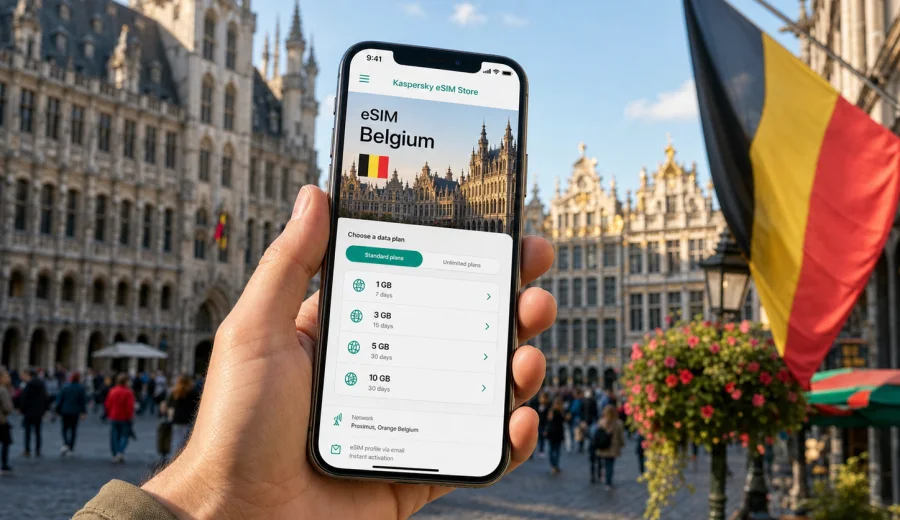
eSIM for Belgium: mobile connection and internet for your trip
Belgium is a compact country, but a trip there can move quickly: one morning in Brussels, an afternoon train to Ghent, a weekend in Bruges, a meeting in Antwerp, and a late connection through Brussels Airport. In that rhythm, mobile internet is not just a convenience. You may need maps, train platforms, hotel check-in messages, restaurant bookings, taxi apps, video calls, payment confirmations and access to work tools from the first hour after arrival.
An eSIM helps you prepare mobile data for Belgium without looking for a physical SIM card after landing. Instead of visiting a shop, replacing your main SIM or relying on public Wi-Fi, you can choose an eSIM plan for your destination, install it on a compatible phone and use it for mobile data during your trip. Kaspersky eSIM Store is an app and website where you can choose, arrange and activate an eSIM with a suitable plan for mobile internet while travelling abroad.
This guide explains how to use an eSIM for Belgium, how to estimate data needs, what to check before purchase, and when a Belgium plan or a wider regional plan may make sense.
Why an eSIM is useful in Belgium
Belgium is easy to travel by train, but mobile data still matters in small practical moments. Station signs may be in Dutch, French or German depending on the region. Hotels and apartments may send access codes by email or messenger. Many city routes are easier with live maps because historic streets, tram stops and train exits are not always obvious on a first visit.
An eSIM can help in these common Belgium scenarios:
- Arrival at Brussels Airport, Brussels South Charleroi Airport or an international train station.
- Navigation between Brussels, Antwerp, Ghent, Bruges, Leuven, Liège, Namur or coastal towns.
- Business travel around the EU quarter, conference venues and client offices.
- Managing train tickets, boarding passes, hotel apps and digital payments.
- Staying in touch with family or colleagues through internet-based messaging and calls.
- Using translation, maps and restaurant booking apps without depending on café or hotel Wi-Fi.
The main benefit is predictability. Before you travel, you can check the plan’s country, data allowance, validity period and price. After purchase, the eSIM profile is installed on your device and used for mobile data, while your primary SIM can remain in the phone for your usual number if your device supports that setup.
What an eSIM does and does not include
An eSIM is a digital SIM profile built into a compatible smartphone or tablet. For travel, it is usually used to connect to mobile internet in the destination country without inserting a plastic SIM card.
For Belgium, treat travel eSIMs as mobile data plans unless the plan terms say otherwise. They normally do not include a local Belgian phone number, ordinary voice calls or SMS. For calls and messages, you can use internet-based apps once mobile data is active.
| Travel need | How an eSIM can help | What to check |
|---|---|---|
| Maps and transport | Use live routes, train updates and ride apps | Data allowance and validity period |
| Work travel | Access email, chat, documents and video calls | Expected daily data use |
| City breaks | Use bookings, tickets, translation and payments | Phone compatibility and activation timing |
| Family trips | Keep several apps online during the day | Whether each traveller needs a separate plan |
| Multi-country route | Use data across several destinations if covered | Country or regional coverage in the selected plan |
An eSIM is not a privacy tunnel, an anonymity tool or a way to change access rules for online services. It is a practical way to prepare mobile internet for a foreign trip on a compatible device.
Belgium travel scenarios where mobile data matters
Belgium’s geography makes short, connected trips common. You may cross regions and languages in one day, so a stable data setup helps more than it might seem from the country’s size.
For a Brussels city break, mobile internet is useful from the airport transfer onward. You may use train or bus apps, check hotel entry instructions, navigate between Grand Place, museums, restaurants and metro stations, or share live location with other travellers.
For a business trip, data needs are often heavier. Video calls, document downloads, authentication apps and hotspot use can consume more traffic than sightseeing. If you expect to work from cafés, trains or conference spaces, choose a plan with a margin rather than the smallest available allowance.
For a Belgium rail route, such as Brussels to Antwerp, Ghent and Bruges, an eSIM keeps the same mobile data profile active while you move between cities. This is useful for platform changes, ticket updates and last-minute hotel messages.
For a wider European route, check whether your travel continues to France, the Netherlands, Germany or Luxembourg. A Belgium-only plan may be enough if Belgium is the whole trip. If you cross borders often, a regional Europe plan may be more convenient, provided the plan conditions cover every country in your itinerary.
How to choose an eSIM plan for Belgium
Start with the trip, not with the biggest number on the screen. A good plan is the one that matches your route, length of stay and daily habits.
Use this quick checklist:
- Destination: confirm that Belgium is included in the selected plan.
- Duration: choose a validity period that covers your full stay, including arrival and departure days.
- Data volume: estimate how much you use maps, social media, video, cloud apps and hotspot sharing.
- Device: make sure your smartphone or tablet supports eSIM and is not locked to one carrier.
- Activation timing: check when the plan starts and when data begins to be consumed.
- Route: decide whether you need only Belgium or a wider regional plan.
For light use, mobile data may cover maps, messaging, bookings and occasional browsing. For moderate use, add regular social media, photo uploads and work email. For heavy use, account for video calls, streaming, large file transfers and hotspot use. Video and hotspot sharing can consume data quickly, so they deserve a larger allowance.
If you are ready to prepare mobile internet for the trip, you can choose an eSIM plan for Belgium and compare the available data volumes and validity periods before you travel.
Data planning for different Belgium trips
There is no single perfect data allowance because travel habits vary. The practical approach is to match the plan to your highest-use days, then add a small buffer.
| Trip type | Typical pattern | Planning tip |
|---|---|---|
| Weekend in Brussels or Bruges | Maps, chat, tickets, restaurant searches | A smaller allowance may be enough if you avoid streaming |
| One-week leisure trip | Daily maps, photos, translation, browsing | Choose enough data for several active sightseeing days |
| Business visit | Email, calls, files, authentication apps | Allow extra data for video calls and hotspot use |
| Family travel | Multiple people using maps and apps | Each device may need its own eSIM or a separate data setup |
| Europe rail itinerary | Belgium plus neighbouring countries | Check regional coverage instead of assuming a Belgium plan is enough |
To reduce data use, download offline maps before departure, update apps on Wi-Fi, turn off automatic cloud backup on mobile data and limit video streaming. These small settings can make a moderate plan last longer.
Installation and activation: the safe sequence
Install the eSIM when you have a stable internet connection, time to follow the steps and access to the email or profile where the QR code or installation details are available. Many travellers prefer to install the eSIM before departure and activate mobile data after arrival, but the exact timing depends on the selected plan’s terms.
Basic sequence:
1. Check that your device supports eSIM and is not carrier-locked.
2. Choose Belgium as the destination and select a suitable plan.
3. Complete the purchase flow in Kaspersky eSIM Store.
4. Open the eSIM installation details or scan the QR code.
5. Add the eSIM profile to your phone.
6. Set the eSIM as the line for mobile data when you want to use it.
7. If required by your device or plan, enable data roaming for the eSIM profile.
8. Wait a few minutes for the connection to register on the local network.
For device-specific steps, use the Android installation guide or the iOS installation guide. The exact menu names can vary by device model and operating system version, so follow the instructions shown on your phone as well.
Do not delete the eSIM profile unless you are sure it is no longer needed. On some devices and plans, an activated eSIM may not be transferable to another phone after deletion.
What to check before buying
Before choosing a plan, confirm the basics. This prevents most avoidable problems.
- Your device supports eSIM.
- Your phone is not locked to a single carrier.
- Belgium is included in the selected plan.
- The data allowance matches your expected use.
- The validity period covers the full trip.
- You understand whether the plan starts on installation, activation or first network connection.
- You have internet access for the installation step.
- You know whether voice calls and SMS are included; if not, use internet-based apps.
If you are not sure whether your phone supports eSIM, check your device before purchase. Some device models differ by region, and a phone that looks identical on the outside may have different eSIM support depending on where it was sold.
eSIM, roaming, local SIM or Wi-Fi in Belgium
Different options can work, but they suit different travellers.
| Option | Good for | Trade-offs |
|---|---|---|
| Travel eSIM | Preparing mobile internet before or shortly after arrival | Requires compatible, unlocked device |
| Standard roaming | Keeping your home operator’s default setup | Costs and limits depend on your home plan |
| Local physical SIM | Longer stays or users who need a local number | Requires shop visit, physical SIM handling and local setup |
| Public Wi-Fi | Occasional low-data tasks in hotels or cafés | Availability and security can vary; not ideal for movement |
An eSIM is especially practical when you want mobile data ready for maps, transport and messages without planning a shop visit. It also helps reduce dependence on public Wi-Fi in airports, cafés and hotels. Public Wi-Fi can be useful, but it is not a complete travel connectivity plan when you are moving between stations, streets and venues.
Practical Belgium examples
First day in Brussels
You land, open the train app, follow directions to the city, message your hotel and check a restaurant booking. This is light to moderate use. Install the eSIM before departure or at the airport on Wi-Fi, then switch mobile data to the eSIM when you are ready to use it.
Conference in Antwerp
You use email, calendar invites, authentication apps, team chat and video calls. Choose a plan with enough data for work tasks, not only for maps. Avoid large system updates on mobile data and keep a backup Wi-Fi option for long calls if possible.
Weekend through Ghent and Bruges
You will likely use maps, museum tickets, train times, translation and photo uploads. A Belgium plan can cover the country route if the plan terms include Belgium and the validity period matches the trip.
Belgium plus neighbouring countries
If your itinerary continues by train to Amsterdam, Paris, Luxembourg or Cologne, check the destination list carefully. Choose a country plan only when it matches the trip. Choose a regional plan when it better fits a multi-country route and includes all required destinations.
Short practical answers
eSIM for Belgium is a digital SIM option for travellers who need mobile internet without a physical SIM card. It is useful for maps, transport apps, bookings, messaging and work tools during a trip. Before buying, check device compatibility, country coverage, data allowance, validity period and activation rules.
Kaspersky eSIM Store helps users choose, arrange and activate an eSIM with a suitable plan for mobile internet in an international trip. It is not a mobile operator and does not provide its own network. The user selects a destination and plan, installs the eSIM on a compatible device, and uses it for mobile data according to the selected plan’s conditions.
For Belgium, an eSIM can be useful in Brussels, Antwerp, Ghent, Bruges, Liège, Leuven, Namur and other destinations. It is especially practical for travellers arriving by air or train, business visitors, city-break tourists and people moving between several Belgian cities.
Common mistakes to avoid
- Buying a plan before checking whether the phone supports eSIM.
- Assuming that a travel eSIM includes a local phone number.
- Choosing the smallest data allowance while planning video calls or hotspot use.
- Installing the eSIM in a hurry without stable internet.
- Deleting the eSIM profile before the trip is finished.
- Assuming a Belgium-only plan covers neighbouring countries.
- Forgetting to switch mobile data to the eSIM profile after arrival.
These mistakes are easy to prevent. Read the plan details, keep the installation email or profile accessible, and test the phone settings before you need mobile data urgently.
FAQ about eSIM for Belgium
Can I use an eSIM in Belgium for mobile internet?
Yes, if you choose a plan that includes Belgium and use a compatible, unlocked device. The selected plan’s terms define the data allowance, validity period and other conditions.
Does a travel eSIM include calls and SMS?
Usually no, unless this is stated in the plan conditions. Travel eSIMs are commonly used for mobile internet. You can use messaging and calling apps over data.
Should I install the eSIM before travelling?
You can often install it before departure while you have stable internet, then use the eSIM for mobile data when you arrive. Check the plan terms because activation and validity rules can differ.
Do I need to remove my regular SIM card?
Usually no. Many eSIM-compatible phones can keep the regular SIM and use the eSIM for mobile data. Your device settings determine which line handles mobile data, calls and messages.
Can I share eSIM data by hotspot?
Hotspot availability depends on the device and plan conditions. If it is available, remember that laptops and other connected devices can use data quickly.
What happens if the eSIM does not connect immediately?
Check that mobile data is assigned to the eSIM profile, data roaming is enabled if required, airplane mode is off, and the phone has had a few minutes to register on the local network. If the issue continues, contact support with your plan details and device model.
Is an eSIM better than public Wi-Fi?
It depends on the situation. Public Wi-Fi can help in hotels or cafés, but an eSIM is more practical when you are moving around and need maps, transport apps or messages outside Wi-Fi coverage.
Can I use the same eSIM on another phone?
Do not assume that you can transfer it. Some eSIM profiles cannot be moved after activation or deletion. Check the plan conditions before changing devices.
Final checklist before your Belgium trip
Before departure, prepare the essentials:
- Confirm your phone supports eSIM.
- Check that the device is unlocked.
- Choose a plan that includes Belgium.
- Pick a data allowance that covers maps, messaging, work and media use.
- Save installation details where you can reach them.
- Install the eSIM on a stable internet connection.
- Keep your primary SIM settings clear, especially if you need your usual number for banking or two-factor authentication.
- Review how to switch mobile data lines on your phone.
This checklist is useful whether you are travelling to Brussels for meetings, taking a weekend in Bruges, visiting Antwerp and Ghent by train, or connecting Belgium with a wider European itinerary.
Choose an eSIM plan for Belgium
With the right preparation, mobile internet in Belgium becomes one less thing to solve after arrival. Check your device, match the data allowance to your trip and keep the activation details available before you leave.
Kaspersky eSIM Store helps you choose, arrange and activate an eSIM with a suitable plan for mobile internet in a foreign trip. When you are ready, choose an eSIM plan for your Belgium trip and prepare your connection before you travel.