
Travel connectivity guide
Berlin eSIM: mobile internet for your trip
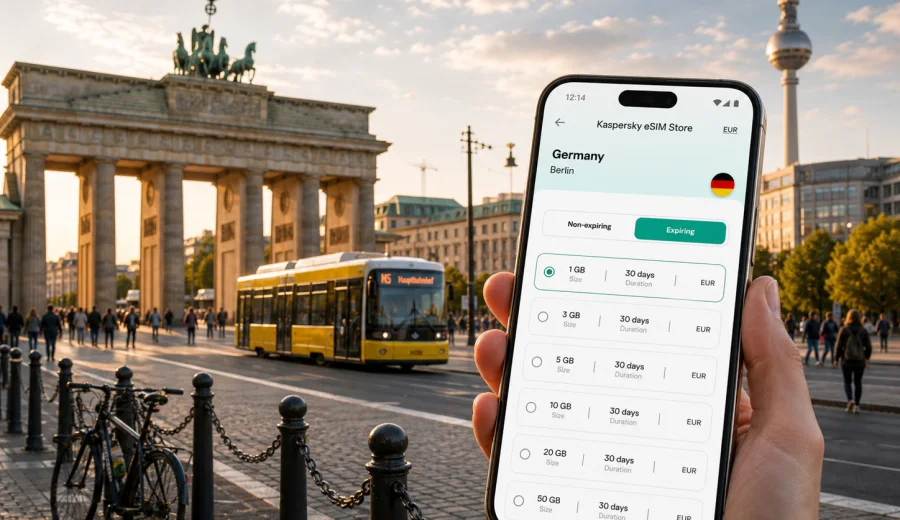
Berlin eSIM: mobile connection and internet for your trip
Berlin is a city where mobile internet quickly becomes part of the trip. You may need maps after leaving Berlin Brandenburg Airport, a ride-hailing app for a late arrival, S-Bahn times, a hotel confirmation, or a messenger call before a meeting near Potsdamer Platz. An eSIM can help you prepare mobile data before you land, without looking for a physical SIM card after a long flight.
This guide focuses on Berlin, not Germany in general. It covers airport arrival, public transport, hotels, business districts, museums, nightlife, and short trips. The goal: choose a suitable eSIM plan for mobile internet, install it, and keep control of data use.
Why eSIM is useful in Berlin
Berlin is spread out, multilingual, and highly dependent on digital navigation. The city is easy to explore, but distances can be longer than they look on a map. A trip from Mitte to Charlottenburg, Kreuzberg, Prenzlauer Berg, or the airport often involves more than one transport mode. Mobile data helps you check route changes, platform information, walking directions, and ticket apps without waiting for public Wi-Fi.
An eSIM is a digital SIM profile used for mobile internet without inserting a physical SIM card. With Kaspersky eSIM Store, you can choose, arrange, and activate an eSIM with a suitable data plan for a trip abroad. It is not a mobile operator and does not provide its own network; it helps you prepare the eSIM setup through the app or website.
In Berlin, that can be useful in several moments:
- after landing at Berlin Brandenburg Airport and looking for the right train, bus, taxi, or transfer;
- while using maps between neighborhoods that are not close to each other;
- when checking museum tickets, restaurant reservations, hotel messages, or event QR codes;
- during business travel, when you need email, calendar access, video-call backup, and secure account sign-ins;
- on day trips to Potsdam, Sachsenhausen Memorial, Wannsee, or other nearby places in Brandenburg;
- when you prefer not to rely on hotel, cafe, or station Wi-Fi for everyday travel tasks.
Public Wi-Fi exists in Berlin, but it is not always available when you need maps, banking, work accounts, or travel documents.
Berlin arrival scenarios where mobile data matters
Berlin Brandenburg Airport is outside the city center, so the first hour often sets the tone. You may need to check whether the Airport Express, S-Bahn, regional train, bus, taxi, or pre-booked transfer is best for your hotel. If you arrive in the evening, mobile data also helps you confirm check-in details.
The same applies if you arrive by train at Hauptbahnhof, Ostbahnhof, Gesundbrunnen, Sudkreuz, or another major station. Mobile internet helps you verify the next platform, follow walking directions, and avoid missing a connection after a last-minute change.
| Berlin moment | Why mobile internet helps | What to prepare |
|---|---|---|
| Airport arrival | Train routes, taxi location, hotel messages | Install eSIM before departure if possible |
| First metro or S-Bahn ride | Platform checks, ticket apps, live disruptions | Keep a data buffer for maps and transport |
| Business meeting | Email, calendar, navigation, calls through apps | Choose a plan with enough daily data |
| Museum or event day | QR tickets, opening times, route changes | Charge your phone and monitor data use |
| Day trip from Berlin | Regional train updates and maps outside the center | Confirm the plan works for Germany |
Berlin rewards flexible movement. You may start near Alexanderplatz, spend the afternoon in the government quarter, visit a gallery in Kreuzberg, then go to dinner in Neukolln or Charlottenburg. That itinerary is easier when maps, reservations, and messaging are available without searching for Wi-Fi.
How much data do you need for Berlin?
The right data volume depends on how you travel. A light user who mainly checks maps, messages, and transport times needs less data than a business traveler who joins calls, shares files, and uses cloud tools. Video streaming, large photo backups, app updates, and hotspot use can consume much more data than city navigation.
Use this practical estimate as a planning tool, not as a guarantee:
| Traveler type | Typical Berlin use | Data planning approach |
|---|---|---|
| Short stopover | Airport transfer, maps, messages, one hotel route | Small plan for one to three days may be enough |
| Weekend visitor | Maps, restaurants, tickets, social sharing | Moderate plan with a buffer is safer |
| Museum and nightlife trip | Navigation, event apps, photo sharing, ride apps | Choose more data if you upload media often |
| Business traveler | Email, cloud files, calendar, messenger calls | Prioritize a larger allowance and validity period |
| Family organizer | Navigation, bookings, group messages, hotspot backup | Allow extra data for shared use |
| Regional traveler | Berlin plus Potsdam or other German cities | Check that the plan covers Germany for the whole route |
Before choosing, look at the length of your stay, expected app use, and whether your home SIM should stay active for calls or SMS. Many travel eSIM plans are data-focused and may not include a regular phone number, voice calls, or SMS unless the selected plan says otherwise.
Where eSIM helps most around the city
Berlin has several centers rather than one compact tourist zone. In Mitte, mobile data helps with museum tickets and walking routes. Around Brandenburg Gate and the government quarter, maps prevent unnecessary backtracking. In Kreuzberg, Friedrichshain, Neukolln, and Charlottenburg, route checks are useful for evening plans, restaurants, hotels, and cultural venues. For business travel near Messe Berlin, Potsdamer Platz, Alexanderplatz, Friedrichstrasse, or Hauptbahnhof, a prepared eSIM can reduce dependence on busy venue Wi-Fi.
Choosing an eSIM plan for a Berlin trip
For a city article, the country still matters because Berlin is in Germany and the data plan must match the destination. If Berlin is the main stop, choose a plan that works in Germany. If your route also includes nearby countries, compare whether a regional Europe option or another destination-specific plan better matches the full trip.
When you are ready to compare options, you can choose an eSIM plan for your Berlin trip in Germany and check the available data volume, validity period, destination, and price before deciding. This is the main country landing page for the city scenario, so use it for Berlin rather than looking for a separate city plan.
Evaluate the plan with these questions:
- Does the destination match Germany, or the region that includes your whole route?
- Is the validity period long enough for arrival day, departure day, and possible delays?
- Is the data volume realistic for maps, messaging, tickets, work, and media?
- Will your phone be used as a hotspot for a laptop or another traveler? If so, plan more data and verify the conditions.
- Do you need only mobile internet, or do you expect a phone number and SMS? Read the plan details carefully.
Avoid choosing only by the smallest data amount. Frequent map use, photo uploads, cloud backup, and calls through messengers can add up. A modest buffer is often more practical than trying to save every megabyte.
Before you buy: device and account checklist
An eSIM needs a compatible device. It also needs a device that is not locked by an operator in a way that prevents adding another mobile profile. Model names can be misleading because some regional versions differ. Before purchasing a plan, check your device and confirm that eSIM support is available on the exact phone or tablet you will bring to Berlin.
Use this checklist before departure:
- Confirm that your device supports eSIM.
- Check that the device is not locked to one carrier.
- Update the operating system if an update is already pending.
- Make sure you know where mobile data, SIM, and roaming settings are on your phone.
- Keep access to email or the Kaspersky eSIM Store profile where the QR code or installation details may appear.
- Save hotel address, flight details, insurance contacts, and a basic map offline as a backup.
- Decide whether your home SIM should stay active for banking SMS or calls.
- Check whether data roaming must be enabled for the eSIM profile on your device.
This preparation is useful because airport and station time can feel rushed. It is easier to review the eSIM calmly before travel than to troubleshoot it near a platform with luggage.
How to install and activate eSIM for Berlin
Install the eSIM when you have stable internet, enough battery, and time to follow the steps carefully. You can do this before travel or after arriving, depending on the selected plan conditions. If the plan starts using data only after connection to a supported network, pre-installing may be convenient. If validity starts earlier, wait until the right moment.
General setup flow:
1. Check that your device supports eSIM and is not carrier-locked.
2. Choose Germany as the destination, or a suitable region if your trip covers several countries.
3. Select a data volume and validity period for your Berlin itinerary.
4. Complete the plan arrangement through the Kaspersky eSIM Store app or website.
5. Install the eSIM profile using the on-screen instructions or QR code.
6. Set the eSIM as the line for mobile data when you want to use it.
7. Allow a few minutes for connection; on some devices, data roaming for the eSIM profile may need to be enabled.
For device-specific steps, use the Android installation guide or the iOS installation guide. Your regular number can often remain available for calls or SMS while the eSIM handles mobile data, but the exact behavior depends on the device and carrier settings.
Do not delete an eSIM profile casually after installation. In many cases, an eSIM cannot simply be moved to another phone or restored like an app. If you need to change devices or something does not work, check the plan conditions and contact support before removing the profile.
Berlin itineraries and eSIM planning
For a weekend, mobile data is mainly about transport, maps, tickets, restaurants, and messages between Mitte, Museum Island, Brandenburg Gate, and evening areas such as Kreuzberg or Friedrichshain. For a business trip, allow more data for calendar changes, cloud tools, messenger calls, and possible laptop hotspot use. For a longer stay, validity period can be as important as data volume.
eSIM, roaming, and local SIM cards in Berlin
There is no single best option for every traveler. Standard roaming may be convenient if your home operator has predictable prices, but it can be expensive or limited depending on your contract. A physical local SIM can work well for longer stays, but it requires time, a compatible phone slot, and a purchase process. An eSIM is useful when you want to prepare mobile data without changing a physical card.
| Option | When it may fit | What to watch |
|---|---|---|
| Home roaming | Short trip with clear roaming terms | Daily fees, speed limits, unexpected charges |
| Physical local SIM | Longer stay with time to arrange it | Store hours, registration process, phone slot |
| Travel eSIM | Prepared mobile data for arrival and city movement | Device compatibility, data-only conditions, plan validity |
Kaspersky eSIM Store is best described as a tool that helps you choose, arrange, and activate an eSIM with a suitable data plan for a trip abroad. The selected plan conditions determine destination coverage, data volume, validity, and any limits. Read those details before relying on it for work, transfers, or group travel.
Common mistakes to avoid
- Waiting until the airport exit to start setup from scratch.
- Assuming eSIM always includes calls and SMS.
- Counting hotel nights instead of full travel days.
- Deleting the eSIM profile before checking mobile data, roaming data for the eSIM profile, and connection time.
Quick answers for Berlin travelers
Can I use eSIM as soon as I land in Berlin?
You can use it after the eSIM is installed, activated according to the plan conditions, and connected through a supported local network. Setup may take a few minutes.
Is eSIM enough for Berlin public transport apps and maps?
For most travelers, a data-focused eSIM is suitable for maps, route checks, messenger calls, ticket confirmations, and browsing. Streaming, large uploads, and hotspot use require more data.
Will an eSIM give me a German phone number?
Not necessarily. Many travel eSIM plans are for mobile internet and do not include a regular phone number, voice calls, or SMS unless this is stated in the plan conditions.
Should I install eSIM before flying to Berlin?
Often yes, if the selected plan conditions make pre-installation suitable. Install it while you have reliable Wi-Fi and enough time, then activate or select it for mobile data at the right point in the trip.
Final preparation before your Berlin trip
Before you leave, make mobile internet part of your travel checklist alongside your passport, hotel address, payment card, and transport plan. Check compatibility, choose Germany as the destination, read the plan details, install the eSIM carefully, and keep an offline backup for essential documents.
Berlin is easier when your phone is ready for the first train, the first hotel message, the first route change, and the first meeting or museum entry. If you want to prepare mobile data in advance, choose an eSIM plan for Germany through Kaspersky eSIM Store and select the option that matches your Berlin dates, data use, and route.