
Travel connectivity guide
Bogota eSIM: Mobile Internet for Your Trip
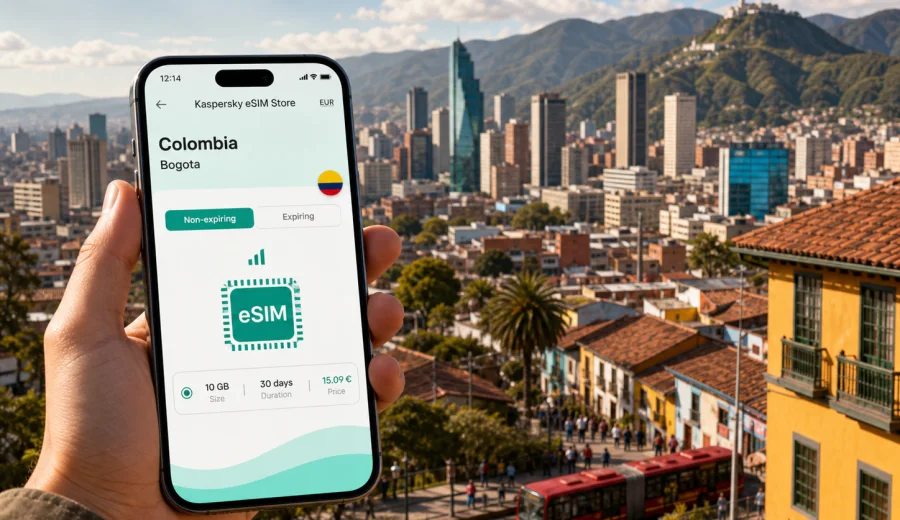
Bogota eSIM: mobile connection and internet for your trip
Bogota is a city where mobile internet becomes useful almost as soon as you land. The airport is outside the historic center, traffic can change quickly, neighborhoods sit at different altitudes and distances, and many everyday travel tasks depend on your phone: ride-hailing, hotel messages, restaurant bookings, maps, banking confirmations, and translation. An eSIM can make this first part of the trip simpler because you can prepare mobile data before you look for a physical SIM card.
This guide focuses on Bogota, not on Colombia in general. The country matters because the eSIM plan must cover Colombia, but the practical questions are city questions: airport transfer, district-to-district movement, maps, business trips, stopovers, and sightseeing.
Kaspersky eSIM Store is an app and website where you can choose, order, and activate an eSIM with a suitable data plan for mobile internet during an international trip. It is not a mobile operator and does not provide its own network. The useful part for travelers is the workflow: choose the destination, check plan conditions, install the eSIM on a compatible device, and use mobile data in the city when the selected plan is active and local network conditions allow it.
Why mobile internet matters in Bogota
Bogota is wide, busy, and highly dependent on digital navigation. The city stretches along the eastern mountains, and trips that look short on a map can take longer because of traffic, one-way streets, rain, or peak-hour congestion. For visitors, mobile data is less about browsing for fun and more about keeping the trip under control.
You will probably use mobile internet in Bogota for:
- checking the route from El Dorado International Airport to your accommodation;
- confirming hotel check-in details or apartment entry codes;
- using maps in La Candelaria, Chapinero, Zona T, Usaquen, Teusaquillo, or the business districts;
- ordering rides or checking public transport routes;
- translating menus, signs, and local messages;
- staying in touch with colleagues, family, or tour providers;
- checking weather before going up toward Monserrate or walking between neighborhoods;
- keeping access to banking, email, and travel documents.
Public Wi-Fi may be available in hotels, cafes, airports, coworking spaces, and shopping centers, but it is not always where you need it. A data eSIM helps reduce your dependence on Wi-Fi at the exact moments when you are moving through the city.
Arrival at El Dorado International Airport
For many travelers, the first real test of connectivity in Bogota is the arrival hall at El Dorado International Airport. You may need to message your driver, compare transport options, check your hotel address, or tell someone that the flight arrived. If your regular roaming is expensive or disabled, having an eSIM ready can remove a common source of friction.
Before the flight, you can install the eSIM profile while you still have a stable connection. Depending on the plan conditions, you may activate mobile data after landing or follow the activation timing shown for the selected plan.
Typical arrival tasks that benefit from mobile data:
| Arrival task | Why data helps |
|---|---|
| Checking the hotel address | Confirms the exact district and entrance details before you leave the airport |
| Ordering a ride | Lets you follow pickup instructions and message the driver |
| Comparing travel time | Helps you choose between a taxi, ride-hailing, private transfer, or public transport |
| Contacting accommodation | Useful if the flight is delayed or check-in time changes |
| Opening offline documents | Some apps still need a connection for verification or fresh booking details |
If you arrive at night, mobile data can be especially useful because you may not want to solve connectivity problems while also handling luggage, currency, and transport.
Choosing data for Bogota, not just for Colombia
For a Bogota trip, choose a plan that matches the way you will use the city. A short meeting schedule in the financial district is different from a week with museums, day trips, and remote work. Data use usually depends on navigation, messaging, video calls, cloud documents, social media, and whether you let apps update or sync in the background.
Use this quick guide as a starting point:
| Trip style in Bogota | Practical data pattern |
|---|---|
| Stopover or 1-2 days | Maps, rides, messaging, hotel details, light browsing |
| Business trip | Email, calendar, ride apps, document access, messenger calls |
| City break | Maps, translation, restaurant searches, photo backup on Wi-Fi only |
| Remote work stay | Larger allowance for calls, tethering if allowed, cloud documents |
| Bogota plus another Colombian city | Check that the plan covers the country or region you need, not only one city |
Do not choose only by the largest data allowance. Check the validity period, destination coverage, when the plan starts counting usage, and whether your device supports eSIM. If you will also visit Medellin, Cartagena, Cali, coffee-region towns, or nearby countries, check whether a country, regional, or global option better matches the route.
Districts where eSIM is especially useful
Bogota rewards planning because neighborhoods have different travel patterns. A reliable mobile data setup helps you adjust when plans change.
| Area | Why mobile data helps |
|---|---|
| La Candelaria | Walking routes, museum plans, ride pickup points, and hotel messages |
| Chapinero | Restaurants, nightlife, offices, universities, and last-mile navigation |
| Zona T and Parque 93 | Reservations, evening transport, meeting points, and live location sharing |
| Usaquen | Weekend walks, dining plans, and route checks from central areas |
| Corferias and Teusaquillo | Events, conferences, venue changes, and schedule coordination |
| Monserrate | Weather checks, queue timing, transport coordination, and offline backup planning |
When to prepare your eSIM
The calmest approach is to prepare before departure. Install the eSIM profile while your phone is connected to trusted Wi-Fi at home, at the office, or at your hotel before a later leg of the trip. Then review how your phone labels mobile lines so you know which profile will handle data in Bogota.
Before buying or installing, check your device. Your phone or tablet must support eSIM, and it should not be locked by a mobile operator in a way that prevents adding another mobile profile. Some models differ by region of sale, so do not rely only on the model name.
Practical preparation checklist:
- confirm that your device supports eSIM;
- check that your device is not carrier-locked;
- make sure your operating system is reasonably up to date;
- choose a plan whose destination includes Colombia;
- check the data allowance and validity period;
- read when the plan validity or data usage begins;
- keep the QR code or in-app installation flow available;
- save your hotel address and first transport details offline.
This preparation does not take the place of normal travel planning, but it helps avoid a common arrival problem: needing internet in order to arrange internet.
How Kaspersky eSIM Store fits into the trip
Kaspersky eSIM Store helps you choose, order, and activate an eSIM with a suitable data plan for international travel. For a Bogota trip, that means you can look for a plan that covers Colombia, compare data volume and validity period, and prepare the eSIM before you need mobile data in the city.
If you are already planning your route, you can choose an eSIM plan for your trip to Bogota after checking your device and estimating your data needs. The page is for Colombia because a city article should point to the country plan that covers the city.
Use the plan details carefully. eSIM data plans for travel usually focus on mobile internet. They may not include a local phone number, regular voice calls, or SMS unless the specific plan conditions say so. For calls and messages, many travelers use internet-based messengers, email, or business communication apps.
Installation before departure or after arrival
The exact installation flow depends on your device and the plan instructions, but the general sequence is simple. You need an internet connection for installation, so it is usually easier to install before departure or while connected to reliable Wi-Fi.
Basic steps:
1. Check that your phone supports eSIM and is not carrier-locked.
2. Choose the destination and plan that match your Bogota trip.
3. Order the plan and open the installation details.
4. Add the eSIM profile by following the on-screen flow or scanning the QR code.
5. Set the eSIM as the mobile data line when you are ready to use it.
6. If the instructions require it, enable data roaming for the eSIM profile.
7. Wait a few minutes for the device to register on an available local network.
For device-specific setup, use the Android installation guide or the iOS installation guide. Keep your primary SIM active if you need to receive banking verification messages or calls, but make sure mobile data is assigned to the eSIM when you want to use the travel plan.
Data planning for common Bogota scenarios
Your ideal allowance depends on habits, not only on trip length. A stopover may need only maps, ride-hailing, messaging, and hotel checks. A business trip can add email, calendar updates, messenger calls, and document access. A first-time city break usually needs maps, translation, restaurant searches, tickets, and ride apps.
For longer stays, check validity as carefully as data volume. A large allowance is not useful if it expires before your stay ends. If you will continue from Bogota to Medellin, Cartagena, Santa Marta, Cali, or coffee-region towns, choose a plan that matches the full Colombia route and check whether top-ups are available.
Bogota transport planning is easier when your phone has data. Use it for live traffic before leaving for the airport, pickup points near malls and office towers, route comparisons, and coordination when meeting people in large areas. For departure, leave extra time: the ride to El Dorado can vary widely from northern districts, Chapinero, or the historic center.
Smart settings to avoid wasting data
An eSIM is most useful when your phone is configured sensibly. Before using mobile data in Bogota, pause cloud photo backup on mobile data, disable automatic app updates, download offline maps, save hotel and airport addresses, reduce video quality in social apps, and check which SIM line handles mobile data.
If your phone supports multiple SIM profiles, label them clearly, such as "Primary" and "Colombia data." This reduces the chance of using the wrong line by mistake.
Calls, SMS, and verification codes
Travel eSIM plans are usually designed for mobile internet. That is enough for maps, messengers, browser use, email, and many travel apps, but it is not the same as getting a local Colombian phone number. If ordinary calls or SMS are important, check the specific plan conditions before relying on them.
Keep your primary SIM active if you need bank SMS or account verification. A banking app or airline app may still send codes to your regular number rather than through the eSIM data plan.
Quick comparison: eSIM, roaming, local SIM, and Wi-Fi
There is no single best option for every traveler. Travel eSIM is useful when you want to prepare data before or soon after arrival. Standard roaming is simple but depends on your home operator's price and limits. A local physical SIM may suit some longer stays, but it can require extra time after arrival. Public Wi-Fi helps in hotels and cafes, but it does not cover movement around Bogota.
Many visitors use a combined approach: eSIM for navigation and transport, trusted Wi-Fi for heavy uploads, long video calls, or streaming.
Mini FAQ for Bogota eSIM travel
Can I install the eSIM before flying to Bogota?
Yes, you can usually install the eSIM profile before departure while you have a stable internet connection. Check the plan conditions for when validity begins and when you should activate mobile data.
Will an eSIM give me a Colombian phone number?
Not usually. Travel eSIM plans are typically for mobile data. Calls and SMS are included only if the specific plan conditions say so.
Is eSIM useful for a one-day stopover in Bogota?
Yes, if you need maps, airport transfer coordination, ride-hailing, hotel messages, or quick access to travel documents. Choose a validity period and allowance that fit a short stay.
What should I do if the eSIM does not connect immediately?
Check that the eSIM is selected for mobile data, confirm that data roaming is enabled if required, restart the device if needed, and wait a few minutes. If the issue continues, contact support with your device model and plan details.
Final preparation before your Bogota trip
Before leaving for Bogota, make your phone part of the travel checklist. Confirm device compatibility, install the eSIM profile over reliable Wi-Fi, save key addresses offline, and decide how much data you need for airport transfer, maps, messaging, work, and local movement. This is especially helpful if you will arrive late, move between several districts, or continue from Bogota to other Colombian cities.
When you are ready to prepare mobile internet for the trip, choose an eSIM plan for Colombia in Kaspersky eSIM Store and check the data allowance, validity period, and destination coverage before activation. A few minutes of preparation can make the first hours in Bogota much easier to manage.