Travel connectivity guide
Bolama eSIM: Mobile Internet and Travel Guide
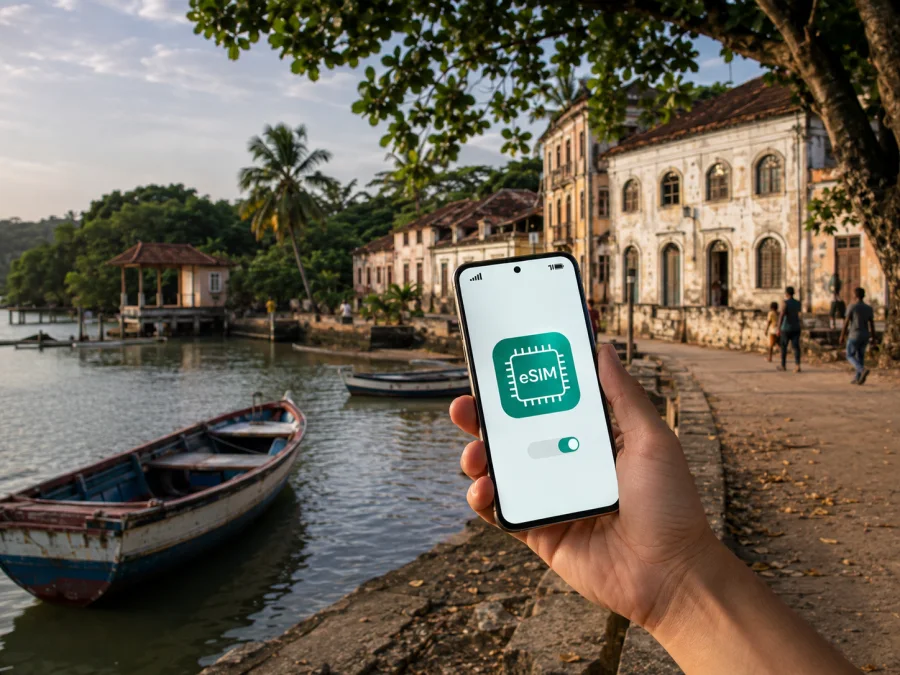
Bolama eSIM: mobile connection and internet for a smoother city trip
Bolama is a destination where the journey matters as much as the arrival. The town sits on Bolama Island in the Bijagós archipelago of Guinea-Bissau, surrounded by waterways, mangroves and a slower island rhythm. A visit here is not a standard city break built around dense public transport and a long list of hotel chains. It is a compact, historically important town where you may need to coordinate a mainland connection, a boat transfer, accommodation, walking routes and practical communication before you set out.
That makes mobile internet useful from the first stage of the trip. You may need to confirm where to meet a boat, share your arrival details, check a map after landing, message a host or keep a work contact informed when plans change. An eSIM can help you prepare a separate data connection without removing your regular physical SIM card. In this guide, you will find a practical way to plan mobile connection in Bolama, choose a suitable eSIM arrangement and avoid the common gaps that make island travel harder.
Why mobile internet matters in Bolama
Bolama rewards travellers who leave room for local conditions. Its streets and historic buildings are best explored at a relaxed pace, but reaching the town usually requires more preparation than reaching a mainland capital. The final part of the route may depend on a boat, a local contact or a departure window that is different from the schedule you would expect in a large transport hub.
Mobile internet is useful for small, concrete tasks:
- confirming a meeting point before a boat transfer;
- sending a message if your arrival time changes;
- keeping a digital copy of booking details accessible;
- checking walking directions between the waterfront, accommodation and the historic centre;
- translating a short message when you need to ask for practical help;
- using a messenger for voice or video calls when the selected eSIM tariff is data-only;
- sharing your location with a travelling companion during a walk;
- checking onward travel options before leaving the island.
The important point is not to treat mobile data as a replacement for preparation. In Bolama, it works best as one part of a resilient travel plan that also includes saved addresses, offline notes, a charged power bank and enough flexibility for an island itinerary.
What to know before arriving in Bolama
Bolama is the main town on the island of the same name and the administrative centre of the Bolama Region. It is also closely associated with the history of Guinea-Bissau: the town served as the capital of Portuguese Guinea from 1879 until the capital moved to Bissau in 1941. Historic remains, open spaces and a quieter urban texture are part of the experience, but visitors should not expect a fully restored colonial centre or the service density of Bissau.
The archipelago is a place of water and tidal landscapes. UNESCO describes the Bolama-Bijagós area as a biosphere reserve made up of 88 islands, with mangroves, mudflats, forests and rich marine and terrestrial life. For a traveller, that geography has a direct practical consequence: an address is not enough. You also need to understand the island, the landing point and the time needed to move between them.
Before leaving for Bolama, save one offline note with:
- your host’s name and phone number;
- the island, town, accommodation and a nearby landmark;
- your planned arrival day and approximate time;
- the mainland departure point and island landing point;
- passport, booking and emergency details.
This small record helps when a message needs to be sent quickly, a map pin is unclear or the phone has limited battery.
Do not rely on a single online map pin. Ask your accommodation how the last part of the journey is normally completed and whether they recommend arranging a meeting at the waterfront. Conditions, vessels and departure arrangements can change, so treat any timetable found in an old message as something to reconfirm rather than a guarantee.
Planning the route from Bissau and the mainland
For many international visitors, Bissau is the practical gateway into Guinea-Bissau. Bolama is not a destination where you simply land at a large airport and take a city bus to a hotel. The route normally has a mainland stage followed by an island stage, and the transfer between the two is the part that deserves the most attention.
Use this sequence when organising the trip:
- Confirm how you will reach the mainland departure point after arriving in Guinea-Bissau.
- Ask your host or travel organiser which boat connection is appropriate for your date.
- Save the contact’s number and send a short message before you leave the mainland.
- Keep your phone charged during the transfer; a power bank is more useful than an extra travel app.
- Once you reach Bolama, confirm the walking route or meeting point before setting off with luggage.
- Keep enough data for the return journey and do not spend the whole allowance on video or large downloads during the first hours.
Mobile connection is particularly valuable during the handover between stages. A message can be more important than a map: it can tell your host that you have boarded, arrived at the waterfront or need a few more minutes to find the correct path. If your regular number remains active for calls and messages, an eSIM data line can be used for maps and messengers while you keep your usual SIM available according to your phone’s settings.
Choosing an eSIM for a Bolama itinerary
The right tariff depends less on the name of the town than on the shape of your trip. A short visit with mostly walking and occasional messages uses data differently from a longer stay with frequent maps, photo uploads and work calls. Read the available conditions carefully and compare the data volume, validity period, destination coverage and activation rules before paying.
As a simple planning framework:
| Trip pattern | What to prioritise |
|---|---|
| One or two days in Bolama | A modest data allowance for messages, maps and essential browsing. |
| Several days with day trips | More headroom for navigation, photos and coordination with hosts. |
| A work-focused stay | Enough data for documents, email and occasional calls, plus a backup plan for unstable conditions. |
| Bolama combined with other islands | A tariff whose destination or regional conditions match the full route, not only the first stop. |
| A stopover before a longer journey | Quick activation, a clear validity period and data reserved for the onward transfer. |
Avoid choosing only by the largest number on a plan card. A larger allowance is not automatically better if your visit is short, and a small allowance can become inconvenient when you use your phone for navigation, translation and image uploads every day. What matters is a transparent match between your expected use and the tariff terms shown at the time of purchase.
Kaspersky eSIM Store is an app and website that helps you choose, arrange and activate an eSIM with a suitable tariff for mobile internet during an international trip. It is a planning tool for the user’s travel data connection; it is not a replacement for a local mobile operator and a data tariff does not automatically include a standard phone number, voice calls or SMS. For calls and messages, you can use messengers over the available data connection when that fits your travel plan.
When you are ready to review options for the wider destination, you can prepare an eSIM option for a trip to Guinea-Bissau. Check the exact destination, data volume, validity and activation conditions shown before completing the purchase.
Getting around and seeing historic Bolama
Bolama is compact enough for walking to be central to the visit. Build each route around your accommodation or landing area, one main sight and a clear return point. Save the essential map view before setting out, keep a photo of a landmark and use location sharing selectively. Surfaces, shade, weather and older structures can affect walking time, so leave room in the plan.
The town’s past as a former capital is visible in colonial-era buildings and civic spaces, but Bolama is not a polished open-air museum. Ask locally before approaching a damaged or occupied structure, and never enter a place that appears unsafe or restricted. A phone is useful for saving place names, translating a short question, sharing your route and keeping enough battery for the walk back.
The town is lived in and the island forms part of the Bijagós environment. Ask before photographing people, respect private spaces and leave mangroves and other natural areas undisturbed.
Accommodation and the arrival message
Ask your accommodation where to meet after landing, which landmark to look for, whether walking with luggage is practical and which number to message if the boat is delayed. Save the answers as a screenshot and share them with your companion. For a longer stay, ask about charging, water, meals, local movement and the best time to arrange trips beyond the town.
Business travel and a short stopover
Bolama may be one stage in a research, conservation, cultural or regional work itinerary. Keep the agenda, key contacts, meeting points and essential documents in an offline note, then use the eSIM data allowance first for confirming a meeting, sending a small file or contacting your host. Large synchronisations and long calls can wait for a time when the connection and battery situation are clear.
For a short stopover, prepare the eSIM before the mainland-to-island transfer, send one arrival message, confirm the meeting point and reserve data for the return journey. This simple order is more useful than trying to configure every travel app after you arrive.
Device compatibility and eSIM preparation
Before choosing a tariff, check that your smartphone supports eSIM and is not restricted by an operator lock. You can check your device compatibility before you pay. Also confirm that you know the passcode or account details needed to add a mobile plan, and make sure the phone has enough battery for installation.
Install the eSIM while you have a stable internet connection, ideally before the boat journey. Follow the official steps for your platform: Android installation instructions or iOS installation instructions. The exact labels can differ by device and operating-system version, so read each screen before confirming.
A safe preparation sequence is:
- Check compatibility and remove any uncertainty about an operator lock.
- Keep your regular SIM active if you still need its number for calls or account verification.
- Install the eSIM profile using the provided instructions.
- Label the lines clearly, for example “Home” and “Travel data”.
- Choose which line handles mobile data and review data-roaming settings for that eSIM if the tariff requires it.
- Disable automatic switching between lines unless you understand how your phone will charge or route data.
- Test the data line before leaving the stable connection where you installed it.
Do not delete a working eSIM profile just because you have finished one walk. Its validity and removal rules depend on the selected tariff. If you are unsure about activation timing, read the plan conditions and keep the profile in place until you know what the next step is.
Battery, data and offline habits
The strongest Bolama setup combines online access with offline preparation. Before departure, check this short list:
- [ ] Phone charged, power bank packed and accommodation contact saved.
- [ ] Arrival instructions, booking details and essential map area available offline.
- [ ] eSIM installed on a compatible, unlocked device.
- [ ] Data line selected and tested; home SIM settings understood.
- [ ] A companion knows your route and expected arrival.
Use data deliberately. Text messages, light map checks and small image files generally use less data than long calls, automatic photo backup and high-resolution streaming. The goal is to keep capacity for finding a person, confirming a boat, checking a route or sending a safety message.
Trips from Bolama and the wider Bijagós area
Bolama can be a base for learning about the surrounding island environment, but onward travel is a separate journey. Before arranging an excursion, confirm the departure point, return connection, weather or tide contingencies, local coordination and whether you should prepare fully offline. Make sure your data allowance covers the return, not only the outbound leg.
The biosphere reserve context calls for responsible choices: follow local guidance around mangroves and mudflats, avoid leaving waste and do not treat sensitive places as a backdrop for risky photography. Mobile internet helps with communication and navigation; local knowledge remains essential.
Common eSIM questions for Bolama
Is an eSIM useful if I plan to walk around Bolama?
Yes. It can help with messages, maps, translation, location sharing and boat coordination. If most of your stay is offline, choose the data amount and validity for that lighter pattern.
Should I install it before arriving?
Usually, installing it on a stable connection before the journey is more convenient. Follow the tariff’s activation rules, because installation and the start of validity are not necessarily the same event.
Can it replace my normal phone number?
Not automatically. Unless the specific conditions say otherwise, an eSIM tariff in this context is for mobile data. Keep your regular SIM if you need your usual number, and use messengers for data-based calls and messages when appropriate.
A practical Bolama travel plan
Build the plan around the moments when information matters most:
Before departure: check compatibility, install the eSIM on a stable connection, save accommodation details and confirm the island transfer.
At the mainland connection: keep the phone charged, message the local contact and verify the meeting point.
On arrival: save the walking route, send one arrival message and keep the return arrangement in a note.
During the stay: explore on foot, use data for coordination and navigation, and ask before entering or photographing historic or community spaces.
Before leaving: reconfirm the transfer, keep enough data for the return and tell your contact when you plan to move.
This keeps the phone ready for the particular rhythm of an island town instead of treating Bolama like a much larger city.
Prepare your mobile connection for Bolama
Bolama is a destination for travellers who value history, landscape and a slower pace, but its setting also makes small logistical details important. A compatible eSIM, a suitable data tariff, a saved contact and an offline backup can make it easier to manage the route from Guinea-Bissau’s mainland, find your accommodation, walk through the historic town and coordinate a trip onward.
Review the available terms, choose the amount of data that matches your itinerary and install the eSIM before the journey if the activation rules allow it. When you are ready, choose an eSIM option for your Guinea-Bissau itinerary, then keep your phone settings, arrival contacts and offline notes ready for the island stage.