Travel connectivity guide
Bonthe eSIM: Mobile Internet for Sierra Leone Travel
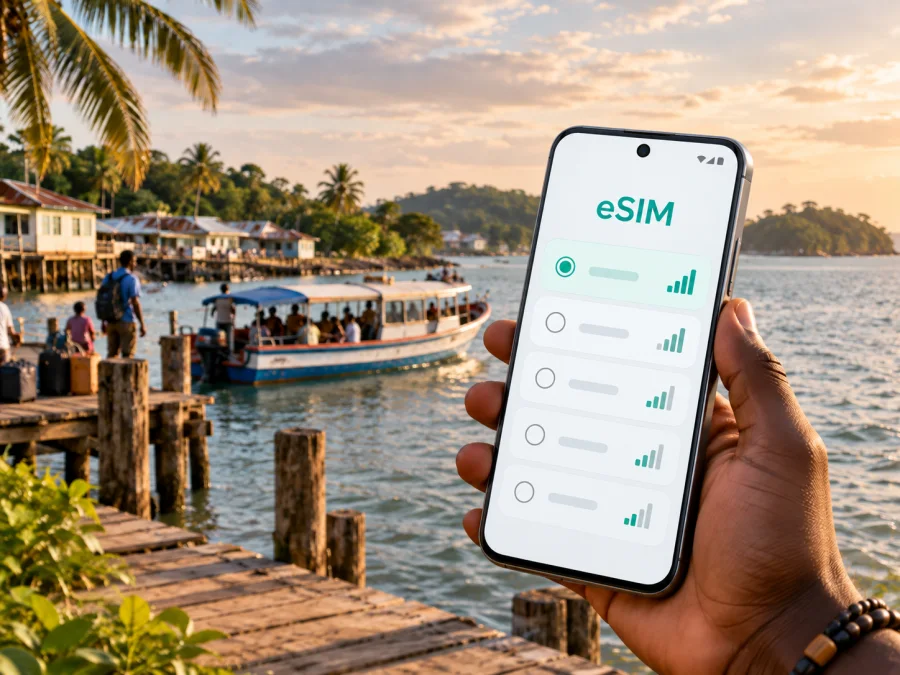
Bonthe eSIM: Mobile Connection and Internet for Travel in Sierra Leone
Bonthe is a destination where the journey is part of the place. The town sits on Sherbro Island in southern Sierra Leone, beside the Sherbro River estuary and the Atlantic coast. Getting there is not the same as arriving in a large inland capital: a road journey normally ends at a mainland crossing point, and the final approach is made by boat. Once you arrive, the town is compact, water and weather shape the pace of the day, and a dependable way to use maps and messages is useful.
An eSIM can help you prepare the mobile internet part of a Bonthe trip before you leave or after you arrive. It is a digital SIM profile installed on a compatible phone. A suitable eSIM tariff can support navigation, messaging, booking communication and work while you keep your physical SIM available for your usual number. The right choice depends on the length of the trip, your data habits and which other parts of Sierra Leone you plan to visit.
Why mobile internet matters in Bonthe
Bonthe is both a town and an access point for the wider island and coastal environment. The district is associated with fishing, rice farming, river travel and island communities. That setting is rewarding, but it also means that a traveller should not plan every step around the assumptions of a major city. Transport information may be arranged locally, accommodation can be limited, and a route that looks simple on a map can include a road transfer, a jetty and a boat crossing.
Mobile data is most useful in small, practical moments:
- checking a saved map while walking between the waterfront, accommodation and local services;
- messaging a host or driver when your arrival time changes;
- sharing your location with a travel companion before a boat departure;
- checking a weather update before an excursion on open water;
- translating a short message or confirming a meeting point;
- keeping a work contact informed during a short visit.
The signal experience can vary between the town, waterfront, mainland route and smaller settlements. Treat a mobile plan as a connection option, not a promise of uninterrupted coverage. Download important information before leaving strong coverage and keep addresses, phone numbers and bookings offline.
Planning the arrival: road transfer, mainland and island
The most important connectivity decision is made before Bonthe appears on the horizon. An itinerary can involve arrival in Sierra Leone, a road transfer toward the south, a mainland town such as Mattru Jong or another departure point, and then a boat journey to Sherbro Island. The exact route depends on your organiser, season, road conditions and the current local transport arrangement.
Do not treat the final boat leg as a minor detail. Confirm where you are going, who is meeting you, when you should be ready and what happens if the crossing is delayed. If you are travelling for work, send the same information to a colleague and your accommodation host. The ability to exchange messages during the road and transfer stages is often more valuable than a large amount of background data.
Arrival checklist for Bonthe
Before leaving the airport, hotel or another strong-connection point, check that you have:
- The name of your Bonthe accommodation written exactly as provided by the host.
- A saved map area for the road leg and the town, if your map application supports offline use.
- A contact for the person arranging your transfer or boat connection.
- A screenshot or offline copy of your booking and onward travel plan.
- A charged phone, a power bank and a dry pouch for the boat journey.
- Enough information to identify the correct jetty or meeting point without a live search.
- A data plan active for Sierra Leone and an eSIM installed if you decided to use one.
Keep the phone protected from spray and heavy rain. A connection is only useful if the device remains charged and usable.
Choosing an eSIM tariff for a Bonthe itinerary
There is no single correct data allowance for every visitor. Someone who needs only messages, occasional maps and booking checks will use data differently from someone who uploads photographs, joins video meetings or shares a connection. Start with the actual plan rather than choosing by the largest number on the screen.
| Travel pattern | Likely data use | Practical approach |
|---|---|---|
| Short stop in Bonthe | Messages, maps and arrival coordination | Choose a modest allowance and download documents first |
| Several days on Sherbro Island | Navigation, messaging and photos | Leave room for daily map use and host communication |
| Bonthe plus mainland travel | Road, boat and more frequent map checks | Plan for the whole Sierra Leone itinerary |
| Work or field visit | Email, internet calls and file sharing | Estimate meeting data separately and keep a fallback |
| Shared or high-use device | Hotspot, uploads and automatic updates | Control background traffic before departure |
The selected tariff shows its data amount, validity period and activation conditions. Compare those details before payment. A prepaid package can make spending easier to understand, but a large allowance is not automatically better, while a small package can become inconvenient if it runs out during a transfer.
Compatibility and phone settings
Check the phone before buying or installing anything. eSIM support differs by model, region and software configuration. Some devices also need to be unlocked for use with another mobile plan. Check your device compatibility and confirm that the phone has enough free space for the eSIM profile and required settings.
Before departure, verify the following:
- The exact phone model supports eSIM, not merely a similar model in the same family.
- The device is not restricted to one operator.
- You know which line will be used for mobile data after activation.
- Your usual SIM remains available for calls and SMS if needed.
- Data roaming is enabled for the eSIM when the tariff instructions require it.
- Automatic updates and cloud photo uploads are controlled.
An eSIM tariff for travel normally provides mobile data, not a regular local telephone number. Voice calls and SMS are not included unless the particular tariff says otherwise. You can use messaging and calling apps over data, but important contacts should not depend on one application alone. If your phone has dual-SIM controls, label the lines clearly, such as “home” and “Sierra Leone trip”.
Installing and activating the eSIM
Installation is easiest with stable Wi-Fi, a charged phone and the activation details at hand. You can install before departure or follow the tariff instructions after arriving. Do not delete your original SIM profile while preparing the trip.
A simple preparation sequence
- Check compatibility and the tariff conditions.
- Complete the selected order in the app or on the website.
- Read when the validity period begins. Installation and first use may be treated differently by different tariffs.
- Keep the QR code or manual activation details on a second screen or in a secure message.
- Add the mobile plan in the phone settings and give it a clear label.
- Select the eSIM for mobile data when appropriate.
- Follow the instructions for installing eSIM on Android or installing eSIM on iOS.
- After arrival, check that the eSIM line is enabled and selected for data.
Activation may take a few minutes and can depend on the device and local network. If the phone does not connect, first check the selected data line, roaming setting, airplane mode, signal, APN instructions if provided, and tariff status. Avoid repeatedly deleting and reinstalling the profile. Use support with the order details if the issue continues.
The Kaspersky eSIM Store app and website help you select a destination and available tariff, complete the order and activate the eSIM for a foreign trip. It is a preparation tool for the traveller; the network experience still depends on the local network, device and conditions where you use it. When you are ready, choose an eSIM tariff for travel in Sierra Leone.
Getting around Bonthe
Bonthe is not a destination where every journey is best measured in driving time. The island setting changes how you move. You may walk between nearby places in town, arrange a local ride for a longer distance, or depend on a boat for a connection beyond the immediate waterfront. Ask your host which names local people use for the landing point, market area, accommodation and departure place; a map pin alone may not be enough if several names refer to one general area.
Waterfront and town walks
The waterfront is a natural reference point for arrival, fishing activity and orientation. It is also a place where weather can change the practical conditions of a walk. Keep your phone in a protected pocket, save the return route and do not assume that every lane will have a clear sign. For a first walk, use a short loop from your accommodation to the waterfront and back. That gives you a local sense of distance before a longer outing.
Local rides and boat transfers
Transport availability can vary by time of day and by the part of the island you want to reach. Arrange a ride through a trusted local contact when the route is unfamiliar, confirm the destination and price, and keep the details in plain text in case the signal weakens.
For a boat transfer, confirm the boarding place, departure window, weather considerations, luggage limits and final landing arrangement. Keep a buffer before a meeting or onward road journey. Save the relevant map area and share your plan before leaving the jetty; do not rely on a live map during the entire crossing.
The same approach works for trips from Bonthe toward other island or coastal locations. A place may be close in a straight line but less direct by water. Treat every excursion as a separate transport plan, not as an extension of a town walk.
Accommodation and daily routines
For a practical booking decision, ask what is close to the waterfront, how guests reach the property from the landing point, whether the host can arrange transport and whether there is backup power. Bonthe’s accommodation offer is more limited than in major urban centres, so advance communication is valuable.
Leave flexible time around boat movement, download documents before leaving, and carry a power bank protected from rain and spray.
Bonthe for business and field work
A work trip can involve a mainland transfer, interviews, site visits, a boat excursion or a return journey with a fixed deadline. Confirm the meeting location, arrival window and backup contact, then save the agenda and necessary files. If you expect an internet video call, test the phone, headset and data line before leaving.
During a field visit, use a map pin and written description together, take notes locally, and synchronise when the connection is stable. Keep a buffer before the next non-flexible commitment; the eSIM does not replace local confirmation of schedules.
Troubleshooting after arrival
If the eSIM is installed but mobile data is not working, check these settings in order:
- Check the signal indicator and move to a more open or settled location if safe.
- Confirm that the eSIM line is switched on and selected for data.
- Check data roaming if the tariff instructions require it.
- Turn airplane mode on and off, then wait briefly for network search.
- Restart the phone if necessary.
- Check tariff validity and activation status, then contact support with the order information if the issue continues.
On a boat, in heavy rain or outside the town, the problem may be local coverage rather than installation. Save the key instructions before leaving your accommodation.
FAQ about eSIM travel to Bonthe
Is an eSIM useful for a short Bonthe stopover?
It can help coordinate the mainland transfer, boat arrival, accommodation and onward plans. Choose the allowance for the stopover and download maps in advance.
Should I install the eSIM before travelling?
You can install it before departure if the tariff conditions and device support allow it. Read when validity begins, because installation and first use may be treated differently.
Can I keep my normal number active?
On a compatible dual-SIM device, you may be able to keep the physical SIM active while assigning data to the eSIM. Check roaming conditions to avoid unexpected charges.
Will the eSIM cover the boat journey to Bonthe?
No plan guarantees coverage on every stretch of water. Share important updates before departure and keep route information offline.
Do I need a separate plan for the mainland and Bonthe?
That depends on the tariff’s stated destination and your route. Review coverage, allowance and validity before buying.
Prepare your Bonthe connection plan
Bonthe rewards travellers who leave room for the island’s pace. Put the arrival contact, boat details, accommodation address and offline maps on the phone before the road leg. Choose a tariff that fits the whole Sierra Leone route, verify the device, install the eSIM carefully and keep your normal SIM settings under control. Then use mobile data for what matters most: finding your way, communicating with people who are expecting you and adapting when a water-based journey takes longer than planned.
When your device and itinerary are ready, prepare an eSIM tariff for your trip to Sierra Leone. Review the data amount, validity and activation conditions, install the profile using the appropriate instructions, and arrive in Bonthe with both a digital connection plan and an offline backup.