
Travel connectivity guide
eSIM for Bosnia and Herzegovina travel internet
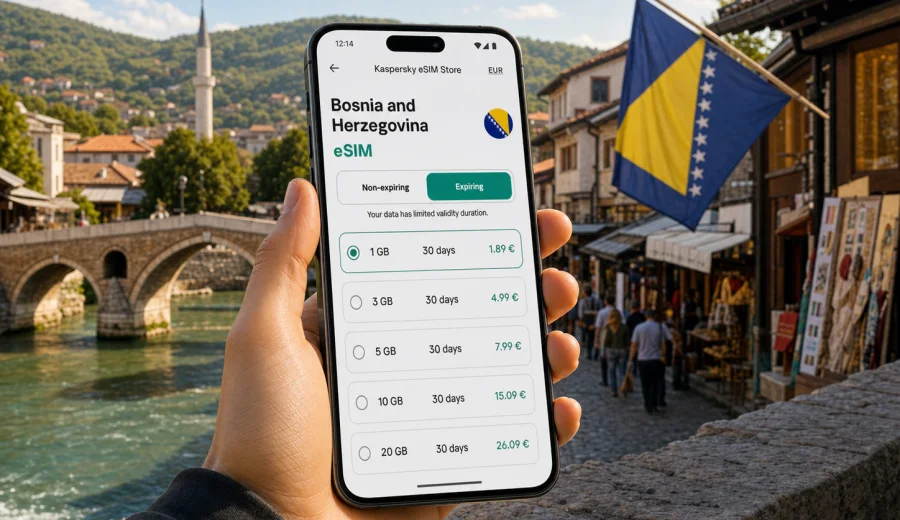
eSIM in Bosnia and Herzegovina: mobile connection and internet for your trip
Bosnia and Herzegovina is a country where a travel day can change quickly: one morning you may be walking through Sarajevo's old bazaar, the next you may be crossing mountain roads toward Mostar, Jajce, Trebinje, Banja Luka, or a quiet village guesthouse. In that kind of trip, mobile internet is not just a convenience. It helps you check routes, message hosts, translate signs, confirm bookings, call a ride, and stay in touch while moving between cities and regions.
An eSIM can make this preparation simpler because it lets you add a digital SIM profile to a compatible smartphone without looking for a physical SIM card after arrival. For many travelers, the useful part is not only the connection itself, but the control: you choose a data package before the trip or soon after landing, see the traffic allowance and validity period, and keep your primary SIM card in the phone for your usual number.
This guide explains how to think about eSIM, mobile connection, and internet access in Bosnia and Herzegovina: when it is useful, what to check before buying, how much data you may need, how installation usually works, and which travel scenarios deserve extra preparation.
Quick answer
An eSIM for Bosnia and Herzegovina is useful if your phone supports eSIM and you want mobile data without buying a local physical SIM card. It is especially practical for travelers who plan to move between Sarajevo, Mostar, Banja Luka, Tuzla, Trebinje, national parks, border areas, and mountain routes where relying only on hotel Wi-Fi is inconvenient.
Kaspersky eSIM Store is an app and website where you can choose, arrange, and activate an eSIM with a suitable data package for mobile internet during an international trip. It is not a mobile operator and does not own a network. The conditions, data amount, validity period, and availability depend on the selected eSIM plan.
Why mobile internet matters in Bosnia and Herzegovina
Bosnia and Herzegovina rewards flexible travel. Many routes combine historic centers, rural roads, rivers, mountains, and border crossings. A stable data setup helps because key travel tasks often happen outside your hotel room:
- navigating from Sarajevo International Airport to the city center;
- checking bus or train details before moving to Mostar, Konjic, Banja Luka, or Tuzla;
- messaging apartment hosts when the street address is hard to find;
- using maps on mountain roads and in old towns with narrow lanes;
- translating restaurant menus, road signs, and parking instructions;
- confirming opening hours and booking details while plans change;
- sharing your location with family or colleagues;
- using banking, ticketing, or ride services that require mobile data.
Public Wi-Fi can help in hotels, cafes, airports, and shopping centers, but it is not a complete travel plan. It may require a local login, be slower at busy times, or simply not be available when you need directions. A prepared eSIM helps reduce dependence on open Wi-Fi networks and physical SIM-card shops.
eSIM compared with roaming and local SIM cards
There is no single best option for every traveler. The right choice depends on your phone, trip length, data use, budget, and how much time you want to spend setting things up after arrival.
| Option | Best for | Main advantage | What to check |
|---|---|---|---|
| eSIM | Short trips, multi-city travel, business travel, arrival-day convenience | You can prepare mobile data without a physical SIM card | Device compatibility, data amount, validity, activation rules |
| Home roaming | Travelers who need their usual mobile number active all the time | Simple if your operator's roaming terms suit your trip | Price per GB, fair use limits, daily fees |
| Local physical SIM | Longer stays or users who need local voice/SMS terms | Can be useful for extended local use | Store location, documents, language, activation time, phone SIM slot |
| Public Wi-Fi only | Very light users staying mostly in hotels | No extra mobile data plan | Availability, security, speed, coverage outside buildings |
An eSIM is often attractive when you want to land with a prepared route, avoid searching for a shop, and keep your physical SIM slot free. It is also useful if you cross into neighboring countries during the same trip and want to think about regional options in advance.
Where eSIM is useful during a Bosnia and Herzegovina trip
The country is compact, but travel patterns are diverse. Mobile internet needs can differ by route.
Sarajevo and arrival days
Sarajevo is the most common first stop. Mobile data helps with airport transfers, accommodation messages, restaurant searches, walking routes around Baščaršija, and navigation between hills, tram stops, and museums. If you arrive late, a prepared eSIM can save time because you do not need to start the trip by looking for a SIM-card counter.
Mostar, Blagaj, and Herzegovina routes
Mostar is a frequent second stop, often combined with Blagaj, Počitelj, Kravica Waterfall, and Trebinje. These routes may include rental cars, tours, or intercity buses. Data is helpful for map rerouting, parking, weather checks, and messaging guides or hosts. If you plan photography, video calls, or cloud backups, your data use may be higher than on a city-only trip.
Banja Luka, Jajce, Travnik, and central routes
Travelers who go beyond the Sarajevo-Mostar axis often rely more on mobile maps. Roads may be scenic but winding, and public transport details are not always as easy to check offline. Downloading offline maps before departure is still wise, but an eSIM gives you a live layer for messages, search, and route changes.
Mountains, parks, and rural stays
In mountainous and rural areas, any mobile connection can depend on local network conditions, terrain, and the selected plan. Do not assume the same data experience in a valley, on a mountain road, and in a city center. For hiking, rafting, skiing, or guesthouse stays outside major cities, prepare key information offline: maps, addresses, booking confirmations, emergency contacts, and transport details.
How much data do you need?
Your data needs depend more on behavior than on the country. Use the table as a practical planning tool, not as a guarantee.
| Trip style | Typical data profile | Practical suggestion |
|---|---|---|
| Weekend in Sarajevo | Maps, messaging, light browsing, ride or taxi apps | A small data package may be enough if hotel Wi-Fi covers video and backups |
| 5-7 day city and Mostar trip | Maps, translation, restaurants, bookings, photo sharing | Choose more data if you use maps constantly or upload many photos |
| Road trip through several regions | Navigation, messaging, route changes, weather, searches | Leave a buffer because mobile data is useful between stops |
| Remote work or business trip | Email, calendar, calls through apps, hotspot if allowed | Check data volume, validity, and tethering rules carefully |
| Family travel | Several devices, shared navigation, entertainment | Consider separate device needs instead of relying on one phone |
Common data-saving habits:
- download offline maps before departure;
- update apps over trusted Wi-Fi, not mobile data;
- disable automatic cloud photo and video backup on mobile data;
- pre-download playlists, guidebooks, tickets, and translation packs;
- use low-data mode for video calls when quality is not critical;
- check which SIM is selected for mobile data after installing eSIM.
What to check before you choose an eSIM
Before paying for any eSIM plan, confirm the basics. This is a small step that prevents most avoidable setup problems.
1. Check that your device supports eSIM.
2. Confirm that your phone is not locked to one mobile operator.
3. Read the plan destination and make sure Bosnia and Herzegovina is included.
4. Compare the data amount with your expected use.
5. Check the validity period and when it starts.
6. Review whether hotspot or tethering is allowed if you need it.
7. Keep an internet connection available for installation.
8. Save your QR code or installation details somewhere accessible.
If you are unsure about device support, check your device before choosing a plan. Some phone models differ by region of sale, and a model name alone is not always enough.
Choosing a plan for Bosnia and Herzegovina
Once you know your device is compatible, choose based on the trip you are actually taking. A short city break and a two-week route through several regions do not need the same package. For a practical starting point, you can prepare an eSIM plan for Bosnia and Herzegovina and compare the available data amounts and validity periods before departure.
Look at three questions first:
- How many days will you need mobile data?
- Will you use the phone mostly for maps and messages, or also for video calls and hotspot?
- Will Bosnia and Herzegovina be the only destination, or part of a wider Balkan route?
For light use, a smaller package can work if you rely on accommodation Wi-Fi for heavy tasks. For road trips, business travel, or frequent uploads, leave a buffer. It is easier to plan with a little extra data than to ration every map search.
How installation usually works
The exact steps depend on your device and the selected eSIM plan, but the typical flow is straightforward.
1. Choose Bosnia and Herzegovina as your destination.
2. Select the data amount and validity period that fit your trip.
3. Complete the order.
4. Open the eSIM details in your profile or email.
5. Add the eSIM to your compatible phone using the QR code or manual details.
6. Set the new eSIM as the line for mobile data when you are ready to use it.
7. If required by your device or plan, turn on data roaming for the eSIM line.
8. Wait a few minutes for registration on a local network.
For detailed device steps, use the Android installation guide or the iOS installation guide. Install the eSIM while you still have a reliable internet connection, because setup may require downloading the eSIM profile.
When should you install and activate it?
Many travelers prefer to install the eSIM before departure and switch mobile data to it after arrival. This gives you time to solve device questions at home, while avoiding unnecessary data use before the trip. Always read the activation conditions of the selected plan because validity may start at a specific moment, such as installation, first network connection, or another plan-defined event.
A careful setup looks like this:
- before departure: check compatibility, choose the plan, save installation details;
- at home or at the airport: install the eSIM profile if the plan rules allow it;
- after landing: select the eSIM for mobile data;
- during the trip: monitor remaining data and validity;
- after the trip: switch mobile data back to your usual SIM if needed.
Do not delete the eSIM profile unless you are sure you no longer need it. Some eSIM profiles cannot be reinstalled after deletion, depending on plan terms.
Practical setup checklist for departure
Use this checklist one or two days before the trip:
- passport, tickets, bookings, and travel insurance saved offline;
- accommodation addresses saved in the original language and in English;
- offline maps for Sarajevo, Mostar, and planned road routes downloaded;
- eSIM-compatible device confirmed;
- phone unlocked and updated enough for eSIM installation;
- QR code or manual installation details saved;
- primary SIM kept active if you need banking codes or calls;
- mobile data line selected correctly after installation;
- data roaming setting checked for the eSIM line;
- charger and power bank packed for long travel days.
Common travel scenarios
You arrive in Sarajevo and go straight to the hotel
A prepared eSIM helps you check the address, message the host, and follow the route without waiting for Wi-Fi. Keep the hotel address offline too, in case mobile registration takes a few minutes.
You rent a car and drive to Mostar
Download the route before leaving, then use mobile data for traffic, stops, weather, and changes. If you cross remote stretches, keep navigation running even when the signal changes.
You work during the trip
Check whether the selected plan allows hotspot use and whether the data allowance suits video calls. For important meetings, avoid relying on one connection only: use hotel Wi-Fi as the main line and mobile data as a backup.
You travel with family
Decide whether each traveler needs their own eSIM or whether one phone will handle maps and messages. If children stream video on mobile data, usage can grow quickly.
You combine Bosnia and Herzegovina with neighboring countries
If your route includes Croatia, Serbia, Montenegro, or other countries, check whether a country-specific or regional plan better matches the itinerary. Do this before travel so you are not making plan decisions at a border crossing.
What eSIM does not replace
An eSIM plan for travel data is not the same as a full local mobile subscription. Unless stated in the conditions of a specific plan, it usually does not include a local phone number, standard voice calls, or SMS. For calls and messages, you can use internet-based apps when data is available.
Also remember:
- speed and availability depend on local network conditions and the selected plan;
- terrain, buildings, and rural areas can affect mobile signal;
- some services may still require your primary SIM for bank verification codes;
- device settings can route calls, messages, and data through different SIM lines;
- refunds, transfers, and reinstall rules depend on the plan and purchase conditions.
Short recommendations by traveler type
| Traveler type | Recommended approach |
|---|---|
| First-time visitor | Prepare eSIM before departure, download offline maps, keep accommodation details saved |
| Backpacker | Choose enough data for maps and messaging, avoid automatic backups, keep transport info offline |
| Business traveler | Check validity, hotspot rules, and backup connection options before meetings |
| Road-trip traveler | Use offline maps plus mobile data for live changes and communication |
| Photographer or creator | Estimate upload needs carefully; large media files can use data quickly |
| Family traveler | Plan per device, not just per trip, and limit streaming on mobile data |
Troubleshooting basics
If mobile data does not work right away, move step by step:
1. Check that the eSIM is installed and not deleted.
2. Confirm that the eSIM line is selected for mobile data.
3. Turn data roaming on for the eSIM line if the instructions require it.
4. Restart the phone.
5. Wait a few minutes for local network registration.
6. Check whether the plan has started and still has data and validity.
7. Review the installation guide for your device.
Avoid changing many settings at once. If you need support, keep screenshots of the eSIM line settings, the error message, and the plan details ready.
FAQ
Is eSIM useful in Bosnia and Herzegovina?
Yes, if your phone supports eSIM and you need mobile internet for maps, messaging, bookings, translation, transport, or work. It is especially useful if you want to prepare data access before arrival.
Can I keep my usual SIM card active?
In many dual-SIM phones, yes. You can often keep your primary SIM for calls or verification messages while using eSIM for mobile data. Check your device settings because behavior differs by model.
Does an eSIM include a phone number?
Usually no, unless this is clearly stated in the selected plan. Travel eSIM plans are commonly focused on mobile data. You can use messaging and calling apps through the internet.
Should I install eSIM before arriving?
You can often install it before departure if the plan conditions allow it. Read when the validity period starts, then decide whether to install at home, at the airport, or after arrival.
Can I use public Wi-Fi instead?
You can, but it is less convenient for navigation, transport changes, and messages while moving. Public Wi-Fi also may not be available exactly when you need it.
What if I visit several Balkan countries?
Check the itinerary first. A country-specific plan may be enough for Bosnia and Herzegovina only, while a regional option may better fit a multi-country trip. The right choice depends on destinations, dates, and data use.
Final preparation before you go
A good mobile internet setup for Bosnia and Herzegovina is simple: confirm that your phone supports eSIM, choose a data package that matches your route, install it while you have reliable internet, and keep key travel information offline as a backup. This gives you more control on arrival days, road trips, and city-to-city travel without making your whole trip depend on public Wi-Fi.
If you are ready to prepare mobile data for the journey, choose an eSIM plan for your trip to Bosnia and Herzegovina in Kaspersky eSIM Store and check the data amount, validity period, and activation details before departure.