
Travel connectivity guide
Cambridge eSIM for mobile internet travel
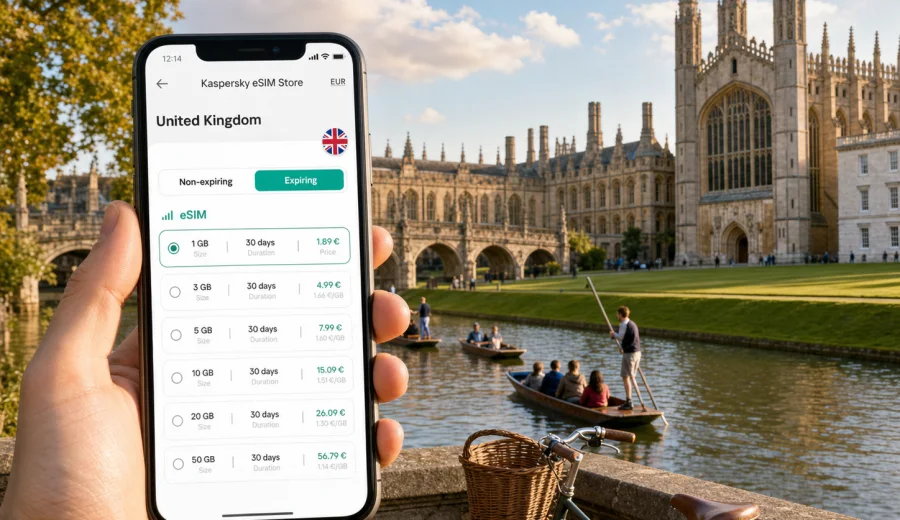
Cambridge eSIM: mobile connection and internet for a city trip
Cambridge is compact enough to explore on foot, but it is not a city where you want to rely only on hotel Wi-Fi or guesswork. The railway station is south-east of the historic centre, many college entrances are hidden behind narrow streets, punts leave from several riverside points, and a short walk can turn into a slow detour when a bridge, gate or one-way cycling route changes your plan. A prepared eSIM helps you keep mobile internet ready for maps, tickets, ride apps, messages and travel updates from the moment your device connects to a local network.
This guide focuses on practical mobile connection in Cambridge, United Kingdom: arrival routes, local movement, hotels, university districts, business visits, stopovers, day trips and the moments when mobile data is more useful than it first seems. It is written for travellers who want a calm, predictable way to stay online without buying a physical SIM card after arrival.
Why mobile internet matters in Cambridge
Cambridge feels easy because the centre is small, but the details are often digital. College opening hours can vary. Museum entry information may change by season. Train services to London, Ely, Stansted Airport and other cities can be disrupted. Restaurants, taxi services and accommodation often communicate through apps or email. If you are visiting for study, work or a conference, your day may depend on calendar updates, QR codes and directions between several venues.
Mobile internet is useful in Cambridge for:
- walking from Cambridge railway station to the city centre without losing your route around Parker's Piece or Regent Street;
- checking bus options between Cambridge Station, Cambridge North, Eddington, Addenbrooke's and the Science Park;
- finding the right entrance to a college, lab, hotel or conference building;
- using maps around the River Cam, where paths and bridges can be confusing on a first visit;
- booking or changing punt tours, restaurant tables and train tickets;
- using messaging apps if your eSIM tariff does not include a standard phone number, calls or SMS;
- sharing documents or joining calls during a business trip.
An eSIM is not a replacement for every travel detail, but it can remove one common friction point: needing mobile data before you have time to find a shop, compare local options or depend on a public network.
Arrival in Cambridge: where data helps first
Many visitors arrive by rail. Cambridge railway station is about a 20 to 30 minute walk from the historic centre, depending on your exact destination and luggage. Taxis, buses and bicycles are available nearby, but the best option depends on weather, time and where you are staying. Mobile data helps you decide quickly instead of standing outside the station searching for a connection.
Cambridge North is useful for the Science Park, Business Park and some northern districts, but it is not the main station for the old city centre. If your hotel is near King's Parade, Market Square or the colleges, check the route before you board. For travellers coming from London, Stansted Airport or other UK cities, real-time train information is especially helpful because platform changes and delays can affect onward plans.
If you arrive by coach, your drop-off may be closer to Parkside or another central point. The city is walkable, but Cambridge streets are not a simple grid. A working mobile connection helps you move from arrival point to hotel without using data-heavy roaming by accident or waiting for Wi-Fi in a cafe.
Choosing an eSIM for Cambridge travel
For a Cambridge trip, the country setting matters more than the city name. You need a tariff for the United Kingdom, because Cambridge is in England and uses the same country-level mobile destination as London, Oxford, Manchester or Edinburgh. In Kaspersky eSIM Store, you can choose the destination, review the data amount, validity period and price, then install and activate an eSIM on a compatible device.
Use your itinerary to estimate data:
| Trip style | Typical data needs | What to check before choosing |
|---|---|---|
| One-day Cambridge visit from London | Light to medium | Maps, train updates, messaging, ticket apps |
| Weekend in the historic centre | Medium | Navigation, photo backup on Wi-Fi, restaurant bookings |
| University visit or open day | Medium | Email, maps between departments, shared documents |
| Business trip to Science Park or Addenbrooke's | Medium to high | Video calls, hotspot needs, calendar updates |
| Cambridge plus UK day trips | Medium to high | Rail apps, maps, accommodation changes, regional travel |
Do not choose only by the largest number of gigabytes. Match the data volume to your travel behaviour. If you mainly use maps and messaging, a smaller package may be enough. If you expect video meetings, hotspot use or cloud work, choose more data and check whether your phone allows tethering under the selected tariff conditions.
Cambridge areas where online navigation is useful
The centre around King's Parade, Trinity Street, St John's Street, Market Square and Senate House Passage is dense with colleges, gates, courtyards and pedestrian areas. A map pin can place you close to a building, but not always at the right entrance. This is one of the most common Cambridge travel problems: the destination is nearby, yet the accessible gate is around the corner.
Around the River Cam, mobile data helps you compare walking routes and punt locations. Some riverside paths are scenic but not always the fastest. If you are moving between Magdalene Bridge, the Backs, Queen's Road and Silver Street, real-time navigation can save time, especially when you are meeting a tour group.
For hotels and serviced apartments, check the exact district. A property described as "Cambridge" may be in the centre, near the station, close to Addenbrooke's, in Eddington or toward the Science Park. That difference matters if you have morning meetings, evening plans or luggage. With an eSIM ready, you can check bus routes, ride availability and walking times before committing to a plan.
A practical setup before you travel
Before you leave for Cambridge, prepare your phone so mobile internet is ready when you need it. The exact steps depend on your device and tariff, but a simple checklist keeps the process controlled.
1. Check that your smartphone supports eSIM and is not locked to another mobile operator.
2. Choose a United Kingdom tariff with a data volume and validity period that fit your stay.
3. Install the eSIM while you still have a stable Wi-Fi connection.
4. Keep your regular SIM active for calls or banking messages if you need it.
5. Set the eSIM as the line for mobile data when you are ready to use it.
6. Check whether data roaming must be enabled for the eSIM profile.
7. Save your QR code or installation details in a place you can access if needed.
If you want to prepare the tariff before arrival, you can use Kaspersky eSIM Store to choose a mobile internet option for the United Kingdom and then keep the eSIM ready for your Cambridge itinerary. Review the tariff conditions carefully: data amount, validity period, destination and activation rules may vary by option.
Device compatibility and installation
Not every phone, tablet or laptop supports eSIM. Some devices also have regional restrictions or operator locks. Before buying a tariff, check your device and confirm that it can install and use an eSIM profile.
Installation is usually easiest before travel, using home or office Wi-Fi. Kaspersky eSIM Store gives you the information needed to add the eSIM to your device, and the exact path depends on the operating system. If you need step-by-step help, use the Android installation guide or the iOS installation guide.
After installation, keep the eSIM turned off until you are ready to use it if the tariff conditions make that preferable. When you arrive in the United Kingdom, select it for mobile data and follow the activation instructions for your selected plan. Some eSIM tariffs may require data roaming to be enabled on the eSIM line; this does not mean you should enable roaming on your primary SIM unless you intentionally want to use it.
Getting around Cambridge with mobile data
Cambridge has several movement patterns, and each benefits from a different online tool.
Walking is often the best choice in the centre. Maps help you avoid long loops around college walls and find pedestrian passages. If you are moving between the station, the Fitzwilliam Museum, King's College Chapel and the river, a saved route keeps the day relaxed.
Buses are useful for Addenbrooke's, Cambridge Biomedical Campus, Eddington, the Science Park and Cambridge North. Live information is helpful because traffic on main roads can affect timing. If you have a meeting outside the old centre, check the route before leaving your hotel.
Cycling is common in Cambridge, but visitors should be careful. Bus lanes, cycle lanes, one-way streets and heavy student traffic can be unfamiliar. If you rent a bike, mobile data helps with route planning, but keep the phone safely mounted or stop before checking directions.
Taxis and ride services can be useful after dark, with luggage, or when staying away from the centre. A working mobile connection lets you confirm pickup points, message your driver and update hotel arrival times.
Business trips, conferences and university visits
Cambridge is not only a leisure destination. Many visitors come for university meetings, research visits, medical appointments, start-up events, language courses or conferences. These trips often involve several locations rather than one sightseeing route.
For business travel, mobile internet is valuable for:
- joining a call if venue Wi-Fi is slow or requires registration;
- opening shared documents and calendar invites;
- finding reception entrances on campuses and business parks;
- checking train options after a meeting runs late;
- using a hotspot for a laptop when allowed by the tariff and device settings.
If you are visiting the Science Park, Cambridge Biomedical Campus, West Cambridge, Eddington or a college department, do not assume every building is near the tourist centre. Save the address, postcode and meeting contact before you travel. With an eSIM active, you can adjust plans without hunting for a public network.
Hotels, apartments and Wi-Fi gaps
Accommodation Wi-Fi is useful, but it does not cover the travel moments that often matter: the walk from the station, the taxi pickup, the late check-in message, the restaurant search after arrival, or the train change before checkout. A hotel network can also be slow during busy evenings or require room details you do not yet have.
For Cambridge, the most practical approach is to use hotel Wi-Fi for large updates, video streaming and photo backup, while using eSIM mobile data for movement and time-sensitive tasks. This keeps your data package under control without making you dependent on every cafe, station or lobby network.
If you are staying near the station, you may spend more time moving between the hotel and the historic centre. If you are staying near the colleges, you may walk more and use less transport. If you are staying near Addenbrooke's, Eddington or Cambridge North, plan for more bus, taxi or rail checks.
Short stopovers and day trips from Cambridge
Cambridge is often part of a wider UK itinerary. Travellers visit from London for a day, stop before or after Stansted Airport, or use the city as a base for Ely, Newmarket, Bury St Edmunds, Norwich or Oxford. A United Kingdom eSIM tariff can support these movements as long as the selected plan covers the country and has enough data for your route.
For a day trip, the key tasks are simple:
- keep train tickets and booking references accessible;
- check platform changes before leaving the centre;
- use maps for the station-to-centre walk;
- keep a low-data navigation option available if your battery is running down;
- avoid large downloads until you are back on Wi-Fi.
For longer UK travel, think beyond Cambridge. A plan that feels generous for one city weekend may be tight if you also use navigation in London, upload photos, work from trains and stream video. Review your expected data use before choosing.
Data-saving habits that work in Cambridge
You do not need to treat mobile data as fragile, but a few habits make your eSIM tariff last longer.
| Habit | Why it helps |
|---|---|
| Download offline map areas before travel | Reduces repeated map loading while walking |
| Disable automatic app updates on mobile data | Prevents background data use |
| Back up photos on Wi-Fi | Keeps the eSIM package for navigation and messages |
| Use audio calls instead of video when possible | Reduces data use during work or family calls |
| Check train routes before leaving Wi-Fi | Keeps key travel details available if signal is busy |
| Monitor data use in your phone settings | Helps you adjust before the package runs low |
Also check your battery. Cambridge sightseeing can be phone-heavy: maps, photos, tickets, camera, messages and payments all compete for power. A small power bank is useful if you plan a full day from station arrival to evening return.
Common Cambridge travel scenarios
You arrive at Cambridge station with luggage. Use mobile data to compare walking, bus and taxi options. If your hotel is near the market or colleges, walking may be simple in good weather. If you are heading to Addenbrooke's or the Science Park, check public transport or taxi timing.
You are meeting someone at a college. Confirm the exact gate and entrance. College names can cover several buildings, and some routes are closed to visitors. A live map and message thread prevent last-minute confusion.
You booked a punt tour. Keep the meeting point and booking confirmation available. There are several river access points, and the shortest route may not be obvious from the street.
You are in Cambridge for work. Keep mobile data ready as a backup for venue Wi-Fi. If you need to use a hotspot, check the tariff conditions and your phone settings before relying on it for a presentation or video call.
You are leaving for London or Stansted Airport. Check train times before you depart your hotel. Cambridge has more than one station, and choosing the wrong one can add stress to a tight connection.
FAQ: eSIM and mobile internet in Cambridge
Do I need a Cambridge-specific eSIM?
No. For Cambridge, choose a United Kingdom eSIM tariff. The city is part of the same country destination as the rest of the UK.
Can I install the eSIM before arriving in the United Kingdom?
In many cases, yes. Install it over a stable Wi-Fi connection and follow the activation rules for the selected tariff. Check when validity starts before you turn it on.
Does an eSIM include a UK phone number?
Usually, travel eSIM tariffs are focused on mobile data. Standard voice calls and SMS are not included unless the tariff conditions say otherwise. You can use internet-based messaging and calling apps over mobile data.
Will I still need Wi-Fi?
Wi-Fi is useful for large downloads, video streaming and backups. The eSIM is most useful for movement, maps, tickets, messages and urgent travel changes when Wi-Fi is not available.
Is public Wi-Fi enough for Cambridge?
It can help in hotels, cafes and some venues, but it is not reliable for every travel moment. You may need data while walking, cycling, waiting for transport or finding an entrance.
When should I choose more data?
Choose more data if you expect video calls, hotspot use, frequent cloud work, photo uploads over mobile data, or several UK destinations beyond Cambridge.
Final preparation for your Cambridge trip
Before travelling, make your mobile setup part of the same checklist as tickets, hotel details and documents. Confirm that your device supports eSIM, select a suitable United Kingdom tariff, install the profile on Wi-Fi, and decide when you want to activate it. Keep your primary SIM available if you need calls, SMS or banking messages, and use the eSIM line for mobile data during the trip.
Cambridge rewards relaxed movement: a quiet walk along the Backs, a meeting that runs over time, a last-minute punt booking, a train change after dinner. Having mobile internet ready means you can handle those details without turning the trip into a search for Wi-Fi. To prepare before you go, choose an eSIM tariff for your Cambridge trip to the United Kingdom through Kaspersky eSIM Store and review the conditions that fit your route, device and travel dates.