
Travel connectivity guide
Casablanca eSIM for mobile internet
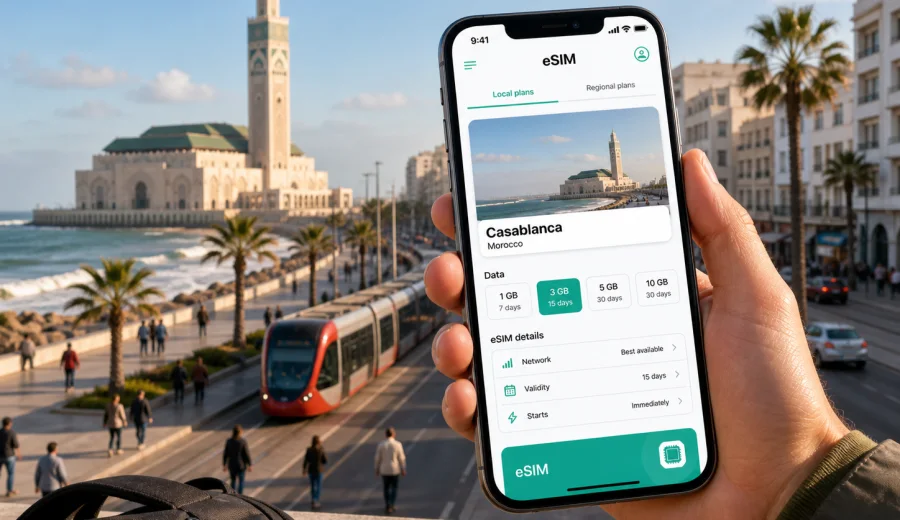
Casablanca eSIM: mobile connection and internet for a smoother city trip
Casablanca is often the first practical stop in Morocco: a business hub, a major Atlantic port city, and a gateway for trips to Rabat, Marrakesh, Fez, or the coast. It is also a city where mobile internet can shape the first hour of your arrival. You may need maps from Mohammed V International Airport, ride-hailing details, hotel messages, train times, restaurant reservations, or a quick call through a messenger before you have time to look for Wi-Fi.
An eSIM can help you prepare mobile internet for Casablanca without buying a physical SIM card after landing. With Kaspersky eSIM Store, you can choose a destination, review available data allowance and validity, install the eSIM on a compatible device, and use mobile data during your trip according to the selected tariff conditions. That makes it useful for travelers who want a clear setup before they step into a taxi queue or board a train.
This guide focuses on Casablanca, not Morocco in general. It covers airport arrival, city movement, neighborhoods, short stopovers, business days, hotel stays, and trips from Casablanca where an eSIM can make navigation and communication easier.
Why mobile internet matters in Casablanca
Casablanca is large, busy, and spread out. Distances between the airport, the business districts, the Old Medina, the Corniche, Maarif, Anfa, Habous, and Casa Voyageurs station can be longer than they look on a map. Traffic conditions can change the best route during the day, and a short ride can become slower if you choose the wrong time or pickup point.
Mobile internet is useful in Casablanca for everyday travel tasks:
- checking your route from Mohammed V International Airport before leaving the terminal;
- confirming hotel address details in Maarif, Gauthier, Bourgogne, or near the Corniche;
- using maps for walking around the Old Medina and nearby central streets;
- comparing tram, train, taxi, and private transfer options;
- receiving booking updates from hotels, restaurants, coworking spaces, and airlines;
- using messenger calls when your regular phone number is not convenient abroad;
- translating menus, signs, and address notes when needed;
- keeping expense apps, banking checks, and travel documents accessible.
Casablanca is not a city where you should rely only on offline plans. You can save maps before departure, but live traffic, ride pickup changes, gate updates, and hotel messages still need a connection. Public Wi-Fi can help in some hotels and cafes, but it is not always available exactly when you need it, and it may require registration or local assistance.
Arrival at Mohammed V International Airport
Many Casablanca trips begin at Mohammed V International Airport, about 30 kilometers south of the city center. After passport control and baggage claim, travelers usually need one of four things: a train connection, a taxi, a private transfer, or directions to a rental car desk. In each case, mobile data can reduce uncertainty.
If your eSIM is installed before departure, you can switch mobile data to the eSIM profile after landing, once the aircraft has stopped and local mobile service is available. If your tariff starts only after activation or connection to a supported local network, check the tariff conditions before the trip so you understand when validity begins.
Practical arrival checklist:
- save your hotel address in English and, if available, in French or Arabic script;
- keep the booking confirmation available offline;
- install the eSIM before travel if your device allows it;
- know which SIM profile will use mobile data after landing;
- keep your primary SIM active only if you need bank SMS or regular calls;
- check whether data roaming must be enabled for the eSIM profile;
- keep a small amount of battery for maps and driver communication.
The airport train can take you toward Casa Voyageurs, one of the key rail stations for onward city travel. If you are heading to a hotel near the center, Maarif, or the waterfront, you may still need a taxi, tram connection, or pickup after the train. A working data connection helps you compare that final segment instead of guessing at the station exit.
Using eSIM around Casablanca neighborhoods
Casablanca is a practical city with several travel patterns rather than one compact tourist zone. Your data needs may change depending on where you stay and how you move.
| Area or scenario | Why mobile internet helps |
|---|---|
| Old Medina and central Casablanca | Maps, meeting points, restaurant searches, and walking routes through dense streets. |
| Hassan II Mosque and the oceanfront | Photo sharing, ride pickup coordination, and route planning along the waterfront. |
| Ain Diab and the Corniche | Restaurant reservations, taxi ordering, and navigation between beach clubs, cafes, and hotels. |
| Maarif and Gauthier | Business meetings, coworking, delivery apps, and short rides between offices and restaurants. |
| Anfa and business districts | Calendar updates, email, video call backup, and moving between hotels and offices. |
| Habous Quarter | Walking navigation, translation, and sharing location with travel companions. |
| Casa Voyageurs and Casa Port | Train times, platform updates, onward route checks, and ticket information. |
For a short leisure trip, you may mostly need maps, messaging, bookings, and light browsing. For a business trip, you may use more data for email, document access, hotspot use, cloud storage, and backup calls. For a family trip, several people may depend on one person for navigation, reservations, and transport coordination, so that person should have the most reliable mobile setup.
How much data to prepare for Casablanca
The right data allowance depends on how you travel. Casablanca can be data-light if your hotel Wi-Fi is reliable and you use mobile internet mainly outside. It can become data-heavy if you work remotely, use maps all day, or share a hotspot with another device.
Typical daily use cases:
- Light use: maps, messengers, ride details, restaurant searches, and email checks.
- Moderate use: everything above plus social media, photo uploads, travel planning, and frequent browsing.
- Heavy use: video calls, laptop tethering, cloud documents, streaming, or long remote work sessions.
For a weekend in Casablanca, a smaller package may be enough if you avoid video streaming on mobile data. For a week that includes business meetings, navigation, and side trips, a larger allowance gives more flexibility. If Casablanca is one stop in a longer Morocco route, choose based on the full itinerary rather than the city alone.
Before choosing a tariff, check four details:
1. Destination coverage: the tariff should match Morocco or the regional route you plan to use.
2. Validity: the active period should cover arrival day, city days, and departure day.
3. Data allowance: choose enough for navigation, messaging, bookings, and work.
4. Activation rules: understand when the tariff starts and whether any setup must be done before arrival.
Choosing an eSIM tariff for a Casablanca trip
When you choose an eSIM tariff for Casablanca, think in terms of your actual route. A city article may start with Casablanca, but your mobile data requirement belongs to the full trip: airport arrival, nights in the city, business meetings, a coastal dinner, and any onward travel.
If your trip stays inside Morocco, a Morocco tariff is usually the most direct option to review. If you combine Morocco with another country, compare whether a regional or broader option fits your dates and route. Always check the destination list and tariff conditions before purchase.
This is the point in planning where it makes sense to move from research to setup. You can choose a mobile internet tariff for your Casablanca trip through the Morocco page in Kaspersky eSIM Store, then review data allowance, validity, price, and activation details before you travel.
Use this comparison to choose more calmly:
| Trip type | Sensible data approach |
|---|---|
| One-night stopover | Prioritize enough data for airport transfer, hotel messaging, maps, and departure updates. |
| Weekend city break | Allow for maps, ride apps, restaurant searches, social sharing, and light browsing. |
| Business trip | Add room for email, calendar, cloud files, and backup hotspot use. |
| Family trip | Choose for the person who will manage maps, bookings, tickets, and group communication. |
| Morocco route starting in Casablanca | Choose for the full number of days and cities, not only the first stop. |
Avoid choosing only by the lowest price. A smaller package can work well for careful use, but it may feel restrictive if your hotel Wi-Fi is weak or if you need hotspot data for a laptop. The better question is: what tasks would be inconvenient if mobile data ran out during the trip?
Installing and activating eSIM before or after arrival
Installation is usually easier before you leave home, while your main internet connection is stable. After purchase, the eSIM profile can be installed on a compatible device. Depending on the device and tariff instructions, you may use an on-screen flow or a QR code. Follow the instructions carefully and avoid deleting the eSIM profile after installation unless support or the tariff terms say it is safe to do so.
For installation help, use the official guides for your device type: Android eSIM installation instructions and iOS eSIM installation instructions.
A simple setup sequence:
1. Check that your phone supports eSIM and is not locked to one mobile operator.
2. Choose a tariff for Morocco or for the wider route if your trip continues beyond Morocco.
3. Install the eSIM while you still have stable Wi-Fi.
4. Label the new SIM profile clearly, for example "Travel data".
5. Keep your regular SIM for calls or SMS if you need it.
6. On arrival in Casablanca, set mobile data to the eSIM profile.
7. Enable data roaming for the eSIM profile if the instructions or device settings require it.
8. Test maps or a browser page before leaving the airport or station.
Before buying, check your device for eSIM support. Compatibility matters because eSIM availability depends on the exact device model, region, and carrier lock status. Some phones with the same marketing name can differ by market.
What eSIM does and does not replace
An eSIM tariff for travel is primarily about mobile data. It helps you use maps, messengers, email, web pages, booking apps, and other internet services. It may not include a regular local phone number, traditional voice calls, or SMS unless those features are specifically included in the selected tariff conditions.
That distinction matters in Casablanca. Many travel tasks can be handled through internet-based apps, but some banks, airlines, or booking services may still send SMS to your regular number. If you need those messages, keep your primary SIM available and check roaming costs with your home operator. You can often use the travel eSIM for mobile data while keeping your regular SIM for essential calls or texts, depending on your device settings.
Also remember that eSIM is not a promise that every basement, elevator, road, or indoor corner will have perfect reception. Local network conditions, building materials, congestion, device settings, and tariff coverage all influence the connection. The practical benefit is preparation: you avoid having to find a physical SIM shop before you can start using mobile data.
FAQ: eSIM and mobile internet in Casablanca
Is eSIM useful for a short stopover in Casablanca?
Yes. It can be useful even for one night if you need airport transfer details, hotel messages, maps, or train information through Casa Voyageurs.
Should I install the eSIM before flying to Morocco?
Installing before departure is usually more convenient because you can use stable Wi-Fi and check the setup without airport pressure. Activation and validity rules depend on the selected tariff.
Can I use eSIM for calls in Casablanca?
Travel eSIM tariffs are usually focused on mobile data. Voice calls and SMS are not included unless the selected tariff states otherwise, but internet-based calling apps can work over mobile data.
Can I keep my regular SIM active?
On many dual-SIM devices, you can keep your regular SIM available for calls or SMS and use the eSIM for mobile data. Check device settings and roaming costs first.
Is public Wi-Fi enough in Casablanca?
It can help in hotels, cafes, and the airport, but it may not cover taxis, station changes, walking navigation, or arrival moments.
What if Casablanca is only the first city in Morocco?
Choose based on the full route. If you continue to Rabat, Marrakesh, Fez, Tangier, or another Moroccan city, check that validity and data allowance cover all travel days.
Prepare mobile internet for Casablanca with Kaspersky eSIM Store
Casablanca rewards practical preparation. If mobile internet is ready before arrival, you can move from airport to hotel, from meetings to dinner, and from city stations to onward trains with less friction. You still need to check device compatibility, tariff conditions, data allowance, and validity, but you do not need to spend the first hour of the trip looking for a physical SIM card.
Kaspersky eSIM Store helps you choose, install, and activate an eSIM with a suitable tariff for mobile internet in a foreign trip. Before you fly, review the Morocco options, confirm that your device supports eSIM, and prepare an eSIM tariff for your Casablanca trip so maps, messages, bookings, and travel updates are ready when you need them.