Travel connectivity guide
Chateaubelair eSIM: Mobile Internet & Travel Tips
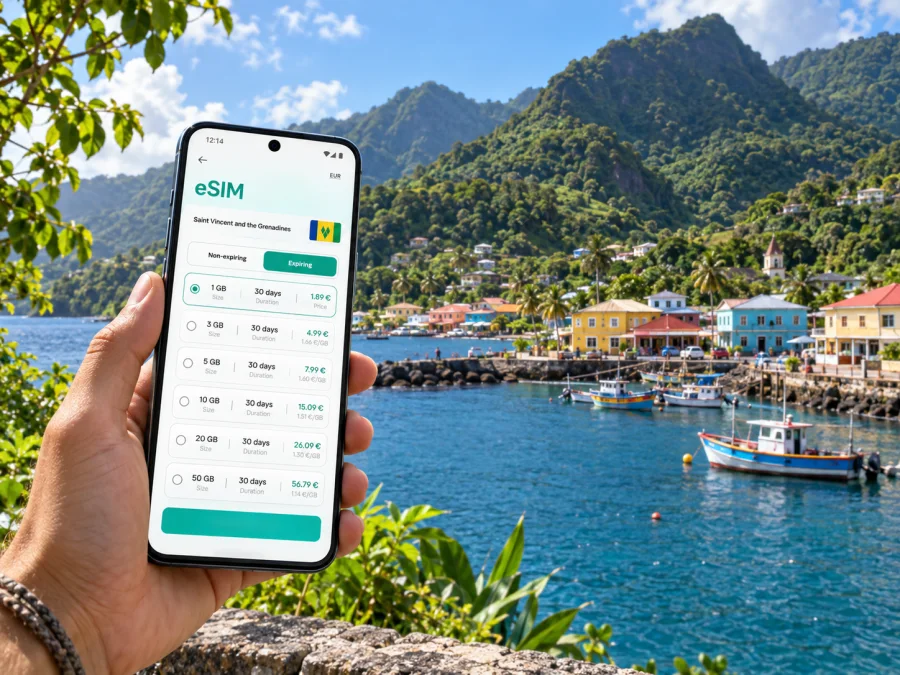
Chateaubelair eSIM: mobile connection and internet for your visit
Chateaubelair sits on the western, or leeward, coast of Saint Vincent, where a compact waterfront meets steep, green volcanic terrain. It is a quieter base than Kingstown and a useful point for exploring the island’s northwest. Getting around here is part of the trip: you may arrive by road, walk around the settlement, arrange a local ride, or use Chateaubelair as a starting point for a longer excursion.
A mobile data connection can make those transitions easier. It helps you check directions, contact your accommodation, message a driver, and keep booking details close at hand. An eSIM lets you prepare a travel data plan digitally, without replacing your physical SIM. For a visit to Chateaubelair, the practical question is not simply how much data to buy; it is how you will travel, how long you will stay, and where you expect to use your phone.
Why mobile internet matters in Chateaubelair
Chateaubelair is a small coastal settlement rather than a large, grid-planned city. Visitors often combine time near the bay with road journeys to other parts of Saint Vincent. Your phone may be useful for the trip from the airport or Kingstown, a message to a host, map directions on unfamiliar roads, or checking a return arrangement before leaving town.
The landscape shapes the experience. The settlement lies south of La Soufrière, the island’s active volcano, and the coast is backed by a rugged interior. Routes can be winding, and a digital map is helpful for orientation, but it should not be your only navigation plan. Download an offline map before setting out, note the name and location of your accommodation, and save important contacts where you can reach them without searching through email.
A travel eSIM is designed for mobile data. It can support map apps, messaging, email, web browsing, and online reservations, depending on the selected plan and local network conditions. It does not automatically provide a regular local phone number, voice calls, or SMS unless the specific plan says otherwise. Keep another way to make essential calls available if you need one.
Plan the arrival before the road journey
Most visitors heading to Chateaubelair first arrive elsewhere on Saint Vincent and continue overland. Argyle International Airport is on the island’s southeast coast, while Kingstown is the main urban and transport center farther south. The trip to the northwest therefore involves crossing a significant part of the island. Confirm your transfer with your accommodation or driver before travel, especially if you land late or have a tight connection.
If you are already in Kingstown, ask locally about the current west-coast minibus service and where to board. Public transport routes and departure patterns can change with the day, demand, and local conditions. Do not rely on an old timetable or assume that a vehicle will be available at a particular hour. If your itinerary depends on reaching Chateaubelair by a set time, arrange the ride in advance and agree on the pickup point and fare before departure.
Before leaving a larger town:
- Save your accommodation’s address and contact details offline.
- Share your expected arrival time with your host or travel companion.
- Take a screenshot of the route and your driver’s instructions.
- Carry a power bank if you will be navigating for much of the day.
- Keep some local cash available for transport and small purchases.
- Ask whether your driver can wait if the journey or stop takes longer than expected.
Moving around town and along the leeward coast
The central waterfront and nearby streets are compact enough to explore on foot at a relaxed pace. Walking gives you time to orient yourself, identify local shops and services, and understand where the road meets the bay. Wear shoes suited to uneven pavement, heat, and occasional rain. If you are carrying luggage, ask your accommodation about the final approach and whether a pickup is more practical than walking.
For journeys beyond the center, ask your host or a local driver about the best option for that specific day. Minibuses serve communities along the main road, but they operate as local transport rather than a guaranteed on-demand service. Confirm direction and destination before boarding, and allow flexibility when making a connection. A hired driver can be more convenient for a return trip or a stop at several places, while a bus may suit a straightforward journey when timing is flexible.
| Trip situation | A practical approach | What to confirm |
|---|---|---|
| Exploring the waterfront | Walk and keep your phone charged for messages or map checks | Your route back to the accommodation |
| Traveling toward Kingstown | Ask about current west-coast minibus departures or arrange a driver | Boarding point, destination, fare, and return plan |
| Visiting a remote viewpoint or trail area | Arrange transport with a local host or guide in advance | Road access, weather, walking conditions, and pickup time |
| Leaving early or after dark | Agree on a direct pickup rather than relying on an uncertain connection | Driver contact, meeting point, and payment method |
Navigation apps can help you follow the general direction of a route, but they may not represent every local road condition or the best place to meet a vehicle. If a turn, trail entrance, or pickup point is unclear, ask someone nearby before continuing. Keep a written or offline note of the place name; a mobile connection may be intermittent in hilly terrain, and a moving map can lose detail when the signal drops.
Choosing an eSIM for a Chateaubelair itinerary
Start with the whole trip, not only the hours spent in town. If Chateaubelair is one stop on a wider visit to Saint Vincent and The Grenadines, select a plan for the country or region that matches the full itinerary. Check the plan’s coverage details and terms for your destination rather than assuming that a city name alone guarantees service. Conditions depend on the local network, terrain, device, and plan.
Estimate your typical daily use. Navigation, chat, and email generally use less data than long video calls, streaming, or uploading large files. If you expect to work remotely, join frequent calls, or back up photos over mobile data, choose a plan with that usage in mind and check how top-ups or validity work before purchase. A smaller allowance may be enough for maps and messages when you use Wi-Fi for heavier tasks; a longer or data-intensive itinerary may call for a different balance.
Before choosing, review these details on the plan page:
- Destination: Confirm that the plan applies to Saint Vincent and The Grenadines and covers the places on your route.
- Data amount: Match the allowance to maps, messaging, browsing, calls through apps, and any work needs.
- Validity: Check when the validity period begins and how long it lasts.
- Network conditions: Read any stated limits and remember that terrain and local conditions affect reception.
- Device support: Confirm that your phone supports eSIM and is not locked to a network. Check your device.
- Existing SIM: Decide which line should handle calls and texts and which one should use mobile data.
Kaspersky eSIM Store is an app and website where travelers can choose, arrange, and activate an eSIM with a suitable data plan for an international trip. You can review eSIM plan options for Saint Vincent and The Grenadines and compare the stated allowance and validity with your own plans before purchasing.
A simple setup sequence
Set up the eSIM while you have stable internet access, preferably before leaving home or while connected to reliable Wi-Fi. Read the plan’s activation instructions carefully: some plans start their validity at installation, while others start at first connection or under another stated condition. Follow the terms for the specific plan you select.
A useful sequence is:
- Check eSIM compatibility and make sure the device is not carrier-locked.
- Choose a plan for Saint Vincent and The Grenadines that fits the length and data needs of the trip.
- Complete the purchase in the app or on the website and follow the installation steps shown.
- Label the new line clearly, for example “Travel data,” so it is easy to identify later.
- Before travel, review which SIM is selected for mobile data and which line handles ordinary calls and texts.
- On arrival, switch on the travel line according to the plan instructions. Enable data roaming for that eSIM only if the instructions require it.
- Open a map or messaging app to check the setup, then monitor data use during the trip.
For step-by-step help, see the Android eSIM installation instructions or the iOS eSIM installation instructions. Menu names can differ by device model and operating-system version, so use the instructions that match your phone. Avoid deleting an installed eSIM profile while troubleshooting unless the plan guidance tells you to do so; reinstalling may not be possible under every plan’s terms.
Navigation beyond the waterfront
Download an offline map over Wi-Fi before a day trip, and save the destination, meeting point, and return arrangement. In hilly terrain, a map may not refresh promptly or show every local road condition, so confirm unclear turns with your host or driver. If you lose data, stop somewhere safe before checking your phone.
Keep your device charged and protected from heat, rain, and sand. A power bank is useful when navigation, messages, and photos keep the screen active. Use mobile data for updates and coordination, with offline information as a fallback.
Day trips and the volcanic interior
Chateaubelair can be a base for exploring the northwest coast and the landscapes around La Soufrière. The volcano is a defining feature of northern Saint Vincent, but access to trails and nearby areas can depend on current safety conditions, weather, official guidance, and whether a qualified guide is required. Do not set off based on an old map pin or an out-of-date travel post. Confirm access locally on the day, and follow official restrictions or closures.
For any excursion, settle the basics before departure: where you will be dropped off, how long the driver will wait, what time you expect to return, and how to contact one another if plans change. If the route passes beyond reliable data coverage, agree on a fallback meeting point. Save emergency and accommodation contacts offline, and carry water and suitable clothing for the planned activity.
A day out can use more phone battery than expected because navigation, photos, and messages keep the screen active. Start with a full charge and take a power bank. Consider saving photos for Wi-Fi rather than uploading every image immediately. This leaves more battery and data for the things that matter on the route.
Work trips and short stopovers
A business traveler may use Chateaubelair as a quiet overnight stop between meetings elsewhere on the island, or as a base for a project in the northwest. Before booking, ask the hotel or guesthouse about its Wi-Fi, desk space, power availability, and transport arrangements. Do not assume that every property offers the same facilities. If calls are essential, test the connection when you arrive and keep a backup option, such as a rescheduled call or a different location with a stronger connection.
For a short stopover, prioritize the practical steps: save your accommodation and driver details, arrange the onward ride, and set aside enough data for maps and messages. Avoid spending your limited time on a complex setup after landing. Installing in advance can reduce the number of tasks you need to complete on arrival, while activation timing should still follow the plan’s terms.
If you need to join video meetings, use Wi-Fi where suitable and check its reliability before the meeting starts. Mobile data can be a backup depending on the plan and local network conditions, but it should not be treated as guaranteed bandwidth. Download documents in advance, store meeting details offline, and let colleagues know if your travel schedule includes a long road transfer.
Frequently asked questions
Is an eSIM useful in Chateaubelair?
It can be useful for mobile data tasks such as navigation, messaging, email, and coordinating transport. Its usefulness depends on the selected plan, local network conditions, terrain, and your device. Review destination coverage and terms before choosing a plan.
Will the eSIM give me a local phone number?
A travel data eSIM does not necessarily include a regular phone number, voice calls, or SMS. Check the individual plan details. Internet-based messaging and calling apps may work over data, subject to the app and connection.
What should I do if data does not work after arrival?
Check that the travel eSIM is enabled and selected for mobile data, then review the plan’s setup instructions and any network settings it specifies. Restarting the phone may help in some cases. If the issue remains, use the support channel stated in your purchase information and connect to Wi-Fi if available.
Chateaubelair is best approached with a simple plan and room to adapt. Prepare your route, confirm local transport, and use mobile data as a practical aid for maps and communication. When you are ready, choose an eSIM data plan for your Saint Vincent and The Grenadines trip through Kaspersky eSIM Store, then install and activate it according to the plan instructions.