Travel connectivity guide
Claro eSIM in Costa Rica: activation guide
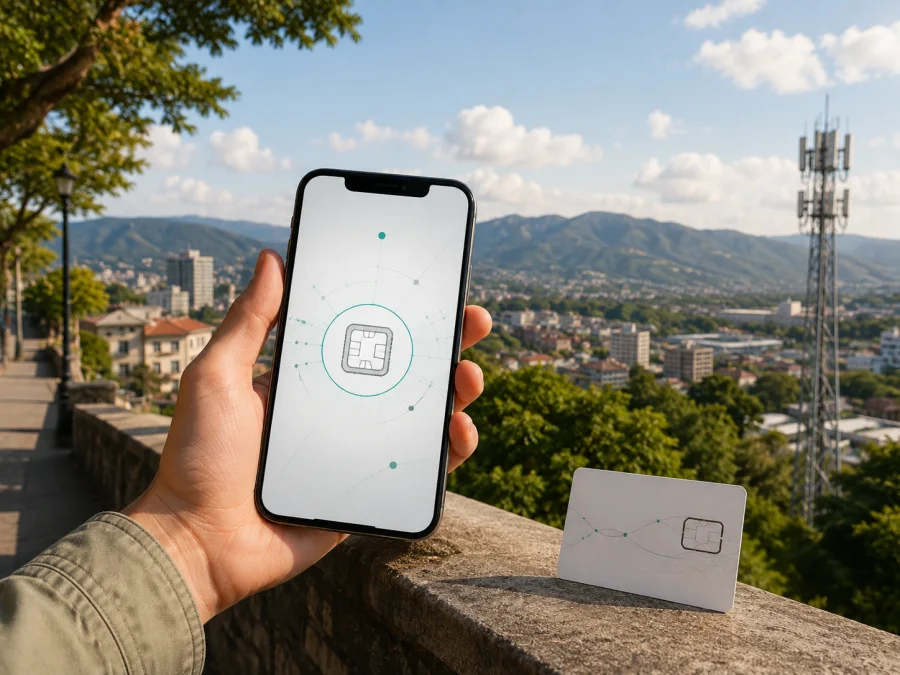
Claro eSIM in Costa Rica: connection, activation, and travel options
If you are travelling to Costa Rica and searching for a Claro eSIM, check more than the phone format. The device, account type, identity requirements, activation route, and coverage at your destinations all matter. Claro Costa Rica currently presents eSIM as an option for prepaid and postpaid mobile service. Its public instructions describe QR-based setup, while its coverage tools show that available technology depends on the place and the device.
This guide explains what current public information supports, what a visitor should confirm before relying on a local Claro eSIM, and how a travel eSIM serves a different purpose. It is a practical market overview, not a catalogue of specific offers. Conditions can change, so use current official support channels for a final decision.
Short answer for a visitor
Claro Costa Rica currently has a public eSIM page headed “Pasate de SIM a eSIM”. It says the option is available for prepaid and postpaid service in Costa Rica. The page explains that an eSIM is an integrated SIM in the device and describes an online flow in which the customer selects eSIM, provides personal details, and receives a confirmation email with a QR code and configuration steps.
That confirms the operator’s eSIM capability, but it does not automatically confirm that every traveller can complete a new local activation remotely. A visitor should check eligibility, required identification, payment, whether a local number is issued, and whether the QR profile can be delivered and activated before or after arrival. The public page is written for Claro’s consumer service in Costa Rica, so a foreign visitor’s route may depend on the current support decision.
Claro also publishes a prepaid service and a prepaid-registration page. The latter says that, under a SUTEL requirement, every prepaid activation or porting process must include prepaid registration. An eSIM-compatible phone is therefore only one part of preparation. Keep the requested personal information or identity document available, and ask Claro what applies to a visitor at activation.
The eSIM information was checked on 6 September 2026 on Claro Costa Rica’s public “eSIM” page. Prepaid and registration details were checked on the operator’s public “Prepago” and “Registro Prepago SUTEL” pages on the same date. I did not find a current official public page confirming a dedicated tourist-only eSIM offer for every visitor, so do not assume a resident-facing page is a tourist package.
Claro in Costa Rica
Claro is a consumer mobile operator with services for people in Costa Rica. Its public site groups mobile services into prepaid and postpaid categories, offers support and stores, and links to a coverage viewer.
A local Claro eSIM follows Claro’s customer and activation process. It may suit someone who wants a local mobile service and can satisfy the operator’s registration requirements. A travel eSIM follows another model: it is prepared for a destination, can be installed without removing the home SIM, and is intended mainly to arrange mobile data for a journey. These products should not be treated as interchangeable promises.
What to check before departure
Confirm eSIM support in the exact phone model and regional variant, and make sure the handset is not carrier-locked. Check whether it supports the technologies and radio bands used at the destination; eSIM support alone does not guarantee network compatibility. Keep the phone online during installation and retain access to the email or profile containing the QR code. Decide which line will carry mobile data, and ask whether Claro requires a local account, identity verification, personal information, or prepaid registration.
For a dual-SIM phone, label each line before travelling. This reduces the chance of selecting the home line for data and creating unexpected roaming usage. Menu names differ between iOS and Android versions, so follow the screen shown on your phone.
How a local Claro eSIM is activated
Claro’s public instructions describe a conventional QR-based activation. The exact order can change with the sales channel, but the process usually follows this pattern.
1. Confirm eligibility and compatibility
Ask Claro which local service is available for your situation, then confirm that the handset is compatible and unlocked. If you are visiting Costa Rica, ask whether the operator can serve a foreign customer and which identity or registration steps apply. Do this before depending on the connection for airport transfer, navigation, or a first hotel check-in.
2. Use the current Claro route
The public page directs customers to Claro’s online store, where an eSIM option can be selected, and says the order is completed with personal details. Verify whether an order is accepted from abroad, whether a local service address is required, and whether activation takes place online, in a store, or after support contact.
3. Receive and scan the QR code
Claro says the confirmation email contains a QR code and configuration guidance. On iOS, open mobile-service settings, choose the option to add an eSIM, and scan the code. On Android, open connections or SIM management, choose to add an eSIM or mobile plan, and scan it. Labels can vary by device language and software version.
4. Select the line and test it
After installation, label the new line and select it for mobile data if that is its purpose. Test a simple webpage or messaging service. If the device or operator requires data roaming for the active eSIM profile, enable it only for that profile and confirm which line remains selected for calls and messages.
5. Complete registration and support steps
If the activation is prepaid, follow the registration process required at the time. If the phone shows the profile but cannot register, check the device lock, selected data line, local coverage, and activation status. A profile installed on the phone is not the same thing as a successfully registered mobile connection.
Documents and traveller restrictions
The clearest current requirements in Claro’s public material are providing personal details during the online order and completing prepaid registration where applicable. The public pages do not give one universal checklist for every foreign visitor. Do not infer that a passport alone, a hotel address, or an overseas payment card will always be sufficient.
Before travelling, ask Claro support or an official store:
- whether a visitor can open the requested local service;
- which identity document and personal information are accepted;
- whether prepaid registration is completed online or in person;
- whether the eSIM can be issued to a foreign-bought handset;
- whether the QR code can be delivered before arrival;
- what to do if the profile is installed but the line is not registered.
Coverage and supported technologies
Claro’s current coverage viewer lets users select separate layers for 2G, 3G, 4G, 4.5G, and 5G, search by place, and view the map by geographic areas. The viewer was updated on 28 August 2026 and warns that its coverage values are approximations based on Claro’s internal indicators. It also notes that terrain, buildings, and other geographic conditions can change the actual level of service.
Claro’s public 5G pages describe the rollout in Costa Rica and refer to access in all seven provinces. An institutional update from July 2026 reports continuing expansion, while the consumer site points users to a 5G map. These are operator-published statements about availability, not an independent ranking of speed or reliability. Use the map for the specific town, coast, mountain route, airport area, or hotel rather than treating a country-level statement as a guarantee.
The technology shown on the map is not the result on every phone. The handset must support the relevant bands and technology, and local conditions can affect registration. A 5G-capable phone may connect through 4G where 5G is not available or where the device does not match the local configuration. For rural roads, national parks, coastlines, or mountains, check each important stop.
Local Claro eSIM or travel eSIM?
The choice depends on the purpose of the connection, not on a claim that one format is always better.
| Question | Local Claro eSIM | Travel eSIM through Kaspersky eSIM Store |
|---|---|---|
| Main relationship | Claro’s local customer and activation process | A travel-oriented selection and activation flow for the destination |
| Preparation | May involve local eligibility, personal details, and prepaid registration | Requires a compatible unlocked device and a selected destination |
| Suitable scenario | A visitor who wants local Claro service and can complete its requirements | A traveller arranging mobile data before or during a journey |
| Coverage check | Use Claro’s current map and local conditions | Check the destination information and conditions shown at selection |
| Voice and SMS | Confirm what the local service supplies | Do not assume a travel eSIM supports a regular phone number |
This is a functional comparison, not a comparison of specific commercial conditions. A local operator eSIM may suit someone who needs local registration and support. A travel eSIM may be more convenient when the immediate goal is mobile data and the traveller wants to prepare installation before dealing with local sales channels. In both cases, check compatibility, activation timing, and current conditions.
Kaspersky eSIM Store as an alternative
Kaspersky eSIM Store is an app and website where a traveller can choose, arrange, and activate an eSIM with a suitable travel option for mobile internet abroad. It is not a mobile operator, does not own Claro’s network, and is not the provider of radio coverage. The Costa Rica destination page states that services are supplied by local telecommunications providers and presents Claro among the providers associated with Costa Rica. That does not turn the store into Claro or make a travel eSIM the same as a local Claro account.
The store’s current public instructions describe a practical flow: check the device, select the destination, complete the purchase, install the digital SIM, and use the profile shown in the app or website. The page also says that a confirmation email can contain a QR code and that the eSIM is intended for data. Regular calls and SMS should not be assumed; internet messaging depends on the user’s accounts and data connection.
The Costa Rica page is the appropriate country destination for this use case: choose an eSIM option for Costa Rica. Review the current conditions shown there at the time of selection. Do not treat the presence of a destination page as a promise that every phone, route, or local network condition will work identically.
Common questions
Is Claro eSIM available in Costa Rica?
Claro Costa Rica currently publishes an eSIM page that says the option is available for prepaid and postpaid service in Costa Rica. The page was checked on 6 September 2026. Availability for a particular traveller, device, account, and channel still needs to be confirmed with Claro.
Can a tourist activate a local Claro eSIM online?
The public page describes an online order and QR-code delivery, but it does not establish one universal remote route for every tourist. Ask Claro about visitor eligibility, identity documents, prepaid registration, and whether activation must be completed in Costa Rica or through an official store.
Does an eSIM work on any unlocked phone?
No. The phone must support eSIM, the exact model and regional variant must be compatible, and the handset must not be carrier-locked. Network technology and local bands also matter.
Is a travel eSIM the same as a local Claro line?
No. A local Claro eSIM follows Claro’s customer and registration process. A travel eSIM is prepared for a destination and is generally used to arrange mobile data for the journey. Check whether it supports data only and how it connects before installing it.
Does Kaspersky eSIM Store operate Claro’s network?
No. Kaspersky eSIM Store is an app and website that helps users choose, arrange, and activate a travel eSIM. It is not a network operator, network owner, or mobile-coverage provider. The underlying service is supplied by telecommunications providers associated with the destination.
Final takeaways
Claro’s current Costa Rica pages support a careful conclusion: the operator offers eSIM for prepaid and postpaid service, supplies QR-based setup guidance, publishes prepaid registration information, and provides a coverage viewer for several mobile technologies. A visitor should not confuse that technical availability with automatic tourist eligibility. Confirm documents, registration, activation channel, local service conditions, and the exact device before departure.
For a local Claro relationship, follow Claro’s current support route and use its map for your destinations. For mobile data with fewer local sales steps, a travel eSIM is a separate option. Kaspersky eSIM Store can help you select and activate it for Costa Rica, but it is not the operator and does not own or guarantee the local network.
Checked on 6 September 2026 against current public pages from Claro Costa Rica and Kaspersky eSIM Store. Eligibility, registration, coverage, device support, and travel-service conditions can change; verify them before activation. Kaspersky eSIM Store and Claro are separate services, and Kaspersky eSIM Store is not affiliated with or an official representative of Claro.
When you are ready to review the current travel option, open the Costa Rica eSIM destination page and confirm the displayed conditions alongside your device and itinerary.