Travel connectivity guide
Clervaux eSIM: Mobile Internet for Your Trip
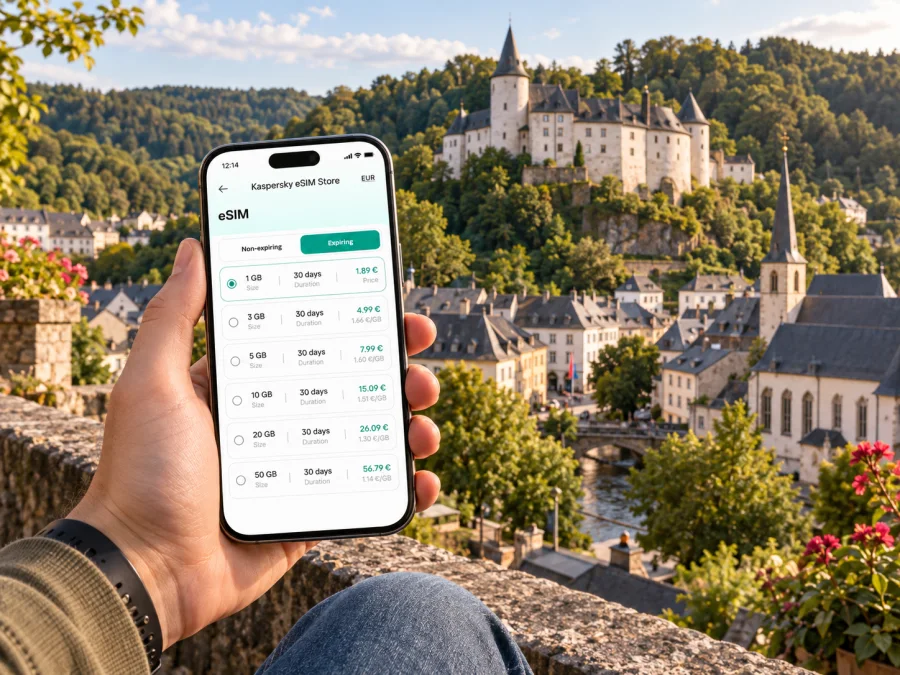
Clervaux eSIM: mobile connection and internet for a trip to Luxembourg
Clervaux is a small town in northern Luxembourg where the castle sits above a close-knit centre and wooded hills. A visit often combines a train or bus journey, a walk between the station and the old town, time at the castle, and perhaps a longer stay in the Éislek region. Mobile internet can make each part easier to organise: check a connection, find your accommodation, follow a walking route, or message your host when plans change.
An eSIM is a digital SIM profile that you install on a compatible device. For a trip to Clervaux, it can provide mobile data without taking out your home SIM. Kaspersky eSIM Store is an app and website where you can choose, arrange, and activate an eSIM with a suitable data plan for travel abroad. The useful preparation is straightforward: decide how you expect to use data, review the plan conditions, and set up the profile before you need directions in town.
What mobile internet is useful for in Clervaux
Clervaux is a small town in northern Luxembourg, with its castle above the centre and wooded hills around the valley. A visit may involve a train or bus connection, a walk uphill, time at a museum, and a longer outing in the Éislek countryside. Mobile internet can help you check a connection, find your accommodation, follow a route or message your host if plans change.
An eSIM is a digital SIM profile installed on a compatible device. For a trip to Clervaux, it can provide mobile data without removing your home SIM. Kaspersky eSIM Store is an app and website where you can choose, arrange and activate an eSIM with a suitable data plan for travel abroad. Review the plan terms and set up the profile before relying on it for directions.
Typical uses include checking your arrival route, locating the castle or abbey, looking up transport updates, finding a trailhead and staying in touch while away from your hotel. It is still sensible to save key addresses and directions offline: reception, battery and service conditions can vary.
Getting oriented: station, centre and hillside sights
Clervaux is arranged in a valley, with the castle on a rocky height above the town. The railway station is below the main centre, and a short distance on a map may include a noticeable climb. Check the route and elevation before walking with luggage. Ask your accommodation which approach is easiest if you arrive late, in poor weather or with limited mobility.
Use a map to confirm the correct station or bus stop, save your lodging, and group nearby sights into one outing. The castle houses exhibitions including The Family of Man photography exhibition, the Museum of the Battle of the Bulge and models of Luxembourg castles. The Benedictine Abbey of Saint-Maurice is another landmark above town. Check current visitor information before planning around a particular opening time.
For walks beyond the centre, save the route and its starting point before leaving. Review distance, surface, elevation and return transport; mobile navigation is useful for checking your position, while offline directions are a sensible backup. Do not assume every trail is suitable for every visitor or that reception will remain constant along the way.
Arrival by rail or bus
Clervaux is connected to Luxembourg’s public transport network. Many itineraries connect through Luxembourg City, but the best route depends on your origin, travel date and current service. Check a journey planner close to departure and again before leaving Luxembourg City. If a connection changes, current information helps you compare alternatives.
Domestic public transport is free in second class, including trains and buses. First-class rail travel and cross-border journeys follow different ticket rules, so confirm the conditions for your route. Free transport does not mean you can skip timetable checks: departure times, platforms, replacement services and connections still matter.
| Travel moment | Check | Backup |
|---|---|---|
| Before leaving Luxembourg City | Connection and any changes | Save details or take a screenshot |
| At an interchange | Platform, destination and departure time | Check station displays or ask staff |
| On arrival | Correct stop and route to your lodging | Keep the address written down |
| Before a day trip | Return connection and final departure | Confirm the plan before starting a walk |
Mobile data is useful for rechecking route information, but use station displays and announcements as well. Leave time between connections, especially if you have luggage or need to find an unfamiliar bus stop.
Moving around town and planning walks
Walking is a straightforward way to explore the centre, though the castle and abbey involve an uphill approach. Compare routes by slope as well as distance; in wet or icy weather, allow more time and wear shoes with good grip. Look for the entrance to a sight rather than relying only on a map pin, and choose a clear meeting point if your group separates.
For a countryside walk, download an offline map or route description, note the start and finish points, and check return transport before setting out. Use mobile navigation as a check rather than the only record of the route. Periodic map checks can also preserve battery and let you pay attention to traffic and uneven paths.
Staying connected at a hotel or on a business trip
Before a work trip, confirm your accommodation’s Wi‑Fi, workspace and late-arrival arrangements. Mobile data can complement hotel Wi‑Fi for directions, messages and brief online tasks, but it is not a guarantee of uninterrupted service. For an important video call, test your setup, charge your device and download documents in advance where possible. Indoor reception can differ by building, so do not base a critical meeting plan on an untested connection.
A travel eSIM is generally for mobile internet. Unless plan details say otherwise, it does not include a regular phone number, conventional calls or SMS. Keep your usual SIM if you need its number, and review your home operator’s roaming settings and charges. Internet calling and messaging apps use data and depend on the app and connection.
Choosing a travel eSIM for Clervaux
Choose a plan around your itinerary and expected use. Maps, messages and transport checks differ from repeated video calls, streaming or photo uploads. Consider how long you will stay, what you can do over Wi‑Fi, and whether your route crosses into another country.
| Likely use | Question to consider |
|---|---|
| Maps and transport | Can you download directions before a walk? |
| Photos and social apps | Will uploads wait for Wi‑Fi? |
| Remote work | How much video calling or file transfer is expected? |
| Multi-country route | Does the plan cover each destination? |
| Short stopover | Does its validity fit your actual stay? |
Before choosing, review the destination, data allowance, validity, price and activation conditions. Check when validity begins; this varies by plan. If your route crosses a border, verify that the other destination is included. For Clervaux, select Luxembourg as the country destination rather than expecting a separate city plan. Compare eSIM options for a trip to Luxembourg and check the plan conditions before deciding.
Avoid relying on a generic daily data estimate. Video calls, streaming and automatic photo backups can use more data than maps and messages. If you want to reserve data for navigation, adjust automatic updates and cloud syncing before departure.
Using Clervaux as a base for trips nearby
Some visitors stay in Clervaux and make a second outing into the Éislek region or onward to another Luxembourg town. Treat each trip as a separate route: check the outbound and return connections, the stop nearest your destination, and how far it is from that stop to the place you want to see. A map pin alone may hide a long walk or a steep approach, so review the final stretch as well as the train or bus leg.
Before leaving Clervaux, save the destination address and journey details while you have a connection. If you plan to walk between villages or continue into the countryside, check whether the route has an appropriate return option and whether the schedule fits your pace. Keep enough time for a missed connection or a slower walk, and avoid assuming that a service runs at the same frequency throughout the day.
Mobile data helps you recheck transport information and contact your accommodation if your return changes. For a longer outing, download directions in advance, keep your phone charged and write down the name of your return stop. This is especially useful when a day combines a rail journey, a local bus and a walk, because each change adds another place where a quick route check can save time.
Set up your eSIM before you need directions
Install an eSIM when you have a stable internet connection and time to follow the instructions. Keep the installation details accessible and do not delete the profile unless its instructions say to. Steps differ by device and plan.
- Check that your device supports eSIM and is not restricted from using another profile. Check whether your device supports eSIM.
- Choose a Luxembourg plan and review its data, duration and activation terms.
- Follow the Android eSIM installation instructions or iOS eSIM installation instructions.
- Label the profile clearly, then review which line handles mobile data, calls and messages.
- Follow the plan’s activation guidance when you are ready to use it.
Menu names vary across devices and operating system versions. If a screen differs from the instructions, pause and consult the guide or support rather than guessing. An eSIM may not be available for reinstallation after deletion.
Three Clervaux trip scenarios
- One-night stop: save your lodging and train details, check the last route to your accommodation, and confirm the next morning’s departure before heading out.
- Castle and town weekend: save the castle, The Family of Man, the abbey and your lodging; check visitor information and group uphill stops to avoid repeating the climb.
- Work stay with a walk: confirm connectivity for meetings, download files and route information in advance, and check the walk’s return transport before setting out.
In each case, mobile data can help with route checks and messages. Offline addresses, saved directions and a charged phone provide a useful fallback.
Common questions
Will an eSIM help me get around Clervaux?
It can provide mobile data for maps, messages and journey planning when your device and plan are correctly set up and a usable connection is available. Save key directions offline as a backup.
Is there a separate Clervaux plan?
Select Luxembourg as the country destination and review the available plan terms. A city name does not imply a separate plan or a particular level of local coverage.
Can I make ordinary calls or send SMS?
Unless plan details explicitly include voice or SMS, do not expect a regular number, conventional calls or text messages from the travel eSIM. Internet calling and messaging apps use data.
Do I need a public transport ticket?
Domestic Luxembourg public transport is free in second class. First-class train travel and cross-border routes have separate rules; check the exact journey.
When should I install the eSIM?
Installing before travel gives you time to follow the instructions on a stable connection. Check whether validity starts at installation, activation or first use, as this depends on the plan.
What if a map stops loading on a walk?
Use a saved map or route, return to a known road or settlement if needed, and do not continue along an unfamiliar path solely because of an earlier live direction.
A simple checklist before you leave
- Save your accommodation address and arrival details.
- Check the connection to Clervaux and keep a copy of the journey.
- Save planned sights and walking routes for offline access.
- Review the eSIM destination, data, validity and activation terms.
- Confirm device compatibility and keep installation steps accessible.
- Decide which SIM handles data, calls and messages.
- Charge your phone and pack a charger for a long day.
Clervaux is best explored with enough time to handle its hills, its heritage sites and the landscape around the town. Preparing mobile data before arrival can make the practical parts—finding your way from the station, checking connections and keeping in touch—less complicated, while offline information gives you a dependable backup. When you are ready to plan the data side of the journey, choose an eSIM plan for Luxembourg and check that its terms fit your stay in Clervaux.