Travel connectivity guide
Coimbra eSIM: Mobile Internet for Your Trip
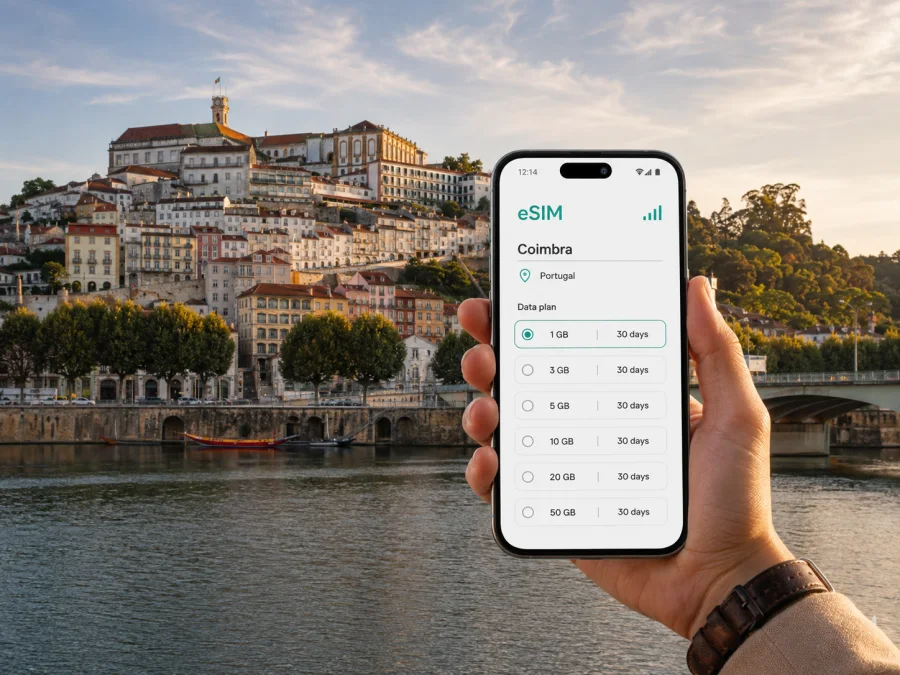
Coimbra eSIM: mobile connection and internet for your trip
Coimbra is a university city in central Portugal on the banks of the Mondego. A visit can move from a railway arrival to the steep university hill, down to the lower centre, across the river to Santa Clara, and then onward to another Portuguese destination. In all of those moments, mobile internet is practical: you may need a map while carrying luggage, a message for a host, a ticket on a screen, or a translation at an unfamiliar turn.
An eSIM is a digital SIM card that can be installed on a compatible phone without removing your regular physical SIM. For Coimbra, it can help you prepare mobile data for Portugal before departure or after arrival. Kaspersky eSIM Store is an app and website where you can choose, arrange, and activate an eSIM with a suitable plan for mobile internet during a trip abroad. Always check the selected plan’s destination, validity, data allowance, and other conditions.
Why an eSIM can be useful in Coimbra
Coimbra is compact, but its districts are not interchangeable. The historic upper town, the lower centre, the Mondego riverfront, Santa Clara, residential areas, and railway connections involve different routes and different levels of walking. Data helps you adapt when a planned route includes a hill, stairs, a bridge, a bus change, or an unfamiliar entrance.
Typical travel tasks include:
- checking a hotel, guesthouse, student residence, or meeting address;
- comparing walking, bus, rail, and taxi options;
- confirming a reservation or sending an arrival message;
- using maps, translation, weather, banking, and messaging apps;
- finding the correct side of the Mondego when moving between central Coimbra and Santa Clara;
- keeping a day trip organised after returning to the city.
Connectivity is part of arrival logistics, not a promise that every app or route works in every situation. Check the conditions of the eSIM plan and local network availability, and keep key reservations available offline as a backup.
Arriving and finding your accommodation
Many travellers reach Coimbra from another Portuguese city by train or road, sometimes after a connection through Lisbon or Porto. The first-hour routine is usually the same: identify the arrival point, confirm the accommodation address, and decide how to cover the final leg.
Arriving by train
Coimbra-B is an important rail arrival point, with public transport connections toward other parts of the city. Before leaving the station area, open your booking, check the full address, and save the route. If your destination is in the historic centre, do not assume that the station name tells you how much walking remains: the upper and lower parts of Coimbra create different arrival routes.
Use this sequence:
- Keep the accommodation address visible in the booking’s original format.
- Confirm whether your next stop is Coimbra-B, the central area, or another named stop.
- Compare the bus, taxi, or walking leg after collecting your luggage.
- Follow the route in short stages instead of memorising every turn.
- Recheck the entrance when you are close, especially on a narrow historic street.
Coimbra’s transport information can change with time of day, events, and service adjustments. Use current departure and route information for a particular journey. An eSIM does not replace a ticket or transport plan; it gives you a practical way to consult the information you need.
Arriving by road
Coach and car arrivals may leave you away from your accommodation. If you are meeting a driver, share a clear landmark and keep your phone available for messages. If you are driving, remember that a route suitable for a car is not automatically a good walking route. Streets around the university and central Coimbra can be steep or restricted, so a final walk may be unavoidable.
After check-in, review which line is being used for mobile data. Keep your home SIM for tasks that require it, and note your reception or host’s contact details. This avoids the common confusion between installing an eSIM and actually selecting it for data.
Getting around Coimbra
Coimbra rewards walking, but not every walk is equally simple. The university area sits above the lower centre, the Mondego separates central Coimbra from Santa Clara, and modern residential or business areas may be more practical by bus or taxi. Plan the day around these contrasts instead of treating the city as one flat zone.
The upper town and university area
The Alta concentrates much of Coimbra’s university identity. The University of Coimbra – Alta and Sofia is a UNESCO World Heritage property, and the surrounding streets combine historic buildings, viewpoints, student life, and demanding climbs. A live map is useful when you are deciding whether to continue uphill, find a less steep street, or return toward the lower centre.
Allow extra time to:
- find the right entrance to a university building or monument;
- pause on a climb rather than rushing with luggage;
- check whether a destination is above or below the city centre;
- choose a less demanding route when travelling with children or limited mobility;
- meet someone at a specific doorway instead of a broad neighbourhood label.
Baixa and the central streets
The lower central area is convenient for everyday errands, cafés, shopping, and routes between the river and the hill. It is also a good place to reset your plan: confirm the next address, check the remaining walking time, and decide whether a bus or taxi is more practical. Save key booking details before leaving the hotel and carry a power bank for a full sightseeing day.
Santa Clara and the riverfront
Crossing the Mondego changes the city’s perspective. Santa Clara, the riverfront, green spaces, and cultural attractions can form a natural second half of a day that began in the old centre. The best order depends on weather, opening arrangements, the bridge you use, and how much uphill walking you want at the end. Use mobile data for orientation and reservations, while checking ticket or venue rules in the relevant booking information.
Solum and stays outside the centre
Accommodation away from the historic core can offer quieter rooms, easier vehicle access, or a more convenient meeting location. The trade-off is a transport leg at the beginning and end of the day. Identify the nearest stop before leaving the hotel and leave a margin for the return journey, particularly after an evening in the centre.
Coimbra’s urban bus network is operated by SMTUC, and rail services connect the city with places in the region. Route and timetable details change, so consult current information instead of relying on an old screenshot.
| Situation | Practical approach | Why data helps |
|---|---|---|
| Luggage and an uphill hotel | Use a door-to-door option for the final leg | Confirm the address and message the host |
| University sightseeing | Combine walking with short transport legs | Recalculate when a climb becomes inconvenient |
| Visit to Santa Clara | Group riverfront stops into one route | Check the bridge, venue, and return direction |
| Accommodation outside the centre | Identify the stop before leaving | Review departures and alternatives |
| Train connection or day trip | Check station and departure details early | Keep tickets and updates accessible |
The goal is not to use one transport mode all day. Coimbra is easier when you switch deliberately between walking, buses, rail, and a taxi when appropriate.
How to choose an eSIM plan for Coimbra
Start with the itinerary rather than a data number. A two-day stopover based on maps and messages has a different profile from a longer stay with remote work, video calls, photo uploads, and regional travel.
Match the destination and route
For a city visit, Portugal is the relevant country destination. If your itinerary includes several countries, read the conditions of a regional plan and confirm that every intended destination is included. Portugal coverage should not be assumed to include another country.
After mapping the route, choose an eSIM plan for your trip to Portugal. Use the landing page to review current destination options, then read the individual plan details before arranging one.
Match the validity to the whole journey
List the days when you need data, including arrival, departure, and overnight connection days. Check when validity starts, whether the package expires, and what the conditions say about remaining traffic, renewal, or top-up options. A plan that suits sightseeing in Coimbra may not suit several workdays or a long onward route.
Match the allowance to your habits
Maps and text messages usually involve less data than video meetings, cloud photo backup, or streaming. The exact amount depends on your settings, so estimates are only planning aids.
| Coimbra travel pattern | Likely data tasks | Planning note |
|---|---|---|
| Short stopover | Maps, messages, reservations, translation | Prioritise arrival and departure windows |
| Cultural weekend | Navigation, tickets, photos, local research | Limit automatic photo backup if needed |
| Study or business visit | Mail, documents, work calls, navigation | Check whether tethering is permitted |
| Coimbra plus regional travel | Repeated route checks and reservations | Confirm the full route is covered |
Hotspot use can consume data faster than ordinary phone navigation, especially when a laptop runs background updates. Turn off automatic updates and unnecessary background refresh, but keep essential travel, messaging, and security tools available.
Keep the roles of your two lines clear
An eSIM plan is primarily a mobile-data option. It does not automatically replace your home number and may not include ordinary calls or SMS unless its stated conditions say otherwise. Depending on your device and operator, you can keep the regular SIM for calls or messages and assign data to the travel eSIM. Review settings carefully so the home line does not create unintended roaming charges.
Install and activate the eSIM
Installation requires a compatible, unlocked device and access to the eSIM profile or QR code. You can set it up at home on a stable connection or after arrival using hotel Wi-Fi or another trusted connection. Do not delete your regular line just because you added a travel profile.
Before installation
- Check whether the phone supports eSIM and is not operator-locked. Check your device compatibility before arranging a plan.
- Make sure you can access the account or profile where the eSIM details will appear.
- Have the QR code or installation information ready on another screen if needed.
- Decide which line should be used for mobile data in Coimbra.
- Save important addresses and reservations offline.
Five practical steps
- Open mobile-network settings. Choose the option for adding a mobile plan or eSIM.
- Scan the QR code or follow the profile instructions. Keep the phone connected to the internet during setup.
- Label the new line. A name such as “Portugal travel” makes it easy to distinguish from your home SIM.
- Select the eSIM for mobile data. Check the selected line before opening maps or messaging.
- Enable data roaming for the eSIM if required. Follow the selected plan’s instructions.
For device-specific guidance, use the Android installation instructions or the iOS installation instructions. Menu names differ between models, operating-system versions, and languages.
If the profile does not connect immediately, wait a few minutes and check the active data line, roaming requirement, signal, balance, and validity. Do not repeatedly remove and reinstall an eSIM unless the instructions or support team advise it. If the issue continues, confirm that the device is unlocked and connected to the internet for setup.
Stopovers and trips from Coimbra
Coimbra can be both the destination and a base for exploring central Portugal. A stopover may include one afternoon in the old town before a train or coach; a longer stay may add a coastal or inland journey. Choose an eSIM plan for the complete itinerary, not only the most photographed part of the route.
Before leaving the city, use this checklist:
- write down every country or region on the route;
- identify travel days when you need maps and messages;
- confirm that the eSIM destination includes those places;
- keep station names and reservations available offline;
- allow time to return to Coimbra-B or another departure point;
- monitor traffic when navigation and photo uploads run together.
The Coimbra–Figueira da Foz urban rail connection is one regional journey linked to the city, and rail and road services connect Coimbra with other Portuguese destinations. Service patterns change, so confirm the current departure, platform, and connection information on the day.
For a short stopover, save the onward ticket before leaving the station area, walk through a manageable part of the centre, and keep a buffer for the return journey. For a multi-day stay, put fixed plans such as a university visit or business meeting first, then group the riverside, Santa Clara, and central streets around them. Check your balance before a day trip.
Final checks before a Coimbra day out
- Confirm eSIM support and the absence of an operator lock.
- Check the plan destination, allowance, validity, activation, and top-up conditions.
- Save accommodation, transport, ticket, and meeting details offline.
- Select the travel eSIM for mobile data and enable roaming only when required.
- Use current transport information, monitor hotspot use, and carry a charged phone.
- If activation fails, check the device, profile, data line, balance, and conditions before contacting support.
Frequently asked questions
Is an eSIM useful for a short visit to Coimbra?
Yes, if you need maps, messages, reservations, or transport information during a stopover. Choose a plan whose destination and validity match the visit, and keep key details offline as a backup.
Does a travel eSIM replace my regular number?
No, not automatically. It is mainly a mobile-data option. Your regular SIM can often remain available for calls or SMS, depending on the device and operator, but review data and roaming settings carefully.
Can I use an eSIM on any phone in Coimbra?
No. The phone must support eSIM and must not be operator-locked. Models can vary by region, so check compatibility and device settings before arranging a plan.
Do I need Wi-Fi to install an eSIM?
You need an internet connection to download or add the profile unless the device and installation method provide another supported route. Installing before departure can make the first arrival easier.
Will an eSIM include calls and SMS?
Not unless the selected plan says so. For travel-data use, calls and messages are usually handled through internet-based applications, while the regular line remains separate.
What should I do if the eSIM does not connect?
Check compatibility, operator-lock status, the active data line, roaming requirements, signal, balance, and validity. Wait a few minutes after one change. If the issue remains, contact support rather than deleting the profile immediately.
Can I use the same plan outside Coimbra?
Only if the selected destination or region includes the places on your route. Coimbra is in Portugal, but Portugal coverage should not be assumed to cover another country. Review the conditions before a border crossing.
Prepare your Coimbra connection
Coimbra is easier to enjoy when you can adapt: walk the university hill while the weather is good, change the order of riverfront stops, find a practical route to your accommodation, or check a train connection before leaving the centre. A travel eSIM can support those decisions without requiring a search for a physical SIM card when you arrive.
Choose Portugal as the destination, compare allowance and validity with the full itinerary, check compatibility, and install the profile while you have a reliable connection. Then select the travel eSIM for mobile data when you are ready to use it. To prepare for your visit, review the available Portugal eSIM plans and choose the option that fits your Coimbra stay.
Before leaving, confirm that the phone is compatible and unlocked, the profile is available, the travel line is selected for data, the home line is configured intentionally, and the accommodation and departure details are saved. With those basics in place, you can focus on Coimbra’s streets, river, university, and nearby journeys while keeping travel information within reach.


