
Travel connectivity guide
Cologne eSIM Guide: Mobile Internet in Germany
Cologne eSIM: mobile connection and internet for your trip
Cologne is an easy city to enjoy when your phone is ready before you arrive. The airport train, hotel check-in details, Rhine-side walking routes, trade fair schedules, restaurant reservations, and day trips across North Rhine-Westphalia all depend on reliable mobile internet at the right moment. An eSIM can make that first hour simpler because you do not need to look for a physical SIM card shop after landing or arriving by train.
For many visitors, Cologne is both a destination and a base. You may come for the cathedral, Christmas markets, museums, business meetings, Gamescom, a medical visit, or a short stop between Amsterdam, Brussels, Frankfurt, and Dusseldorf. In each scenario, mobile connection planning is less about speed tests and more about practical control: maps load, tickets open, messages arrive, and your travel day stays manageable.
Quick planning summary for Cologne
Use this checklist before you leave for Germany:
- Check whether your smartphone supports eSIM and is not locked to one mobile operator.
- Choose a data volume that matches your trip style: light navigation, daily work, streaming, or hotspot use.
- Install the eSIM while you still have a stable home or hotel Wi-Fi connection.
- Keep your primary SIM active if you need your usual number for bank confirmations or calls.
- Save your hotel address, train ticket, and airport route offline as a backup.
- Turn on data roaming for the eSIM if the selected plan instructions require it.
An eSIM is mainly useful for mobile data. It usually does not include a local phone number, standard voice calls, or SMS unless the selected plan states otherwise. For calls, many travelers use internet-based apps, hotel messaging, airline apps, and business chat tools.
Why Cologne trips depend on mobile internet
Cologne is walkable in the center, but its travel pattern is often mixed. You may land at Cologne Bonn Airport, take the S-Bahn or regional train to Koln Hauptbahnhof, walk across the cathedral square, move on to a hotel in Altstadt-Nord, attend an event in Deutz, then cross the Rhine for dinner. Even a simple itinerary can involve several apps and small decisions.
Mobile internet is especially useful in Cologne for:
- live train platforms between the airport, central station, Messe/Deutz, and nearby cities;
- maps around the cathedral, Old Town lanes, the Rhine promenade, and shopping streets;
- tram and bus route changes when streets are busy during events;
- hotel check-in messages and digital room access;
- restaurant bookings in the Belgian Quarter, Ehrenfeld, Nippes, or the Old Town;
- business travel between Koelnmesse, MediaPark, and office districts;
- translation, payments, ride hailing, and messaging when Wi-Fi is unavailable.
Public Wi-Fi can help in hotels, cafes, and conference venues, but it is not a complete trip plan. You still need data while walking from the station, waiting on a platform, checking a late train, or finding the right entrance at a large venue.
Arrival scenarios: airport, train station, and first route
Cologne Bonn Airport is close to the city by rail, so many visitors go online immediately to confirm the next train and destination stop. If your eSIM is already installed, you can switch to the data line after landing and avoid using airport Wi-Fi for every small task. This is useful when you need to send an arrival message, open a hotel confirmation, or check whether a faster connection goes to Koln Hauptbahnhof or Koln Messe/Deutz.
If you arrive by train, mobile data matters even more. Cologne Central Station is next to the cathedral, and the area is busy throughout the day. A connected phone helps you leave by the correct exit, choose whether to walk or take public transport, and avoid dragging luggage through crowded streets when your hotel is better reached by tram.
For a short stopover, prepare a compact route:
1. Save the station or airport exit you will use.
2. Keep your next train or flight ticket available offline.
3. Use mobile data for live platform updates and walking directions.
4. Choose one realistic city focus: the cathedral, the Rhine promenade, or a quick meal nearby.
5. Leave extra time to return, especially during trade fairs, football matches, or Christmas market season.
How much data you may need in Cologne
Data use depends on behavior, not only trip length. A traveler who mainly uses maps and messaging can use far less than someone who uploads videos, joins video calls, or shares a hotspot with a laptop.
| Trip style in Cologne | Typical mobile internet use | Practical plan logic |
|---|---|---|
| One-day stopover | Maps, tickets, messages, transport checks | Small data package with short validity |
| Weekend city break | Navigation, restaurant search, photos, messaging | Moderate data package for 2-4 days |
| Trade fair or business trip | Email, documents, calendar, video calls, hotspot | Larger package and enough validity for delays |
| Family trip | Several phones, maps, entertainment, shared plans | Separate eSIMs or a larger allowance for each main device |
| Germany route from Cologne | Trains to Bonn, Dusseldorf, Aachen, Frankfurt | Germany or regional plan matching the full route |
Do not choose only by the lowest price. Look at the data volume, validity period, destination, activation rules, and whether your phone can use eSIM. A slightly larger package can be practical if you expect long train journeys, business calls, or daily map use.
Districts and movement: where connection helps most
Cologne feels straightforward once you know the river and the cathedral, but the city spreads into distinct neighborhoods. Mobile data helps you move between them without constantly stopping to decode transport maps.
Altstadt-Nord and the cathedral area are the most obvious starting points. You will use navigation for museum entrances, restaurant streets, hotel lobbies, and routes away from the station crowd. Altstadt-Sued adds nightlife, shops, and Rhine-side walks, so live maps are useful in the evening.
Deutz is important for business travelers because Koelnmesse and the Messe/Deutz station sit on the east side of the Rhine. If your event day includes appointments on both sides of the river, mobile data helps you decide between walking across Hohenzollern Bridge, taking a train, or using local transit.
The Belgian Quarter, Ehrenfeld, Nippes, and Sudstadt are popular for cafes, bars, boutiques, and local restaurants. They are good areas to explore with a connected phone because you may change plans quickly: one place is full, another is a few tram stops away, and your group chat decides the next meeting point.
Preparing eSIM before your Cologne trip
The best time to prepare mobile internet is before the stressful part of travel begins. Install the eSIM while you have stable Wi-Fi, enough battery, and time to read the instructions. If you wait until you are tired at the airport or standing outside the hotel, every small delay feels larger.
Before choosing a plan, check your device. Your phone or tablet needs eSIM support, and some devices bought through a mobile operator may be locked. Also check whether you can keep your regular SIM active for calls and bank messages while using the eSIM for mobile data.
When you are ready to install, follow the relevant setup guide: Android installation guide or iOS installation guide. The exact screens can vary by device model and operating system version, so follow the instructions shown for your phone and the selected plan.
Choosing a plan for Cologne and Germany
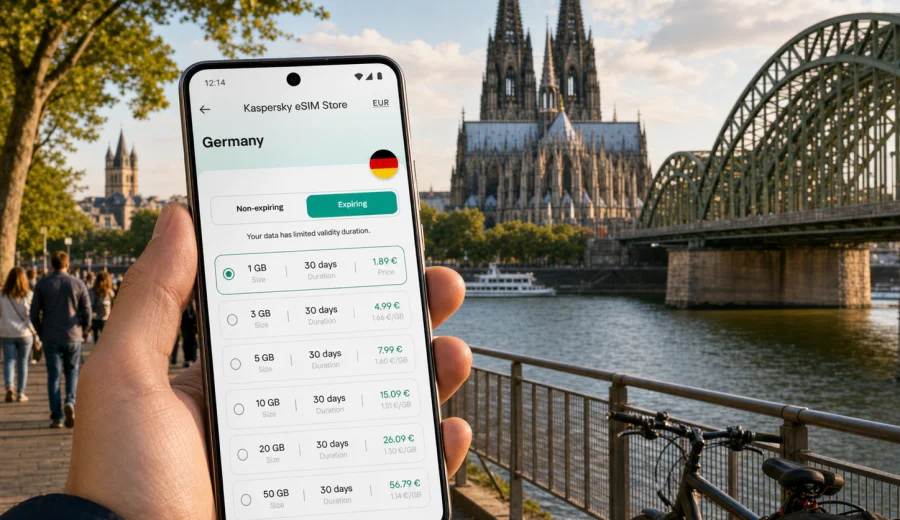
For a city article, the correct destination is Germany, because Cologne uses the country-level mobile internet plan context. In Kaspersky eSIM Store, you can review available options for the destination, compare data volume and validity, then prepare the eSIM before your trip. If Cologne is your first stop or your only stop, choose a suitable eSIM plan for Germany after you estimate how much data you will use in the city.
Think through the first 24 hours. You may need data for the airport train, maps to the hotel, a messaging app, restaurant search, and ticket checks. Then think through the heaviest day. A trade fair day with laptop hotspot use is very different from a museum day with occasional navigation.
Useful decision questions:
- Will you stay only in Cologne, or also visit Bonn, Dusseldorf, Aachen, or Frankfurt?
- Do you need mobile data for work calls or only for travel tasks?
- Will you upload many photos and videos on mobile data?
- Do you plan to use your phone as a hotspot for a laptop?
- Is your trip flexible enough that you may need extra validity?
If you are unsure, choose a plan with enough validity for your full stay rather than a plan that expires before your return journey. A late train, an extra meeting, or a changed flight can turn the final day into the moment when mobile internet matters most.
Hotel, apartment, and business travel use cases
Hotel Wi-Fi is helpful, but the first connection still often happens outside the building. You may need mobile data to find a side entrance, message reception, open a booking platform, or show a confirmation when the lobby is crowded. In apartment stays, the host may send access codes shortly before arrival, so a working mobile connection can prevent waiting outside with luggage.
Business travelers should plan for redundancy. Cologne has many event and conference trips where schedules change during the day. Keep your calendar, venue map, ticket QR code, and transport app ready. If you expect long video calls, use venue or hotel Wi-Fi when possible and keep eSIM data for mobility, messages, and backup tasks. If you need hotspot use, select a data allowance that reflects laptop consumption, not only phone browsing.
For Koelnmesse, decide in advance whether your hotel is better connected to Messe/Deutz, the central station, or another tram line. During major events, walking a short distance to a less crowded station can be easier than following the nearest crowd. Mobile maps and live departures help you make that call without guessing.
A practical first-day setup
Use this sequence for a low-friction arrival:
1. Install the eSIM before travel, but activate it according to the plan instructions.
2. Save the QR code or installation details in a secure place until setup is complete.
3. Label the line clearly, for example "Travel data" or "Germany eSIM".
4. Keep your regular SIM as the default line for calls if you need your home number.
5. Set mobile data to the eSIM line when you land or arrive.
6. Check that roaming data is enabled for the eSIM if required.
7. Open maps, transport, hotel, and messaging apps before leaving the airport or station.
Do not remove the eSIM profile after activation unless you are sure you no longer need it. In many cases, an activated eSIM profile cannot simply be moved to another phone. If you change devices before the trip, check the plan conditions before installing.
Cologne routes where data is useful
The most common Cologne routes are simple, but they rely on timing. From Cologne Bonn Airport, trains usually take visitors toward the central station or Messe/Deutz. From the central station, the cathedral, Old Town, and Rhine are walkable. From Deutz, you can cross the river on foot or take a short rail connection.
For sightseeing, mobile data is useful on these routes:
- Cathedral to Hohenzollern Bridge and the Rhine promenade;
- Old Town to the Chocolate Museum and Rheinauhafen;
- Central station to the Belgian Quarter for dinner;
- Deutz to Koelnmesse halls and riverside viewpoints;
- Cologne to Bonn for museums and the former government district;
- Cologne to Dusseldorf for shopping, business, or an airport connection;
- Cologne to Aachen for a day trip by train.
For each route, save one offline backup and use mobile data for live changes. This combination avoids panic if a station is crowded, a tram is delayed, or your battery is low.
Public Wi-Fi, roaming, and eSIM: what to compare
There are three common ways to stay connected in Cologne. Each can work, but they solve different problems.
| Option | Strength | Limitation |
|---|---|---|
| Public Wi-Fi | Useful in hotels, cafes, airports, and venues | Not available everywhere and may require repeated logins |
| Home SIM roaming | Keeps your usual number and familiar account | Conditions and costs depend on your mobile operator |
| Travel eSIM | Lets you prepare mobile data for Germany without a physical SIM card | Requires compatible device and correct setup |
Many travelers use a combination: home SIM for their usual number, eSIM for mobile data, and trusted Wi-Fi for large downloads. This keeps travel tasks flexible without relying on a single connection method.
Common mistakes to avoid
Avoid these problems before your Cologne trip:
- Buying a plan before checking whether your device supports eSIM.
- Installing the eSIM on the wrong phone in a family group.
- Waiting until arrival to read setup instructions.
- Forgetting that eSIM data usually does not include standard voice calls or SMS.
- Choosing a validity period that ends before the return journey.
- Using mobile data for large updates, backups, or streaming when hotel Wi-Fi is available.
- Deleting the eSIM profile while the trip is still active.
The most reliable preparation is simple: check compatibility, choose the destination and data volume, install with stable Wi-Fi, and test the settings before you need them under pressure.
FAQ: eSIM for Cologne
Is Cologne enough as a destination when choosing a plan?
Plans are normally selected by country or region, not by individual city. For Cologne, choose Germany as the destination unless your route requires a broader regional option.
Can I install eSIM after I land at Cologne Bonn Airport?
You may be able to, but it is usually easier to install before travel on stable Wi-Fi. Arrival is better used for switching the data line on, checking maps, and confirming your first route.
Do I still need my regular SIM card?
Often, yes. Keep your regular SIM if you need your usual number for calls, SMS, bank confirmations, or account access. Use the eSIM line for mobile data if that matches your setup.
Will eSIM replace hotel Wi-Fi?
Not completely. eSIM is useful when you are moving around the city. Hotel Wi-Fi is still practical for laptop work, large downloads, cloud backups, and video streaming.
Is eSIM useful for a Cologne stopover?
Yes, especially if you need live train information, walking directions, and messaging during a short visit. A small data package can be enough if your stopover is focused and you avoid heavy media use.
What should I do if mobile data does not start immediately?
Check that the eSIM is selected for mobile data, data roaming is enabled if required, airplane mode is off, and the eSIM profile is active. If the selected plan includes specific setup instructions, follow those first.
Final preparation before you go
Cologne rewards travelers who can move easily: from the airport train to the cathedral, from the Rhine to Deutz, from a trade fair hall to dinner in Ehrenfeld, or from a hotel lobby to a day trip in Bonn. Mobile internet is not the trip itself, but it supports the decisions that make the trip smoother.
Before departure, confirm your phone compatibility, choose a data volume that fits your real itinerary, and install the eSIM while you have time to focus. For a Cologne trip, you can prepare an eSIM plan for Germany through Kaspersky eSIM Store, then arrive with mobile data ready for maps, transport, messages, and everyday travel tasks.