
Travel connectivity guide
Dhaka eSIM: Mobile Internet for City Travel
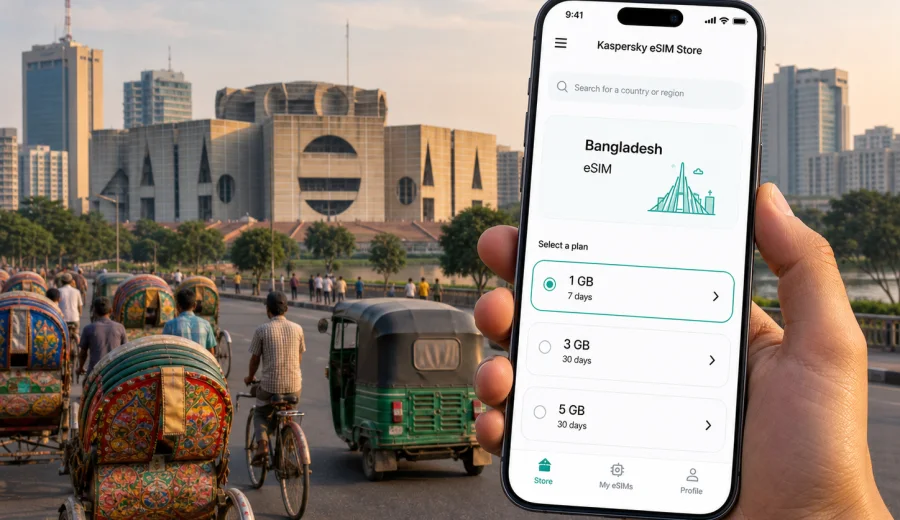
Dhaka eSIM: mobile connection and internet for a city trip
Dhaka rewards travelers who can check routes, message quickly, and adapt when plans change. The capital of Bangladesh is dense and practical: airport arrivals, hotel transfers, ride-hailing pickups, business districts, markets, river crossings, and day trips can all depend on having mobile internet ready.
An eSIM is useful in Dhaka because many decisions happen on the move. You may need to confirm a driver at Hazrat Shahjalal International Airport, share a live location in Gulshan, find a hotel entrance in Banani, check traffic toward Motijheel, or translate a menu near Dhanmondi Lake. With a compatible phone, an eSIM lets you prepare mobile data without handling a physical SIM card.
This guide focuses on Dhaka itself: arrival, local movement, navigation, hotels, business trips, stopovers, and routes from the city. Bangladesh matters because the eSIM tariff must cover the country, but the focus stays on using mobile internet in the city.
Why mobile internet matters in Dhaka
Dhaka is not a city where you should rely only on memory, printed addresses, or hotel Wi-Fi. Addresses may be written in different formats, traffic can change the best route, and meetings may move from one district to another during the day. A working data connection helps you keep the day under control.
Common mobile internet moments in Dhaka:
- checking pickup points at the airport;
- using maps for Gulshan, Banani, Baridhara, Dhanmondi, Uttara, Motijheel, Old Dhaka, and the university area;
- messaging drivers, hotel staff, hosts, colleagues, or family;
- confirming restaurant, office, or event locations;
- using translation for short practical phrases;
- checking ferry, bus, train, or domestic flight information;
- checking traffic before choosing a route;
- keeping work chats and email available during a business trip.
For many visitors, the value is not entertainment. It is predictable access to maps, messages, booking details, and travel documents when the city is busy.
Arrival at Hazrat Shahjalal International Airport
Most international visitors arrive through Hazrat Shahjalal International Airport in northern Dhaka. The first hour is often when mobile internet matters most: you may need a hotel address, a pickup driver, a meeting update, or a quick message after arrivals.
Before landing, save your hotel name, district, reservation number, and one local contact offline. After landing, mobile data helps with the live parts of the journey: messages, navigation, route checks, and ride coordination.
Useful arrival checklist:
- install the eSIM before departure if your device allows it;
- keep the QR code or installation details available;
- check whether your phone supports eSIM and is not locked to one mobile operator;
- switch mobile data to the eSIM when you are ready to use the selected tariff;
- keep your primary SIM active for calls or banking messages if you need it;
- avoid starting large app updates on arrival unless you have enough data.
The airport-to-city ride depends on traffic and final destination. Uttara is relatively close to the airport. Gulshan, Banani, and Baridhara are common business and hotel areas. Dhanmondi, Motijheel, and Old Dhaka can take longer. Mobile internet helps you compare routes and share your updated arrival time.
District-by-district mobile data scenarios
Dhaka is easier to handle when you think in districts rather than in one general city map. Each area creates different data needs.
| Dhaka area | Typical reason to visit | Mobile internet use |
|---|---|---|
| Gulshan | Business meetings, embassies, hotels, restaurants | Driver coordination, live maps, calendar updates |
| Banani | Offices, cafes, hotels, evening plans | Ride-hailing pickup points, messaging, navigation |
| Baridhara | Diplomatic area, offices, quieter stays | Secure route planning, contact with hosts |
| Uttara | Airport access, residential stays, transit | Airport timing, hotel transfers, food delivery |
| Dhanmondi | Lake area, cafes, universities, medical visits | Walking routes, local search, translation |
| Motijheel | Commercial and administrative trips | Meeting updates, document access, route checks |
| Old Dhaka | Heritage streets, food, markets, river access | Walking navigation, photo backup, group messaging |
| Hatirjheel | City drives, evening views, crossings | Route comparison and meeting points |
If you are in Dhaka for work, Gulshan, Banani, Baridhara, and Motijheel may be central to your schedule. If you are visiting friends, family, universities, or cultural places, Dhanmondi, Uttara, and Old Dhaka may matter more. In both cases, choose a mobile data tariff that fits your actual time in the city.
How to choose an eSIM tariff for Dhaka
Start with the length and rhythm of your trip. A short stopover needs a different amount of data than a week of meetings, shared documents, and frequent route changes.
For one or two days, you may mainly need maps, messages, email, ride coordination, and hotel communication. For three to seven days, add restaurant searches, cloud documents, social updates, translation, and backup navigation. For longer stays, choose enough data and validity for the whole city plan.
Practical selection criteria:
- data volume: enough for maps, messaging, email, browsing, and internet calls;
- validity period: long enough for your full stay in Dhaka and any extra days in Bangladesh;
- coverage area: Bangladesh, not only a region that excludes your destination;
- activation rules: when the validity period starts and what steps are required;
- device compatibility: eSIM support and no operator lock;
- hotspot needs: whether you plan to share data with a laptop or another device, if allowed by the tariff terms.
Video streaming, cloud backups, app updates, and high-resolution uploads can use data quickly. If your trip is work-focused, preserve data for maps, internet calls, email, and document access.
What to prepare before you travel
The smoothest Dhaka eSIM setup starts before departure. You still need an internet connection to install or activate an eSIM, so handle the setup over reliable Wi-Fi before leaving if the instructions allow it.
Preparation steps:
1. Check whether your phone supports eSIM and is not locked to a single mobile operator.
2. Choose Bangladesh as the destination for your eSIM tariff.
3. Compare data volume and validity period against your Dhaka itinerary.
4. Install the eSIM profile before departure if the instructions allow it.
5. Keep your main SIM for calls and SMS if you still need your usual number.
6. Download offline maps for central Dhaka as a backup.
7. Save hotel and meeting addresses in a notes app.
8. Disable automatic photo backup and app updates on mobile data.
Before choosing a tariff, check your device. Compatibility matters because an eSIM can be installed only on supported devices, and some phones bought through mobile operators may be locked.
When to choose your Dhaka data plan
By the time your itinerary is clear, it is easier to select a tariff that matches your stay. If Dhaka is your main destination, choose Bangladesh as the destination and compare the data volume and validity period against your real schedule. You can prepare an eSIM tariff for your trip to Dhaka before you leave or while you still have reliable Wi-Fi.
This is useful when your arrival is late, when you have an early meeting, or when your first destination after the airport is an office, event venue, or family address.
Installing and activating eSIM for Dhaka
Kaspersky eSIM Store is an app and website where you can choose, arrange, and activate an eSIM with a suitable tariff for mobile internet in an international trip. After purchase, follow the installation details in your profile, in the app, or in the email you receive.
If you need device-specific guidance, use the Android installation instructions or the iOS installation instructions. Install the eSIM while you still have stable internet access, and activate mobile data when you are ready to use the selected tariff.
Basic flow:
1. Open the installation details for the purchased eSIM.
2. Add the eSIM profile through your phone settings or QR code.
3. Label it clearly, for example Travel data or Bangladesh.
4. Keep your primary number for calls and messages if needed.
5. Set mobile data to the eSIM when you arrive or when the tariff should start.
6. Turn on data roaming for the eSIM if the instructions for the tariff require it.
7. Test maps and messaging before leaving the airport or hotel.
An eSIM for travel is primarily for mobile data. It usually does not include a regular phone number, voice calls, or SMS unless the selected tariff states otherwise. For calls, many travelers use internet-based messaging apps over mobile data.
Using eSIM during a business trip to Dhaka
Business travelers often need a stable routine more than sightseeing detail. Meetings may happen across Gulshan, Banani, Baridhara, Motijheel, Tejgaon, and hotel conference spaces. Traffic makes timing important, and mobile data helps you adjust without searching for Wi-Fi.
A practical business setup:
- keep your calendar, hotel address, and meeting addresses available offline;
- use mobile data for live route checks before leaving each location;
- keep email and work chat notifications on, but limit heavy file sync;
- use hotel or office Wi-Fi for large downloads when available;
- carry a power bank for long days across several districts;
- keep the eSIM label clear so you do not confuse it with your primary SIM.
If you are attending a conference or visiting several offices, choose data for maps, messaging, document previews, and internet calls. Use hotel or office Wi-Fi for large files where practical, and keep mobile data for movement around the city.
Stopovers and short visits
A Dhaka stopover can still require mobile data. You may leave the airport for a hotel near Uttara, meet someone for a few hours, or continue to another destination in Bangladesh the next day. The tariff should be simple: enough data for maps, messaging, transport coordination, and travel documents.
For a short visit, prioritize:
- quick installation before departure;
- clear validity period;
- enough data for maps and messaging;
- a backup of hotel and flight information;
- low background data use on your phone.
Do not build a stopover plan around public Wi-Fi alone. The practical difficulty often appears between fixed Wi-Fi points: pickup zones, roadside waiting, hotel entrances, and traffic delays.
Trips from Dhaka to other places in Bangladesh
Many travelers use Dhaka as a base for other destinations in Bangladesh, such as Chattogram, Sylhet, Cox's Bazar, Rajshahi, Khulna, or countryside routes. If your eSIM tariff covers Bangladesh and its validity period fits the full trip, one travel data setup can cover more than the capital.
Departure points can be spread out. Keep enough data for:
- route checks before leaving the hotel;
- messaging with drivers or hosts;
- ticket and booking confirmations;
- weather and travel updates;
- translation and local search during stops.
For remote areas, be realistic: local network quality can vary by place, building, congestion, and operator conditions. Keep offline copies of essential documents and maps.
Data-saving settings for Dhaka
Dhaka is a city where you may use maps repeatedly. Small settings can stretch your data allowance without making the phone inconvenient.
Recommended settings:
- download offline maps for Dhaka before travel;
- disable automatic app updates on mobile data;
- pause automatic cloud photo and video backup;
- reduce video quality in social apps;
- use text and voice messages when data is limited;
- close navigation after the ride ends;
- check which apps are allowed to use background data;
- connect to trusted Wi-Fi for large files.
If you travel for work, review laptop tethering carefully. A laptop can use much more data than a phone because it syncs documents, email attachments, system updates, and cloud storage. Use hotspot mode only when the selected tariff allows it.
Comparing connection choices in Dhaka
Different connection options solve different problems. The best choice depends on your trip length, device, budget, and need for control.
| Option | Good for | Watch out for |
|---|---|---|
| Travel eSIM | Preparing mobile data before or during the trip | Requires compatible, unlocked device |
| Standard roaming | Keeping your home operator setup simple | Costs and terms depend on your home operator |
| Local physical SIM | Longer stays or local calling needs | Requires time, a shop, and a physical SIM slot |
| Public Wi-Fi | Large downloads at hotel or office | Not available during movement around the city |
An eSIM is not a complete replacement for every connection option. It is most useful when you want mobile data for travel tasks without changing a physical SIM card. If you need a local phone number, check the terms of the selected tariff.
Practical Dhaka scenarios
Airport to Gulshan hotel. You land, turn on mobile data for the eSIM, message the hotel, confirm the pickup point, and follow the route as traffic changes.
Two-day business trip. You move between a hotel in Banani, meetings in Gulshan, and a commercial appointment in Motijheel. Keep maps and work chat available, but use hotel Wi-Fi for large files.
Old Dhaka afternoon. Walking routes can be dense and winding. Mobile data helps with navigation, photo sharing, group coordination, and return transport.
Dhaka plus another city. If you leave for Sylhet, Chattogram, or Cox's Bazar, choose a Bangladesh tariff with enough days for the full route, not only for your first night in Dhaka.
Quick answers about eSIM in Dhaka
Is an eSIM useful for Dhaka?
Yes, if your phone supports eSIM and you need mobile data for maps, messaging, transport, hotel coordination, and work tools while moving around the city.
Should I install it before arriving in Bangladesh?
If the instructions allow installation before travel, it is usually more convenient to install it over reliable Wi-Fi before departure. Activate data according to the tariff rules.
Does an eSIM give me a Bangladeshi phone number?
Usually no. Travel eSIM tariffs are mainly for mobile internet. Voice calls and SMS are included only if the selected tariff says so.
Can I use it for ride-hailing and maps?
Yes, mobile data is well suited for maps, messaging, route checks, and app-based transport coordination, subject to local network conditions.
Is hotel Wi-Fi enough for Dhaka?
Hotel Wi-Fi helps inside the building, but it does not cover airport pickup zones, traffic delays, walking routes, or movement between districts.
What should I check before buying?
Check device compatibility, operator lock status, destination coverage, data volume, validity period, activation rules, and whether hotspot use is allowed if you need it.
Final preparation before you go
Before leaving for Dhaka, make your phone ready for the city rather than for an abstract trip. Save the airport, hotel, first meeting point, and one backup contact. Download offline maps. Decide how much data you need for transport, messaging, email, and navigation.
Kaspersky eSIM Store helps you choose, arrange, and activate an eSIM with a suitable tariff for mobile internet in an international trip. If Dhaka is on your itinerary, choose an eSIM tariff for Bangladesh before departure or while you still have reliable Wi-Fi, then follow the installation steps for your device and keep your travel data ready for arrival.