
Travel connectivity guide
Dusseldorf eSIM: Mobile Internet for Your Trip
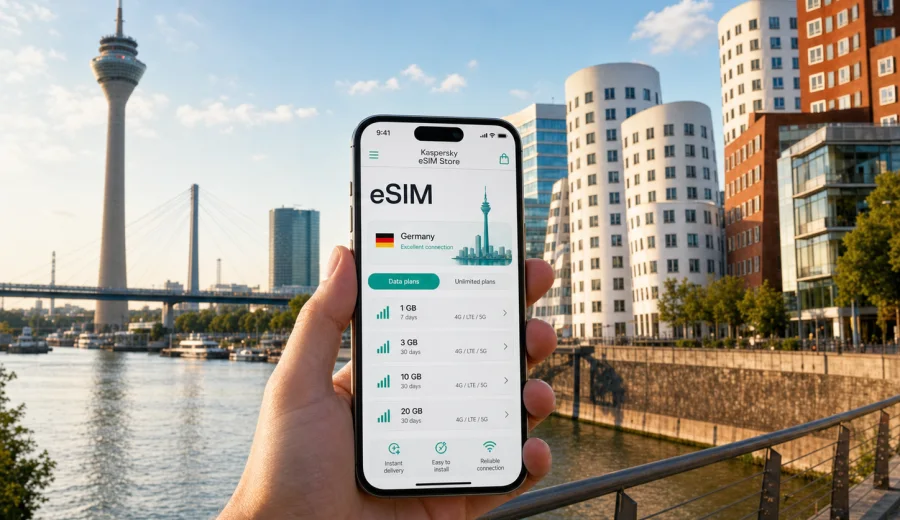
Dusseldorf eSIM: mobile connection and internet for your city trip
Dusseldorf is a city where mobile internet becomes useful before you even leave the airport. You may need the route from Dusseldorf Airport to your hotel, a platform update at the main station, a taxi pickup point after a late flight, a restaurant booking near Altstadt, or a message from colleagues before a meeting at Messe Dusseldorf. An eSIM can make those first steps easier because you can prepare mobile data before the trip and avoid looking for a physical SIM card when you arrive.
This guide is about using an eSIM for Dusseldorf, Germany. It is written for travelers who need a practical connection in the city: weekend visitors walking between the Rhine promenade and Konigsallee, business travelers moving between the airport, hotels and the trade fair grounds, people on short stopovers, and travelers using Dusseldorf as a base for Cologne, Essen, Bonn or the wider Rhine-Ruhr region.
An eSIM is a digital SIM profile for compatible devices. In a travel context, it is usually used for mobile internet rather than for a separate local phone number. Kaspersky eSIM Store is an app and website where you can choose, arrange and activate an eSIM with a suitable data plan for international travel, then use that data connection for maps, messaging, tickets, bookings and everyday online tasks while you are in Germany.
Why mobile internet matters in Dusseldorf
Dusseldorf is compact in the center, but visitor routes are spread across several areas. The airport is north of the city, Messe Dusseldorf sits near the Rhine and the airport corridor, Hauptbahnhof is east of the old town, MedienHafen is south of the center, and many hotels are in practical business districts rather than directly beside the main sights.
Mobile data helps with the small decisions that happen while you move:
- checking the correct train, tram or U-Bahn route after arrival;
- loading hotel addresses, booking confirmations and event passes;
- finding restaurants, pharmacies, supermarkets and meeting points;
- using maps around Altstadt, Carlstadt, Pempelfort, Oberkassel and MedienHafen;
- coordinating with colleagues, family, drivers or hotel staff;
- opening digital tickets for regional trains or local transport;
- using translation, browser search and messaging without waiting for Wi-Fi.
Public Wi-Fi can be useful in hotels, cafes and some travel areas, but it is not a full trip plan. You may need data before check-in, outside opening hours, on a tram platform, or during a business day when guest networks are overloaded. With an eSIM, you have a prepared mobile data option on your phone when the selected plan and local network conditions allow service.
Arrival: airport, station and first transfer
Many visitors arrive through Dusseldorf Airport. The city center is close, but your first transfer can still involve several choices: S-Bahn to Hauptbahnhof, taxi to a hotel, public transport to Messe, or a regional train connection to another city. If your eSIM profile is already installed, you can turn on mobile data after landing and check the route before leaving the terminal.
The same applies if you arrive by train. Dusseldorf Hauptbahnhof connects long-distance trains, regional routes, U-Bahn lines, trams and buses. The station area is practical but busy. If your hotel is in MedienHafen, Pempelfort, Oberkassel, Bilk or near the trade fair grounds, a working data connection helps you decide whether to walk, take public transport or order a ride.
For late arrivals, mobile internet can be especially valuable. You may need to message the hotel, open a door code, confirm whether public transport still runs, share your live location, or find a taxi stand. These tasks do not require huge data volumes, but they do require a connection at the right moment.
Where eSIM is most useful inside the city
Dusseldorf is easy to explore, but it rewards flexible navigation. A typical day might start with Konigsallee, continue through Altstadt, cross the Rhine toward Oberkassel, move to MedienHafen for architecture and dinner, then return by tram or U-Bahn. Mobile data keeps those transitions simple.
| City moment | Why data helps | Typical tasks |
|---|---|---|
| Airport transfer | Route choice, platform changes, taxi pickup | Maps, transport apps, messaging |
| Old town walk | Meeting points and restaurant plans | Maps, bookings, reviews |
| Messe visit | Event details and team coordination | Email, calendar, messenger |
| Hotel check-in | Address and reservation access | Email, hotel app, maps |
| Rhine promenade | Changing plans while walking | Location sharing, map search |
| Day trip | Train updates and digital tickets | Browser, wallet, transport apps |
If your phone supports dual SIM use, you may be able to keep your regular SIM active for your home number while using the eSIM profile for mobile data. This is useful when banks, airlines or colleagues still contact you through your usual number. Exact behavior depends on your device, home operator and settings, so check it before departure.
How to choose a data plan for Dusseldorf
For a Dusseldorf trip, choose a plan that matches Germany, your travel dates and your likely data use. A weekend traveler who mainly uses maps and messages may need less data than a business visitor joining video calls, using a laptop hotspot and downloading documents. A trade fair week can also increase data use because event apps, email attachments and shared files add up quickly.
Before selecting a plan, answer four questions:
1. How many days will you spend in Dusseldorf?
2. Will you stay only in the city, or also visit Cologne, Essen, Bonn, Dortmund or another German destination?
3. Will you mainly use maps and messaging, or also video calls, cloud files and hotspot mode?
4. Do you need data immediately after arrival, or only after reaching your hotel?
For most city trips, the country matters more than the city name. Dusseldorf is in Germany, so the relevant destination is Germany. If your itinerary stays inside Germany, choose a plan for Germany that fits the trip length and traffic volume. If your route continues into the Netherlands, Belgium, France, Switzerland or another country, check whether a regional or global option better matches the full route.
| Trip type | Dusseldorf pattern | Data planning tip |
|---|---|---|
| Weekend break | Maps, restaurants, photos, train times | Choose enough data for daily navigation and browsing |
| Business trip | Email, taxi, hotel, documents | Allow extra data for work apps and attachments |
| Trade fair visit | Messe app, badges, team chat | Plan for heavier daily use |
| Airport stopover | Transfer updates, messaging, maps | A smaller plan may be enough |
| Rhine-Ruhr base | Day trips by regional train | Match validity to all travel dates |
| Remote work stay | Calls, hotspot, cloud tools | Check data volume and tethering conditions |
Navigation and messaging are usually light. Video, cloud backup and hotspot use can consume much more. Before relying on your phone as your main work connection, read the selected plan conditions, data allowance, validity period and hotspot rules.
Prepare your eSIM before departure
The best time to set up an eSIM is usually before you need it. Installation requires an internet connection, so it is often easier to do it at home, in the office, or on trusted Wi-Fi before flying to Dusseldorf. You can review the data allowance, validity period and destination coverage without the pressure of an airport transfer.
Before buying or activating an eSIM, check your device. Your phone or tablet must support eSIM and should not be locked in a way that prevents adding another mobile profile. Some models differ by region of sale, so do not rely only on the model name if you are unsure.
Use this preparation checklist:
- confirm that the device supports eSIM;
- update your device software if needed;
- choose Germany or the relevant regional destination for your route;
- compare data volume and validity period;
- keep access to the email or profile where activation details appear;
- install the eSIM while you still have stable internet;
- decide which SIM profile will handle mobile data in Germany;
- keep your home SIM settings clear if you need calls or SMS on your usual number.
When you are ready to install, follow the setup flow for your device. You can use the Android installation guide or the iOS installation guide for step-by-step help. Screen names may vary by model and system version, but the core idea is the same: add the eSIM profile, select it for mobile data and wait for the connection to register when the plan and local network are available.
Activate mobile data in Dusseldorf
Installing an eSIM profile and using it for data are not always the same moment. You may install the eSIM before departure, then select it for mobile data after arrival in Germany. Some plans start validity when activated or when first connected to a supported network; conditions depend on the selected plan, so read the details before travel.
After landing, turn off aircraft mode, select the eSIM profile for mobile data, and test a simple online task before leaving the airport or station. Open a map, load your hotel address and send a short message. On some devices or plans, data roaming for the eSIM line may need to be enabled. This is a device setting for the travel eSIM profile; it does not mean you should accidentally use expensive roaming on your home SIM.
For a Dusseldorf trip, you can choose an eSIM plan for Germany through Kaspersky eSIM Store and prepare mobile internet before you start moving through the city.
Practical movement around Dusseldorf
Most visitors combine walking with public transport. U-Bahn, S-Bahn, trams and buses are useful for moving between the airport, Hauptbahnhof, Altstadt, Pempelfort, Bilk, Oberkassel, MedienHafen and Messe Dusseldorf. Mobile data helps because routes can change with time of day, events, construction and delays.
Common city movements include:
- Airport to Altstadt: compare rail plus walking with taxi timing for your arrival hour.
- Airport to Messe: check the correct entrance and whether a direct ride saves time.
- Hauptbahnhof to MedienHafen: choose a tram or U-Bahn route if you have luggage.
- Konigsallee to Rhine promenade: walking is easy, but maps help for specific restaurants.
- Oberkassel to Altstadt: confirm tram stops and late-night return options.
- Dusseldorf to Cologne: keep regional train updates and digital tickets available.
Save your hotel address offline before traveling, but do not rely only on offline maps. Live transport changes, ticket pages, taxi pickup points and event schedules usually need a connection. That is where eSIM data is useful: not for sightseeing itself, but for the online steps that keep the day organized.
Districts, hotels and business days
Altstadt is dense and busy, so data helps with meeting points, restaurant bookings and routes back to the hotel. Konigsallee and Stadtmitte are useful for shopping, offices and central hotels. MedienHafen is common for restaurants and riverside plans. Pempelfort, Derendorf, Bilk and Friedrichstadt are practical for longer stays, while Oberkassel is quieter across the Rhine.
Dusseldorf is also a trade fair and meeting city. At Messe Dusseldorf, you may scan badges, open event maps, confirm appointments, send photos of materials, or join a quick call. Venue or hotel Wi-Fi may be available, but it can be busy. If you expect video calls, hotspot use or cloud files, choose a larger data allowance and check the selected plan conditions.
Limits to understand
An eSIM for travel is mainly a mobile data tool. Voice calls and SMS are not included unless the selected plan explicitly says so. Your usual phone number may remain on your home SIM, depending on device settings, while messaging apps can work over mobile data if you are signed in and the service is available. Connection quality depends on local network conditions, device support and the selected plan. eSIM profiles may also have transfer or reuse limits after activation, so read the plan terms before relying on it for the whole trip.
Day trips and regional routes
Dusseldorf is a strong base for western Germany. Cologne, Essen, Duisburg, Dortmund, Bochum, Bonn and Aachen can fit regional train itineraries. If your plan covers Germany and remains valid for your travel dates, the same eSIM data plan can support navigation and messaging across those German stops, subject to plan conditions.
For cross-border trips, check the destination list carefully. A Germany plan is designed for Germany. If you continue into the Netherlands, Belgium, Luxembourg, France or Switzerland, you may need a plan that covers those countries or a regional option.
Choose an eSIM plan for your Dusseldorf trip
Dusseldorf is easier when your phone is ready for maps, transport, tickets, hotel messages and everyday travel tasks from the moment you arrive. Before you travel, check that your device supports eSIM, choose a plan that covers Germany, review the data allowance and validity period, and install the eSIM while you still have a stable connection.
Kaspersky eSIM Store helps you choose, arrange and activate an eSIM with a suitable data plan for international travel. For a city trip, business visit or Rhine-Ruhr route starting in Dusseldorf, you can prepare an eSIM plan for Germany before departure and keep your mobile internet setup clear before the first transfer.