
Travel connectivity guide
Egypt eSIM: mobile connection and internet
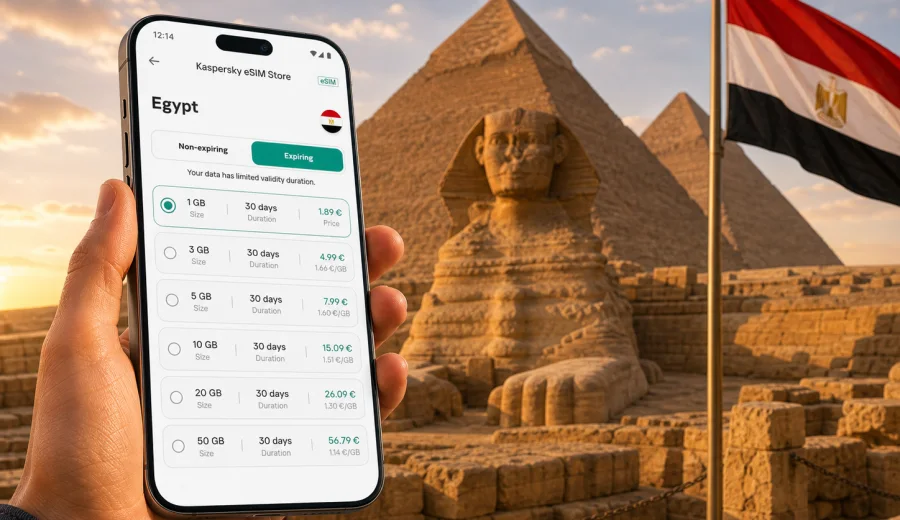
Egypt eSIM: mobile connection and internet for your trip
Planning mobile connection and internet for Egypt is easier when you prepare it before your flight. An eSIM can help you get mobile data without looking for a physical SIM card after landing, especially if your first hours in the country include airport transfers, hotel check-in, maps, ride-hailing apps, ticket bookings, or messaging family and colleagues.
For a trip to mobile internet for a trip to Egypt is a practical option if you use a compatible smartphone or tablet and want a clear data plan for travel. Kaspersky eSIM Store is an app and website where you can quickly choose, arrange, and activate an eSIM with a suitable plan for mobile internet during an international trip. It does not replace a local mobile operator or guarantee coverage in every place, but it can simplify how you prepare mobile data for your route.
This guide explains how to choose an eSIM plan for Egypt, what to check before buying, how installation works, and how to avoid common setup mistakes.
Quick answer
An eSIM for Egypt is a digital SIM profile that lets a compatible device use mobile data without inserting a plastic SIM card. It is useful for travelers who want to prepare internet access before arrival or shortly after landing. Before you choose a plan, check that your device supports eSIM, is not locked to another carrier, and that the plan covers Egypt for the dates and amount of data you need.
An eSIM plan is usually best for mobile internet: maps, messengers, email, banking apps, ride services, hotel apps, work tools, and browsing. It may not include a standard phone number, voice calls, or SMS unless the plan conditions say so. For calls, many travelers use internet-based messaging apps over mobile data.
Why eSIM is useful in Egypt
Egypt is a country where many travel scenarios depend on being online from the first hour. You may arrive at Cairo International Airport, continue to Giza, take a domestic flight to Luxor or Aswan, join a Red Sea resort transfer, or move between cities by train, bus, or car. In each case, mobile internet makes the trip less dependent on hotel Wi-Fi, printed confirmations, and offline directions.
An eSIM can be useful when you need to:
- open maps and navigation during airport transfer;
- contact a driver, guide, hotel, or apartment host;
- confirm bookings for museums, Nile cruises, flights, or buses;
- translate signs, menus, and short messages;
- use banking and travel apps without waiting for Wi-Fi;
- send updates to family or your team;
- keep a physical SIM active for calls while using eSIM for data.
The main advantage is preparation. You can choose the destination and plan conditions in advance, install the eSIM on a compatible device, and understand how much data and validity you have before the trip starts. That does not remove the need to check local network conditions, but it gives you a clearer setup than trying to solve everything after a long flight.
How to choose an eSIM plan for Egypt
Start with your route, not with the largest data package. A plan should match where you go, how long you stay, and how you normally use mobile internet. In Kaspersky eSIM Store, you can review the destination, data amount, validity period, and price before arranging the plan.
Use this simple method:
1. Write down your travel dates in Egypt.
2. Note your arrival city and any domestic route: Cairo, Giza, Luxor, Aswan, Alexandria, Hurghada, Sharm El Sheikh, Dahab, or other stops.
3. Estimate your daily data use.
4. Check whether you need hotspot mode for a laptop or another device.
5. Compare plan validity with your full stay, including arrival and departure days.
6. Read the plan conditions before payment.
For many travelers, the best choice is the plan that fits the expected use with a small reserve. Too little data can interrupt navigation or work at the wrong moment. Too much data may be unnecessary if your hotel and main venues have reliable Wi-Fi and you only need mobile internet for movement between places.
Estimate your data needs
Exact data use depends on apps, phone settings, photo uploads, video quality, and background updates. The table below is a practical planning guide, not a guarantee.
| Usage style | Typical behavior | What to consider |
|---|---|---|
| Light | Maps, messengers, email, occasional browsing | Suitable for short stays or travelers with regular Wi-Fi access. |
| Moderate | Maps, social media, photos, bookings, daily browsing | Often a better fit for a one-week tourism route. |
| Heavy | Video calls, hotspot, cloud backups, streaming, remote work | Choose a larger data amount and control background app updates. |
Before you travel, reduce automatic data use. Turn off cloud photo backup on mobile data, disable automatic app updates, and download offline maps, tickets, and important PDFs. These small steps help make the chosen plan last longer.
What to check before buying
The most important check is device compatibility. eSIM works only on devices that support it, and some models differ by country or region of sale. A phone can also be locked to a carrier, which may prevent adding another mobile plan.
Before arranging a plan, check your device and confirm:
- your phone or tablet supports eSIM;
- the device is not locked to a carrier;
- the operating system is up to date enough for eSIM setup;
- you have a stable internet connection for installation;
- your chosen plan covers Egypt;
- the data amount and validity period match the trip;
- you understand when the plan validity or data usage starts;
- you know whether hotspot mode is allowed by the plan conditions.
Also check how you want to use your main SIM. Many travelers keep the home SIM active for calls or banking SMS while using eSIM for mobile data. Your phone settings usually let you choose which SIM handles mobile data, calls, and messages.
A practical setup before departure
You do not need to wait until you are standing in an airport arrival hall to prepare your mobile data. If your device is compatible, you can usually arrange the eSIM before leaving home and complete the installation while you still have stable Wi-Fi.
Good preparation looks like this:
1. Choose Egypt as your destination.
2. Select a plan based on data amount and validity.
3. Complete the arrangement process.
4. Install the eSIM profile using the on-screen instructions or QR code.
5. Keep your main SIM settings unchanged until you are ready to switch data.
6. Save installation details in case you need to refer to them later.
7. On arrival, choose the eSIM profile for mobile data and check whether data roaming must be enabled for that profile.
If you need a plan for Egypt now, you can choose an eSIM plan for Egypt and compare available data options for your travel dates. Review the conditions carefully so the selected plan fits your route and device.
How to install and activate an eSIM
The exact steps depend on your device, but the general flow is similar. You arrange the plan, add the eSIM profile to your phone, then select it for mobile data when you want to use it.
For detailed setup, use the official installation guides: Android instructions and iOS instructions.
Typical steps:
1. Make sure the device is connected to Wi-Fi.
2. Open the eSIM installation details after arranging the plan.
3. Add the eSIM profile through phone settings or by scanning the QR code.
4. Name the profile clearly, for example "Egypt travel data".
5. Keep your primary SIM as default for calls if you need it.
6. Select the eSIM profile for mobile data when you are ready.
7. Wait a few minutes for the connection process to complete.
8. If required by the plan or device, enable data roaming for the eSIM profile.
Do not delete the eSIM profile after installation unless you are sure you no longer need it. In many cases, deleting an eSIM profile does not mean it can simply be installed again on another device.
When to activate mobile data
Installation and activation are not always the same thing. Installation adds the eSIM profile to your device. Activation or first use depends on the plan and device behavior. Some plans start their validity when the eSIM connects to a supported network; others may have different conditions. Read the plan details before you travel.
If you want more control, install the eSIM before departure while you have reliable Wi-Fi, but switch mobile data to the eSIM only when you are ready to use it. On arrival in Egypt, open mobile network settings and confirm that the travel eSIM is selected for mobile data.
If the phone does not connect immediately, wait a few minutes, restart the device if needed, and check whether data roaming is enabled for the eSIM profile. This is a common requirement for travel eSIMs and does not mean you are using your home carrier's roaming plan, as long as the eSIM profile is selected for data.
How to reduce data use
Small settings can make a travel plan last longer:
- download offline maps for Cairo, Giza, Luxor, Aswan, and resort areas you plan to visit;
- save hotel addresses, tickets, insurance documents, and boarding passes offline;
- turn off automatic cloud backups on mobile data;
- disable app updates over mobile data;
- reduce video streaming quality;
- send compressed photos in messengers when quality is not important;
- use Wi-Fi for large downloads when you trust the network;
- check data consumption in phone settings every day or two.
These steps are useful even if you choose a larger plan. They help prevent one background app from consuming data you intended to use for navigation, messages, or work.
Common mistakes to avoid
The most common eSIM problems are not complicated, but they can be stressful during travel.
Avoid these mistakes:
- buying before checking that your device supports eSIM;
- assuming every version of a phone model has the same eSIM support;
- installing the eSIM on the wrong device;
- deleting the eSIM profile too early;
- leaving mobile data assigned to the home SIM;
- forgetting to enable data roaming for the travel eSIM when required;
- choosing a plan that expires before the trip ends;
- using video calls, backups, or streaming without checking data use.
If something does not work, start with the basics: confirm the eSIM profile is installed, choose it for mobile data, check roaming settings for that profile, restart the device, and make sure you are in an area where a local network is available.
Mini checklist for Egypt eSIM preparation
Before departure:
- confirm your device supports eSIM;
- check that it is not locked to a carrier;
- choose Egypt as the destination;
- select a data amount and validity period for the whole trip;
- install the eSIM while you have stable Wi-Fi;
- save the QR code or installation details if provided;
- download offline maps and key documents;
- label the eSIM profile clearly.
After arrival:
- select the eSIM for mobile data;
- keep your home SIM from using roaming data unless you intend to use it;
- enable data roaming for the eSIM profile if required;
- wait a few minutes for network registration;
- test maps, messaging, and browser access;
- monitor data use during the trip.
FAQ
Does an eSIM for Egypt include calls and SMS?
Usually no, unless the plan conditions specifically say otherwise. Travel eSIM plans through Kaspersky eSIM Store are focused on mobile internet. For calls and messages, you can use internet-based apps over mobile data.
Can I install the eSIM before flying to Egypt?
Yes, in many cases you can install the eSIM before departure while connected to Wi-Fi. Check the plan conditions so you understand when validity starts and when you should switch mobile data to the eSIM profile.
Do I need to remove my physical SIM?
Usually no. Many compatible phones let you keep the physical SIM for calls and messages while using the eSIM for data. Check your phone settings carefully so mobile data uses the travel eSIM, not your home SIM.
What if my phone does not support eSIM?
You will need another connectivity option, such as roaming or a physical SIM. Do not arrange an eSIM plan until you have confirmed compatibility and carrier unlock status.
Can I use hotspot mode with an eSIM in Egypt?
It depends on the plan and device settings. If hotspot is important for work or sharing data with another device, check the conditions before choosing the plan.
Is eSIM better than public Wi-Fi?
It depends on the situation. eSIM can be more convenient for movement, maps, messaging, and transport because it is not tied to one building or login page. Public Wi-Fi can still be useful for large downloads when the network is trusted and stable.
What should I do if the eSIM does not connect?
Check that the eSIM profile is installed, selected for mobile data, and allowed to use data roaming if required. Restart the phone, wait a few minutes, and confirm that you are in an area with local mobile network access. If the issue remains, contact support with your device model and plan details.
Choose an eSIM plan for Egypt
For a smoother trip, prepare mobile internet before you need it at the airport, hotel desk, taxi pickup point, or train station. Kaspersky eSIM Store helps you choose, arrange, and activate an eSIM with a suitable plan for mobile internet during your Egypt trip, while keeping the key checks visible: destination, data amount, validity, device compatibility, and installation steps.
Choose an eSIM plan for Egypt, install it on a compatible device, and keep your travel data ready for maps, messages, bookings, and everyday online tasks throughout the journey.
Before departure, open Kaspersky eSIM Store and review mobile internet options for your destination. Choose the data volume and validity period deliberately, then install the eSIM on a compatible device over a stable Wi-Fi connection.