Travel connectivity guide
Entel eSIM in Peru: Setup and Coverage
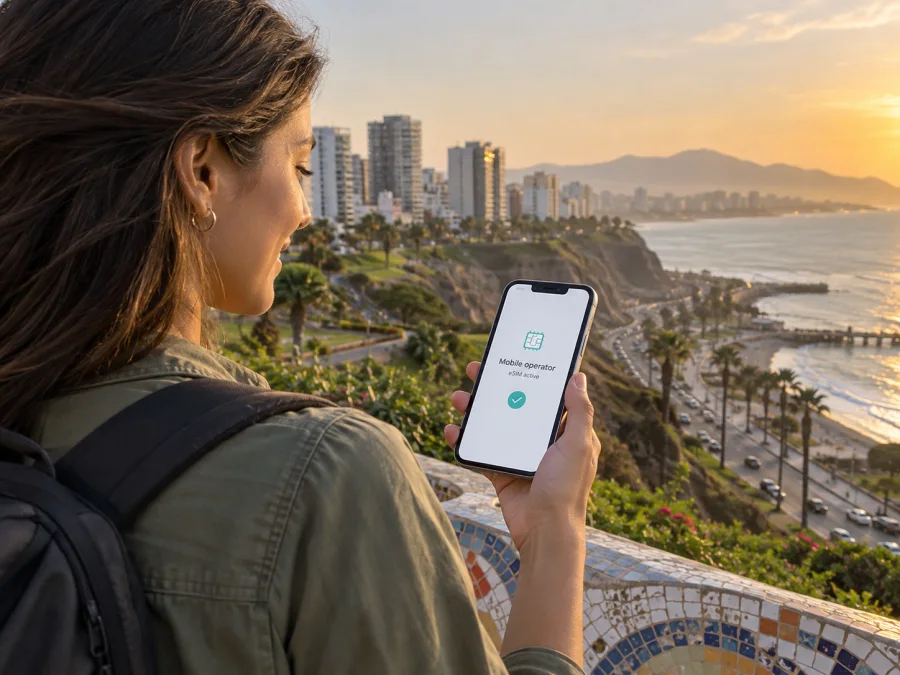
Entel eSIM in Peru: activation, coverage and travel checklist
If you are travelling to Peru and considering an Entel eSIM, check more than whether your phone supports the technology. You will also want to know where activation takes place, which documents are accepted, whether the places on your itinerary appear on the coverage map, and what to expect if you replace your phone. Entel Perú currently documents eSIM service and directs customers to an Entel store for a new eSIM or a change from a physical SIM.
This guide explains the practical points to check before relying on Entel during a trip. It distinguishes the operator’s published instructions from visitor details that you should confirm for yourself.
Entel’s place in Peru’s mobile market
Entel is one of the mobile operators serving Peru. The country has several mobile providers, and each traveller’s choice depends on where they are going, which services they need and whether their device can use the local network. In a report published on 8 June 2026, telecom regulator OSIPTEL said Entel accounted for 22.54% of active mobile lines that had carried traffic during the first quarter of 2026. That statistic describes market participation for a defined period; it is not a measure of reception quality or a guarantee that service will be available at a particular address.
For a travel decision, operator presence is background. Your specific questions are whether Entel can register and activate the line you need, whether your exact phone works with eSIM, and whether the network map covers your destinations. Entel’s public “E-sim” support page and “Búsqueda Cobertura” map were reviewed on 26 September 2026. They provide useful starting points, but neither replaces confirmation for your account or a real-world signal check.
Is Entel eSIM available in Peru?
Yes. Entel Perú’s public “E-sim” page describes eSIM service and changing an existing physical SIM to eSIM, provided the device is compatible. It directs customers to visit an Entel store to request a new eSIM or make the change. This confirms that Entel eSIM is offered in Peru and sets a practical expectation: the documented route includes an in-person store visit rather than a fully self-service online activation.
The page does not establish that every customer type, plan or activation case follows the same conditions. In particular, it does not clearly confirm that a first-time visitor can order a new Entel eSIM online before travelling, or that every prepaid service is available as eSIM. If you are not already an Entel customer, ask Entel whether it can register the kind of line you need, whether that line can be issued as eSIM, and what you must bring. This matters if you plan to go directly from the airport to another city or have limited time to visit a store.
Entel’s “Términos y Condiciones - Prepago” page, reviewed on 26 September 2026, names a passport among the identity documents accepted for the prepaid service described there. That is useful for international visitors, but it does not confirm that every foreign visitor qualifies, that every store can activate an eSIM, or that a dedicated tourist eSIM offer is available. Confirm accepted documents, registration steps, line type and current prepaid or tourist options with Entel before travelling. Do not assume that the general reference to a passport settles eligibility for your specific case.
Before making Entel eSIM your only way to connect, confirm your eligibility and store arrangements directly with the operator. If you arrive late or continue travelling immediately, have another way to get online for the first part of the trip.
How Entel eSIM activation works
Entel’s published route starts at an Entel store and requires a compatible phone. Its support page also explains what happens when a customer changes phones: a direct transfer is not available. The customer must visit a store to request a SIM change, after which Entel sends a link and QR code for activation on the new handset. The page gives QR reuse conditions as well, so check its current wording before deleting a profile or relying on an old code for recovery.
A practical preparation sequence is:
- Check your exact phone model and unlock status. Confirm eSIM support for the regional variant in the manufacturer’s documentation; carrier restrictions can prevent activation.
- Ask Entel about your case. Verify whether you need a new line or SIM change, whether that service can use eSIM, and which identity documents are required.
- Find a suitable store. Check the address and current opening hours. The published route is store-based, so do not assume setup can be done at the airport or remotely.
- Install using Entel’s instructions. Keep the activation email or QR code available and add the profile through your phone’s cellular settings. Use a trusted internet connection.
- Check the setup and data line. Confirm the profile appears in settings, choose the intended SIM for mobile data, and test the connection where service is available. Retain activation and support details.
These are preparation steps, not a replacement for Entel’s instructions. Its eSIM page says a removed profile will no longer be active on the phone and describes limits on re-scanning a QR code on the same device. If the reuse conditions are exceeded, the customer must visit a store for a new code. Because the rules may be updated, consult the live Entel page before troubleshooting by deleting a working profile.
If your phone is replaced, lost or reset, plan for the possibility of a store visit. Entel says a profile cannot simply be transferred to another handset and describes a store request for a SIM change followed by a new activation link and QR code. Keep access to the email address linked to the service and carry the identity document used for registration. If your phone is lost or stolen, contact Entel using its current official support channels and secure your other accounts.
Entel coverage and supported network technologies
Entel’s coverage search lets users enter a city or address and select 2G, 3G, 4G or 5G layers. Its map distinguishes “guaranteed coverage” from “additional network capacity.” The page states that the information was updated through 31 December 2025. This is the date shown for the published map information, not a promise about service at a location on the day you visit.
Peru includes urban areas, coastal settlements, highland routes and remote parts of the Amazon basin. A national-level coverage label cannot establish whether a signal will reach inside a particular building, along a mountain road or at a sparsely populated destination. Terrain, construction, handset bands and temporary network conditions can all affect an individual connection. Do not infer uniform coverage from Entel’s presence in the country or from coverage shading around a city.
Before travel, search the exact addresses that matter: your accommodation, meeting sites, transport hubs and stops outside major cities. Check the technology layers separately. If your itinerary includes a road or rail journey, search the important stops rather than assuming uninterrupted coverage between them. Save maps, tickets and contact details offline, especially if you will travel beyond larger towns.
The map’s 2G–5G selectors show the technologies Entel publishes for location checks; they do not mean every location has every generation or every handset supports them. A 5G-capable device may use a different generation where 5G is unavailable, and an eSIM by itself does not provide coverage. OSIPTEL also offers a public coverage-checking tool using information reported by operators. It is another planning reference, not a live indoor reception test; the regulator says coverage information is supplied periodically. Keep a backup for places where mobile service may not be available.
Prepaid and tourist options: what visitors should verify
Entel publishes prepaid service information, and the prepaid terms reviewed for this guide name a passport as an accepted identity document for the service described. This supports a general statement that prepaid service exists and that a passport may be relevant to registration. It does not confirm the full requirements for every foreign visitor, availability of a tourist-specific offer, or that every prepaid option can be issued as eSIM.
Before visiting a store, ask Entel directly:
- Can a visitor with my passport and status register a new mobile line?
- Is eSIM available for the line I need, or does the published procedure apply only to a particular customer case?
- Which store can complete registration and eSIM setup?
- What identity documents or local account details should I bring?
- How can I contact support if installation or QR activation fails?
- Does the service meet my needs for local calls and messages, or is it intended mainly for data?
Ask for current answers because registration rules and availability may change. “Prepaid” does not automatically mean remote activation, a tourist-only offer or anonymous service. The public pages reviewed establish Entel eSIM support, a store-based request route and prepaid terms that mention passports; they do not settle every visitor’s eligibility. Confirm the conditions that apply to you before depending on the line.
Local Entel service and a travel eSIM are different arrangements
An Entel eSIM is a digital SIM profile associated with an Entel service in Peru. The operator’s public procedure involves device compatibility, an Entel store and account-specific activation. This can fit a traveller who needs a local Entel service and can complete registration in person. The specific service features depend on the current offer and your account; ask Entel directly if a local number, calls or messages are important.
A travel eSIM is a separate way to prepare mobile data for a trip. Depending on the service, it may be possible to arrange it online before departure and avoid finding a SIM shop immediately after landing. Do not assume it includes a local number, voice calls or SMS: check the selected service’s terms. If you need an Entel line or local calling features, confirm those with Entel rather than treating a data-focused travel eSIM as a full substitute.
The useful distinction is practical, not a claim that one option is universally better. With Entel, confirm registration, store access, eSIM eligibility and the current activation process. With a travel eSIM, check destination availability, device compatibility, when to install it, what is included and how support works. Your itinerary, need for a local number and time available for an in-person visit can guide your choice.
For travellers who want to prepare mobile data before reaching a store, review the eSIM options for Peru in Kaspersky eSIM Store. Kaspersky eSIM Store’s Peru and setup pages, reviewed on 26 September 2026, describe an app and website that help users choose, arrange and activate an eSIM plan for mobile internet while travelling abroad. It is not a mobile operator, network owner or provider of mobile internet or coverage. Availability and service details depend on the selected option, so review its current terms before proceeding.
Quick checklist before departure
- Confirm eSIM support for the exact phone model and make sure it is unlocked.
- Ask Entel to verify eligibility, accepted documents and whether your intended line can use eSIM.
- Find a store that can complete the request and check its current opening hours.
- Review the map for your actual destinations; its published information date is 31 December 2025.
- Choose which SIM will handle data and review roaming on your home line.
- Keep activation information accessible and do not delete a working profile without Entel’s guidance.
- Save essential addresses, tickets and maps offline; prepare a backup connection if store access or service is uncertain.
Frequently asked questions
Can I get an Entel eSIM in Peru?
Yes. Entel Perú’s eSIM support page describes the service and directs customers to an Entel store to request an eSIM or convert a physical SIM. A compatible phone is required. Confirm that your customer type and requested service qualify before visiting.
Can I activate an Entel eSIM before arriving?
The public process reviewed here directs customers to a store, so do not assume a new visitor can complete activation remotely before arrival. Ask Entel whether another route applies to your situation. If you need data immediately after landing, arrange a backup connection.
Can a tourist use Entel prepaid service?
Entel’s prepaid terms name a passport among the documents accepted for the service described there. They do not settle every visitor’s eligibility or confirm a tourist-specific eSIM offer. Check your nationality, documents, line type and activation route directly with Entel.
Final take
Entel eSIM is available in Peru. Entel’s published support page gives a clear starting point: use a compatible device and visit an Entel store to request an eSIM or change an existing SIM. Its prepaid terms mention a passport among accepted identity documents for the service described there, but this does not answer every visitor’s eligibility question. Confirm registration, line type and eSIM activation with Entel before travelling.
Check your destinations on the coverage map, note its stated update date, and prepare for the possibility that a device change or profile problem requires another store visit. If you would rather arrange a separate travel-data option before arrival, Kaspersky eSIM Store can help you choose, arrange and activate an eSIM plan for mobile internet abroad. It does not operate Entel’s network or provide coverage, and Kaspersky eSIM Store is not affiliated with Entel.