
Travel connectivity guide
Essaouira eSIM for mobile internet
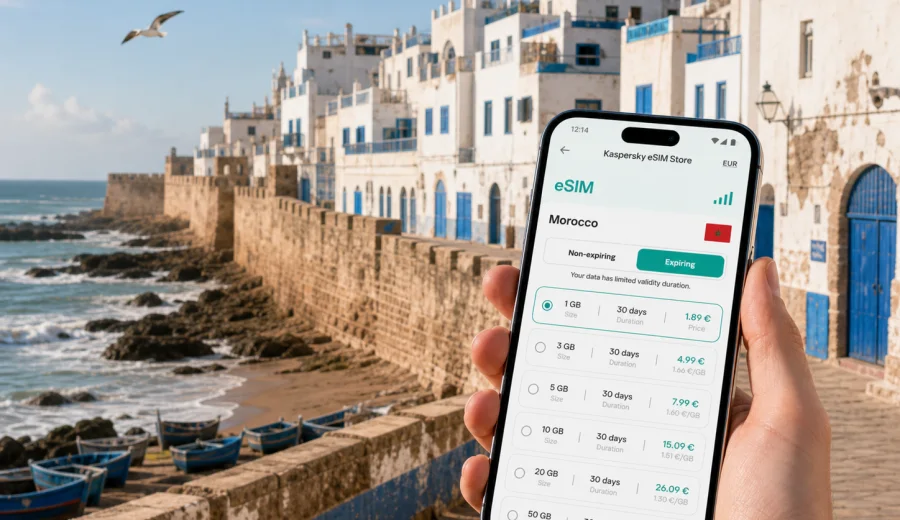
Essaouira eSIM: mobile connection and internet for a smoother trip
Essaouira is an easy city to enjoy slowly, but it is not a place where mobile internet becomes optional. You may arrive after a long transfer from Marrakech, look for a riad inside the medina, follow a walking route along the ramparts, check the wind forecast before the beach, or message a driver about a trip to Sidi Kaouki. In each of these small moments, a prepared eSIM can make the trip feel more controlled.
This guide focuses on mobile connection in Essaouira, not on Morocco in general. The city has its own rhythm: a compact UNESCO-listed medina, windy beaches, fishing port, craft streets, ocean-view cafes, surf and kitesurf schools, and hotels spread between the old town, the beach road, and quieter residential areas. Navigation is usually simple on foot, but practical online access still helps with maps, restaurant reservations, ride coordination, translation, banking checks, boarding passes, and work messages.
An eSIM is useful because it lets you prepare mobile internet without searching for a physical SIM card after arrival. With Kaspersky eSIM Store, you can choose a destination, review the available data amount and validity period, arrange the eSIM, install it on a compatible device, and activate it for the trip. The service is best understood as an app and website that helps you prepare a suitable eSIM tariff for mobile internet abroad, while the actual conditions depend on the selected tariff.
Why mobile internet matters in Essaouira
Essaouira is smaller and calmer than Marrakech or Casablanca, yet travel tasks often happen outdoors and on the move. You may need a map while walking through narrow medina lanes, a translator in a craft shop, a taxi message after dinner, or a video call from a hotel terrace. Public Wi-Fi can help in some cafes and hotels, but it is not a reliable travel plan by itself.
The most common internet needs in Essaouira are practical:
- finding your riad or hotel entrance inside the medina;
- navigating between Bab Marrakech, the port, the ramparts, and the beach;
- checking bus or private transfer details for Marrakech, Agadir, or the airport;
- using messaging apps for accommodation, guides, drivers, and surf schools;
- reading menus, reviews, opening hours, and route notes;
- sharing your location with fellow travelers;
- keeping boarding passes, booking confirmations, and payment notifications available;
- working from a hotel, coworking-style cafe, or apartment without relying only on Wi-Fi.
Essaouira rewards wandering, but it is still a coastal city where wind, daylight, and distances shape the day. Mobile data helps you adjust plans without returning to the hotel lobby each time you need to check something.
Arrival scenarios: when to activate your eSIM
There is no single arrival pattern for Essaouira. Some travelers fly through Marrakech and continue by bus, shuttle, rental car, or private transfer. Others use Essaouira-Mogador Airport when it fits their route, or combine the city with Agadir and the Atlantic coast. Your best activation moment depends on where you need internet first.
| Arrival situation | Practical internet need | Suggested eSIM approach |
|---|---|---|
| Transfer from Marrakech | Maps, driver messages, accommodation contact | Install before departure and activate when ready to use mobile data in Morocco |
| Arrival at Essaouira airport | Taxi coordination, hotel address, messaging | Prepare the eSIM in advance so setup is not the first task after landing |
| Bus arrival near the city | Navigation to medina gate or hotel | Activate before leaving the station area if you need live maps |
| Rental car route | Navigation, parking search, route changes | Prepare data before the drive, especially if several people depend on your phone |
| Coastal trip from Agadir | Maps, weather, check-in messages | Choose a tariff that covers the full Morocco part of the route |
If you will need connection immediately after landing or during a road transfer, install the eSIM before the trip while you still have stable Wi-Fi. Activation can usually wait until the correct moment, but installation is easier when you are not dealing with luggage, arrival queues, or a driver waiting outside.
Before arranging an eSIM, check whether your device supports eSIM. Compatibility matters because an eSIM requires a supported smartphone or tablet, and some devices may have carrier restrictions. It is better to confirm this before you pay for a tariff or build your arrival plan around it.
Essaouira districts and where mobile data helps most
The medina is walkable, compact, and atmospheric, but it can be confusing on the first day. Streets bend around markets, workshops, guesthouses, and small squares. A saved hotel pin, offline map, and mobile data for live corrections are a useful combination.
Near the port and Skala de la Ville, mobile internet is helpful for photography routes, meeting points, and checking tide or wind information. The beach area is more open, with long walks, surf schools, and hotels along the coast. If you stay outside the medina, you may rely more on taxis and messaging.
For most travelers, these areas create different connection needs:
- Medina: map corrections, translation, riad communication, restaurant searches.
- Port and ramparts: meeting points, photo sharing, walking routes, weather checks.
- Beach road: surf school messages, taxi coordination, hotel navigation.
- Diabat and nearby coast: maps, ride planning, day-trip coordination.
- Bus and transfer points: ticket details, arrival messages, route tracking.
A city trip can use less data than a remote-work stay, but Essaouira often encourages long days outside. If you expect to use maps, cloud photos, messaging, and occasional video calls, choose a data amount that gives you room for changes.
Choosing an eSIM data amount for Essaouira
The right data amount depends on travel style, not only trip length. A weekend in Essaouira with hotel Wi-Fi and light messaging may need modest data. A week with route planning, work calls, video uploads, hotspot use, and day trips can need much more.
Use this as a practical starting point:
| Travel style in Essaouira | Typical mobile data use | What to consider |
|---|---|---|
| Short leisure stop | Maps, messaging, bookings, light browsing | A smaller package may be enough if hotel Wi-Fi is reliable |
| Beach and activity trip | Maps, messaging, weather, photos, surf school contact | Leave extra data for outdoor days away from Wi-Fi |
| Family trip | Several people coordinating plans | One phone may become the main navigation and messaging device |
| Business visit | Email, calls, documents, hotspot backup | Choose more data and check validity carefully |
| Morocco route with Essaouira as one stop | Navigation between cities, transport updates | Pick a Morocco tariff that fits the whole route, not just one city day |
Do not choose only by the lowest number. Check the validity period, data volume, destination, price, and whether the tariff supports the way you plan to use your device. If hotspot use is important, review the selected tariff conditions before relying on it for a laptop or travel companion.
A practical setup checklist before you travel
Good eSIM preparation is simple, but it works best when done before a tiring travel day. Use this checklist before leaving for Essaouira:
- confirm that your smartphone supports eSIM and is not locked to one carrier;
- install the eSIM while you have stable Wi-Fi;
- keep your primary SIM active if you need SMS or calls from your usual number;
- save your hotel address and arrival instructions offline;
- download an offline map of Essaouira and Morocco routes;
- check when the eSIM validity period starts under the selected tariff conditions;
- understand whether data roaming must be enabled for the eSIM profile;
- keep the installation instructions available in case you need to review them later.
If you need installation guidance, use the official internal setup pages for Android eSIM installation or iOS eSIM installation. The exact menu names can vary by device model and operating system version, so follow the instructions together with your phone settings.
How to use mobile internet during the first hour in Essaouira
The first hour often decides whether the arrival feels smooth. You may be tired, the medina may be busy, and your accommodation may have a door that is easier to find with a message than with a street address. A simple sequence helps:
1. Turn on the eSIM line when you are ready to use mobile data in Morocco.
2. Make sure mobile data is assigned to the eSIM profile.
3. Enable data roaming for the eSIM if the selected tariff instructions require it.
4. Open your hotel or riad address before leaving the arrival point.
5. Message the accommodation if the entrance is inside the medina or near a gate.
6. Keep battery saving in mind, because live maps and photos can drain a phone quickly.
For a city like Essaouira, the goal is not constant screen time. The goal is to make sure the phone can solve practical travel tasks at the moment they appear.
When to choose an eSIM before reaching the city
If Essaouira is part of a Morocco route, preparing the eSIM before arrival is usually more convenient than waiting until you are in the medina. A long transfer, an evening arrival, or a packed first day can make setup feel like unnecessary friction.
Once you know your travel dates and approximate data needs, you can choose an eSIM tariff for Morocco before your Essaouira trip and review the available options by data amount, validity period, and price. This is easier to do before the travel day, when you can compare options calmly and install the eSIM on stable Wi-Fi.
This is especially useful if you will:
- travel from Marrakech to Essaouira on the same day you arrive in Morocco;
- depend on maps or messages during a private transfer;
- arrive outside normal shop hours;
- stay in a riad where the entrance is easier to find with live instructions;
- combine Essaouira with Agadir, Marrakech, or coastal villages;
- work during the trip and need a mobile backup to hotel Wi-Fi.
Kaspersky eSIM Store helps you prepare mobile internet through an eSIM tariff for the destination. It does not replace a local mobile operator, and an eSIM data tariff may not include a regular phone number, voice calls, or SMS unless the selected conditions say so. For calls and messages, many travelers use internet-based apps over mobile data.
Transport, hotels, and local movement
Essaouira is a strong walking city. Many places inside and around the medina are easier on foot than by car, while taxis and transfers are useful for the beach road, Diabat, the airport, and longer routes. Mobile data supports each mode differently: walking needs map orientation, taxis need clear meeting points, and intercity transport needs ticket details and arrival messages.
For medina navigation, do not expect a map pin to solve every doorway. Use the map together with written hotel instructions and gate names. For taxis or transfers, send a hotel name, medina gate, or map pin instead of trying to explain every turn by voice.
Accommodation Wi-Fi can be helpful, but it varies by building layout and room position. A riad may have thick walls, an apartment may need check-in messages before you reach the door, and a beachfront hotel may be fine in the lobby but weaker on a terrace. An eSIM gives you a backup for late check-in, pickup confirmation, maps, and short work calls when Wi-Fi is not enough.
Data-saving habits that work well in Essaouira
Use mobile data for tasks that need movement and timing, and leave heavy uploads for Wi-Fi. Before long walks or transfers, download offline maps, save boarding passes and hotel details, turn off automatic cloud photo uploads on mobile data, and update apps on Wi-Fi. If you use hotspot for a laptop or travel companion, check the selected tariff conditions and monitor usage in your phone settings.
These habits matter because many of Essaouira's best moments happen outside: walking the ramparts, watching the port, moving between the beach and the medina, or taking a short trip along the coast. You want data available for useful tasks, not consumed quietly in the background.
Stopovers, day trips, and wider Morocco routes
Some travelers visit Essaouira as a day trip or a short overnight stop. In that case, eSIM preparation is still useful because there may be little time to solve connection problems after arrival. Keep the medina gate or meeting point, ticket details, and enough mobile data for maps, messages, and route changes.
Essaouira is also often combined with Sidi Kaouki, Diabat, argan oil cooperatives, Atlantic viewpoints, Marrakech, Agadir, or Casablanca. For these routes, think in country terms. Your day may be centered on one city, but the tariff should match the Morocco coverage, validity period, and data amount shown in the selected plan.
Before you commit, check whether the tariff destination matches your full route, whether the validity period covers arrival and departure days, whether your device can keep your usual SIM active for calls or SMS if needed, and whether you understand when data use starts.
eSIM for business trips to Essaouira
Essaouira can be part of creative work, hospitality projects, events, retreats, coastal meetings, or remote-work travel. For business use, plan more conservatively than you would for a casual weekend. Keep offline copies of documents, test hotel Wi-Fi before important calls, keep mobile data ready as a backup, carry a charger, and check hotspot conditions if you need a laptop connection. A few video meetings can use more data than maps and messaging for several days.
Common mistakes to avoid
Avoid buying a tariff before checking device compatibility, waiting until arrival to read installation steps, assuming an eSIM data tariff includes a regular phone number, choosing too little data for transfers and day trips, or relying on public Wi-Fi for urgent messages. The best setup is simple: the eSIM is installed, the destination is correct, the validity period makes sense, and the phone settings are clear before you need them.
FAQ: eSIM and mobile internet in Essaouira
Is an eSIM useful if my hotel has Wi-Fi?
Yes. Mobile data helps with maps, messages, transport coordination, check-in details, and backup access away from the hotel.
Should I install the eSIM before arriving in Morocco?
Usually, yes. Installation is easier on stable Wi-Fi before travel, then you can activate mobile data according to the selected tariff instructions.
Can I use an eSIM for calls and SMS in Essaouira?
Many travel eSIM tariffs focus on mobile data and may not include a regular phone number, voice calls, or SMS. Check the selected tariff conditions and use internet-based apps when appropriate.
Is public Wi-Fi enough in Essaouira?
It can help, but it is not a dependable plan for arrival, walking navigation, transfers, payment checks, or urgent messages.
Prepare your Essaouira connection before the trip
Essaouira is at its best when you can move without overplanning every step: walk through the medina, follow the sea wall, adjust to the wind, meet a driver at the right gate, and decide whether to stay longer at the beach. A prepared eSIM supports that flexibility by keeping maps, messages, bookings, and travel details available when Wi-Fi is not enough.
Before you leave, check device compatibility, install the eSIM on stable Wi-Fi, review the tariff conditions, and save the essentials offline. Then choose a data amount that matches how you will actually travel: a short medina stop, a beach week, a business stay, or a wider Morocco route.
When your dates are clear, you can prepare an eSIM tariff for mobile internet in Morocco through Kaspersky eSIM Store and keep your Essaouira arrival, local movement, and onward travel easier to manage.