
Travel connectivity guide
eSIM Estonia: mobile internet for travel
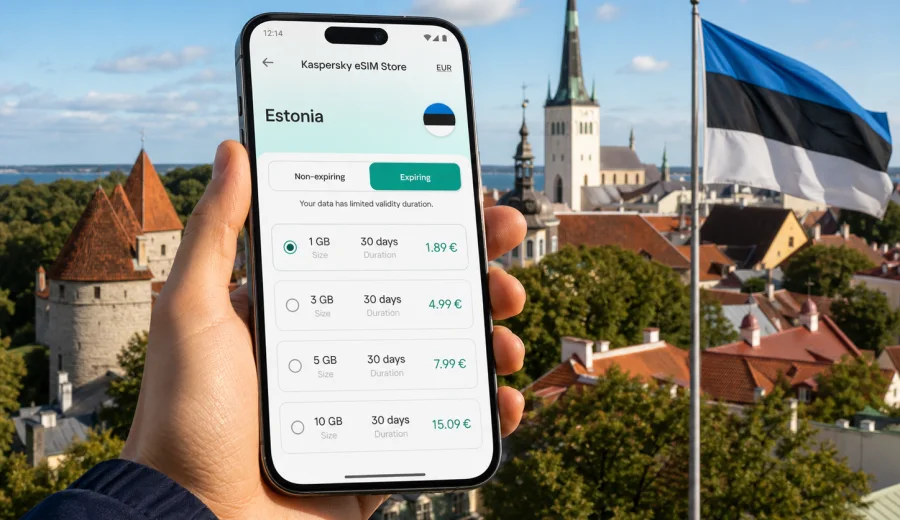
eSIM in Estonia: mobile connection and internet for travel
Estonia is a country where a trip can be surprisingly mobile. You may land in Tallinn, take a train or bus to Tartu, visit Saaremaa, move along the Baltic coast, or continue toward Latvia or Finland. Mobile internet quickly becomes a practical travel tool: maps, tickets, hotel messages, translation, ride apps, work chats, and banking often depend on being online.
An eSIM can help you prepare that connection before you start looking for a local shop or relying on public Wi-Fi. Instead of inserting a physical SIM card, you install a digital SIM profile on a compatible phone, choose it for mobile data, and use a prepaid data plan for your trip. Kaspersky eSIM Store is an app and website where you can quickly choose, arrange, and activate an eSIM with a suitable mobile internet tariff for travel abroad.
This guide explains how to think about eSIM for Estonia, how much data to consider, what to check before purchase, and how to use the connection in real travel scenarios.
Why eSIM is useful for Estonia
Estonia is highly digital in everyday life, and travelers often feel that quickly. Many routine tasks are easier when your phone has data as soon as you need it:
- opening a boarding pass or ferry ticket;
- finding the correct airport bus or tram stop in Tallinn;
- checking hotel check-in instructions;
- using maps in the Old Town, on islands, or between cities;
- confirming card payments or banking notifications;
- using messaging apps for calls and updates;
- checking museum, restaurant, or transport schedules;
- working remotely during a business trip.
A travel eSIM does not replace every form of communication. Many eSIM tariffs are built for mobile internet and may not include a local phone number, voice calls, or SMS unless this is stated in the tariff conditions. For many trips, that is enough: calls and messages can go through internet-based apps, while your main SIM can stay in the phone for important incoming messages if your device supports dual SIM use.
The main benefit is preparation. You can decide on a tariff before departure, understand the data allowance and validity period, and reduce dependence on public Wi-Fi at airports, cafes, hotels, and transport hubs.
Estonia travel scenarios where mobile internet matters
Different routes create different data needs. A short city break in Tallinn does not use data the same way as a week of remote work or a multi-stop Baltic trip.
| Trip scenario | Typical online tasks | What to consider |
|---|---|---|
| Weekend in Tallinn | Maps, restaurant bookings, tickets, messaging | A modest data package may be enough if you use hotel Wi-Fi for heavy downloads. |
| Business trip | Email, calendars, messengers, taxi apps, video calls | Choose more data if you cannot rely on office or hotel Wi-Fi. |
| Tartu, Parnu, Narva, or island routes | Navigation, transport updates, translation, photo sharing | Plan extra data because you may use maps and messaging more often between stops. |
| Estonia plus neighboring countries | Cross-border transport, ferry information, multiple hotel bookings | Check whether a country tariff or a regional option suits your route better. |
| Family trip | Shared navigation, children streaming, cloud photo backup | Separate heavy streaming from essential travel use and choose data accordingly. |
Estonia is small enough that people often underestimate how much they will use their phone. The country is easy to explore beyond one city, but the more you move, the more you depend on live navigation, transport searches, and messages. If you plan to drive, cycle, take ferries, or visit national parks, download offline maps before the trip and keep mobile data for updates, route changes, and communication.
How to choose an eSIM tariff for Estonia
Start with the trip, not with the biggest package. The best fit depends on how long you are staying, how you use your phone, and whether Estonia is the only destination.
Use this quick framework:
1. Estimate your trip length. A two-day stay has different needs from a two-week remote work stay.
2. List your essential apps. Maps, messaging, email, banking, translation, and transport usually matter most.
3. Separate light and heavy use. Browsing and chats use much less data than video calls, streaming, cloud backups, and large uploads.
4. Check whether your route stays in Estonia. If you continue to Latvia, Finland, or another country, compare country and regional options.
5. Read the tariff conditions. Check data volume, validity period, destination, price, activation logic, and any limitations before purchase.
A prepaid eSIM tariff helps you control travel data because you choose the package in advance. Still, do not treat any plan as unlimited unless the tariff says so. If your phone automatically backs up photos, updates apps, or syncs large files, it can consume data quickly.
Practical data planning for Estonia
These estimates are not promises, because apps and settings vary. Use them as a planning guide:
| Use type | Examples | Data impact |
|---|---|---|
| Light | Messaging, maps, email headers, basic browsing | Usually manageable on a smaller package. |
| Medium | Social media, photo uploads, route searches, travel research | Needs a more comfortable allowance for several days. |
| Heavy | Video calls, streaming, hotspot use, cloud backup | Can consume several gigabytes quickly. |
For a city break, you may be able to keep data use low by downloading maps, saving tickets offline, and connecting to trusted Wi-Fi at your hotel for updates. For a business trip, choose a data allowance that covers the moments when Wi-Fi is weak, unavailable, or inconvenient. For a family trip, decide whether one person will use hotspot mode for others; if yes, check whether tethering is allowed under the selected tariff conditions.
Before you commit, it is useful to compare available options and choose a plan that matches your travel style. When you are ready, you can choose an eSIM tariff for your trip to Estonia and review the data volume, validity period, and destination before activation.
What to check before buying
An eSIM is convenient only if your device and trip conditions match the tariff. Check these points before purchase:
- Your phone supports eSIM.
- The device is not locked to one carrier.
- You have a stable internet connection for installation.
- The tariff covers Estonia and the dates of your trip.
- You understand when the validity period starts.
- You know whether the tariff is data-only or includes other services.
- You know whether hotspot mode is allowed if you plan to share data.
- Your main SIM settings will not create unwanted roaming costs.
If you are unsure whether your phone can use eSIM, check your device before choosing a tariff. This is especially important if you bought the phone through a carrier, use an older model, or travel with a tablet instead of a smartphone.
How to install and activate eSIM for Estonia
Installation is usually straightforward, but it is worth doing it calmly rather than in a hurry at baggage claim. After purchase, the eSIM information appears in your profile or app, and you can follow the on-screen instructions or use a QR code if this option is available.
General steps:
1. Connect your phone to stable Wi-Fi.
2. Open the eSIM information in your account or app.
3. Add the eSIM profile to your phone.
4. Name the plan clearly, for example "Estonia data".
5. Keep your primary SIM for calls or messages if needed.
6. Set the eSIM as the mobile data line when you are ready to use it.
7. Turn on data roaming for the eSIM profile if the tariff instructions require it.
8. Test mobile data after arrival or once the plan is active.
For device-specific setup, use the Android installation guide or the iOS installation guide. Menus differ by device model and operating system version, so follow the instructions shown for your phone.
Do not delete an installed eSIM profile unless you are sure you no longer need it. In many cases, an eSIM profile cannot simply be moved to another device after activation. If something does not work, check the plan settings first and contact support before removing the profile.
Estonia-specific tips for smoother travel data
Estonia is easy to navigate with a phone, but the details matter. Prepare a few things before departure:
- Save your hotel address and booking confirmation offline.
- Download offline maps for Tallinn and any regions you plan to visit.
- Keep transport tickets or QR codes available without data.
- Add your eSIM as a named mobile data line so you do not confuse it with your primary SIM.
- Disable automatic app updates on mobile data.
- Pause cloud photo backup until Wi-Fi is available.
- Check whether messaging apps are ready for internet calls.
- Keep your charger or power bank available on travel days.
For Tallinn, mobile internet is useful immediately after arrival: route planning from the airport, public transport, ride apps, and access to accommodation messages. In Tartu, Parnu, Narva, Haapsalu, and island routes such as Saaremaa, the same connection helps with maps, ferry schedules, museum hours, restaurant bookings, and weather changes. If you are driving, do not rely only on live data. Download offline maps first, then use mobile data for traffic, closures, and communication.
eSIM compared with roaming, public Wi-Fi, and local SIM cards
There is no single best option for every traveler. The practical choice depends on price, convenience, device support, and the amount of data you need.
| Option | Strengths | Limits |
|---|---|---|
| Travel eSIM | Can be prepared before the trip, no physical SIM card, clear prepaid package | Requires compatible unlocked device; usually data-focused. |
| Standard roaming | Keeps your home number active and may require no setup | Costs and data limits depend on your home operator. |
| Public Wi-Fi | Useful for large downloads at hotels or offices | Not always available, may be inconvenient, and should be used carefully. |
| Local physical SIM | Can suit longer stays or local calling needs | Requires finding a seller, handling a physical card, and checking local terms. |
For many short or medium trips to Estonia, eSIM is attractive because it removes one practical step: you do not need to search for a SIM card after arrival. You can keep your original SIM in the phone and use the eSIM for mobile data. Before using both lines, check your phone settings so calls, SMS, and mobile data are routed the way you expect.
Quick setup checklist before departure
Use this checklist one or two days before travel:
- Confirm your phone supports eSIM and is not carrier-locked.
- Choose a tariff that covers Estonia and your travel dates.
- Install the eSIM while you still have stable Wi-Fi.
- Save the installation instructions and support access.
- Label the eSIM profile clearly in phone settings.
- Decide which SIM handles mobile data.
- Turn off mobile data roaming on your primary SIM if you want to avoid roaming charges.
- Download offline maps and important documents.
- Test that you can switch mobile data lines on your phone.
This preparation is especially useful for late arrivals, business trips, and family travel. When you are tired after a flight or ferry, a prepared data line can make the first hour simpler: navigation, messages, taxi apps, and check-in details are already within reach.
Frequently asked questions
Does eSIM for Estonia include calls and SMS?
Many travel eSIM tariffs focus on mobile internet. A regular phone number, voice calls, and SMS are not included unless the selected tariff conditions say otherwise. You can usually use internet-based messaging and calling apps over mobile data.
Can I install the eSIM before I arrive in Estonia?
In many cases, you can install the eSIM before departure while connected to Wi-Fi, then use it when the tariff is active and the phone is in the covered destination. Always check the activation and validity details for the selected tariff.
Should I keep my main SIM active?
That depends on your needs. Some travelers keep the main SIM active for banking messages or incoming calls and use the eSIM for mobile data. Check your phone settings carefully to avoid unintended roaming charges on the primary SIM.
Can I use hotspot mode with an eSIM?
Hotspot availability depends on the selected tariff and device settings. If you plan to connect a laptop or share data with family, check the tariff conditions first and monitor usage closely.
What if Estonia is part of a wider Baltic or European route?
If your trip includes Latvia, Lithuania, Finland, or other countries, compare an Estonia-specific tariff with regional options. The right choice depends on destinations, dates, and data volume. Do not assume that a country tariff covers every border crossing unless the conditions say so.
Final thoughts before your trip
For Estonia, eSIM is most useful when it is treated as part of travel preparation rather than a last-minute fix. Check your device, choose a realistic data package, install the profile on stable Wi-Fi, and set your phone so the eSIM handles mobile data when you need it. That gives you a clearer way to manage internet access for Tallinn, Tartu, island routes, business meetings, and onward travel.
Kaspersky eSIM Store helps you choose, arrange, and activate an eSIM with a suitable tariff for mobile internet in a foreign trip. Before you go, review the available options and prepare an eSIM tariff for Estonia so your mobile connection is ready for maps, messages, tickets, and everyday travel tasks.