Travel connectivity guide
ETL eSIM in Laos: what to check
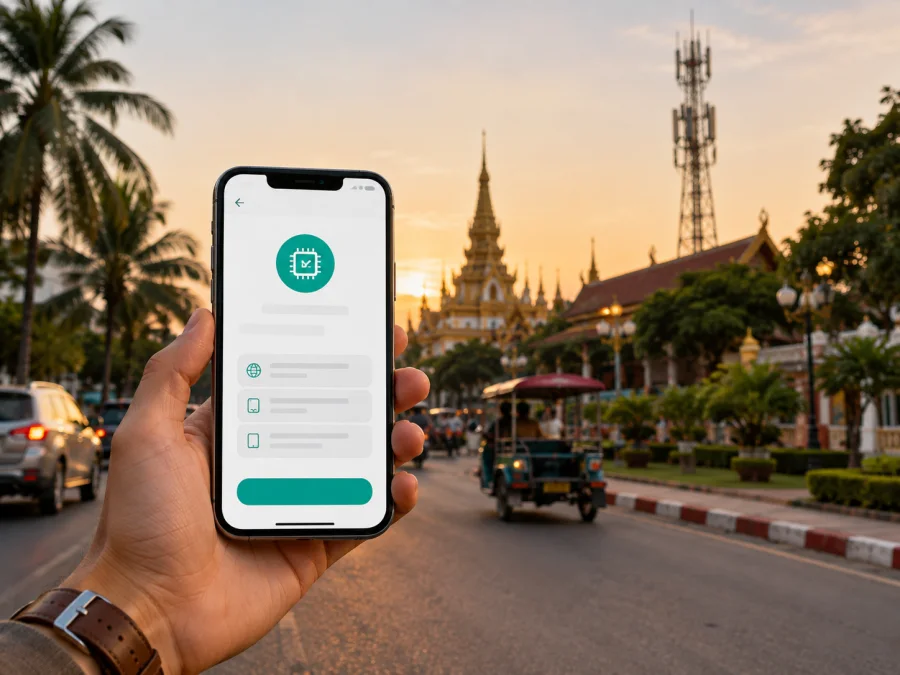
ETL eSIM in Laos: what travelers should check before connecting
If you are planning a trip to Laos and are searching for an ETL eSIM, the first step is to separate confirmed information from assumptions. ETL is a Lao telecommunications operator with mobile, internet, prepaid and customer self-service offerings. Its public English pages describe 4G and 4.5G mobile services, prepaid SIM registration, recharging and account management. However, on the verification date, 7 September 2026, those official pages did not provide a current public confirmation that ETL issues an eSIM directly to travelers. That does not prove that the option is unavailable; it means that the current eSIM status should be checked with ETL before a purchase or installation.
This distinction matters because an eSIM sold for use in Laos may connect through a local network without being issued by ETL. A travel eSIM and a local ETL line can follow different registration, activation and support processes. This guide explains what is confirmed, what to ask and how Kaspersky eSIM Store may help with travel data.
ETL’s role in the Laos mobile market
ETL Company Limited presents itself as a telecommunications operator in Lao PDR. Its public English site groups mobile phone, mobile internet, prepaid, customer service and self-service tools in one operator environment. This makes ETL relevant for people who want a local mobile connection in Laos, particularly when they need an account that can be registered and managed through local channels.
The operator’s public materials show several parts of the local customer journey. A prepaid customer can register a SIM, activate service, recharge an account and check balance or data information. ETL also describes a customer application for self-service actions, including account queries, recharging and purchasing mobile data services. Its separate ETL-KYC application is described as a tool for registering ETL SIM cards and collecting identity information for registration.
For a visitor, this means that a local ETL connection should be treated as a regular operator account rather than as an automatically anonymous travel product. Registration requirements, accepted documents, activation channels and the availability of service for foreign visitors may depend on current local rules and the point of sale. The safest approach is to confirm those details at an official ETL channel before relying on the connection for arrival, transport, accommodation or work.
The official prepaid information also shows that ETL supports prepaid service in general. It describes ways to activate mobile service, recharge and manage an account, but the specific commercial offers on that page can change. This article intentionally does not reproduce named offers, commercial parameters, activation codes or other plan details. Travelers should use the current operator page or an ETL representative for those details at the time of the trip.
Is an ETL eSIM available in Laos?
As of 7 September 2026, confirmation was not found on ETL’s current public English pages that ETL offers a directly issued eSIM for travelers in Laos. The reviewed pages cover prepaid service, mobile internet, an ETL customer application and SIM registration through ETL-KYC. The site map also exposes regular mobile and prepaid sections, but it did not expose a current public ETL eSIM page or a traveler eSIM activation guide.
Do not interpret the absence of a public page as a definitive statement that ETL can never provide an eSIM. Operators may restrict information to stores, apps, customer support or local-language channels, and service policies can change. Before paying for a product described as an “ETL eSIM,” ask the seller or ETL support to clarify three points: whether the profile is issued by ETL, whether it uses ETL radio access in the intended locations, and which registration and identity documents are required for a visitor.
If current ETL support confirms a direct eSIM option, check whether it is available for prepaid customers, whether it can be issued before arrival, whether the customer must appear in person, and whether a passport or another identity document is needed. Ask what happens if the phone is replaced, reset or lost. Also confirm whether the profile can be reinstalled, whether it is data-only or includes ordinary voice and SMS, and where technical support is provided. These are service conditions, not details that should be guessed from the word “eSIM.”
If ETL does not confirm eSIM support for your case, a physical prepaid SIM may be the local alternative, subject to registration. Keep the distinction clear: an ETL prepaid SIM is a local operator product, while a travel eSIM is normally arranged through another service and may only provide mobile data. Check the name of the issuing provider and the underlying network before you install anything.
What ETL’s official pages confirm about connection and activation
ETL’s current public pages are more detailed about physical SIM service than about eSIM. The prepaid section explains that customers register a SIM and use operator channels for activation and account actions. It also gives customer-care contacts and references SIM registration through Lao KYC processes. The ETL-KYC page describes identity-document capture and confirmation by SMS for SIM registration. For a traveler, this indicates that registration is an important part of the local connection process and should be planned rather than left until the moment a phone is needed.
The operator also describes an ETL self-service app for account queries, recharging and mobile data management. App availability and the exact steps for a foreign visitor should be checked in the current store listing or with ETL.
For an eSIM, the activation path is different from inserting a local plastic SIM. The phone may display an “Add eSIM” option, while the issuer may provide a QR code, activation link or in-app instructions. Download the profile over a working connection, select it for mobile data and follow the issuer’s instructions. Before travel, confirm that the handset is unlocked, label dual-SIM lines clearly and do not delete a profile during troubleshooting unless the provider confirms that it can be reissued.
Documents and traveler restrictions
The ETL-KYC material describes registration using an identity document and a photograph of the person registering. The exact document rules for a foreign visitor, the accepted passport format, the need for a local address and the role of an authorized agent should be confirmed with ETL at the time of purchase. Carry the original travel document when a local registration process requires it, and avoid handing a copy to an unofficial seller whose identity and data-handling practices are unclear.
A traveler should also check whether the service can be registered before arrival. The public ETL material points to local registration and customer-service channels, but it does not establish that a visitor can complete every step remotely. If the connection is needed immediately after landing, arrange a backup such as hotel Wi‑Fi, airport connectivity or a pre-installed travel eSIM from a service that clearly confirms support for Laos.
The phone needs eSIM hardware, an unlocked cellular configuration and current software. Regional variants differ, and some phones limit stored or active profiles. Check the exact model before ordering; keep the primary line available for important messages and prevent unintended data roaming.
Coverage and supported technologies
ETL’s official mobile pages describe 4G and 4.5G service. That is useful evidence of the technologies presented for ETL mobile internet, but it is not a promise that every street, road or indoor location in Laos will have the same access. The operator’s pages reviewed for this article did not provide a current detailed public coverage map that could be used to make a location-by-location guarantee.
A responsible coverage check has two parts: confirm that the phone supports the intended technology and check the planned route with the operator or issuer, especially in rural areas, mountain roads, islands and border regions. Terrain, buildings, maintenance and local availability can affect access. A displayed 4G or 4.5G label describes the current connection mode, not guaranteed performance everywhere, so keep essential addresses and maps available offline.
An eSIM seller’s claim that a profile works on ETL does not by itself confirm that ETL issued it or that ETL will be selected in every location. Ask which network the profile can use and how the provider handles failed registration.
Local ETL service or travel eSIM?
The choice depends on what you need from the connection. A local ETL account may be appropriate when you want a Laos-issued line, local customer support, ordinary operator services or a local number, and you are ready to follow the registration process. It can require a store, an authorized agent, identity verification and a local recharge method. Those requirements are not disadvantages by themselves; they are simply part of using a local operator.
A travel eSIM is designed around a different journey. It can often be selected before departure, installed on a compatible unlocked phone and used for mobile data after landing. It may avoid a visit to a local sales point, but it may not include an ordinary local number, voice service or SMS, and its support is provided by the travel eSIM service rather than ETL. The underlying network and roaming configuration should be visible in the service information.
The two options can coexist. A traveler may keep the home SIM for important messages and use a local ETL line or travel eSIM for data. Check which line is active for calls, SMS and mobile data, and disable automatic data switching if needed.
Kaspersky eSIM Store as a travel-data alternative
Kaspersky eSIM Store is an app and website that helps a traveler choose, order and activate an eSIM with a travel mobile-data plan. It is not a mobile operator, does not own ETL’s network and does not provide Laos radio coverage itself. The official Kaspersky description explains that the service gives access to travel eSIM options connected through local telecommunications providers. The practical role is to prepare a data connection for a trip, not to replace the local operator’s registration or customer account.
If you want to review a travel eSIM option for Laos, explore the Kaspersky eSIM Store options for Laos. Before ordering, check the phone’s eSIM compatibility, unlock status and installation instructions. The app or website can be used to review the destination and the current conditions shown for the selected offer. Do not assume that a Laos travel eSIM is an ETL-issued line unless the service explicitly identifies ETL as the issuing operator and states the relevant network arrangement.
Kaspersky’s official travel-eSIM guidance describes installation and activation through the app or website, with preparation before the trip when the selected service supports it. A stable internet connection is needed for installation. After arrival, select the eSIM for data and follow the provider’s instructions. The travel option is intended for mobile internet rather than a local telephone identity; traditional calling, bank messages or a Laos number may require another line.
ETL and Kaspersky eSIM Store are different parts of the travel decision: ETL is the local operator with publicly documented prepaid mobile service and 4G/4.5G offerings, while Kaspersky eSIM Store is a travel-oriented app and website for selecting, ordering and activating an eSIM data option. Neither description confirms ETL eSIM issuance through Kaspersky eSIM Store.
Practical preparation checklist
Use this sequence before a Laos trip:
- Confirm the exact phone model, eSIM support and operator-unlock status.
- Decide whether you need a local ETL identity, mobile data only, or both.
- Ask ETL whether a direct eSIM is currently issued to foreign visitors and what registration documents are required.
- If using prepaid ETL service, confirm the current registration, activation and recharge process through an official channel.
- If using a travel eSIM, verify the issuing provider, permitted network, data-only limitations and support procedure.
- Install only after checking the destination and keeping the activation instructions available offline.
- At arrival, select the intended data line, review roaming settings and test a simple web page or message.
- Keep offline copies of bookings, addresses, emergency contacts and support instructions.
The most important step is the third one: ETL’s public pages confirm local prepaid and mobile services, but not a directly issued traveler eSIM on the verification date.
Final takeaway
ETL is a local Laos operator with public prepaid, mobile internet, SIM registration and self-service information. Its pages describe 4G and 4.5G mobile service. A directly issued ETL eSIM for travelers was not confirmed on the pages checked on 7 September 2026. Verify that point with ETL and do not confuse a travel eSIM using ETL access with an ETL-issued profile.
If you need a separate travel-data route, check your device and the current Laos conditions in Kaspersky eSIM Store, then follow the activation instructions for the selected product. Prepare offline information and keep your primary line under control. Kaspersky eSIM Store is not affiliated with ETL, and this article does not represent a partnership, endorsement or other commercial relationship between the two services.