Travel connectivity guide
Flamands eSIM: Mobile Internet in Saint Barthélemy
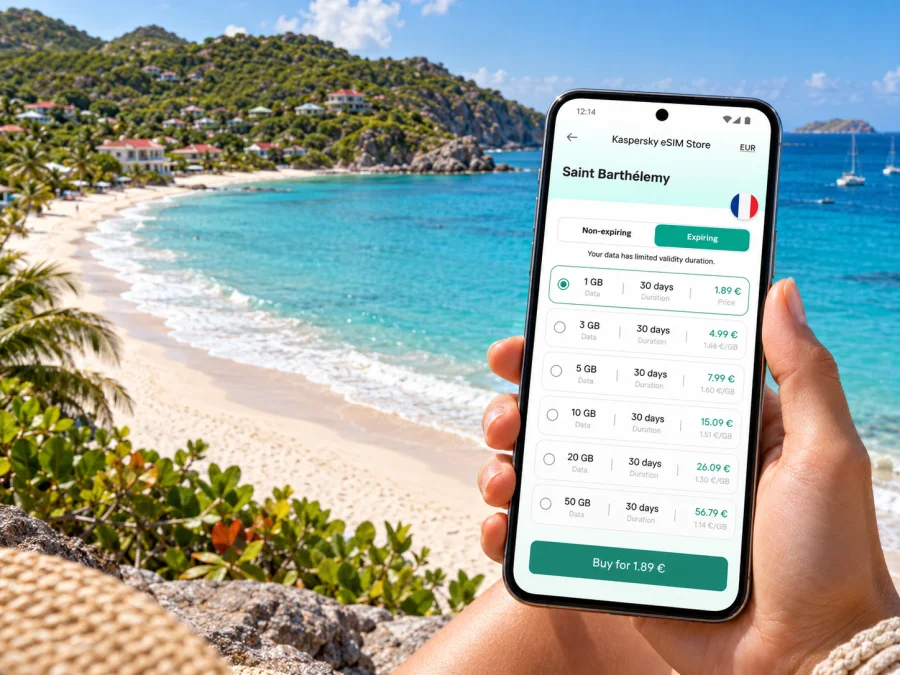
Flamands eSIM: Mobile Connection and Internet for Your Stay
Flamands is a quiet coastal area on the northwest side of Saint Barthélemy, best known for its broad, pale-sand beach and open Atlantic-facing shoreline. A stay here can feel wonderfully unhurried: mornings by the water, a drive to Gustavia for errands or dinner, and perhaps a walk toward Colombier. Yet even a relaxed island visit involves practical moments when mobile internet matters: confirming a villa arrival, checking a route, contacting a driver, or looking up a change in plans.
Preparing an eSIM before you travel can make those moments easier. It gives a compatible phone a digital mobile data profile without replacing the physical SIM already in your device. The details that matter are the destination included in the selected plan, its data allowance, validity period and activation rules. Those details help you decide whether an eSIM fits a short beach break, a longer stay in a villa, or a working trip based around Flamands.
Flamands is a beach area, not a separate city
Flamands is a named area on Saint Barthélemy, not an independent city or a separate country. Its identity is closely tied to Anse des Flamands, the island’s long sandy beach, with accommodation and a small number of places to eat scattered around the shoreline and hillsides. For practical planning, think of Flamands as a peaceful base on the island rather than a dense urban centre with a walkable grid of shops and services.
That distinction affects how you use mobile data. You may rely on directions more often than you would in a compact town, especially when following a driver, finding a villa entrance, or choosing a route between bays. Shops, restaurants, and errands may be in other parts of the island, so it is useful to save your accommodation address and key details before you leave a reliable connection.
Saint Barthélemy is a French overseas collectivity in the Caribbean. It has its own destination identity and local telecommunications market. A French territory status does not mean every plan labelled for metropolitan France automatically includes Saint Barthélemy. Check the plan’s eligible destination list and conditions specifically for Saint Barthélemy before purchase. Saint Martin, Guadeloupe, and other Caribbean destinations are separate coverage questions; nearby geography does not guarantee that a plan for one includes another.
What to expect around Flamands
The beach is the central landmark. It is long and open, backed by green slopes and low-rise accommodation rather than a continuous commercial promenade. The setting is excellent for swimming, walking, and taking a break, but it is exposed to the sea. Conditions change, and mobile service can vary with terrain, buildings, network load, and the plan’s partner network. Do not treat an advertised island-wide service as a promise of identical performance at every point on the sand, inside a villa, or along a hillside road.
Flamands is also a useful base for short island journeys. Gustavia, the island’s main harbour town, is where many visitors handle shopping, dining, appointments, and onward connections. Saint-Jean is another practical reference point for airport access, services, and places to eat. Roads are winding and follow the island’s hills and coast; travel times depend on traffic, weather, and where exactly you are staying. Use a live map when available, but keep the address and directions to your lodging somewhere accessible offline as a backup.
| Part of the trip | Why mobile data helps | A sensible backup |
|---|---|---|
| Arrival and meeting a driver | Share your arrival status, confirm a pickup point, or message if plans change | Save the driver’s number and meeting instructions in advance |
| Finding a villa | Follow the final route and coordinate with the host | Keep the full address, access notes, and a screenshot of directions |
| Beach time | Check messages, weather updates, and plans for the rest of the day | Download a map and avoid relying on a signal at the water’s edge |
| Going into Gustavia or Saint-Jean | Compare routes and confirm opening details before leaving | Save reservations and addresses offline |
| A day around the island | Adjust plans as you move between beaches and viewpoints | Keep a paper or offline itinerary and enough battery for navigation |
Plan the connection around your itinerary
A Flamands holiday may have very different data needs from a fast city break. If you spend most of the day at the beach and use a villa’s Wi-Fi in the evening, messaging, maps, and occasional browsing may be enough. If you work remotely, make frequent video calls, upload photos, or stream while away from Wi-Fi, your data use can rise quickly. Estimate your typical daily use rather than selecting a plan from the destination name alone.
A simple planning method:
- List the tasks you expect to do on mobile data: navigation, chat, email, ride coordination, browsing, calls through apps, or media uploads.
- Check how many days you need data away from trusted Wi-Fi, including arrival and departure days.
- Allow for heavier use on travel days, when you may need maps, messages, and booking details at the same time.
- Compare the plan’s data amount and validity with that estimate. Read whether validity begins at installation, activation, or first network connection.
- Confirm that Saint Barthélemy itself is listed as an eligible destination and note any conditions for use or top-ups.
For a short visit, avoiding a plan that expires before the trip ends may matter more than choosing the largest allowance. For a week or longer, consider how often you will be away from lodging Wi-Fi and whether your work depends on uploads or calls. Keep automatic photo backups and app updates on Wi-Fi if you want to preserve data for navigation and communication.
When you are ready to compare the available destination options, review eSIM plans for Saint Barthélemy and check each plan’s allowance, validity, eligible territory, and activation terms. This is the relevant destination page for a stay in Flamands. Do not select a plan for France, Saint Martin, or the wider Caribbean solely because the names appear geographically or administratively related.
Coverage: plan for variation, not a guarantee
Mobile networks are built and operated locally. In Saint Barthélemy, the regulator lists multiple authorised mobile operators, and local network operators publish coverage information for their own services. That tells you that connectivity is a local network matter; it does not identify the network used by every travel eSIM. The operator market, your phone’s regional hardware variant, and the roaming or partner arrangements attached to a particular eSIM plan are separate factors.
For your trip, use the plan’s terms to determine whether the destination is included and which network selection or roaming requirements apply. If the plan specifies an available network, compare that information with current coverage information from that network where possible. A general island coverage map can help with expectations, but maps are approximations. Signal indoors, behind a hillside, at the edge of the beach, or during busy periods can differ from an outdoor coverage estimate.
Keep these distinctions in mind:
- Territory: Saint Barthélemy is the place you are visiting; it is not interchangeable with metropolitan France or another Caribbean island for plan eligibility.
- Market: the local operator market is distinct from the travel eSIM provider or app where you choose a plan.
- Network: the specific plan determines which partner network or networks may be available, subject to the plan’s current conditions.
- Device variant: phones with the same retail name can have different radio-band support by region. Compatibility with eSIM alone does not guarantee every network feature.
- Location: a signal can vary between Gustavia, Saint-Jean, Flamands, indoor rooms, and roads through hills.
Choose an eSIM for Flamands
Kaspersky eSIM Store is an app and website where you can choose, purchase, and activate an eSIM with a suitable plan for mobile internet on an international trip. The service is not the local mobile operator. Your selected plan’s terms determine the included destination, data, validity, and usage conditions, so review those details before checkout.
Use this checklist before choosing:
- Destination: Saint Barthélemy is explicitly covered by the plan. Do not infer inclusion from a plan for France or another island.
- Data allowance: the amount fits your likely use away from Wi-Fi, especially maps, app calls, photo sharing, and work uploads.
- Validity: the plan remains valid for the dates you need it. Check when the validity period starts.
- Top-ups: if you may need more data, find out whether the selected plan allows a top-up and how it works.
- Phone support: the device supports eSIM, is not restricted by a carrier lock, and has the right regional configuration for use abroad. Check whether your device supports eSIM.
- Current SIM: decide whether to keep your regular line active for incoming calls or messages, and check its roaming settings and charges with your current provider.
An eSIM plan for mobile data does not automatically provide a standard local phone number, voice minutes, or SMS. Those services are included only if the selected plan says so. Many travellers keep their usual number available for important calls or verification messages and use data-based messaging apps for everyday contact. Check your home provider’s charges before leaving your primary line enabled abroad.
Install before departure, activate with care
If you have a stable connection before travelling, setting up the eSIM in advance can reduce the number of tasks after landing. Follow the plan’s instructions: some eSIMs can be installed before the trip, while the validity period may start only under the activation conditions stated for that plan. Do not assume that installing the profile and beginning to use data are always the same event.
A practical setup sequence:
- Confirm the phone is unlocked and supports eSIM. Some regional versions of a device differ, so verify the exact model and variant rather than relying only on the product family name.
- Purchase a plan that explicitly includes Saint Barthélemy. Save its activation steps and support details.
- Install the eSIM over a stable Wi-Fi connection, using the method provided with your purchase. Keep the QR code or activation information available until setup is complete.
- Label the new line clearly, for example “Travel data”, so you can distinguish it from your home SIM.
- Before departure, leave your primary line configured for the services you need and avoid enabling data roaming on it unless you have checked the charges.
- On arrival, select the travel eSIM for mobile data and follow the plan’s instructions for data roaming or network selection if required.
For step-by-step help, use the Android eSIM installation instructions or the iOS eSIM installation instructions. Menu names can differ by operating-system version and manufacturer, so follow the instructions shown for your device. Keep the primary line’s voice and SMS settings separate from the travel eSIM’s data settings.
If the data connection does not start, pause before deleting the eSIM profile. Check that the plan is active, that the phone has selected the travel line for mobile data, and that any required roaming setting is enabled for that line. Restarting the phone can help it register again, but do not repeatedly change settings without checking the plan instructions. If the issue remains, use the support channel shown with your purchase; retaining the profile and order details may help resolve it.
Getting around from Flamands
The island is small, but it is hilly and its roads curve around bays rather than following a city grid. If you are renting a car, save your accommodation pin and check the route before setting off. If a host or driver is meeting you, send the exact lodging name and location; “Flamands” alone may not identify a specific entrance.
For a beach day, download a map and save your return plan before heading to the shore. A saved map will not show live traffic or fresh business updates, but it can help you orient yourself if mobile data pauses. Carry a charging cable or power bank if you expect to use navigation and messaging throughout the day.
For errands in Gustavia or Saint-Jean, save addresses, reservations, and pickup details before leaving. Confirm airport transfer time and meeting point with your driver. Flight and transfer information can change, so check current details through the carrier or booking service when you have a connection.
A simple arrival scenario
Before departure, store the address, host’s number, access instructions, and map pin in your notes. When your travel eSIM is active, message your host with your arrival status and follow the saved route. If the final turn is unclear, contact details stored outside your email make it easier to ask for help without searching online.
A remote-work scenario
Test work apps and video calls before travel. Ask your accommodation what its Wi-Fi can support, and treat mobile data as a backup for messages or short interruptions. Video calls and cloud backups can use a substantial share of a small allowance. If work cannot tolerate a drop in service, arrange a backup with your team rather than relying on an unverified beach-side connection.
Reduce data use while keeping essentials available
- Download maps, boarding passes, reservations, and work files over Wi-Fi.
- Set photo backups and app updates to Wi-Fi only if you want to preserve mobile data.
- Choose audio-only or lower video quality for calls when possible.
- Check remaining allowance in the account or app associated with the plan; the phone’s total data counter may include other lines.
Before you leave: Flamands connection checklist
- [ ] Confirm that Saint Barthélemy is included in the exact eSIM plan you selected.
- [ ] Check the plan’s start condition, validity dates, data amount, and top-up rules.
- [ ] Verify eSIM support and carrier-unlocked status for your exact phone variant.
- [ ] Install the profile when you have reliable Wi-Fi and keep its setup instructions.
- [ ] Save your lodging address, host details, driver contact, and map pin offline.
- [ ] Set the travel eSIM as the mobile-data line only when appropriate; review roaming on your primary SIM.
- [ ] Download confirmations and maps, and bring a charging option for long days out.
- [ ] Keep another way to contact your host or travel companions if mobile data is temporarily unavailable.
Frequently asked questions
Is Flamands a city?
No. Flamands is a coastal area on Saint Barthélemy, known for its beach and nearby accommodation. It is best treated as a place to stay and explore from, with trips to other island centres such as Gustavia and Saint-Jean.
Does a plan for France include Saint Barthélemy?
Not necessarily. Saint Barthélemy has a distinct destination market for mobile service. Check the selected plan’s included destinations and terms; do not rely on the fact that the island is a French overseas collectivity.
Will an eSIM work everywhere around Flamands?
No plan can guarantee uninterrupted service in every building, on every road, or along the entire coastline. Availability depends on the plan, its network arrangements, the device, location, terrain, and local network conditions. Download essential details and maps in advance.
Can I use the eSIM for regular calls and text messages?
Only if those features are explicitly included in the selected plan. A data-only eSIM can support calls and messages through internet-based apps, but it does not itself provide a standard phone number or SMS service.
Should I install the eSIM before I travel?
Often it is convenient to install it over reliable Wi-Fi before departure, but follow the specific plan’s instructions. Check when validity begins, because installation and activation may be separate steps.
What if I am visiting Saint Martin as well?
Check whether the exact plan includes both Saint Barthélemy and Saint Martin. They are separate destinations for plan eligibility, and coverage in one should not be assumed from inclusion of the other.
Prepare your mobile connection for Flamands
A good connection plan starts with the actual shape of your trip: a beach area, winding island roads, and visits to Gustavia, Saint-Jean, or other bays. Check the destination, data allowance, validity, device compatibility, and activation rules before departure. Then save the addresses and essentials you may need offline, so a temporary signal change does not disrupt the day.
Use Kaspersky eSIM Store on the app or website to choose and activate an eSIM with a plan suited to your travel needs. Explore eSIM options for Saint Barthélemy and compare the terms for your dates before you go.


