
Travel connectivity guide
Germany eSIM: mobile internet for travel
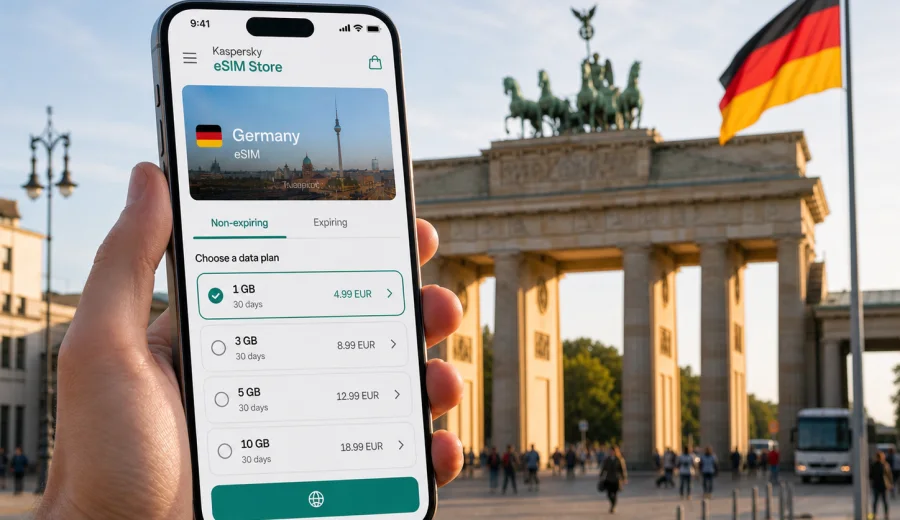
Germany eSIM: mobile connection and internet for your trip
Planning mobile connection and internet access before you arrive in Germany can make the first hours of your trip much easier. With a mobile internet for a trip to Germany, you can prepare mobile data for navigation, hotel check-in, train tickets, business messages, and everyday travel tasks without looking for a physical SIM card after landing.
An eSIM is a digital SIM profile installed on a compatible phone or tablet. In the context of international travel, it is mainly used for mobile internet. You choose a tariff for the country or region you are visiting, install the eSIM profile on your device, and use it for data when the trip starts. Kaspersky eSIM Store is the app and website that helps you choose, arrange, and activate an eSIM with a suitable tariff for mobile internet during a foreign trip.
Germany is a country where mobile data is useful almost immediately. You may need it at Frankfurt Airport, Munich Airport, Berlin Brandenburg Airport, Hamburg Central Station, a rental car desk, a trade fair, a hotel reception, or while moving between cities by train. Public Wi-Fi can help in some places, but it is not a complete travel plan. A prepared eSIM gives you a more controlled way to keep essential apps online.
Why an eSIM is useful for Germany
Germany is easy to travel around, but many routine actions depend on internet access. Rail platforms can change, local transport apps may require live updates, museum tickets are often digital, and business visitors may need email or messaging before reaching a hotel. A travel eSIM helps you avoid turning every arrival task into a search for Wi-Fi.
For many visitors, the most practical benefits are:
- mobile internet soon after arrival, once the eSIM is installed and activated according to its conditions;
- no need to replace your physical SIM card;
- the ability to keep your usual SIM active for calls, banking messages, or account verification if your phone supports dual SIM use;
- clearer control of data volume, validity period, destination, and price before you choose a tariff;
- less dependence on airport shops, hotel Wi-Fi, or local SIM card counters.
This does not mean that an eSIM replaces every mobile service. Most travel eSIM tariffs are designed for data. They usually do not include a regular local phone number, traditional voice calls, or SMS unless this is clearly stated in the selected tariff conditions. For calls and messages, many travelers use internet-based apps through mobile data.
Germany travel scenarios where mobile data matters
Your data needs depend on the style of your trip. A weekend in Berlin is different from a two-week route through Bavaria, the Rhine Valley, Hamburg, and Cologne. A business trip to a trade fair is different again. Use the scenarios below to estimate what you need before choosing a tariff.
| Scenario in Germany | Typical online tasks | What to consider |
|---|---|---|
| Airport arrival | Maps, taxi or train apps, hotel route, messaging | Activate only when you are ready to use data if the validity period starts on activation |
| City break | Navigation, reservations, tickets, translation | A smaller data package may be enough if you use hotel Wi-Fi for heavy downloads |
| Business trip | Email, calendars, video links, document access | Choose a validity period that covers arrival, meetings, and departure day |
| Rail route between cities | Live train updates, platforms, maps, messaging | Allow extra data for navigation and changes in plans |
| Family travel | Shared logistics, tickets, photos, messaging | Check whether hotspot use is allowed in the selected tariff |
| Longer stay | Daily maps, work tools, streaming, cloud backup | Choose more data or plan for top-ups if available for your selected tariff |
The point is not to buy the largest package automatically. It is to match the tariff to your route, number of days, and expected app use. Germany has dense urban travel patterns, and mobile data is often used in small but frequent sessions: opening a map, checking a platform, scanning a ticket, sending a message, or confirming a booking.
How to choose an eSIM tariff for Germany
Start with your dates and your itinerary. A traveler who lands in Munich, spends three days in the city, and flies home may need less data than someone who travels from Berlin to Dresden, Prague, Nuremberg, and Frankfurt. If your route stays inside Germany, a Germany-specific tariff can be the simplest option. If your trip crosses borders, check whether a regional Europe tariff is more suitable.
Before you choose, compare these points:
- destination: Germany only, Europe, or a wider region;
- data volume: light navigation and messaging, normal daily use, or heavier work use;
- validity period: it should cover all travel days, including arrival and departure;
- start rules: some tariffs begin when installed, others when first connected to a supported network;
- top-up options: check whether you can add data later for the selected tariff;
- hotspot use: important if you plan to share data with a laptop or another device;
- device compatibility: your phone or tablet must support eSIM and must not be blocked by an operator.
If you are ready to compare options, you can choose an eSIM plan for Germany and review the available data volumes, validity periods, and conditions before completing the setup.
How much data do you need in Germany?
There is no single correct amount of data for every traveler. A careful estimate is better than a guess. Messaging and maps usually use much less data than video calls, cloud backups, or streaming. Automatic app updates and photo synchronization can also consume data quietly if they are not limited in settings.
Use this practical guide as a starting point:
- Light use: messaging, maps, search, transport apps, email without large attachments.
- Standard travel use: maps, bookings, tickets, social media, moderate photo uploads, restaurant search, ride apps.
- Work use: email, documents, conference tools, cloud access, occasional video meetings.
- Heavy use: video calls, streaming, large file transfers, hotspot for a laptop, frequent photo and video uploads.
For a short city trip, a smaller package may be enough if you keep streaming and backups on Wi-Fi. For a business trip or a route across several German cities, choose more headroom. If you plan to use a laptop through your phone, check hotspot permissions and remember that desktop browsing and cloud tools can consume data faster than mobile apps.
Before you buy: compatibility checklist
Not every device can use an eSIM. Before choosing a tariff, check your device and confirm that it supports eSIM. Also check that the device is not locked to one mobile operator. Some phone models differ by region, even when the model name looks the same.
Use this checklist:
- Your phone or tablet supports eSIM.
- The device is not locked by an operator.
- The operating system is up to date enough to add an eSIM profile.
- You have stable internet access for installation.
- You can receive the installation email or open your Kaspersky eSIM Store profile.
- You understand when the selected tariff validity period starts.
- You know whether data roaming must be enabled for the eSIM profile on your device.
- You have not already used the same QR code or profile on another device, unless the tariff conditions allow it.
If any point is unclear, check it before payment. Compatibility is especially important when you travel with a work phone, a phone bought in another country, or a device managed by an employer.
Once your route and approximate data needs are clear, you can choose a suitable eSIM data plan for the trip and compare data volume, validity period, and activation conditions before installation.
Installing and activating your eSIM
The exact flow can vary by device, but the overall process is simple: choose a tariff, install the eSIM profile, and select it for mobile data when you need internet in Germany. For device-specific steps, use the Android installation guide or the iOS installation guide.
Typical steps:
1. Check that your device supports eSIM and is not operator-locked.
2. Choose the Germany tariff that matches your travel dates and data needs.
3. Complete the order process in Kaspersky eSIM Store.
4. Open the installation instructions from your profile or email.
5. Add the eSIM profile to your phone by following the on-screen steps or scanning the QR code.
6. Name the eSIM profile clearly, for example "Germany data".
7. Select the eSIM for mobile data when you are ready to use it.
8. If required by your device or tariff conditions, enable data roaming for the eSIM profile.
9. Wait a few minutes for connection if the device needs time to register on a local network.
If you install the eSIM before departure, keep your primary SIM selected for everyday data until the trip begins. When you arrive in Germany, switch mobile data to the eSIM profile if that is the recommended activation scenario for your selected tariff. Always follow the conditions shown for your tariff because validity rules can differ.
eSIM, roaming, local SIM, and public Wi-Fi
Travelers usually compare four ways to stay online in Germany: standard roaming from their home operator, a local physical SIM card, public Wi-Fi, and a travel eSIM. Each option can work, but they solve different problems.
| Option | Main advantage | Main limitation |
|---|---|---|
| Standard roaming | Uses your existing SIM and number | Cost and conditions depend on your home operator |
| Local physical SIM | Can be useful for longer stays | Requires finding a point of sale and using a physical card |
| Public Wi-Fi | Often available in hotels, airports, and cafes | Not always available when you need it and may require logins |
| Travel eSIM | Can be prepared before the trip and used without a physical SIM | Requires a compatible, unlocked device and a suitable tariff |
An eSIM is often attractive because it fits the real rhythm of travel. You can prepare it before the flight, keep your main SIM in the phone, and use mobile data for daily tasks. It may help reduce travel connectivity costs compared with some roaming scenarios, but the right choice depends on your home plan, your data needs, and the tariff you select.
Practical Germany route examples
Berlin weekend
For a three-day Berlin trip, mobile data is useful for airport transfers, U-Bahn and S-Bahn routes, digital tickets, restaurant bookings, and messaging. If you mostly use hotel Wi-Fi for photos and video, moderate mobile data may be enough. Keep offline maps saved as a backup, but do not rely on them for live transport changes.
Munich and Bavaria
If your trip includes Munich, Neuschwanstein, lakes, or alpine day trips, you will likely use maps more often outside one city center. Check route apps before leaving the hotel, keep tickets accessible offline, and choose a validity period that covers travel days in both directions.
Business travel to Frankfurt, Cologne, or Hannover
Trade fairs and meetings often require reliable access to email, calendars, document links, ride apps, and messaging. If you may share data with a laptop, confirm hotspot rules. Choose enough data for work tasks and avoid large cloud sync operations on mobile data unless your tariff has room for them.
Multi-country Europe trip
If Germany is one part of a wider Europe route, check whether a Germany tariff or a Europe tariff fits better. For example, a route through Germany, Austria, Switzerland, France, or the Netherlands may need regional coverage. The important point is to choose a tariff that matches the actual countries on your route, not only your arrival airport.
Settings that help control data use
Once your eSIM is active, a few settings can make the data package last longer:
- Turn off automatic app updates on mobile data.
- Pause cloud photo and video backup until Wi-Fi is available.
- Download offline maps for major cities before departure.
- Limit video streaming quality when using mobile data.
- Use messaging apps in data-saving mode if available.
- Check which SIM profile is selected for mobile data.
- Keep your primary SIM from using roaming data if you do not want roaming charges.
These settings are especially useful when you travel across Germany by train, because you may check maps, tickets, messages, and platforms repeatedly during the day. Small sessions add up, and controlling background data helps keep the tariff predictable.
What to know about calls and SMS
Most travel eSIM tariffs for mobile internet are data-focused. They are not usually intended to replace a local phone contract. If calls, SMS, or a local number are included, this should be stated in the selected tariff conditions. If it is not stated, assume that the eSIM is for mobile data.
For everyday communication, you can use internet-based calling and messaging apps through the eSIM data connection. If you need to receive SMS from your bank or airline on your usual number, keep your primary SIM active for that purpose, but check your home operator's roaming conditions. On many dual SIM phones, you can keep one SIM for voice or SMS and use the eSIM for mobile data.
Common mistakes to avoid
Avoid these issues before and during your Germany trip:
- Buying a tariff before checking whether your phone supports eSIM.
- Installing the eSIM on the wrong device.
- Scanning the same QR code multiple times if the tariff does not allow reinstalling.
- Forgetting to switch mobile data to the eSIM profile after arrival.
- Leaving cloud backup, app updates, or video autoplay enabled on mobile data.
- Choosing a validity period that ends before your departure day.
- Assuming a data eSIM includes a local phone number.
- Waiting until a crowded airport arrival hall to read installation steps for the first time.
A few minutes of preparation before departure usually prevents most setup problems. Save the instructions, check the phone settings, and make sure you understand when the tariff starts.
Quick answers for travelers
Can I install an eSIM before flying to Germany?
Yes, in many cases you can install the eSIM before departure, but activation and validity rules depend on the selected tariff. Read the conditions before installing or connecting.
Will an eSIM give me a German phone number?
Usually no. Travel eSIM tariffs are typically for mobile data. Calls, SMS, or a local number are included only if the tariff conditions say so.
Can I keep my normal SIM card in the phone?
Yes, if your device supports dual SIM use with eSIM. Many travelers keep their regular SIM for calls or SMS and use the travel eSIM for mobile data.
Do I need to enable data roaming for the eSIM?
On some devices and tariffs, yes. If the instructions say to enable data roaming for the eSIM profile, enable it only for that profile and keep your main SIM settings under control.
Can I use the eSIM for hotspot?
It depends on the selected tariff and device settings. Check the tariff conditions if you plan to share data with a laptop, tablet, or another phone.
What happens when the data package is used up?
Your data access may stop or slow according to the tariff conditions. If top-up is available for the selected tariff, you can add more data through the supported flow.
Is public Wi-Fi enough for Germany?
It may be enough for some hotel or cafe use, but it is less convenient for arrival, transport, live maps, tickets, and urgent messages. A travel eSIM gives you a mobile data option when Wi-Fi is unavailable or inconvenient.
Short preparation plan
Use this plan the day before your trip:
1. Confirm that your phone supports eSIM.
2. Check that the phone is not operator-locked.
3. Choose a Germany or Europe tariff that matches your route.
4. Read the validity rules before installing.
5. Save installation instructions where you can access them offline.
6. Turn off background data-heavy features.
7. Keep your booking, ticket, and map apps ready for arrival.
This preparation is especially useful if you arrive late, travel with family, have a tight connection, or go directly from the airport to a meeting. The goal is simple: your mobile internet setup should not become the first problem of the trip.
Choose an eSIM plan for Germany
Kaspersky eSIM Store helps you choose, arrange, and activate an eSIM with a suitable tariff for mobile internet during your trip. Before you decide, check device compatibility, review the data volume and validity period, and make sure the tariff covers your actual route.
Choose an eSIM plan for Germany and prepare mobile internet for your trip before you need it.