
Travel connectivity guide
Guangzhou eSIM for Mobile Internet
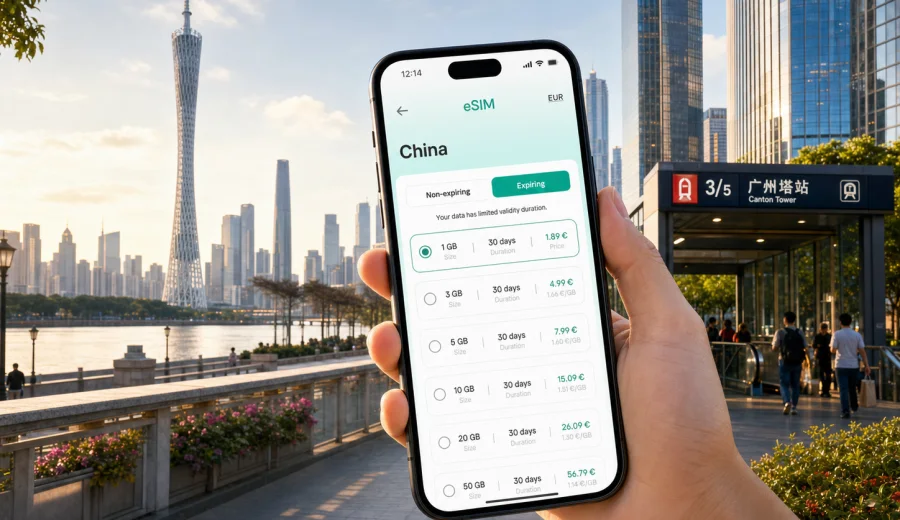
Guangzhou eSIM: mobile connection and internet for a smoother city trip
Guangzhou is a practical city for travelers who like to move fast. The airport is far from the central districts, the metro network is large, and business areas are spread across both sides of the Pearl River. A stable mobile connection helps with maps, translation, ride-hailing, hotel messages, tickets, restaurant searches and work calls exactly when you need them.
An eSIM is useful in Guangzhou because it lets you prepare mobile data before you arrive or shortly after landing, without looking for a physical SIM card. Instead of swapping cards, you install a digital SIM profile on a compatible phone, choose a data package for the trip, and use it for everyday internet access. Kaspersky eSIM Store is an app and website where you can quickly choose, arrange, and activate an eSIM with a suitable data plan for international travel.
This guide focuses on Guangzhou itself: arrival at Baiyun International Airport, movement between Tianhe, Zhujiang New Town, Yuexiu, Liwan, Haizhu and Pazhou, business visits, hotel stays, Canton Fair trips, stopovers and day trips from the city.
Why mobile internet matters in Guangzhou
Guangzhou is not difficult to navigate, but it rewards preparation. Distances are longer than they look on a small map, station names may have several English transliterations, and a short business appointment can involve metro transfers, security checks, lift queues, and a final walk through an office complex. When mobile data works, you can adjust in real time instead of relying on screenshots from the hotel Wi-Fi.
Typical online tasks in Guangzhou include:
- checking the route from Guangzhou Baiyun International Airport to your hotel;
- comparing metro, taxi, ride-hailing and rail options;
- finding the correct exit at large metro stations;
- translating signs, menus and hotel messages;
- confirming a meeting address in Tianhe or Pazhou;
- sharing your live location with colleagues or family;
- checking train times for Shenzhen, Hong Kong, Foshan, Zhuhai or other nearby cities;
- using cloud documents, email and messenger calls during a work trip.
Public Wi-Fi can help in hotels, airports, malls and some cafes, but it is not a full travel plan. It may require local verification, slow down in crowded areas, and disappear while you are walking between stations or looking for a taxi pickup point.
Guangzhou arrival: where eSIM helps first
Most international travelers arrive through Guangzhou Baiyun International Airport. The airport is connected to the city by metro, taxis, buses and private transfers, but your best route depends on your hotel district, luggage, arrival time and whether you need to go directly to a meeting. A working eSIM can help before you leave the arrivals area.
If your hotel is in Tianhe or Zhujiang New Town, you may need to compare travel time by metro and car. If you stay near Beijing Road, Shamian Island or Liwan, the route can involve different metro transfers or a longer taxi ride. If you are attending an event in Pazhou, mobile data helps you check the exact hall, entrance and traffic situation before you start moving.
Useful first-arrival actions:
1. Turn on the travel eSIM only when you are ready to use the data plan, according to the plan terms.
2. Keep your primary SIM active if you need to receive bank or account verification messages.
3. Set the eSIM as the mobile data line in your phone settings.
4. Open your hotel address in a map app before leaving the terminal.
5. Save the hotel name in English and Chinese if your booking provides both.
6. Keep the airport, hotel and first destination screenshots as a backup.
An eSIM usually gives mobile data, not a local phone number, unless a specific plan clearly says otherwise. For calls and messages, you can normally use internet-based apps once mobile data is active.
Best Guangzhou situations for using an eSIM
An eSIM is most useful when the route is time-sensitive: airport transfers, metro changes, Canton Fair visits, office meetings in Tianhe, old-city walks in Yuexiu and Liwan, and rail trips from Guangzhou South Railway Station. The benefit is not only speed. It is control. When you can check the next step, you are less dependent on a single Wi-Fi point, a printed address, or someone nearby who understands your route.
Device compatibility before you travel
Before you choose a plan, check that your phone or tablet supports eSIM and is not locked to one mobile operator. This matters everywhere, but it is especially important before a China trip because some device variants sold in different markets may have different eSIM support.
Check your device before purchase, and also review the device settings yourself. On many phones, you can look for an option such as Add eSIM, Add Mobile Plan, Cellular Plans or SIM Manager. If you cannot find any eSIM option, check the exact device model, region variant and operating system version.
Also check these points:
- your phone supports eSIM in the country where it was purchased;
- the phone is unlocked for mobile service from other operators;
- you have a stable internet connection during installation;
- your operating system is updated enough for eSIM setup;
- you know which SIM line will be used for data, calls and messages;
- your current physical SIM or primary eSIM remains available if you need SMS codes.
Compatibility is a preparation step, not an arrival task. Once the device check is clear, you can choose a mobile internet option for China and match the data volume to your Guangzhou route before departure.
How much data to plan for Guangzhou
Data use depends on your habits, but Guangzhou can be data-heavy because visitors rely on maps, translation, messaging and transport apps throughout the day. Video streaming, laptop hotspot use and large uploads are the biggest drivers of usage.
Approximate planning guide:
| Trip style | Data planning approach |
|---|---|
| 1-2 day stopover | Keep enough data for maps, messaging, translation and airport routes |
| 3-4 day city break | Plan for daily navigation, restaurant searches and some media uploads |
| Canton Fair or business visit | Choose more data for email, documents, calls and venue navigation |
| Greater Bay Area route | Check destination coverage and validity period carefully |
If you plan to use your phone as a hotspot, check whether tethering is allowed under the selected plan. A laptop can consume a mobile data package quickly through cloud sync, system updates and video meetings.
Choosing an eSIM plan for Guangzhou
For a Guangzhou city trip, the destination plan should match China. The plan does not need to be city-specific because mobile data plans are normally selected by country or region, but the way you choose the data amount should reflect how you will move through Guangzhou.
Start with three questions:
1. How many days will you stay in Guangzhou and nearby cities?
2. Will you use data mainly for maps and messaging, or also for work calls and laptop hotspot?
3. Do you need the plan active from the airport, or only after hotel check-in?
Once you know the answers, compare data volume, validity period, destination and price. Kaspersky eSIM Store lets you review plan conditions before you arrange the eSIM, so you can choose based on the actual trip rather than on a vague idea of "some data for travel."
For most visitors, the strongest reason to prepare an eSIM before Guangzhou is the first day. The city is easier when you can step out of the airport, open your route, message your hotel, translate a sign, and keep moving. Install the eSIM in advance when the instructions allow it, then activate it according to the selected plan rules.
Guangzhou districts and mobile data scenarios
Guangzhou is easier to understand by district. Business zones, riverfront walks, old neighborhoods and exhibition halls create different mobile data tasks.
| Area | How mobile data helps |
|---|---|
| Tianhe and Zhujiang New Town | Confirms tower entrances, metro exits and meeting addresses |
| Pazhou | Keeps hall details, badge messages and colleague coordination available |
| Yuexiu | Supports walking routes and translation between older central stops |
| Liwan and Shamian Island | Helps with restaurant searches, return routes and location sharing |
| Haizhu and Pearl River areas | Keeps maps and transport options ready after sunset |
Metro, taxis and walking: using data wisely
Guangzhou Metro connects the airport, central districts, rail stations and major business areas. It is often faster than a car during rush hours, but the wrong station exit can add a long walk. Use mobile data to compare routes, choose the exit letter and check the last walking segment.
For taxis and ride-hailing, keep your destination saved in both English and Chinese when possible. Hotels can usually provide a Chinese address. For walking, download or screenshot key addresses so you are not dependent on perfect signal in every underground passage, mall or station corridor.
Installing and activating your eSIM
The exact setup flow depends on your device and the selected eSIM profile, but the basic process is simple: arrange the plan, install the eSIM profile, set it as the data line, and activate data when the plan instructions say it is time. You can use the Android installation guide or the iOS installation guide if you want step-by-step setup help.
A practical Guangzhou setup checklist:
1. Install the eSIM while you still have reliable Wi-Fi, such as at home or at the hotel.
2. Do not delete the eSIM profile after installation unless support instructions tell you to do so.
3. Give the eSIM a clear label, for example "China data" or "Travel data."
4. Set mobile data to the eSIM line when you are ready to use it.
5. Keep your primary line available for SMS if you need verification codes.
6. Turn off heavy app updates, photo backup and cloud sync on mobile data.
7. Check whether data roaming must be enabled for the eSIM line.
If your phone has dual SIM settings, review them calmly before travel. A common mistake is installing the eSIM correctly but leaving mobile data assigned to the home SIM. Another mistake is turning off the primary line and then missing a banking or account verification message.
Business trips, stopovers and trips from Guangzhou
Guangzhou is a major business destination for trade, manufacturing, sourcing and exhibitions. For a Canton Fair or Pazhou visit, save the hotel address, venue hall, meeting points, Chinese address versions if available, offline copies of invitations or badges, and a data plan with enough validity for the full stay.
For a stopover, keep the setup simple: airport-to-hotel directions, return timing to Baiyun International Airport, one compact sightseeing route, translation for food and transport, a saved hotel card and enough battery.
Guangzhou is also a base for Shenzhen, Foshan, Dongguan, Zhuhai, Hong Kong, Macau and other cities. Before leaving the city, check whether your plan covers the next destination, whether the validity period continues through the route, which rail station you need, and whether the return arrives at the same station. Guangzhou South Railway Station is large, so mobile data helps with gate changes, platform information and pickup points.
Quick troubleshooting and data-saving checklist
If mobile data does not work immediately, confirm that the eSIM profile is installed, mobile data is assigned to the eSIM line, data roaming is enabled if the plan instructions require it, and airplane mode is off. Restart the phone and wait a few minutes after activation. Do not delete the eSIM profile as a first troubleshooting step, because some profiles cannot simply be reinstalled without support.
To make the data package last longer, save key addresses, use hotel Wi-Fi for system updates and large uploads, disable automatic cloud backup on mobile data, and watch hotspot use with laptops. Spend data on the moments that matter: routes, translation, messages, transport, tickets and work tasks.
FAQ: eSIM and mobile internet in Guangzhou
| Question | Short answer |
|---|---|
| Is an eSIM useful if my hotel has Wi-Fi? | Yes. Wi-Fi helps indoors, but mobile data covers airport transfers, metro exits, taxis, sightseeing and meetings. |
| Does an eSIM give me a Chinese phone number? | Usually no. Travel eSIM plans commonly provide data, unless the selected plan states otherwise. |
| Should I install the eSIM before flying? | Often yes. Installation on reliable Wi-Fi reduces arrival stress; activation timing depends on plan rules. |
| Can one eSIM cover Guangzhou and other Chinese cities? | A China destination plan is normally country-based, but you should check coverage, validity and conditions. |
| What should I check before buying? | Device compatibility, operator lock status, destination, data volume, validity, price, activation rules and hotspot terms. |
Prepare mobile internet before your Guangzhou trip
Guangzhou is easier when your phone is ready before the first transfer, meeting or metro ride. An eSIM can help you keep maps, translation, hotel messages, tickets and work tools available without searching for a physical SIM card after landing.
Before you travel, check your device, choose the data volume and validity period that match your itinerary, install the eSIM on a reliable connection, and keep important addresses offline as a backup. For a city trip, business visit, Canton Fair schedule or short stopover, you can prepare an eSIM data plan for China through Kaspersky eSIM Store and arrive in Guangzhou with a clearer mobile internet plan.