Travel connectivity guide
Ha Long eSIM: Mobile Internet for Your Trip
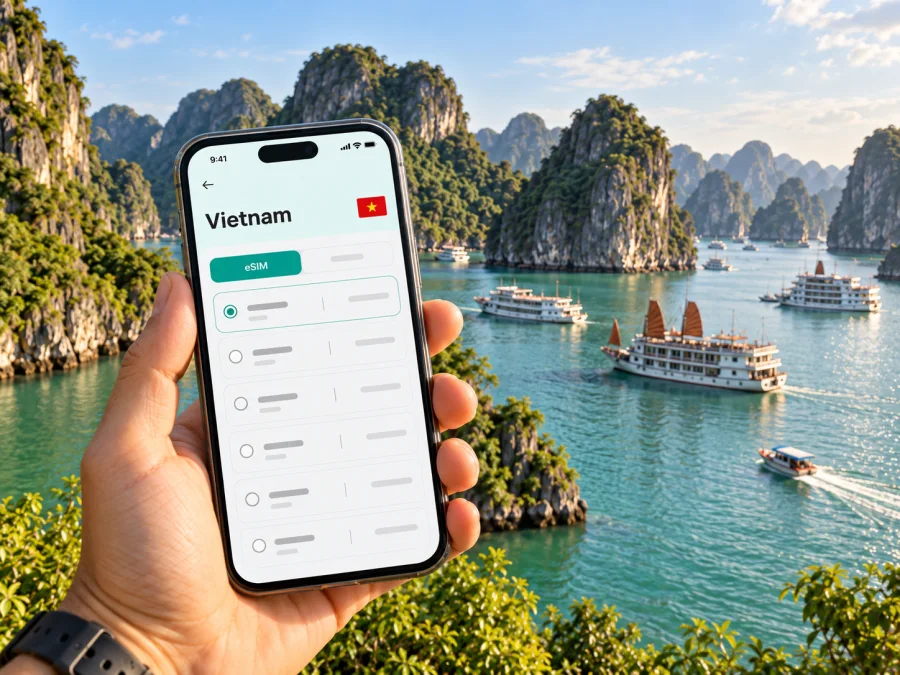
Ha Long eSIM for a reliable mobile connection and internet on your trip
Ha Long is easy to picture as a line of hotels beside a famous bay, but a visit usually involves more than one waterfront. You may arrive from Hanoi or Van Don, stay around Bai Chay, cross to the older Hon Gai side for local errands, and set off by boat from a separate port. A working mobile connection helps with each change: confirming a pickup, opening a map, contacting your hotel, and keeping travel details available while you move.
An eSIM can make mobile data simpler to prepare for a trip to Vietnam. It is a digital SIM profile installed on a compatible, unlocked device. A travel data plan can be used alongside your home SIM, depending on your phone’s capabilities and settings. It does not automatically include a local phone number, ordinary voice calls or SMS; check the selected plan’s terms. Messaging and internet calls can use data, while your home line may remain available for calls or verification messages if your operator allows it.
Ha Long in context: a destination and a changing address
Ha Long is the familiar English name for Hạ Long, the coastal destination in Quảng Ninh Province associated with Ha Long Bay. The administrative map changed in 2025. The former Ha Long City-level administration was reorganized as Vietnam introduced a two-tier local-government structure, and the province now includes a specific Ha Long Ward, formed from the former Hong Ha and Hong Hai wards. That ward is only one part of the wider destination visitors mean when they say “Ha Long.”
For a traveler, this distinction matters most when entering an address into a booking, arranging a car, or searching for an office. “Ha Long” may refer to the destination or bay area; “Ha Long Ward” is a current administrative area. Hotels, attractions, ports, and meeting venues may use district or ward names that have changed. Keep the venue name and a map pin from your host or operator, not just an old ward label. If an address does not appear exactly as written, search the hotel or attraction name and confirm the pickup point directly.
The city experience is shaped by the water. Bai Chay is a major visitor base on the western side of the bay, while Hon Gai and the central waterfront are across the water to the east. Tuan Chau is a separate island area with a marina and visitor facilities. These are not interchangeable drop-off points. A hotel in Bai Chay and a cruise departure at Tuan Chau can be in the same general Ha Long itinerary but still require a road transfer. Put the actual pier, terminal, or hotel into navigation before you start moving.
Plan mobile data around the way you will travel
Ha Long is a place where you may alternate between a fixed address and a changing route. Data use is usually practical rather than constant: a map for the drive in, a message to a driver, a restaurant search, a digital ticket, and photos sent after a boat trip. The right data allowance depends on how many days you will use the eSIM, whether you stream or upload large files, and whether your hotel or cruise provides Wi-Fi.
A simple estimate is more helpful than choosing a plan by habit:
| Travel pattern | Common data tasks | What to consider |
|---|---|---|
| One-night stop | Pickup messages, hotel map, restaurant search, tickets | A short validity period may be enough; download maps and bookings before arrival. |
| Several days in Bai Chay or Hon Gai | Navigation, ride coordination, translation, messaging, browsing | Estimate daily use and leave room for route changes or a delayed transfer. |
| Cruise plus city stay | Port details, meeting-point messages, weather checks, photos | Confirm whether the vessel offers Wi-Fi and when it can be used; do not assume it replaces mobile data on shore. |
| Work trip | Email, calendar, video calls, hotspot use | Check whether tethering is allowed and whether the data allowance suits laptop use. |
| Ha Long with onward travel | Maps and coordination between towns or transport hubs | Choose a plan whose listed destination and validity cover every stop on the itinerary. |
These are planning categories, not a promise of a particular amount of data or network performance. A video call, cloud backup, or high-resolution photo upload can use much more data than checking a map. If you need a hotspot, verify that the plan and your device permit it. Turn off automatic app updates and large photo backups over cellular data, then use Wi-Fi for heavy downloads where available.
Before paying, read the plan details for the covered destination, data volume, validity period, activation rules, hotspot policy, and any speed or fair-use conditions. Travel eSIMs for Vietnam can connect through a local partner network, but the specific network, technology, and coverage depend on the selected plan and the partner arrangement. Do not infer that the brand of an app is the mobile operator or that one provider’s coverage statement describes every eSIM. If you need to know which Vietnamese network a plan uses, check its details or ask support before purchase.
Arrival: leave room for the last part of the journey
Many visitors reach Ha Long overland from Hanoi. The road journey can include a long expressway section, but the total trip time depends on the starting point, traffic, stops, and drop-off location. A driver may take you straight to Bai Chay, Hon Gai, or Tuan Chau; ask which area is included in the quoted transfer. Keep the destination pin ready before leaving the airport or station, since a lodging address alone may not make the neighborhood obvious to a driver unfamiliar with the booking.
Van Don International Airport is in Quang Ninh Province, outside the Ha Long urban area. Provincial information has described it as roughly 50 kilometres from Ha Long by road, but the actual transfer varies with route and destination. Check current flights and ground transport on the date of travel; schedules and services change. If you land there, confirm the driver, bus, or onward connection before boarding. A data connection can be useful for resolving a changed pickup, but save your booking confirmation offline as a backup.
For any airport arrival, use this sequence:
- Before departure, save your hotel name, address, and map pin for offline access.
- Confirm whether your transfer ends in Bai Chay, Hon Gai, or another area.
- Keep the driver’s name or meeting instructions in a message or screenshot.
- Once the eSIM is active, check that mobile data is assigned to it and that your home line has not been selected for data by mistake.
- If the connection does not start, use the saved pickup details first, then troubleshoot from a stable location rather than while crossing a road or boarding transport.
The nearest airport is not always the simplest route. Compare flight times, transfer frequency, luggage, and the exact address. A late arrival can affect cruise check-in or a prearranged pickup, so leave room for delays.
Moving between Bai Chay, Hon Gai, and Tuan Chau
Ha Long’s two main urban waterfronts face each other across the bay. Bai Chay is often convenient for resort stays, entertainment, and departures toward the western bay; Hon Gai is a working urban center with government offices, markets, and a different waterfront character. Tuan Chau sits further toward the bay entrance and is a common starting area for boat excursions. A route that looks short on a small-scale map can take longer when it follows roads, bridges, or a specific port entrance.
Use a map as a planning aid, not as a guarantee of journey time. Before leaving, check the pickup point and the side of town, then confirm whether a bridge or road route is open and practical. Share the destination pin with a driver if language or address formatting could cause confusion. For boat trips, verify the pier name and check-in time with the cruise company; “Ha Long harbour” is too broad when several terminals or departure areas are involved.
Mobile data is especially useful when plans shift: a hotel changes the pickup time, weather affects a boat departure, or you need to find a pharmacy after dinner. Keep essential details accessible even when offline:
- hotel and port names, with Vietnamese spelling where provided;
- booking and transport confirmations;
- the phone number or messaging contact for your driver or host;
- a saved map area around your accommodation and the departure point;
- a note with the address written in the format supplied by the venue.
For a walk along a waterfront or through a busy visitor area, use navigation before you set off and pause somewhere safe if you need to zoom or reorient. Do not rely on a phone screen while crossing traffic or stepping on and off a boat. If the route involves a ticketed attraction, save the ticket or QR code before you leave your accommodation; weak reception, a drained battery, or a crowded entrance can turn a small delay into a missed time slot.
Choosing an eSIM for Vietnam: what the destination name does and does not tell you
A destination label such as Vietnam tells you where the plan is intended to work; it does not by itself identify a particular local network, guarantee the same experience in every setting, or confirm that a plan includes voice service. Ha Long is in Vietnam, so a Vietnam plan is the relevant category for a city-only visit. If your itinerary includes other countries, check whether the plan covers them too instead of assuming a Vietnam plan extends across borders.
Vietnamese mobile operators offer their own eSIM services under their own registration rules. Those local subscriber products and an international travel data eSIM are different purchase routes. A visitor may choose a local SIM or operator eSIM where eligible, or prepare a travel eSIM for data; eligibility, identity checks, voice number, top-up options, and support arrangements differ. This article does not imply that a travel eSIM uses a particular Vietnamese operator. Use the plan’s network details when operator identity is important to your decision.
A quick comparison can help you decide what matters:
| Question | Why it matters in Ha Long |
|---|---|
| Is Vietnam included as a destination? | A plan for another country or region may not cover your stay. |
| When does validity begin? | Installing a profile and starting paid use may be separate events; follow the plan’s activation instructions. |
| Is the plan data-only? | If so, it will not replace a phone number for ordinary calls or SMS. |
| Is hotspot use allowed? | Useful for a laptop at a hotel or on a transfer, subject to the plan terms. |
| Which network or networks are listed? | This is the relevant detail if you need to compare local partner coverage. |
| Is the device unlocked and eSIM-compatible? | A locked or incompatible phone may prevent installation or use. |
If you are comparing plans, choose a Vietnam eSIM plan for your travel dates. Vietnam is the relevant destination for a Ha Long stay; compare the exact plan conditions, partner network details, and validity against your itinerary.
Device compatibility: regional variants matter
Support for eSIM varies by manufacturer, model, and market. Two phones sold under a similar model name can have different hardware or carrier restrictions depending on the country or region where they were made for sale. Some device variants do not support eSIM, and a carrier-locked device may reject a profile even if the model family usually supports it. Check the exact model number and the device settings before purchase; do not rely only on a product family name or another traveler’s experience. Check your device’s eSIM compatibility.
Also confirm that the phone can use an eSIM while retaining your home SIM if that is important to you. Dual-SIM behavior varies: your phone may let you choose a line for data, calls, and messages, but the available combinations depend on the model and operating system. A tablet or wearable may support eSIM for one market and not another, and a data plan intended for phones may not be suitable for a watch. Review both the device documentation and the selected plan before you travel.
Install before departure, activate with care
If possible, install the eSIM while you have a stable internet connection and enough time to read the prompts. Some plans let you install ahead of time and begin using data only after reaching the destination; others may start their validity at a different point. The plan instructions control this detail. Do not delete an installed eSIM to troubleshoot unless the provider’s instructions tell you to: some profiles cannot be installed again after removal.
A calm setup sequence is:
- Check that the phone is unlocked, compatible, charged, and connected to Wi-Fi.
- Review the destination, data allowance, validity, and activation conditions in the plan details.
- Install the profile by the method supplied with the order, such as a QR code or in-app steps.
- Label the new line clearly, for example “Vietnam data,” so it is easy to identify.
- Keep your home line selected for ordinary calls or SMS if needed, and set the travel eSIM as the mobile-data line only when appropriate.
- Enable data roaming for that eSIM only if its instructions require it; roaming settings differ by provider and plan.
- When in Vietnam, check the selected line and test a simple page or message before relying on navigation.
For step-by-step device help, use the Android eSIM installation guide or the iOS eSIM installation guide. Menu names can vary by operating-system version and manufacturer. Follow the screen on your phone and the instructions supplied for your specific plan.
Kaspersky eSIM Store is an app and website where you can choose, order, and activate an eSIM with a suitable plan for mobile internet during an international trip. The plan’s conditions, partner network, installation method, and support terms determine how the service works. Keep your order information available in the app or saved securely, and do not share an installation QR code publicly.
Match the plan to your stay
A short stopover usually needs maps, a transfer message, and access to saved tickets. A weekend may add frequent restaurant searches and photo sharing. A work visit can require email, calls, and hotspot use, so check whether tethering is allowed and estimate laptop data separately. For a cruise plus a city night, confirm the plan covers the entire validity period and save the vessel details offline. If you continue beyond Ha Long, verify every destination in the plan rather than assuming a city plan covers the whole route.
Maps and messages generally use less data than video, remote meetings, or automatic photo backups. List your likely daily tasks, add a modest allowance for a changed pickup or hotel, and use Wi-Fi for large downloads where available. Check plan terms for top-ups or extensions if your schedule changes.
Frequently asked questions
Is Ha Long a city or a bay?
The name commonly refers to the coastal destination and the nearby bay in Quang Ninh Province. Following Vietnam’s 2025 administrative reorganization, the former city-level administration was replaced by new local units; a current Ha Long Ward is one specific ward, not the whole travel destination. For bookings and transfers, use the venue’s current address and exact pin.
Which eSIM should I use for Ha Long?
For a stay limited to Ha Long, look for a plan whose destination includes Vietnam. Compare its validity, data allowance, activation rules, hotspot terms, and listed partner network. The destination label alone does not establish which Vietnamese operator is used or guarantee service in every location.
Will mobile data work on a Ha Long Bay cruise?
It may be available in some places, but signal can vary as the vessel moves away from shore and with the boat’s location or construction. Download tickets and instructions before departure and ask the operator about onboard Wi-Fi if you need a dependable work connection.
Does a travel eSIM include calls and texts?
Many travel plans are data-only, so check the specific plan terms. You can use internet-based messaging and calling apps over data, but those services do not provide an ordinary local phone number unless the plan explicitly says it does.
Can I install the eSIM after I arrive?
Usually the profile can be installed when you have internet access, but the exact process and activation timing depend on the plan. Installing before departure on reliable Wi-Fi can reduce tasks after landing. Follow the supplied instructions and do not remove the profile unless directed.
Is a travel eSIM the same as a Vietnamese operator eSIM?
No. A local operator eSIM is issued under that provider’s own plans and registration conditions. An international travel eSIM is a separate travel product and may connect through a local partner network. Check the selected plan if the network identity or a local number matters.
Prepare your eSIM for Ha Long
Before departure, check that your phone supports eSIM in its specific regional version, choose a Vietnam plan whose dates and data allowance match your stay, and install it according to the plan instructions. Kaspersky eSIM Store’s app and website let you choose, order, and activate an eSIM for mobile internet on an international trip. Choose a suitable eSIM plan for Vietnam and keep the plan details and arrival information saved for the road to Ha Long.


