
Travel connectivity guide
Haa eSIM: Mobile Internet for Bhutan Travel
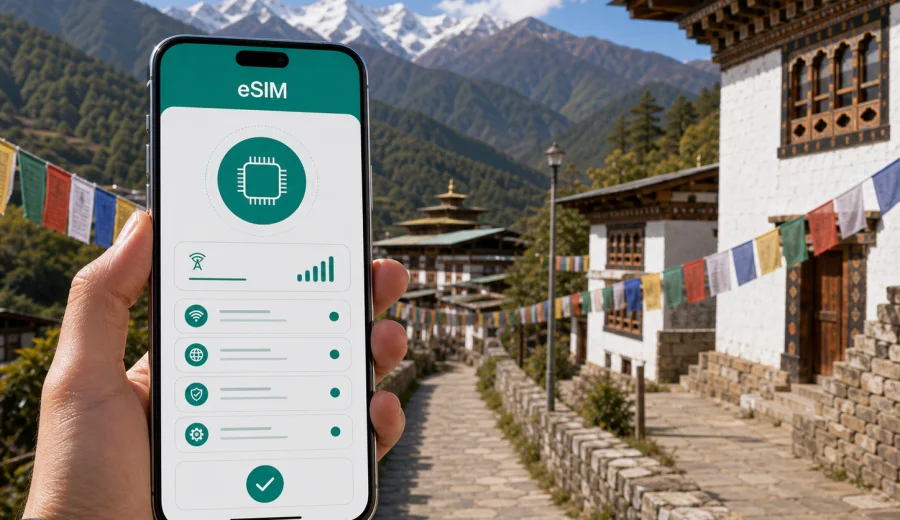
Haa eSIM: mobile connection and internet for a trip to Haa, Bhutan
Haa is one of Bhutan's quieter valley towns, and that is exactly why mobile internet matters there. A trip to Haa usually means mountain roads, small hotels, scattered villages, prayer-flag viewpoints, local monasteries, and day routes where you may not want to depend only on hotel Wi-Fi or printed directions. An eSIM helps you prepare mobile data before the journey, so you can use maps, messages, bookings, translation, and travel documents from the first practical moment of your trip.
This guide is written for travelers who are going to Haa itself, not only passing through Bhutan. It focuses on arrival, local movement, transport, hotels, work trips, stopovers, and short routes from Haa to nearby areas.
Why Haa is a city where mobile data should be planned early
Haa is not a large transit city with a dense choice of mobile shops on every corner. It is a compact valley destination where your online needs often appear between places: on the road from Paro, while checking a homestay location, when coordinating a driver, or when confirming a meeting time after the plan changes because of weather or road conditions.
Mobile data can be useful in Haa for practical, everyday tasks:
- following offline and online maps while moving between Haa town, nearby villages, and valley viewpoints;
- messaging a hotel, guide, driver, colleague, or family member;
- checking booking confirmations, travel permits, tickets, and passport scans stored in the cloud;
- using translation tools for short phrases, menus, signs, or local arrangements;
- checking the weather before a drive over mountain roads;
- using ride, taxi, or private-transfer coordination where available through your local contacts;
- keeping work chat and email available during a business or field visit.
The main point is not to be online every second. It is to avoid turning simple travel tasks into delays. If you have mobile internet ready, you can make small decisions faster: whether to stop for a viewpoint, which road to take back, whether your hotel has received your message, or whether your driver has changed the pickup time.
Arrival in Haa: when an eSIM becomes useful
Most international visitors enter Bhutan through Paro and continue by road to Haa. That makes the arrival stage especially important. You may need data before you are settled in Haa, while you are still moving between the airport, a hotel, a meeting point, or a road transfer.
Common arrival scenarios include:
| Travel moment | Why mobile internet helps |
|---|---|
| At Paro airport | Message your driver, open hotel details, check documents, and confirm the next stop. |
| On the road to Haa | Use maps, share location with companions, and check weather or timing updates. |
| First evening in town | Find your accommodation, coordinate dinner plans, and contact local hosts. |
| Early next morning | Confirm route plans before leaving for villages, monasteries, or viewpoints. |
If your phone supports eSIM, installing it before departure can make this stage calmer. You can keep your primary SIM in the phone for your usual number and use the eSIM profile for mobile data in Bhutan. Conditions depend on the selected tariff and your device, so check the plan details before paying.
Local movement around Haa
Haa is easy to underestimate on a map. The town center is compact, but the valley experience is spread across roads, villages, slopes, and stops that are not always next to each other. You may walk in town, travel by arranged car, use a hotel transfer, or follow a planned route with a guide. In each case, mobile data supports the parts of the trip that happen between fixed addresses.
For a short stay, your main mobile internet needs may be maps, messaging, and quick searches. For a longer stay, you may also need cloud files, video calls, photo backups, or hotspot use for a laptop. The right eSIM tariff depends less on the city name and more on what you will do in Haa each day.
Use this simple estimate:
| Trip style in Haa | Typical data use | What to consider |
|---|---|---|
| Overnight stop | Low to moderate | Maps, messages, hotel details, light browsing. |
| Two or three days in the valley | Moderate | Navigation, messaging, photo sharing, restaurant and route checks. |
| Business or project visit | Moderate to high | Email, documents, team chats, video calls if needed. |
| Remote work add-on | High | Laptop hotspot, cloud apps, calls, backups, and longer sessions. |
| Photo-heavy trip | Variable | Uploads and backups can use much more data than maps. |
If you are not sure how much you need, choose a tariff that matches your expected stay length and leave some room for unexpected use. Mountain travel often changes by weather, timing, or road conditions, and that can increase messaging and map use.
Districts, hotels, and valley stays: where connectivity matters
In Haa, the difference between "I have Wi-Fi at the hotel" and "I can get things done on the move" is important. Hotel Wi-Fi may be enough for evening browsing, but mobile data helps during check-in, transfers, village visits, and early starts. It is also useful when a guesthouse Wi-Fi signal is weak in your room or when several travelers are using the same network.
Think of mobile internet as a travel layer that follows you outside the lobby:
- at a homestay or small hotel when you need to message reception or a host;
- near the town center when you are checking a meeting point;
- on a village road when you want to confirm your route before signal becomes weaker;
- at a viewpoint when you need to share an update but do not want to wait until evening;
- during a work trip when a short message matters more than a long online session.
Haa's travel rhythm is slower than in a major city, but the need for reliable information can still be immediate. A map pin, a confirmed pickup time, or an updated weather check can save an hour.
Choosing an eSIM tariff for Haa
For a city article, the relevant plan is the country plan for Bhutan. Haa belongs to Bhutan, so you should choose a tariff that covers Bhutan rather than looking for a separate Haa-only product. In Kaspersky eSIM Store, you can review available options, compare data volume and validity period, and prepare the eSIM before the trip.
When you compare tariffs, pay attention to five details:
1. Country or region coverage: make sure Bhutan is included in the selected tariff.
2. Data volume: choose enough GB for maps, messaging, browsing, uploads, and work needs.
3. Validity period: match the tariff duration to your full time in Bhutan, not only your nights in Haa.
4. Activation rules: check when the validity period starts and what steps are needed.
5. Device requirements: confirm that your phone supports eSIM and is not locked by an operator.
For Haa, the practical choice is often connected to your route. If you arrive through Paro, spend time in Haa, and continue to Thimphu or another Bhutanese destination, choose a plan for the entire Bhutan trip. That avoids having to solve the same mobile internet task again after leaving the valley.
Before the middle of your planning, keep a simple rule in mind: choose your tariff around the whole route, not only the first hotel. When you are ready to compare options, you can prepare an eSIM tariff for your trip to Haa in Bhutan and review the available data volumes and validity periods before you travel.
How much data do you need in Haa?
There is no single correct amount of data for every visitor. A traveler who mainly uses maps and messages may need far less than a consultant, photographer, or remote worker. The safest approach is to connect data use to real actions.
Use this checklist before selecting a tariff:
- Will you use maps every day outside the hotel?
- Will you message a guide, driver, hotel, or local contact often?
- Will you upload photos or videos during the trip?
- Will you use your phone as a hotspot for a laptop?
- Will you join work calls or send large attachments?
- Will you continue from Haa to other parts of Bhutan?
- Will you rely on cloud storage for tickets, permits, and documents?
If most answers are "no", a smaller data package may be enough. If several answers are "yes", especially hotspot use or photo uploads, choose a larger package. You can also reduce data use by downloading offline maps, keeping app updates disabled on mobile data, and waiting for stable Wi-Fi before uploading large media files.
Installing an eSIM before departure or after arrival
It is usually more convenient to install your eSIM before you leave, while you still have stable home internet. After purchase, follow the steps shown in your profile, app, or email. If you need device-specific help, use the Android installation guide or the iOS installation guide.
A practical setup flow looks like this:
1. Check that your smartphone supports eSIM and is not locked to one operator.
2. Choose Bhutan as the destination and select a tariff by data volume and validity.
3. Install the eSIM profile using the provided instructions or QR code.
4. Keep your primary SIM for calls and messages if you still need your usual number.
5. On arrival, set mobile data to the eSIM profile when you are ready to use it.
6. If required by the selected tariff or device, enable data roaming for the eSIM profile.
Do not delete an eSIM profile casually after installation. In many cases, an eSIM cannot simply be moved to another phone after activation. Read the plan conditions and keep the installation details available until the trip is complete.
Device compatibility before a Haa trip
Before buying any eSIM tariff, confirm that your device supports eSIM. Some phones have regional versions, operator locks, or settings that affect eSIM installation. If you are unsure, check your device before selecting a tariff.
This check is especially useful before traveling to a quieter destination like Haa. Solving compatibility questions at home is easier than trying to troubleshoot while moving between airport, road transfer, and hotel. You should also make sure your phone is updated, has enough battery, and can receive the installation information before you leave.
Haa travel scenarios where eSIM is useful
A short stopover in the valley
If Haa is part of a wider Bhutan route, you may have only one evening and one morning there. Mobile data helps you move efficiently: confirm check-in, open a map, message your driver, check road timing, and keep your next hotel details close. In this scenario, the main value of eSIM is less about heavy browsing and more about reducing friction.
A slow cultural stay
Some travelers visit Haa for its valley atmosphere, traditional buildings, local monasteries, and quieter pace. You may not use much data while walking, but you will still need it for practical moments: route checks, translation, messages, weather, and opening saved information about places such as Lhakhang Karpo or nearby village stops.
A business or field visit
Haa can also appear in work, research, development, or field-project itineraries. In that case, mobile data becomes a productivity tool. Email, shared documents, chat apps, voice calls over the internet, and location sharing can matter throughout the day. If your work depends on being reachable, choose more data than you would for a leisure trip and test the eSIM before the first workday.
A road trip from Paro or onward to Thimphu
Road travel in western Bhutan often combines several stops. With an eSIM for Bhutan, your data plan follows the country route rather than a single hotel network. That is useful when you leave Haa for another town, stop for photos, or need to update your expected arrival time.
Mobile internet habits that work well in Haa
Good connectivity planning is not only about buying data. It is also about using it carefully in a mountain destination.
Before leaving for the day:
- charge your phone and carry a power bank if the route is long;
- download offline maps for Haa and the surrounding road route;
- save hotel, driver, and guide contacts outside a single messaging app;
- keep passport, permit, ticket, and booking copies available offline;
- turn off automatic cloud backup on mobile data if your package is limited;
- check whether your messaging apps can receive calls over mobile data.
During the day:
- use mobile data for navigation, messages, and essential updates first;
- avoid uploading long videos until you are on stable Wi-Fi;
- keep your primary SIM active only if you need calls or SMS from home;
- monitor data use in your phone settings or the app if available;
- save important addresses before leaving the town center.
These small habits make your eSIM last longer and make the trip less dependent on perfect signal at every stop.
eSIM, roaming, local SIM, and Wi-Fi in Haa
Travelers usually compare four ways to stay online: roaming from a home operator, a local physical SIM, public or hotel Wi-Fi, and eSIM. Each option can work, but the best choice depends on your time, device, and route.
| Option | Strength | Limitation in a Haa trip |
|---|---|---|
| Home roaming | Keeps your existing SIM active | Costs and conditions can vary widely by operator. |
| Local physical SIM | Familiar for longer stays | May require time at a shop and a physical SIM slot. |
| Hotel or cafe Wi-Fi | Useful for heavier evening tasks | Does not follow you on roads, walks, or transfers. |
| eSIM | Can be prepared before travel and used for mobile data | Requires a compatible, unlocked device and correct setup. |
An eSIM is not a full replacement for every communication need. Most travel eSIM tariffs are designed for mobile internet and may not include a regular phone number, voice calls, or SMS unless the plan states otherwise. For calls, many travelers use internet-based messaging apps once mobile data is active.
Common mistakes to avoid
Avoid these issues before traveling to Haa:
- buying a data package only for the first day and forgetting the rest of the Bhutan route;
- assuming that hotel Wi-Fi will be enough for road transfers and village visits;
- waiting until the airport transfer to check eSIM compatibility;
- deleting the eSIM profile after installation without checking whether it can be restored;
- leaving app updates, photo backups, and video uploads active on mobile data;
- choosing a tariff without checking when the validity period starts;
- assuming that mobile data includes a phone number, voice calls, or SMS.
The safer approach is simple: check the device first, select the country plan for Bhutan, install the eSIM while you have stable internet, and keep your most important travel details available offline.
Quick planning table for Haa
| If your Haa plan includes... | Prepare mobile data for... |
|---|---|
| One night in town | Maps, hotel messages, driver coordination, and next-day route checks. |
| Valley walks and monasteries | Navigation, translation, weather, and contact with companions. |
| A private driver or guide | Messaging, pickup updates, shared location, and itinerary changes. |
| Business meetings | Email, documents, chat apps, and backup data for short calls. |
| Photo and video sharing | A larger package or a plan to upload media later on Wi-Fi. |
| Travel onward in Bhutan | A tariff whose validity covers the full country route. |
FAQ: eSIM and mobile internet in Haa
Can I buy a Haa-specific eSIM?
For a city trip to Haa, choose an eSIM tariff for Bhutan. City articles help with local planning, but the mobile data tariff is normally selected by country or region. Haa is in Bhutan, so the Bhutan destination is the relevant one to check.
Should I install the eSIM before I fly?
Installing before departure is often more convenient because you can use stable internet and follow the instructions calmly. Activation timing depends on the selected tariff, so read the conditions before switching mobile data to the eSIM profile.
Will eSIM replace my normal phone number?
Usually, travel eSIM tariffs are focused on mobile internet. They may not include a regular phone number, calls, or SMS unless this is stated in the tariff conditions. You can often keep your primary SIM active for your usual number and use eSIM for data.
Is hotel Wi-Fi enough in Haa?
It may be enough for some evening tasks, but it does not help when you are on a road transfer, walking between places, checking a map, or coordinating with a driver. Mobile data is useful because it follows you outside the hotel.
What if I travel from Haa to other Bhutanese cities?
Choose a tariff for Bhutan and check that the validity period covers the whole route. This is more practical than planning only around your nights in Haa.
Prepare mobile internet for Haa before you travel
Haa rewards travelers who plan calmly: road timing, local movement, hotel communication, and day routes all become easier when your phone is ready for mobile data. An eSIM can help you avoid relying only on public Wi-Fi or last-minute SIM shopping after arrival.
Before your trip, check device compatibility, review the data volume and validity period, install the eSIM while you have stable internet, and keep your key travel details offline as a backup. When you are ready to plan the mobile internet part of the journey, choose an eSIM tariff for Bhutan in Kaspersky eSIM Store and prepare your phone for Haa before the first mountain road transfer.