Travel connectivity guide
Hac Sa eSIM: Mobile Internet in Macao
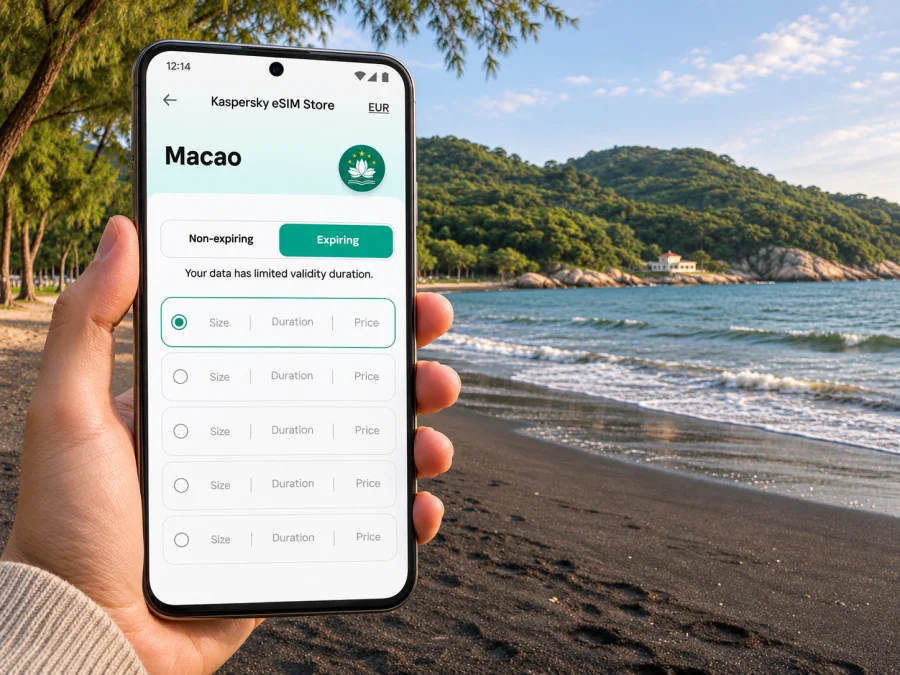
Hac Sa eSIM for mobile connection and internet by the coast
Hac Sa is a quiet coastal destination on Coloane, at the southern end of Macao. Visitors come for the long dark-sand shoreline, the sea, nearby green hills and a slower pace than the busy peninsula or Cotai. The name is often written Hac Sá, and the beach is also described as Black Sand Beach. It is a beach area rather than a separate city, so when arranging a hotel, taxi or route, use the exact place name and address shown by your accommodation.
Mobile internet can make the practical parts of a Hac Sa visit easier: checking the route from the airport, finding the right bus stop, confirming a return ride, messaging your hotel or looking up a current beach notice. An eSIM is a digital SIM profile installed on a compatible phone. It can give you mobile data under the terms of its plan, while your regular SIM may remain available for calls or messages if your phone and home operator allow that setup.
Where Hac Sa is and what to expect
Hac Sá Beach lies on Coloane Island, in the eastern and southern part of the island. Macao’s tourism office describes it as the larger of the territory’s two main beaches and notes the adjoining Hac Sá Park, with picnic and recreation facilities. The surrounding area includes coastal road, wooded slopes and scattered places to eat or stay. It does not have the dense grid of shops and transport choices you find in central Macao.
| Trip need | How mobile data helps around Hac Sa |
|---|---|
| Getting there | Compare a bus route with a taxi or hotel transfer and confirm the stop or pickup point. |
| Finding an address | Match the lodging’s full address to the map pin; several places are reached from roads that run along Coloane. |
| Beach day | Check local information, message your group and arrange a return journey before leaving the shoreline. |
| Moving onward | Navigate back towards Taipa, Cotai or Coloane Village without relying on a single remembered route. |
| Short stopover | Keep essential bookings and directions available even when you have only a few hours. |
The beach is a natural outdoor setting, so signal strength can vary with the exact spot, handset, network conditions and weather-related disruptions. Do not plan on a continuous connection at every point along the shore or on a trail. If you need to meet someone, agree on a landmark and a backup time in advance rather than depending on a live location share alone.
Arriving in Macao and continuing to Coloane
Macao International Airport is on Taipa, north of Coloane. From the airport, the next leg to Hac Sa is a separate journey; the airport is not within walking distance of the beach. The Macao Government Tourism Office lists public buses, taxis and hotel shuttle buses as airport transport options. Its travel guidance also gives approximate car journey times from the airport to Taipa Village and other Macao districts, but traffic and your final Hac Sa address affect the actual journey.
Before landing, save your accommodation’s name, address and a map pin. If you are taking a taxi, show the address on screen and confirm the destination with the driver. If you are using a bus, check the current route and direction on the day of travel. Route numbers, service patterns and stop arrangements can change, so a saved screenshot or remembered route from an older guide should not replace a current check.
A practical arrival sequence is:
- Connect to airport Wi-Fi if available, or activate your travel data line according to the plan instructions.
- Open your saved map pin for Hac Sa and check the current route from the airport.
- Compare the time and convenience of bus, taxi and any transfer arranged by your accommodation.
- Keep the hotel’s contact details accessible in case the pickup point or arrival time needs to be clarified.
- Once you reach Coloane, verify the final walk from the stop or drop-off point; do not assume the beach entrance and your lodging share the same address.
When your itinerary starts outside Macao, distinguish the jurisdictions on the route. A trip through Hong Kong or mainland China may require separate entry planning and may involve a different mobile coverage market. A plan listing Macao should not be assumed to include mainland China or Hong Kong unless those destinations are expressly named in its current terms. This matters particularly when a flight lands in one place and a ferry, bridge or cross-boundary coach continues to another.
Choosing data for a Hac Sa itinerary
Start with the route, length of stay and the way you use your phone. Hac Sa itself does not call for a special “beach” package: the relevant question is whether the eSIM plan covers Macao and has enough data and validity for your whole visit. If you are also travelling through other destinations, check each one against the plan’s destination list rather than inferring regional coverage from a product name.
Use these questions to narrow down a suitable option:
- How long will you need data? Include travel days, late arrivals and any time spent in Macao before or after the Hac Sa visit. Compare the plan’s validity rules with your actual dates.
- What will you do online? Maps, messages and short searches generally use less data than video streaming, cloud photo backups or video calls. If you expect heavy use, estimate it from your own habits instead of choosing solely by a headline amount.
- Does your route cross a border? If the itinerary includes Hong Kong or mainland China, verify those destinations explicitly. Local coverage in Macao does not imply service across a border.
- When does validity begin? Read whether the period starts on purchase, installation, first connection or another trigger. Install timing can matter if you buy before departure.
- What does the plan include? Travel eSIM plans are commonly data-focused. Check the specific terms for voice calls, SMS, tethering, top-ups and any fair-use limits; do not assume these features are included.
Coverage and connected travel around the beach
Mobile data is most useful when it supports decisions you can make before signal becomes important. Check the route while you have a stable connection, note the stop name, and keep enough battery for the return journey. At a beach, the surrounding hills, buildings, crowds and temporary network conditions may affect service. A working connection on one part of Coloane is not proof of identical reception on the sand, at a park facility or inside a hotel room.
You can review current eSIM options for Macao and compare the terms shown for each available plan. Kaspersky eSIM Store is an app and website where you can choose, arrange and activate an eSIM with a suitable plan for mobile data on an international trip. The Macao destination page currently identifies CTM among local telecommunications providers for its listed services; availability, plan details and network conditions can change, so use the terms displayed for the option you select. No plan should be treated as a promise of signal at every beach access point.
A connected beach-day checklist:
- Save the beach and your return destination as separate map points.
- Check the public transport route and last practical return option before setting out.
- Keep a small power bank or begin with a charged phone, especially if you use camera, navigation and messaging together.
- Save booking confirmations and the accommodation phone number for offline access.
- Share your intended return time with companions if your group may split up.
- Check current beach or weather notices through an official channel before swimming or doing water activities.
Mobile service is not an emergency plan. Follow posted safety instructions, lifeguard directions and local notices. If you need help, use the locally available emergency procedures; do not assume that an internet-only eSIM provides an ordinary phone number or supports emergency voice calls. Keep your normal line available if you rely on it for calls, and check your home operator’s roaming conditions before departure.
Public transport, taxis and return planning
Public buses connect the Macao Peninsula, Taipa and Coloane. Bus stops display route information, but signs may not be in English, and the route you need can depend on the direction of travel. Use current route information and a map together. The tourism office’s general visitor guidance lists a MOP 6 cash fare and notes that exact coins are needed when paying cash because buses do not give change. Payment methods and fares can be updated, so confirm current information locally and carry a backup payment option.
Taxis are convenient when you have luggage, are travelling with others or do not want to manage a transfer. The official visitor information describes Macao taxis as black with a cream roof and lists extra charges that can apply at airport and island journeys. Fare rules may change. Confirm the destination before departure and use the meter or an approved booking method; mobile data can help you show the address, but it does not replace checking the fare and route.
The Light Rapid Transit serves parts of Macao, including Taipa, but it does not take you directly to Hac Sa Beach. You may need to combine rail with a bus, taxi or other onward trip. In practice, the choice often comes down to the full door-to-door route rather than one mode:
| Option | Useful when | Check before leaving |
|---|---|---|
| Bus | You are travelling light and can follow the current stop and route information. | Direction, stop name, service hours, fare and payment method. |
| Taxi | You have luggage, a tight schedule or a specific address on Coloane. | Exact drop-off, meter or fare conditions, and any applicable surcharge. |
| Hotel transfer | Your accommodation offers a pickup or can arrange one. | Reservation, meeting point, arrival updates and return arrangements. |
| LRT plus onward transport | Your starting point is convenient to a station and the connection suits your schedule. | Current line and station, then the final bus or taxi leg to Hac Sa. |
Before you settle in at the beach, look up how you will return. A bus stop that is convenient for arrival may not be the correct stop in the opposite direction. If you are relying on a taxi, note where you can request one or ask your accommodation to advise on pickup. Save the plan offline in case your battery or mobile connection is reduced later.
Districts and nearby places to combine
Hac Sa works well as one part of a Coloane day rather than as a base for every Macao activity. The island’s quieter character makes it a contrast with the peninsula’s historic streets and the denser resort districts around Cotai. If your lodging is near the beach, check the distance to restaurants and transport before assuming you can walk to everything. If you are staying elsewhere, allow time for the return leg and avoid packing a beach visit too tightly between fixed reservations.
Coloane Village, Cheoc Van Beach and Hac Sá Beach are distinct stops, even though they share the same island. Use separate pins for each place. A day plan might pair time on the shore with a meal or a village walk, but exact opening hours, events and transport should be checked close to the visit. Do not rely on a single route screenshot to navigate between them; the terrain and road layout can make short distances feel less direct than they look on a small map.
Compatibility and setup before departure
Check that your phone supports eSIM and is not locked to a carrier that prevents adding another profile. Support depends on the exact device model, its regional hardware variant and the market where it was sold; the name of a phone family alone is not enough. Confirm with the manufacturer or your operator if the device’s eSIM capability is unclear, and check whether your device is compatible before you choose a plan.
Install the eSIM while you have reliable internet access and follow the instructions provided for the specific purchase. Some plans can be installed before departure and activated later; others have different validity triggers. Read the plan terms rather than assuming that installing the profile starts or does not start its validity. Avoid deleting the profile during troubleshooting unless the instructions or support team tell you to do so, because reinstalling may not be possible under every plan.
General installation guides are available for Android and iOS. Menu names vary across operating system versions and manufacturers, so follow the guide that matches your phone. Before departure, confirm which line will use mobile data, whether data roaming must be enabled for the travel eSIM, and whether your home line should remain active for calls or authentication messages. Keep the QR code or manual installation details accessible on a second device or printed copy if the setup flow requires them.
A compact pre-trip setup checklist:
- Confirm exact phone model, regional variant, eSIM support and carrier-unlocked status.
- Compare the plan’s Macao coverage, data amount, validity and start condition with your itinerary.
- Install over reliable Wi-Fi and label the profile clearly, such as “Macao travel”.
- Leave the home SIM’s settings as needed for calls or verification, while avoiding unintended data roaming charges.
- Learn how to select the eSIM for mobile data and how to switch back if required.
- Save the confirmation and support details before your flight.
If the connection does not work as expected
First check the simple settings: confirm that the travel eSIM is enabled, selected for mobile data and within its validity period. Review the plan’s coverage destination and remaining data, then follow its instructions about data roaming and network selection. Restarting the phone or briefly toggling airplane mode can help refresh a connection, but the right troubleshooting steps depend on the device and plan.
If you are indoors or in a low-lying or sheltered spot, move to a safe open area and try again. Compare service at another location only as a diagnostic, not as proof that the entire beach has the same reception. Do not repeatedly delete and reinstall an eSIM profile. If the problem continues, use the purchase confirmation to contact the relevant support channel and provide your device model, location, time and the steps already tried. Avoid posting QR codes or account details in public messages.
Keep an offline map and essential booking details available for exactly this reason. If mobile data is unavailable, you can still use saved directions, ask staff for local guidance, or take a taxi using the address saved on your screen. A sensible backup is more useful than assuming a phone will remain online in every situation.
Frequently asked questions
Is Hac Sa a city?
No. Hac Sa refers to the coastal area and beach on Coloane Island in Macao. The beach is also commonly written Hac Sá. For navigation and accommodation, confirm the full address rather than treating Hac Sa as a separate municipality.
Does a Macao eSIM automatically work in Hong Kong or mainland China?
No such assumption is safe. Coverage depends on the exact plan. Check that each territory on your itinerary is explicitly included in the current plan terms. A Macao destination label alone is not a regional pass for neighbouring markets.
Can I rely on mobile internet everywhere on the beach?
No. Reception can vary by location, network conditions, device and surroundings. Download a map, save important details and agree on a fallback meeting plan before you need them.
Will the eSIM provide a local phone number?
Do not assume it will. Travel eSIM plans may be data-only, and voice calls or SMS may not be included. Check the terms of the particular plan. Internet calling and messaging apps may work over data, but they do not replace an ordinary emergency phone service.
When should I install the eSIM?
Usually it is easiest to install before travel using stable Wi-Fi, then activate it according to the plan’s stated instructions. Since start conditions vary, verify when validity begins and do not rely on a general rule.
Is an eSIM better than roaming for a Hac Sa visit?
It depends on your home operator’s roaming rates, the plan’s price and allowance, the length of the trip and how much data you use. Compare the actual terms on both options. An eSIM may be convenient, but it is not automatically the best choice for every traveller.
Prepare your Hac Sa connection
Before travelling, check that your phone supports eSIM, review the current Macao plan terms and save your routes to Hac Sa and back. In Kaspersky eSIM Store, you can choose and arrange an eSIM for mobile data abroad, then install and activate it according to the selected plan’s instructions.
Choose an eSIM option for your trip to Macao and check its coverage, allowance, validity and activation conditions before purchase. Keep an offline map and your accommodation address available, and enjoy the coast with a return plan already in hand.