
Travel connectivity guide
eSIM Ireland: mobile internet for travel
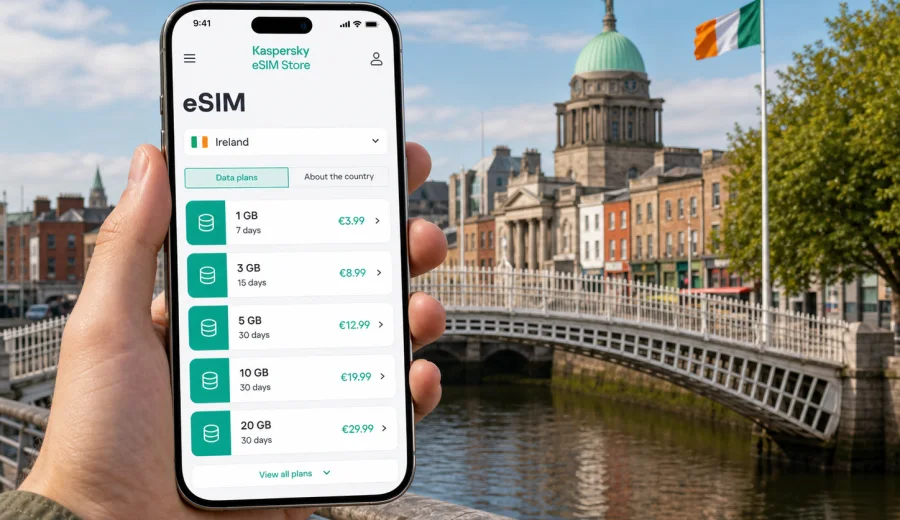
eSIM in Ireland: mobile connection and internet for your trip
Ireland is an easy country to explore by train, rental car, bus, ferry and walking routes, but a smooth trip still depends on reliable mobile internet. You may need maps after landing in Dublin, a messenger for a hotel check-in in Galway, train updates between Cork and Limerick, or a route planner on the Wild Atlantic Way. An eSIM can help you prepare mobile connection for Ireland before you start looking for a physical SIM card after arrival.
With Kaspersky eSIM Store, you can choose, arrange and activate an eSIM with a suitable data plan for your trip. The focus is simple: mobile internet abroad without changing a physical SIM card. You select the destination, review the data allowance and validity period, install the eSIM on a compatible device, and use mobile data while travelling.
This guide explains how eSIM works in Ireland, how to choose a data plan, what to check before purchase, and how to avoid common setup mistakes.
Why eSIM is useful for mobile internet in Ireland
For many travellers, Ireland is not one fixed point on a map. A typical route may include Dublin Airport, the city centre, a train to Kilkenny, a drive through County Kerry, a day in Cork, and several hours in smaller towns where you still need navigation, bookings and messages. Public Wi-Fi can help in hotels or cafes, but it is not a stable plan for the whole journey.
An eSIM is useful because it lets you prepare mobile data without visiting a shop for a plastic SIM card. You keep your regular SIM in the phone, add a digital profile for travel data, and switch mobile data to the eSIM when you need it.
Practical benefits for Ireland include:
- using maps and transport apps from the airport;
- checking hotel, car rental and ticket confirmations;
- messaging family, colleagues or hosts through internet apps;
- uploading documents for bookings when needed;
- using translation, weather and route apps on the road;
- reducing dependence on public Wi-Fi in stations, cafes and hotels.
An eSIM for Ireland is mainly about data. Unless a specific plan says otherwise, it should not be treated as a regular phone number for voice calls and SMS. For calls and messages, many travellers use internet-based apps over mobile data.
Where mobile data matters most during an Ireland trip
The first hours after arrival are often the most demanding. You may need to find the right bus stop at Dublin Airport, open a rideshare or taxi app, tell your hotel about a late arrival, or check whether the next train from Heuston or Connolly Station is delayed. If your mobile data is ready, these small tasks are less stressful.
Outside the capital, mobile internet is just as useful. In western Ireland, a route may move through coastal roads, viewpoints, guesthouses and small restaurants. In the south, you may switch between Cork, Kinsale, Cobh and rural stops. In the north-west, plans may change quickly because of weather. A prepared eSIM gives you a practical backup for maps, messages and booking details.
Here are common travel scenarios:
| Scenario | Why mobile internet helps |
|---|---|
| Arrival in Dublin | Open maps, transport apps, hotel messages and booking emails. |
| Road trip | Check navigation, fuel stops, weather and route changes. |
| City break | Use restaurant reservations, digital tickets and local transport tools. |
| Remote work | Connect for email, messengers and basic cloud access when Wi-Fi is weak. |
| Family travel | Keep group chats, location sharing and itinerary updates available. |
| Outdoor routes | Check weather, maps and emergency information before moving between areas. |
Mobile data quality depends on the selected plan, the local network, your device settings and where you are in the country. No travel eSIM should be described as working everywhere, so it is better to plan with realistic expectations, especially for remote coastal or mountain areas.
How to choose an eSIM data plan for Ireland
The best eSIM plan is the one that matches your route, trip length and expected data use. A weekend in Dublin does not need the same amount of data as a two-week road trip across the island. Before choosing a plan, estimate how you actually use mobile internet.
Start with these questions:
- How many days will you stay in Ireland?
- Will you use mobile maps every day?
- Do you plan to work remotely or join video calls?
- Will your accommodation have stable Wi-Fi?
- Are you travelling only in Ireland or also visiting the United Kingdom or other European countries?
- Do you need a small data backup or a larger allowance for daily use?
A light user may only need data for maps, messengers, tickets and occasional browsing. A heavier user may stream music, upload photos, use hotspot mode if allowed by the plan, or work with cloud files. Video calls and high-resolution media can consume data quickly, so they should be planned carefully.
Data planning guide for Ireland
Use this table as a practical estimate, not a guarantee. Actual data use depends on apps, settings, image quality, updates and how often you use Wi-Fi.
| Traveller type | Typical use | What to consider |
|---|---|---|
| Light city traveller | Maps, chat, bookings, email | A smaller plan may be enough for a short stay. |
| Active tourist | Maps, transport, photo uploads, research | Choose more data if you move between cities daily. |
| Road trip traveller | Navigation, weather, route checks, messages | Allow extra data for maps and unexpected detours. |
| Remote worker | Email, messengers, files, occasional calls | Check validity period and data allowance carefully. |
| Family or group organiser | Shared routes, tickets, messages, bookings | A larger plan can reduce the need to rely on hotel Wi-Fi. |
Before travel, reduce unnecessary data use. Download offline map areas where possible, disable automatic cloud backups on mobile data, update apps over Wi-Fi, and set streaming apps to lower quality. These small steps can make a fixed data allowance last longer.
What Kaspersky eSIM Store helps you do
Kaspersky eSIM Store is an app and website where you can quickly choose, arrange and activate an eSIM with a suitable data plan for mobile internet in an overseas trip. It is not a mobile network operator and should not be treated as a telecom provider. The role is to make preparation easier: you choose the destination, compare available plan conditions, install the eSIM and manage it through the site or app.
When reviewing a plan for Ireland, pay attention to:
- data allowance;
- validity period;
- destination or region covered by the plan;
- price and currency shown at checkout;
- when the validity period starts;
- whether top-up is available;
- whether hotspot mode is allowed by the selected plan;
- any device or activation requirements.
If you are ready to prepare mobile data for the trip, you can choose an eSIM data plan for Ireland and review the available options before departure. This is best done after you know your travel dates, route and expected data use.
Device compatibility: check before you pay
An eSIM only works on devices that support eSIM and are not restricted by an operator lock. Many recent iPhone, Samsung Galaxy, Google Pixel and other flagship devices support eSIM, but support differs by model, region and carrier version. Some tablets and laptops support eSIM as well, but the setup flow can be different.
Before buying a plan, check your device and confirm three points:
- the device supports eSIM;
- the device is not locked to one mobile operator;
- the operating system is updated enough for eSIM setup.
It is also worth checking whether your phone can use two SIM profiles at the same time. Many travellers keep their regular SIM active for calls or banking SMS while using the eSIM for mobile data. In that setup, make sure mobile data is assigned to the travel eSIM and data roaming is enabled for that eSIM profile if the installation instructions require it.
How to install and activate an eSIM for Ireland
The exact steps depend on your device, but the general flow is simple. You choose the plan, complete the purchase, install the eSIM profile, and then select it for mobile data. Installation can be done before departure if the plan conditions allow it, while activation and data use may depend on the selected plan and local network availability.
For detailed setup steps, use the Android installation guide or the iOS installation guide. Follow the instructions on your device carefully and keep a stable internet connection during installation.
Typical setup sequence:
1. Check that your phone supports eSIM.
2. Choose Ireland as the destination and review plan conditions.
3. Complete the purchase.
4. Open the eSIM details in your profile, app or email.
5. Install the eSIM using the on-screen steps or QR code.
6. Name the profile clearly, for example Ireland data.
7. Set mobile data to the new eSIM profile when you are ready to use it.
8. Enable data roaming for the eSIM profile if required.
9. Test mobile data after arrival and restart the device if needed.
Do not delete the eSIM profile unless you are sure it is no longer needed. Some eSIM profiles cannot be installed again after removal. If something does not work, check the instructions first and contact support before deleting the profile.
When to install: before departure or after arrival
Many travellers prefer to install the eSIM before leaving home because they have stable Wi-Fi and enough time to follow the setup steps. This can be especially useful if you land late, travel with children, or need mobile data immediately after arrival.
However, you should always check when the plan validity starts. Some plans begin counting from installation, others from the first connection to a supported network, and conditions can vary. If you install too early without reading the details, you may shorten the useful period of the plan.
A balanced approach:
- choose and arrange the plan before travel;
- read the validity and activation conditions;
- install the eSIM when it makes sense for that plan;
- keep the QR code or setup details accessible;
- test only according to the plan instructions.
If your trip is short, timing matters. For a weekend in Dublin, a plan that starts too early may waste part of its validity period. For a longer road trip, the main priority may be enough data and a validity period that covers the full route.
Ireland travel routes where eSIM can be especially helpful
Ireland rewards flexible travel. Weather, transport and opening hours can change plans quickly, so mobile data helps you make practical decisions throughout the day.
In Dublin, it can support airport transfers, museum tickets, restaurant bookings and local transport. In Galway, it can help with bus times, day trips and messages from accommodation hosts. Around the Ring of Kerry, the Dingle Peninsula or the Cliffs of Moher, it is useful for route checks, weather updates and finding services on the road.
What to check before buying an eSIM plan
Use this checklist before you confirm a plan for Ireland:
- Destination: the plan includes Ireland and matches your route.
- Duration: the validity period covers your full stay.
- Data: the allowance fits your expected usage.
- Device: your phone or tablet supports eSIM.
- Lock status: the device is not restricted to one operator.
- Installation timing: you understand when validity starts.
- Calls and SMS: you know whether the plan is data-only.
- Hotspot: you have checked whether sharing data is allowed.
- Support: you know where to ask for help if setup fails.
Also check your regular SIM settings. If you want to avoid roaming charges on your home number, turn off data roaming for the regular SIM and assign mobile data to the eSIM. Keep important authentication options available, especially if your bank or travel service sends SMS codes to your primary number.
eSIM compared with roaming, public Wi-Fi and local SIM cards
There is no single best option for every traveller. eSIM is useful because it is flexible and can be prepared in advance, but it should be compared with your actual needs.
| Option | Strengths | Things to watch |
|---|---|---|
| Travel eSIM | No physical SIM swap, can be prepared before or during the trip, clear data allowance and validity. | Requires compatible unlocked device; usually focused on data. |
| Home roaming | Keeps your existing number and familiar billing. | Costs and included data depend on your mobile operator. |
| Public Wi-Fi | Useful in hotels, cafes and airports. | Not available everywhere; quality and security vary. |
| Local physical SIM | Can be suitable for longer stays. | Requires shop visit, physical SIM handling and sometimes more setup time. |
For a short or medium trip to Ireland, eSIM is often attractive because it reduces friction. You do not need to find a shop immediately after landing, and you can keep your regular SIM in the phone. Still, check the plan details instead of assuming every plan has the same rules.
Tips to save mobile data in Ireland
Even a generous data plan lasts longer when your phone is configured sensibly. These settings are especially useful if you drive across the country or spend time away from hotel Wi-Fi.
- Download offline maps for Dublin, Cork, Galway or your road trip route.
- Turn off automatic app updates on mobile data.
- Disable cloud photo backup until you are on Wi-Fi.
- Reduce video streaming quality.
- Check which apps use background data.
- Keep travel documents available offline.
If you plan to use your phone as a hotspot, check the selected plan conditions first. Hotspot use can consume data quickly, especially with laptops, cloud sync and video calls.
Common mistakes to avoid
The most common eSIM problems are not complicated, but they usually happen at inconvenient moments. Avoid these mistakes:
- buying a plan before checking device compatibility;
- installing the eSIM on the wrong device;
- deleting the eSIM profile while troubleshooting;
- leaving mobile data assigned to the regular SIM;
- forgetting to enable data roaming for the eSIM profile when required;
- assuming the plan includes calls or SMS without checking;
- using high-quality video on a small data allowance;
- waiting until the airport exit to open setup instructions.
If mobile data does not work after arrival, check the active data line, roaming setting for the eSIM profile, APN instructions if provided, and whether the device has connected to a supported local network. Restarting the phone can also help after a new eSIM setup.
Quick answers for travel planning
An eSIM for Ireland helps travellers use mobile internet without a physical SIM card. It is useful for maps, transport apps, hotel messages, booking confirmations and everyday communication during a trip.
Kaspersky eSIM Store helps users choose, arrange and activate an eSIM with a suitable data plan for mobile internet abroad. Travellers should check device compatibility, data allowance, validity period and activation rules before purchase.
Most travel eSIM plans are data-focused. If you need calls or SMS, check the exact plan conditions and consider using internet-based calling apps over mobile data.
FAQ about eSIM and mobile internet in Ireland
Can I use eSIM in Ireland for mobile internet?
Yes, if your device supports eSIM, is not operator-locked and the selected plan includes Ireland. Check the plan conditions before purchase.
Does an eSIM for Ireland include a phone number?
Many travel eSIM plans are designed for mobile data and may not include a regular phone number, voice calls or SMS. Review the specific plan details before relying on it for calls.
Should I install the eSIM before flying to Ireland?
You can often prepare the eSIM before departure, but check when the validity period starts. Install it when it matches the plan rules and your travel schedule.
Can I keep my regular SIM active?
In many dual-SIM phones, yes. You can keep your regular SIM for calls or SMS and use the eSIM for mobile data. Check your phone settings to avoid unintended roaming charges.
What if I travel from Ireland to another country?
Check whether your plan is only for Ireland or covers a wider region. If your route includes the United Kingdom or several European countries, compare destination and regional options before choosing.
Can I top up my eSIM?
Top-up availability depends on the selected plan. Review the details in the app or website before purchase, especially for longer trips.
Does eSIM work in rural Ireland?
Mobile data performance depends on local network conditions, terrain, buildings, device support and the selected plan. In remote areas, it is practical to download maps and key documents in advance.
Prepare your eSIM before travelling to Ireland
A well-chosen eSIM can make an Ireland trip easier from the first airport transfer to the last train, coastal drive or hotel check-out. The important part is to choose a plan that matches your route, check device compatibility, understand the validity period and install the eSIM carefully.
Kaspersky eSIM Store helps you prepare mobile internet for overseas travel through an app and website where you can choose, arrange and activate an eSIM with a suitable data plan. Before departure, review the available options and prepare an eSIM plan for your trip to Ireland so mobile data is ready when you need it.