
Travel connectivity guide
Istanbul eSIM for Mobile Internet and Travel
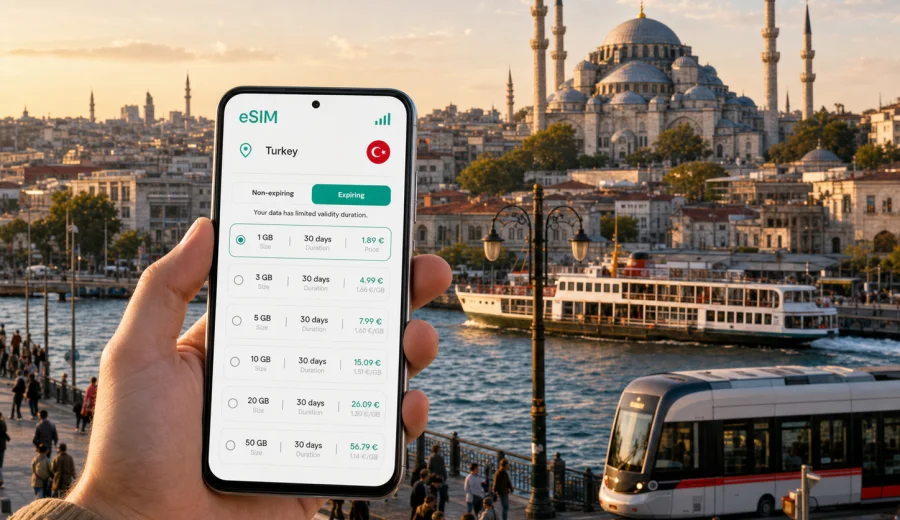
Istanbul eSIM: mobile connection and internet for your city trip
Istanbul is a city where mobile internet quickly becomes part of the route. You may land at Istanbul Airport on the European side, arrive through Sabiha Gokcen on the Asian side, cross the Bosphorus by ferry, take the metro to a hotel in Levent, walk through Sultanahmet, or move between meetings in Maslak and Karakoy. In each of these moments, a stable data connection helps with maps, ride apps, restaurant bookings, ferry schedules, mobile banking, translation, and messaging.
An eSIM is useful in Istanbul because it lets you prepare mobile internet before the trip without looking for a physical SIM card after arrival. You still need a compatible device and a suitable data plan, but you can avoid one of the most common first-day tasks: finding a store, comparing local offers in a hurry, and setting everything up while carrying luggage.
This guide focuses on Istanbul, not on Turkey in general. It explains how to think about mobile connection and internet for airport arrival, local transport, neighborhoods, hotels, business trips, short stopovers, and routes from Istanbul to other parts of the country.
Why mobile internet matters specifically in Istanbul
Istanbul is large, layered, and spread across two continents. A route that looks simple on a map can involve a metro line, a tram, a ferry, a steep walk, and a taxi ride. Tourist areas are compact in places, but many hotels, offices, airports, shopping areas, cruise terminals, and event venues are not close to each other.
Mobile internet is especially helpful for:
- checking the best route between European and Asian districts;
- comparing metro, tram, ferry, Marmaray, bus, and taxi options;
- using navigation in dense historic streets around Sultanahmet, Eminonu, Galata, and Balat;
- confirming hotel check-in details after a late flight;
- messaging drivers, hosts, colleagues, or family members;
- translating menus, signs, address details, and service messages;
- checking opening hours before crossing the city;
- managing online tickets, QR codes, and travel documents.
Public Wi-Fi can help in airports, hotels, cafes, and malls, but it is not a complete travel internet plan. You may need data between networks, on the street, in transport, or when a login page is not convenient. A prepared eSIM gives you a separate data option for the parts of the trip where Wi-Fi is not available or not practical.
Arrival in Istanbul: where an eSIM helps first
Most international visitors arrive through one of two airports: Istanbul Airport, often used for long-haul and connecting flights, or Sabiha Gokcen Airport on the Asian side. Both airports are far enough from many central districts that the transfer can become the first real test of your mobile connection.
With mobile data ready, you can:
1. Open the hotel address before leaving the terminal.
2. Compare public transport, shuttle, taxi, and ride app options.
3. Share your arrival time with someone waiting for you.
4. Track the route if your transfer crosses unfamiliar parts of the city.
5. Use translation if you need help with directions, payment, or luggage.
If you install an eSIM before departure, you can usually keep your primary SIM in the phone and use the eSIM for travel data. The exact activation moment depends on the selected tariff conditions, so read the validity rules before you start using data. Some plans begin when installed, while others begin when the device connects to a supported network.
Istanbul movement: the routes that use the most data
The city is not difficult to explore, but it rewards preparation. Mobile internet is most valuable when you are changing districts, checking real-time information, or deciding between several transport modes.
| Istanbul situation | Why mobile data helps | Practical tip |
|---|---|---|
| Airport to hotel | Routes can be long and traffic-dependent | Save the hotel address and keep maps ready |
| Sultanahmet sightseeing | Streets are dense and landmarks are close together | Use walking navigation but download key areas offline too |
| Ferry across the Bosphorus | Schedules and piers can be confusing at first | Check the departure pier before walking there |
| Taksim, Galata, Karakoy | Short distances can include hills and busy streets | Compare walking time with tram, metro, or funicular |
| Asian side visit | Kadikoy and Uskudar are easy by ferry or Marmaray | Keep data on for return routes after dinner |
| Business districts | Levent, Maslak, Atasehir, and office towers are spread out | Confirm entrances, meeting points, and ride details online |
For most visitors, Istanbul data use is not only about posting photos. It is about reducing friction: one missed ferry, wrong tram direction, or unclear pickup point can cost more time than a small amount of mobile data.
How much data may you need in Istanbul?
Data use depends on habits, but city trips often follow predictable patterns. Maps, messaging, ride apps, translation, and light browsing are moderate. Video calls, constant cloud backup, streaming, and social video uploads use much more.
| Trip style | Typical use | Data planning idea |
|---|---|---|
| Short stopover, 1 day | Maps, messaging, boarding pass, a few searches | A small package may be enough |
| Weekend city break | Navigation, restaurants, tickets, photos, ride apps | Choose enough data for several active days |
| 5-7 day visit | Daily maps, social apps, bookings, translation | Pick a plan with a comfortable buffer |
| Business trip | Email, messaging, maps, hotspot for laptop if allowed | Check whether tethering is permitted in the tariff |
| Family trip | Several users, shared routes, more media use | Consider separate eSIMs or a larger data allowance |
Do not choose only by price. Look at data volume, validity period, destination, activation rules, and whether the plan fits the way you actually travel. If you plan to use the phone as a hotspot, check the conditions of the selected tariff first.
Before you travel: eSIM checklist for Istanbul
Before buying any eSIM plan, check the basics. This is quicker than solving a device issue after landing.
- Your phone or tablet supports eSIM.
- The device is not locked to one mobile operator.
- You know which SIM should handle calls and which one should handle data.
- You have Wi-Fi available for installation before departure or at the airport.
- You understand when the selected plan validity starts.
- You know whether the tariff is data-only or includes other services.
- You have saved hotel, airport, and transport details offline as a backup.
If you are not sure whether your device can use eSIM, check your device before choosing a plan. This is especially important if you bought the device in a market where eSIM support varies by model, region, or carrier configuration.
Installing an eSIM before Istanbul
The simplest travel setup is to install the eSIM while you still have reliable Wi-Fi, then enable it according to the plan instructions. Keep your regular SIM active if you need your usual phone number for banking, two-factor authentication, calls, or SMS. Use the eSIM line for mobile data when you arrive.
For setup guidance, follow the relevant device instructions: Android eSIM installation guide or iOS eSIM installation guide. The exact screens may differ by phone model and operating system version, so read each step on your device carefully.
A practical setup flow looks like this:
1. Choose Turkey as the destination for your Istanbul trip.
2. Select a data package and validity period that match your route.
3. Install the eSIM profile on a compatible device.
4. Label the line clearly, for example "Travel data".
5. Keep your home SIM as the default for calls if you need it.
6. Set the eSIM as the mobile data line when you are ready to use it.
7. Turn on data roaming for the eSIM if the tariff instructions require it.
Kaspersky eSIM Store is an app and website where you can choose, arrange, install, and activate an eSIM with a suitable data tariff for mobile internet during an international trip. It is not a mobile operator and does not replace the need to read the selected tariff terms. The important point is control: you can see the destination, data volume, validity period, and other conditions before you prepare the plan.
Choosing an eSIM plan for an Istanbul itinerary
Istanbul travel patterns are different from a beach holiday or a single-resort stay. You may have heavy navigation days, quiet museum days, and one or two days outside the city. Choose the plan around behavior, not only the number of nights.
For a first-time visitor, a comfortable plan should cover:
- airport transfer and hotel check-in;
- route planning between European and Asian sides;
- maps in historic areas where streets are not always intuitive;
- ticket, restaurant, and museum searches;
- messaging throughout the day;
- possible trip changes caused by weather, traffic, or opening hours;
- a small reserve for unexpected detours.
If you want to prepare your data plan before departure, you can choose an eSIM tariff for a trip to Turkey and use it for your Istanbul itinerary. Check the available tariff details before purchase, especially data volume, validity, destination coverage, and activation rules.
District-by-district internet needs
Istanbul feels different depending on where you stay and how you move. Your mobile internet needs may also change by district.
Sultanahmet and Eminonu. These areas are rich in landmarks and foot traffic. Data helps with walking routes, museum timings, QR tickets, and finding the correct tram or ferry stop after sightseeing.
Beyoglu, Galata, and Karakoy. These neighborhoods are full of cafes, hotels, galleries, restaurants, and steep streets. A live map can prevent unnecessary uphill detours, especially at night or with luggage.
Besiktas and Ortakoy. These are popular for waterfront walks, ferries, nightlife, and access toward business districts. Mobile data helps with ferry schedules and late return routes.
Kadikoy and Moda. Many visitors cross to the Asian side for food, markets, ferries, and a more local pace. Keep your data line active for return planning, because the best route back may change by time of day.
Levent, Maslak, and Atasehir. These business areas are more spread out than the historic center. If you are traveling for work, reliable mobile data helps with meeting addresses, ride coordination, email, and calendar changes.
Balat, Fener, and Eyup. These areas reward slower exploration. Data helps with route checks because streets, hills, and transport links can be less obvious than in the main tourist corridor.
Hotel Wi-Fi is useful, but it is not a full city plan
Hotel Wi-Fi can be enough for backups, video calls, and evening planning. It is not enough for the active parts of an Istanbul day. You may leave the hotel early, change plans on the way, or need a ride after dinner on the opposite side of the Bosphorus.
Use hotel Wi-Fi for heavier tasks when possible:
- downloading offline maps;
- backing up photos;
- updating apps;
- streaming video;
- large file transfers;
- long work calls.
Use mobile data for time-sensitive tasks:
- live navigation;
- messages and ride confirmations;
- mobile tickets;
- translation;
- transport checks;
- urgent email;
- payment confirmations.
This split helps preserve your data allowance while keeping internet available when it matters most.
Business trips to Istanbul
For business travelers, Istanbul can involve several zones in one day: airport arrival, hotel check-in, office meetings, dinner in another district, and a late ride back. A prepared eSIM reduces dependence on venue Wi-Fi and lets you respond while moving.
Before the trip, check:
- meeting addresses in both English and local spelling if available;
- whether your calendar invites include building entrances, not only district names;
- whether you need mobile data for authentication apps;
- whether your eSIM tariff permits hotspot use if you may connect a laptop;
- whether your company requires specific security settings for public Wi-Fi or travel connectivity.
An eSIM is a mobile data tool, not a replacement for corporate security rules. If your organization has requirements for VPN, device management, or approved apps, follow those separately.
Short stopovers and long layovers
Istanbul is a major connection point. If you have a long layover and plan to leave the airport, mobile internet becomes useful before you even reach the city. You may need to check transit rules, estimate travel time, store your luggage, and keep an eye on the return journey.
For a stopover, data use is usually practical rather than heavy:
1. Route from the airport to the selected district.
2. Live timing for the return transfer.
3. Messaging if plans change.
4. Map searches for food, viewpoints, or a short walk.
5. Boarding pass and airline updates.
Keep the itinerary conservative. Istanbul traffic and airport distances can be significant, so mobile data helps you monitor the plan, but it cannot remove the need for a safe time buffer.
Trips from Istanbul
Many travelers use Istanbul as the starting point for more of Turkey. You may continue to Cappadocia, Izmir, Antalya, Ankara, Bursa, or the Princes' Islands. If your eSIM plan covers Turkey, it can support the route beyond Istanbul, subject to the selected tariff terms and coverage conditions.
For day trips and onward travel, mobile data helps with:
- intercity tickets and booking confirmations;
- station, pier, and airport navigation;
- hotel address changes;
- translation outside the most tourist-heavy districts;
- family or group coordination;
- checking weather before changing plans.
If your trip includes multiple countries, do not assume a single-country tariff is enough. Review the destination list before purchase and choose a country, regional, or global option that matches the actual route.
Practical data-saving habits in Istanbul
You can make a modest data package last longer with a few simple habits:
- Download offline map areas before leaving the hotel.
- Disable automatic cloud photo backup on mobile data.
- Use Wi-Fi for app updates and large downloads.
- Lower video quality in social and streaming apps.
- Close navigation after you arrive instead of leaving it running.
- Save ticket PDFs, hotel addresses, and key confirmations offline.
- Turn off mobile data for apps that do not need it during travel.
These habits are especially useful in Istanbul because days can be long. You may start with breakfast near Galata, spend midday in Sultanahmet, cross to Kadikoy by ferry, and return late through Taksim or Karakoy. Even light app use adds up over a full day.
Common mistakes to avoid
Avoid these problems before and during your trip:
- Buying a plan without checking device compatibility.
- Installing the eSIM on the wrong device if you travel with several phones.
- Forgetting that many travel eSIM plans are data-only.
- Assuming voice calls and SMS are included without reading tariff terms.
- Activating the plan too early if validity starts immediately.
- Leaving your home SIM as the data line by mistake.
- Using mobile data for large media uploads without checking remaining balance.
- Depending only on public Wi-Fi for airport transfer and late-night routes.
The most important habit is to read the selected tariff details before purchase. Conditions can vary, and a few minutes of checking is easier than changing plans after arrival.
FAQ: eSIM and mobile internet in Istanbul
Can I use an eSIM as soon as I land in Istanbul?
You can use it when it is installed, activated according to the instructions, and connected to a supported local network. Check the selected plan terms to understand when validity starts.
Do I need a Turkish phone number for maps and messaging?
Usually no. Maps, messaging apps, translation, email, and ride coordination can work over mobile data. Standard phone calls and SMS are not included unless the tariff explicitly says so.
Is an eSIM better than airport Wi-Fi?
They solve different problems. Airport Wi-Fi can help in the terminal. An eSIM is useful once you leave Wi-Fi coverage and need data during transfers, walking routes, ferry crossings, or hotel check-in.
Should I install the eSIM before traveling?
Installing before departure is often more convenient because you can use a stable Wi-Fi connection. Make sure you understand the activation and validity rules before turning on the data line.
Can I keep my usual SIM active?
On many compatible phones, yes. You can keep your regular SIM for calls or SMS and use the eSIM for mobile data. The exact setup depends on your device.
Will an eSIM cover every Istanbul route?
Coverage and speed depend on the selected tariff and local network conditions. Avoid absolute assumptions and keep key details offline for backup.
Prepare mobile internet before Istanbul
Istanbul is easier when your phone is ready for the first transfer, the first ferry, the first hotel message, and the first route change. Before you travel, check your device compatibility, choose the right data volume and validity period, install the eSIM on reliable Wi-Fi, and keep your main SIM settings clear.
With Kaspersky eSIM Store, you can prepare an eSIM data tariff for Turkey before your Istanbul trip and manage the setup through the app or website. Choose the plan that matches your itinerary, read the conditions, and keep mobile internet ready for the city from arrival to departure.