Travel connectivity guide
Istaravshan eSIM: Mobile Internet for Travel
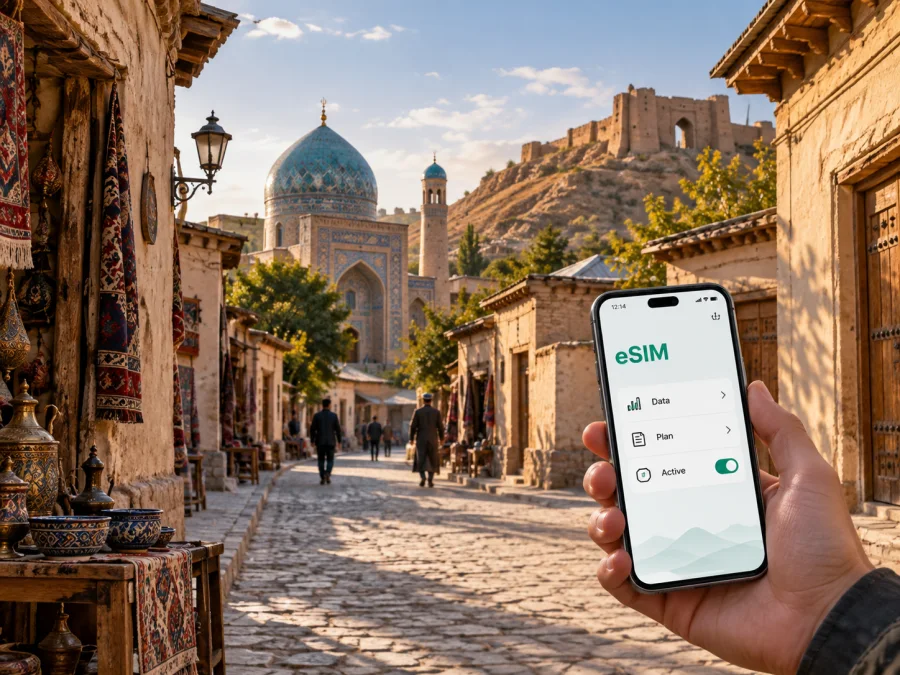
Istaravshan eSIM: Mobile Connection and Internet for Your Trip
Istaravshan is an old city in Sughd Province, near the foothills of the Turkestan Range and connected by road with Khujand and Dushanbe. A visit may be a city break, cultural route, business appointment, or stop between larger cities. Mobile internet helps with maps, hotel messages, translations, confirmations, and the next leg of the journey.
An eSIM, or digital SIM, can help you prepare that connection without changing a physical SIM card. Kaspersky eSIM Store is an app and website where you can choose, arrange, and activate an eSIM with a suitable mobile-data plan for an international trip. The right choice depends on your route, device, trip length, and expected data use. This guide focuses on Istaravshan itself: arrival, movement around the city, neighbourhoods and sights, accommodation, work, short stays, and onward travel.
Why mobile internet matters in Istaravshan
Istaravshan is compact enough to explore on foot in several central areas, but a visitor still moves between distinct points: the road into the city, a hotel, the historic core, Mug Teppa, the bazaar, restaurants, and a pickup point for onward transport. Addresses and landmarks may be easier to explain by sharing a map pin than by describing a turn. A working data connection also helps you keep a local itinerary in one place instead of carrying printed confirmations.
Here are common situations in which an eSIM can be useful:
- First arrival: contact your host, confirm check-in instructions, and open a map before leaving your vehicle.
- Independent sightseeing: move between the old town, Mug Teppa, Kok Gumbaz, Hazrati Shoh, and craft workshops without relying on public Wi-Fi.
- Transport coordination: message a driver, share a pin, or check the next stage of a route to Khujand, Dushanbe, or Panjakent.
- Business travel: use email, calendars, documents, and messaging between meetings while keeping your main number available if needed.
- Short or regional routes: coordinate a one-night stop or a longer Tajikistan itinerary without changing a physical SIM.
The point is to keep important tasks possible outside a hotel or café while choosing the plan in advance.
The city context: routes, landmarks, and areas to plan around
Istaravshan is an established city rather than a resort built around one modern complex. The central experience is a combination of living streets and historic places. Allow for walking, use landmarks as meeting points, and do not assume that an unfamiliar address will be obvious from a vehicle window.
Arrival from the north or south
Many visitors approach Istaravshan overland, especially when travelling through northern Tajikistan. Khujand is an important reference point: Istaravshan lies about 78 kilometres southwest of it, and the cities are linked by the main road that continues toward Dushanbe. Depending on your itinerary, you may arrive from Khujand, travel north after a stay in the city, or make Istaravshan a cultural pause on a longer road journey.
Before arrival:
- Keep the hotel name and phone number offline.
- Mark your accommodation, the historic centre, and the onward pickup point on a map.
- Confirm the destination with the driver and check that the intended line is selected for data.
This reduces the need to search for Wi-Fi while carrying luggage.
The historic core and old-town lanes
The old parts of Istaravshan mix streets, courtyards, religious buildings, and workshops. Use data to save a route, translate a phrase, or tell someone where you are waiting.
Mug Teppa and the city view
Mug Teppa, also written Mugteppa or Mug Tepe, is the historic hill associated with the city’s ancient fortified past. The surviving and reconstructed elements are a reminder that Istaravshan has developed on an old settlement pattern. From an elevated point, the relationship between the hill, the city, and the surrounding landscape becomes easier to understand.
Compare the route from the old town, locate the entrance, or arrange a meeting place after the visit. Wear comfortable shoes and allow time for uneven surfaces and pauses.
Kok Gumbaz, Hazrati Shoh, and craft streets
Kok Gumbaz is known for its blue dome and historic religious architecture, while Hazrati Shoh is another important cultural site. Visit religious places respectfully and follow local instructions. A phone can help with a meeting point or a message to your accommodation without distracting from the site.
Istaravshan is also associated with metalwork, knives, wood carving, pottery, textiles, and embroidery. Mobile internet can help you record a maker’s name, compare details, or message a companion. Ask before photographing people or work in progress.
Choosing an eSIM plan for an Istaravshan trip
Choose by use case rather than by the city name alone. An eSIM plan is generally set for a country, region, or route, while your daily needs depend on what you do in Istaravshan. A short cultural stop requires a different amount of data from a work trip with video meetings or a multi-city itinerary.
| Travel pattern | Typical data activities | What to compare |
|---|---|---|
| One day or overnight stop | Maps, messages, confirmations, occasional searches | Short validity and a modest data allowance |
| Two to four days in the city | Navigation, photos, translation, messaging, browsing | Enough data for regular map use and travel coordination |
| Business visit | Email, documents, messaging, tethering if permitted | Validity period, data volume, hotspot conditions, and work needs |
| Istaravshan plus Khujand or Dushanbe | Navigation between cities, bookings, calls in apps, route changes | Country or regional coverage that matches the whole itinerary |
| Longer cultural or road trip | Maps, uploads, research, communication | Higher allowance, longer validity, and refill conditions |
Before choosing, answer four questions:
- How many days will the eSIM need to remain available?
- Will you use data mainly for maps and messages, or also for photos, video, and work files?
- Does the route stay within Tajikistan, or does it include a border crossing or another country?
- When does the chosen plan’s validity begin, and when does traffic start to be consumed?
Maps and messaging are usually lighter than video, but automatic photo backup, application updates, and social-media feeds can use data in the background. Disable unnecessary updates and set a warning for the data limit.
For the country-specific option, you can choose an eSIM plan for a trip to Istaravshan and compare the available data volume and validity before purchase. The country link is appropriate because Istaravshan is in Tajikistan; it does not imply a separate city network or a city-only tariff.
Prepare before leaving for the city
Complete the setup while you still have stable internet and time to read the plan conditions, rather than at a busy stop when you need a map immediately.
Device and account checklist
- Confirm that your phone supports eSIM and is not locked to another operator. Check your device compatibility before paying.
- Make sure you can sign in to the Kaspersky eSIM Store app or website.
- Check the plan’s country or regional scope, data allowance, validity, activation conditions, and refill rules.
- Keep your regular physical SIM active if you need its number for calls or SMS, but review which line is selected for mobile data.
- Save accommodation details, key phone numbers, and the first destination offline.
- Carry a charged power bank for a road transfer or a full day of walking.
An eSIM is primarily a mobile-data solution in this travel context. It does not automatically provide a normal telephone number, voice calls, or SMS unless the particular plan says otherwise. Keep your usual SIM for calls if needed, but confirm the data settings so that line does not unintentionally use roaming data.
Install the profile at the right moment
Install the eSIM when you have a stable Wi-Fi connection or another working data line, and follow the conditions shown for your plan. Installation and activation are related but not identical: adding a profile to the device does not necessarily mean that you should turn on mobile data immediately. Some plans begin their validity or data use under specific conditions, so read the plan details before completing the last step.
For step-by-step device guidance, use the Android installation instructions or the iOS installation instructions. The menu names vary, but the usual sequence is to add the plan, label the line, select it for data, and enable data roaming for that eSIM if required. Keep the QR code or activation details available until it works.
Using mobile internet around Istaravshan
Navigation without wasting data
Plan the day in layers: save the accommodation and main historic landmarks, then add the bazaar, meeting point, and next departure location. Open routes before walking and avoid leaving video-heavy applications running.
If your group divides, agree on one easy-to-recognise point. A landmark and screenshot can be clearer than a long description. For a road transfer, send the destination name used by your driver and keep the address offline.
Transport and taxis
City movement may involve walking, local taxis, and shared or private road transport between towns. Availability, pickup points, fares, and departure times can change, so avoid presenting any one informal arrangement as a fixed city rule. Ask your accommodation or a trusted local contact where to wait, and confirm the destination before the vehicle leaves.
Data helps with communication but does not replace local judgement. Check the vehicle, agree on the destination, and keep your accommodation’s contact available. Make clear whether you mean Istaravshan city, the district, or another settlement.
Hotels, guesthouses, and working visits
For a leisure stay, use data to confirm check-in, a late arrival, and your estimated time. A property may be described by a landmark rather than a street number, so save both the written address and a map pin.
For a business trip, open needed documents before departure, check video-call data use, and confirm whether a hotspot is allowed. Do not assume a data plan includes voice service; keep meeting details in an offline note.
Practical scenarios
A one-night cultural stop
Install and check the profile before the road leg. On arrival, message the accommodation, walk through a concentrated group of historic streets, and reserve battery for the return. Use data for maps and confirmations rather than continuous video.
A two-day city visit
Divide the itinerary by area: give the old town and religious architecture a calm morning, then leave time for Mug Teppa and craft streets. Mark the departure point early.
A business appointment
Save the host’s name, meeting address, and backup contact. Use the eSIM for navigation and messaging, keep your main number available if needed, and download documents while online.
A northern Tajikistan route
Istaravshan can sit between Khujand and Dushanbe or form part of a route toward Panjakent. Select an option whose scope matches the complete itinerary, not only the overnight stop. Check the plan before a border crossing.
What to do if the connection is not working
Start with the simple checks:
- Confirm that the eSIM line is turned on and selected for mobile data.
- Check whether data roaming is enabled for that eSIM when the plan requires it.
- Turn airplane mode on briefly, then off, and allow the phone a moment to register.
- Check the plan status, remaining data, validity, and activation conditions in the app or profile.
- Make sure the phone has not reverted to the physical SIM for data.
- If the problem remains, contact support with the device model, eSIM status, and the steps already attempted.
Do not delete an eSIM profile as a first reaction: a profile may not be transferable after activation, and removal can make troubleshooting harder. Use saved instructions or trusted Wi-Fi to contact support when possible.
FAQ for an Istaravshan trip
Is an eSIM useful if I am staying only one night?
It can be. Arrival, check-in, navigation, and onward coordination still require data; choose a matching validity period and allowance.
Can I use the same eSIM on a route through several Tajik cities?
That depends on the country or regional scope. Check the destination and conditions; a country-level plan may cover travel between these cities when its terms say so.
Will the eSIM replace my normal phone number?
Usually it is for mobile data, not a replacement for your number or ordinary voice calls and SMS. Configure your usual line deliberately.
Should I activate the eSIM before arriving?
You can prepare and install it before the trip, but read the plan conditions to know when validity and traffic begin.
What should I do before visiting historic sites?
Save the accommodation, return route, and key landmarks. Carry a charged phone, use it discreetly in religious or quiet spaces, and ask before photographing people or workshops.
A simple departure checklist
Before leaving Istaravshan, verify the next destination, departure point, and estimated time with your host or driver. Keep the eSIM enabled only when you need it, monitor the remaining data, and save any tickets or address details that may be needed offline. If your route leaves Tajikistan, review the next country’s connection arrangement separately.
Istaravshan rewards a measured pace: time for an old lane, a blue dome, a view from Mug Teppa, and a conversation in a workshop. A prepared eSIM helps keep maps, messages, and travel information available.
Prepare your connection for Istaravshan
Check device compatibility, choose a Tajikistan plan by trip length and data needs, and install the profile while you still have a reliable connection. Then you can arrive ready to contact your accommodation, navigate the historic centre, coordinate transport, and continue your route with fewer interruptions.
Choose an eSIM plan for your Tajikistan journey and review the conditions before you travel.


