
Travel connectivity guide
Jajce eSIM for Mobile Internet
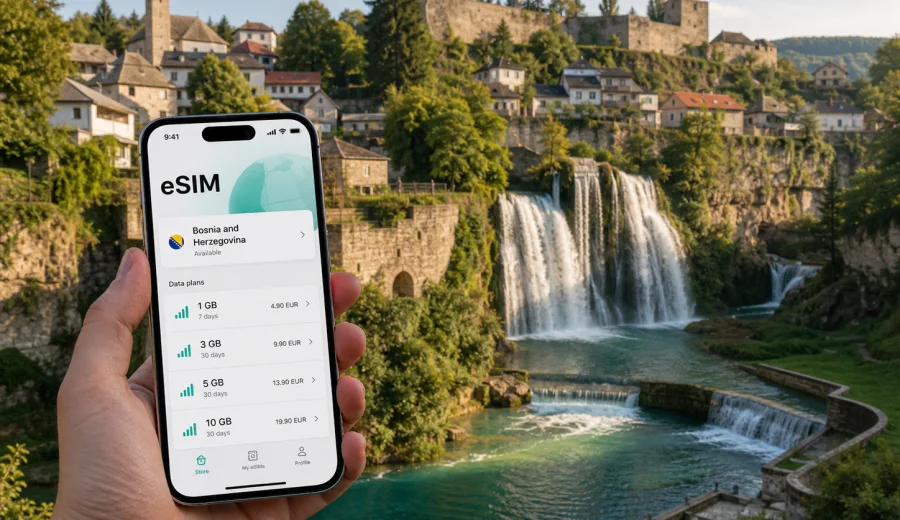
Jajce eSIM: mobile connection and internet for a trip to Bosnia and Herzegovina
Jajce is a compact Bosnian city where mobile internet becomes useful almost immediately. The waterfall is below the old town, the fortress is above it, the Pliva Lakes are outside the center, and many visitors arrive by road from Sarajevo, Banja Luka, Travnik, Bihac, or Mostar. You can see a lot in one day, but only if maps, messages, tickets, hotel details, and translation tools are available when you need them.
An eSIM is a practical way to prepare mobile data before you arrive in Jajce. Instead of looking for a physical SIM card after a bus ride or a long drive, you can install a digital SIM on a compatible phone, choose a suitable data allowance for Bosnia and Herzegovina, and use internet-based services during the trip. The most useful point is control: you know the validity period, the data volume, and the destination before you start moving around town.
This guide focuses on Jajce itself: arrival, local movement, navigation, hotels, short stopovers, business trips, the Pliva Lakes, day trips, and the moments when a stable mobile connection matters more than it seems from a map.
Why mobile internet matters in Jajce
Jajce is easy to walk through, but it is not a flat grid city. The old town rises above the Pliva and Vrbas rivers, the fortress sits on the hill, the waterfall viewing areas are below the historic core, and the lakes and wooden watermills are several kilometers away. Offline plans help, but real-time mobile internet is useful for the parts of the day that change.
Common online tasks in Jajce include:
- checking the walking route between the bus station, waterfall, fortress, and hotel;
- confirming whether a taxi or arranged transfer can take you to the Pliva Lakes;
- using maps when narrow streets split around the old walls;
- sending your live location to a guide, driver, host, or travel partner;
- translating menus, museum notes, parking signs, and guesthouse instructions;
- checking weather before walking to viewpoints or lakeside paths;
- uploading documents or joining a work call from a hotel or cafe;
- keeping messaging apps available if you are crossing Bosnia and Herzegovina by road.
Jajce rewards flexible movement. You may start with the waterfall, climb to the fortress, return to the center for lunch, then continue to the lakes. A data connection helps you adjust that order without depending only on hotel Wi-Fi or a printed route.
Arrival scenarios: bus, car, tour, or private transfer
Most international visitors reach Jajce through another Bosnian city. Sarajevo and Banja Luka are common arrival bases, Travnik is a frequent stop on the way, and some travelers include Jajce in a longer route toward Bihac, Una National Park, Mostar, or Croatia. There is no major airport in Jajce itself, so your mobile setup should be ready before the final road segment.
| Arrival style | What you may need online | Why eSIM helps |
|---|---|---|
| Intercity bus | Station location, timetable checks, hotel address, messaging | You can stay reachable if plans change during the road trip |
| Rental car | Navigation, parking, fuel stops, weather, route changes | You do not need to depend on public Wi-Fi between towns |
| Guided day tour | Pickup details, guide messages, photo backup | You can coordinate meeting points and share location quickly |
| Private transfer | Driver contact, address confirmation, payment messages | You can handle delays without searching for a local SIM shop |
| Business visit | Email, calendar, documents, calls through apps | You can arrive with mobile data prepared for work tasks |
If you are arriving late, the benefit is especially clear. Small cities can feel simple in daylight and confusing after dark, especially when your hotel is above or below the old town streets. Having mobile internet on arrival helps you check the exact entrance, call through a messaging app, or send a location pin.
Jajce city zones where data is useful
Jajce is not large, but its attractions sit in distinct zones. Thinking in zones makes it easier to estimate how much data you need and when you will rely on maps.
Old town and fortress
The historic core is the natural starting point for many visitors. You may walk past old walls, towers, steep lanes, viewpoints, cafes, small shops, and the fortress above the town. Mobile data is useful for orientation because a short route on the map can involve steps, slopes, or a detour around walls. If you are meeting a guide or another traveler, a live location is more reliable than saying "near the old town."
Pliva Waterfall and the river area
The waterfall is one of Jajce's defining sights: the Pliva River drops into the Vrbas close to the city center. You will probably use your phone for photos, short videos, route checks, and weather updates. Mist, crowds, and wet paths can slow you down, so keep your phone charged and avoid using all data on automatic photo backup while you are still out walking.
Pliva Lakes and Mlincici watermills
The Pliva Lakes and the small wooden watermills are outside the tight center. Some visitors walk part of the route, some use a car, taxi, bicycle, or tour transfer. This is where mobile internet becomes more than convenience: you may need navigation, a return pickup message, a route back before sunset, or a map check if you continue toward nearby villages.
Hotels, guesthouses, and cafes
Many accommodations in Jajce provide Wi-Fi, but you should not build the whole trip around it. Hotel Wi-Fi can be enough for video calls or backups, while mobile data is better for movement between places, check-in communication, and route changes. If you are staying in a guesthouse outside the center, eSIM data can be useful before you get the Wi-Fi password.
How much data to plan for Jajce
Data needs depend on trip style. A traveler who only checks maps and messages for one day needs far less than someone who works remotely from a hotel, uses video calls, uploads photos, and drives across the country.
| Trip type | Typical use in Jajce | Sensible data approach |
|---|---|---|
| Half-day stop | Maps, messages, a few searches | Small data allowance with enough margin for navigation |
| One overnight stay | Maps, translation, restaurant search, photo sharing | Moderate allowance for two active travel days |
| Road trip through Bosnia and Herzegovina | Navigation, route changes, hotel coordination | Larger allowance that covers Jajce and other cities |
| Business trip | Email, documents, calendar, app calls | Choose more data and keep hotel Wi-Fi for heavy calls |
| Family trip | Multiple maps, messaging, shared photos | Plan for higher use or separate device needs |
As a practical rule, maps, messaging, translation, and web searches are light. Video, cloud backup, social media uploads, and hotspot use consume data quickly. If you want to keep the eSIM package for the whole Bosnia and Herzegovina route, turn off automatic cloud sync on mobile data before you start sightseeing.
Choosing an eSIM for Bosnia and Herzegovina when Jajce is on your route
For a city trip to Jajce, the destination you need is Bosnia and Herzegovina, not a separate city product. Jajce is a city within the country, and a country-level eSIM tariff is the relevant option when you want mobile internet for the town, the Pliva Lakes, Travnik, Sarajevo, Banja Luka, or another domestic stop on the same route.
When comparing options, look at four practical details:
- data volume: enough for maps, messages, translation, and any work tasks;
- validity period: long enough for the whole route, not only the day in Jajce;
- activation rules: when the validity period starts and how the eSIM should be enabled;
- device compatibility: whether your smartphone or tablet supports eSIM and is not restricted by an operator lock.
If Jajce is part of a wider route, prepare the eSIM before you leave the airport city. You can use Kaspersky eSIM Store to choose a data plan for Bosnia and Herzegovina and keep the same preparation flow for Jajce, Sarajevo, Travnik, Banja Luka, and other stops in the country. The service helps you select, arrange, install, and activate an eSIM with a suitable mobile data tariff for travel; the final conditions depend on the plan you choose.
A practical setup checklist before you travel
Do these checks before the road to Jajce, not while standing at the bus station:
- confirm that your device supports eSIM and is not locked to one mobile operator;
- check whether your primary SIM is needed for bank codes, calls, or SMS;
- install the eSIM while you have a stable connection;
- save the QR code or installation details if the flow provides them;
- keep your accommodation address in both English and local spelling if available;
- download an offline map of central Bosnia as a backup;
- switch off automatic video backup on mobile data;
- pack a power bank if you will use the phone for navigation and photos all day.
Before paying for any eSIM tariff, use the compatibility check if you are unsure: Check your device. This is especially important if the phone was bought through a carrier, if it is an older model, or if you plan to use the same device for your main SIM and travel eSIM at the same time.
Installing and activating eSIM for the Jajce trip
The exact setup depends on your device and the selected tariff, but the preparation logic is simple. Install the eSIM before the trip or while you have reliable Wi-Fi, then activate mobile data according to the tariff instructions. On some phones, you may need to enable data roaming for the eSIM profile, because travel eSIMs often use roaming agreements to connect abroad.
Useful installation references:
Recommended sequence:
1. Install the eSIM profile before the travel day.
2. Keep your regular SIM active if you need calls or bank messages.
3. Name the eSIM profile clearly, for example "Bosnia data".
4. Set mobile data to the eSIM when you are ready to use it.
5. Check whether data roaming must be enabled for that eSIM profile.
6. Open a map or browser page to confirm that data is working.
7. Keep the support and account details available in case you need help.
An eSIM for travel data usually does not include a regular local phone number, voice calls, or SMS unless the selected plan explicitly says so. For most Jajce travel scenarios, internet-based messaging and calls are enough, but you should keep your main SIM available if you expect bank verification messages or traditional calls.
Jajce itinerary examples and data use
One-day cultural route
Start near the waterfall, walk up into the old town, continue to the fortress, return for lunch, then take a taxi or arranged transfer to the Pliva Lakes and watermills. The main data tasks are maps, opening hours checks, translation, messaging, and photo sharing. A small or moderate data package can be enough if you avoid video uploads.
Overnight nature and history route
Arrive in the afternoon, check in, visit the waterfall area, and leave the fortress and lakes for the next morning. This route gives you more time but adds hotel coordination, restaurant search, weather checks, and possibly remote work from the accommodation. A moderate data package gives you room to move without watching every megabyte.
Road trip route through central Bosnia
Combine Sarajevo, Travnik, Jajce, Pliva Lakes, and Banja Luka, or continue toward Bihac. Here, your phone is not only a city guide; it is the navigation and coordination tool between towns. Plan more data, because maps, route checks, music streaming, and hotel messages happen throughout the day. If you use a rental car, download offline maps as backup and keep live navigation for traffic and route confirmation.
Business or field visit
Jajce may be a meeting point for local business, NGO work, construction, cultural heritage, tourism, or regional travel planning. In that case, the data plan should cover email, messaging, document access, and app-based calls. Do heavy file uploads on hotel Wi-Fi where possible, but keep enough mobile data for movement between meetings.
Transport, navigation, and local movement
Jajce is walkable in the center, yet transport planning still matters. The bus station, old town, waterfall, lakes, and accommodation may not all fit into one flat walking loop. Mobile internet helps you decide when to walk and when to use a taxi or transfer.
Useful habits:
- save your hotel location before arrival;
- take a screenshot of the return bus time or transfer contact;
- check the walking route elevation, not only the distance;
- use mobile data for live maps near the lakes, where detours are easier to miss;
- keep a small data reserve for the end of the day, when you may need a ride or route update.
If you are using a rental car, confirm parking before entering the tight historic center. The easiest route on a map may not be the easiest street for a visitor to drive. Use mobile data for navigation, but do not rely on it as your only plan: save the hotel address and parking instructions offline.
Hotels, work, and backup data
Jajce is not a large business hub, but remote workers and business travelers still pass through it. A hotel or apartment may provide Wi-Fi, yet quality can vary by room, floor, and time of day. Use Wi-Fi for heavy uploads and long video calls, and keep mobile data for email, chat, calendar checks, authentication, route updates, and messages while moving between meetings or sights.
If mobile data does not start immediately, check the basics in order: confirm that the eSIM profile is installed, assign mobile data to that profile, enable data roaming for the eSIM if the instructions require it, restart the phone, and move outside thick stone walls or basement areas before changing more settings. If the settings look correct and data still does not work, use the account or app support route.
Data-saving tips for Jajce
A few settings can make a small data package last longer:
- download offline maps for Bosnia and Herzegovina before the trip;
- preload hotel booking details and bus tickets;
- turn off automatic photo and video backup on mobile data;
- use Wi-Fi for app updates;
- send compressed photos in chats;
- avoid long video calls while walking around town;
- keep live streaming for hotel Wi-Fi;
- monitor data use in the phone settings after the first travel day.
These steps matter in Jajce because the most photogenic parts of the trip are also the moments when people often use data heavily: waterfall videos, lake photos, route checks, and group messages all happen within a short period.
FAQ: eSIM and mobile internet in Jajce
Do I need a separate eSIM only for Jajce?
No. Choose a plan for Bosnia and Herzegovina that covers your whole route, including Jajce and connecting cities.
Can I install eSIM after arriving in Jajce?
You can install it with a stable internet connection, but it is easier to prepare before arrival so you are not searching for Wi-Fi after a bus ride or late check-in.
Will eSIM replace my regular phone number?
Usually no. A travel eSIM is mainly for mobile data unless the selected plan says otherwise. Keep your main SIM active if you need calls, SMS, or bank verification messages.
Is public Wi-Fi enough for Jajce?
It can help at hotels and cafes, but it does not cover movement between the bus station, old town, waterfall, lakes, and viewpoints.
Final preparation before the road to Jajce
Jajce is a city where the best travel moments are spread between water, hills, old streets, and short trips out of the center. Mobile internet helps you move between them with fewer interruptions: you can find the next viewpoint, confirm transport, translate practical details, stay in contact with your hotel, and keep your route flexible if weather or timing changes.
Before you travel, check device compatibility, choose a data allowance that fits your full Bosnia and Herzegovina route, install the eSIM while you have reliable Wi-Fi, and keep your main SIM available if you need calls or SMS. For a prepared trip to Jajce, you can select an eSIM data plan for Bosnia and Herzegovina through Kaspersky eSIM Store and activate it according to the plan instructions when you are ready to use mobile internet abroad.