Travel connectivity guide
La Digue eSIM: Mobile Internet & Travel Guide
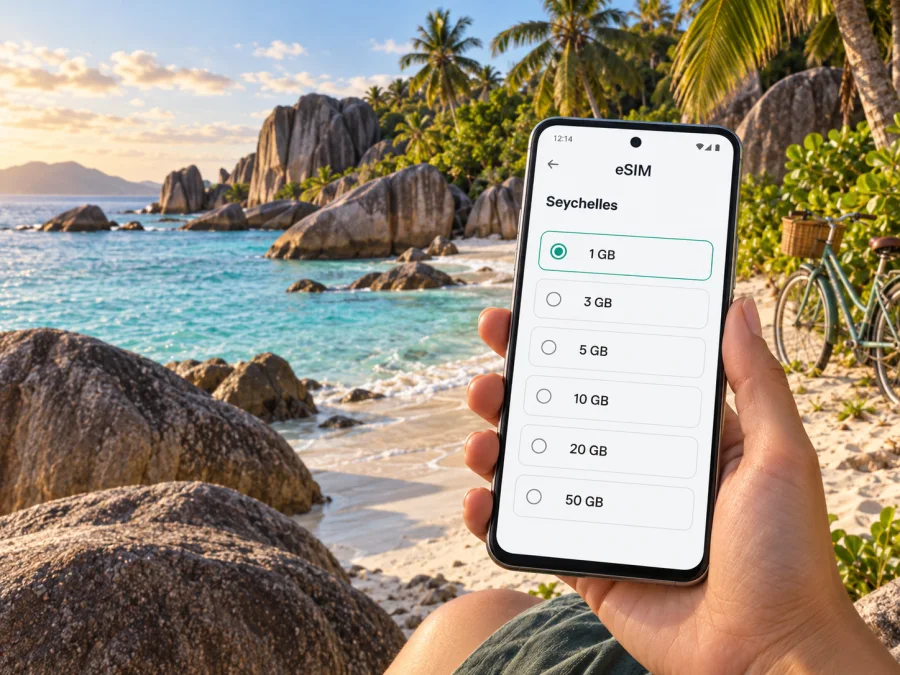
La Digue eSIM for a reliable mobile connection and internet on your trip
La Digue rewards a slower pace: you arrive by sea, leave the busy travel corridor behind, and explore a small island where a bicycle or a walk can shape the day. Mobile internet still has a practical role here. It helps you confirm your onward ferry, find the way to your accommodation, message a host, check a weather update, or keep a map available while you move between La Passe and the beaches.
An eSIM can make the data part of that preparation easier. Before choosing one, check that its coverage and conditions fit your whole Seychelles itinerary, including any time on Mahé or Praslin. The island’s quiet character also makes preparation useful: save essential details for offline access, charge your phone, and avoid relying on a single connection for every step of the journey.
Arriving on La Digue: plan around the jetty
La Digue has no airport. Most visitors reach it by ferry, commonly connecting through Praslin or travelling from Mahé with a transfer. Your exact route depends on the sailing and ticket you book, so confirm the current timetable, check-in requirements, and transfer details with the ferry operator before setting out. A connection can involve more than one boat, and a late arrival may affect what onward options remain that day.
The ferry jetty at La Passe is the island’s main arrival point and the natural reference point for the first few minutes. From here, visitors continue to guesthouses, self-catering stays, small hotels, restaurants, and bicycle hire. Ask your accommodation whether it arranges a transfer or can explain the easiest route with luggage. Do not assume that a car taxi will be waiting as it might at a large airport: transport on La Digue is shaped by its small scale and quieter road network.
Before boarding, keep the essentials together:
- accommodation name and address, saved as text or a screenshot;
- ferry ticket and any transfer confirmation;
- the host’s contact details and an agreed arrival plan;
- an offline map covering La Passe and your lodging;
- a charged phone and, if you have one, a small power bank;
- a local-data plan whose stated destination includes Seychelles.
A working connection is useful for messages and live updates, but your first hour should not depend on it. Download the information you will need while you still have dependable Wi-Fi, and keep a written address or reservation detail available. This small backup helps if the phone battery is low, a ferry is delayed, or a map takes time to load.
Choose mobile data for the whole route
A La Digue stay is often one part of a multi-island trip. You may pass through Mahé, spend time on Praslin, and then continue to La Digue. Compare the tariff’s stated destination, data allowance, validity period, activation rules, and any restrictions before you choose. A city or island name in a travel plan does not by itself confirm coverage; look for Seychelles in the tariff details and review the relevant terms.
Kaspersky eSIM Store is an app and website where you can choose, arrange, and activate an eSIM with a suitable data tariff for an international trip. It is a way to prepare mobile internet without changing the physical SIM in your phone. The selected tariff’s conditions determine where it can be used, how much data it includes, and how long it remains valid.
A quick planning comparison can help you decide what to prepare:
| Your travel pattern | What to check before choosing |
|---|---|
| La Digue is your only stop | Confirm that Seychelles is included and that the data amount suits maps, messaging, and the activities you expect to use online. |
| You will visit Mahé or Praslin too | Check that the same tariff applies across the islands and review its validity dates against all ferry and accommodation nights. |
| You are arriving late or changing boats | Save tickets, lodging details, and transfer instructions offline; choose a plan before travel rather than depending on a connection during the transfer. |
| You need data mainly for navigation | Download an offline map as a backup and use mobile data for updates, searches, and messages when available. |
When you are ready to compare the available destination options, choose a Seychelles eSIM tariff for your trip. Check the plan details against your itinerary rather than estimating from the island name alone. If you are making multiple stops, read the destination and validity information for each option before completing your selection.
Getting around: bicycles, short walks, and practical routes
La Passe is a practical starting point for collecting a bicycle, buying essentials, and arranging onward travel. Visitors commonly explore by bicycle or on foot; some accommodation providers or local operators can arrange electric-cart transfers. Confirm availability and luggage arrangements before relying on a transfer.
La Digue does not have a dense city grid. A map shows direction, but terrain, heat, and your pace affect a route. Treat a beach outing as a return journey, carry water, and ask locally about unfamiliar roads or paths. Mobile data can refresh a route or help you send a message, but signal availability may vary by place, device, and tariff. Save directions offline.
For a first ride, check the bicycle’s brakes and tyres, save your lodging location, carry water and sun protection, and leave enough daylight for the return.
La Passe, accommodation, and choosing a base
La Passe is useful if you want to stay close to the jetty, bicycle hire, food, and everyday services. A quieter property farther away may suit a slower stay, but consider the route with luggage and how you will reach shops or meals.
Before booking, check the distance and terrain from the jetty, food and supply options, bicycle availability, check-in timing, and whether the property can help arrange a luggage transfer. Ask what internet access is available on site; treat it as separate from your mobile-data plan. A map pin is only a starting point, so message the property if the final approach or arrival plan is unclear.
Beaches and day trips: save the route before you go
Anse Source d’Argent, reached through the L’Union Estate area, is La Digue’s best-known outing. Check current entrance arrangements and local conditions before setting out. Other beaches, including those on the island’s southern and eastern sides, may involve a longer ride or walk. Do not assume every destination is a quick trip from La Passe; ask your host about the route, weather, and access that day.
Before leaving, save the route and accommodation contact, check the forecast and sea conditions through a current local source, carry water, and keep enough battery for the return. A mobile connection can help with updates, but it cannot determine whether swimming or a trail is safe. Follow local advice and turn back if conditions do not suit.
A short stopover versus a slower stay
For a day trip or one night, check ferry connections first, choose one main outing near your route, and keep return details available offline. With several nights, spread longer rides across different days and leave time to rest. A phone is most useful for practical tasks—checking a sailing update, contacting a host, or refreshing a route—while a saved map reduces dependence on a live signal.
| Situation | Practical approach |
|---|---|
| Same-day visit | Confirm onward and return sailings; choose one main outing. |
| Overnight stay | Confirm check-in and luggage arrangements; save the next ferry details. |
| Several nights | Space out longer routes and ask locally about access or sea conditions. |
| Work call | Confirm accommodation internet in advance; do not rely on mobile data without checking tariff and local availability. |
Prepare your eSIM before boarding
Set up your travel data plan while you have a stable internet connection. Confirm that your device supports eSIM and is not restricted by a carrier lock; models and regional variants can differ, so check your device’s eSIM compatibility before purchase. Compare destination, data amount, validity, and activation conditions with your travel dates.
A practical sequence:
- Review the tariff and confirm that Seychelles and your travel dates are covered.
- Install the profile over a stable connection, following your device’s instructions.
- Label the line clearly, for example “Travel data.”
- Select the travel eSIM for mobile data when appropriate, while keeping your usual line’s calling settings as needed.
- Follow the tariff’s activation rules; validity does not necessarily begin the same way for every plan.
- Keep the QR code or account details safe, and do not delete the profile unless instructed.
Use the Android eSIM installation instructions or iOS eSIM installation instructions for device-specific steps. Menu names vary by phone and software version.
A data-focused travel eSIM does not automatically include a regular number, voice calls, or SMS unless the selected tariff says so. Internet-based messaging may work where the apps and connection allow it. If you keep your home SIM active for calls or verification messages, review its roaming settings to avoid unintended charges.
Keep data use predictable
Maps, messaging, photos, video, and backups use data differently. Choose an allowance based on your habits. Download maps and travel documents on Wi-Fi, turn off automatic backups over mobile data if you do not need them, and check which line is selected for mobile data. Keep some allowance available for route updates and messages. Monitor the plan’s remaining data and validity in its details or app.
Use suitable Wi-Fi where available for large downloads, but keep ferry tickets and accommodation details saved offline. A saved itinerary is often faster and more dependable than reopening a large attachment on the move.
Common questions about La Digue and eSIM
Is La Digue a city?
La Digue is an island in Seychelles; La Passe is its main arrival and visitor hub. For travel planning, focus on your lodging, jetty access, and transport around the island.
How do visitors arrive?
There is no airport on La Digue. Visitors generally travel by ferry, often connecting through Praslin or travelling from Mahé. Confirm the operator, sailing, and check-in details for your dates.
Is a bicycle useful?
For many visitors, yes. Cycling and walking are common options. Choose transport based on your route, luggage, fitness, and the day’s conditions.
Will mobile internet work everywhere?
No plan can guarantee the same service in every place. Check the tariff’s destination and remember that availability depends on local coverage, your device, and surroundings. Save directions offline.
Does an eSIM replace my normal phone line?
Not necessarily. A data-focused eSIM is for mobile internet; voice calls, SMS, and a separate number depend on the tariff. Review your home SIM and roaming settings too.
A simple arrival checklist
Before leaving for La Digue, confirm that you know your ferry and any connection point; can open your accommodation details offline; have a plan for luggage from La Passe; and have checked the eSIM destination, dates, and activation terms. Make sure your device is compatible and unlocked, and save a map before leaving Wi-Fi.
La Digue is easier to enjoy when ferry, lodging, and mobile data are planned together. Let the sailing set your arrival framework, use local advice for routes and conditions, and keep offline information ready for moments when you would rather look at the coast than troubleshoot a phone.
Choose a plan for your Seychelles trip
Kaspersky eSIM Store helps you prepare for mobile internet abroad by choosing, arranging, and activating an eSIM with a suitable tariff. Compare the Seychelles options with your route through La Digue, Mahé, and Praslin, and check the data amount, validity, and activation terms before you travel. Choose an eSIM tariff for your Seychelles trip and keep your ferry, stay, and route details ready for offline access as well.


