Travel connectivity guide
Lantau Island eSIM: Hong Kong Travel Guide
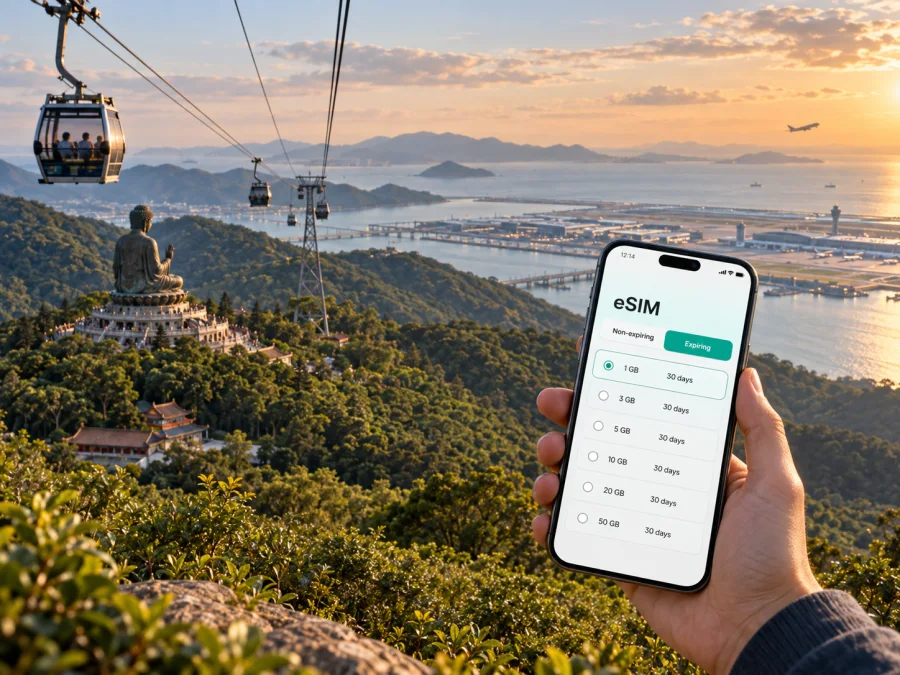
Lantau Island eSIM: mobile connection and internet guide for Hong Kong
Lantau Island is a practical Hong Kong base for travellers who need mobile internet from the first airport transfer to the last ferry or bus of the day. The island combines Hong Kong International Airport, Tung Chung, Ngong Ping, beaches, hiking routes, Mui Wo, Discovery Bay and Tai O. Distances between these places can feel short on a map but take planning in real life, especially when a cable car, ferry, rural bus or a change of transport is part of the route.
An eSIM, or digital SIM, can help you prepare mobile data without removing your primary physical SIM card. With Kaspersky eSIM Store, you can use the website or app to choose, arrange and activate an eSIM with a suitable mobile-data plan for an international trip. You see the plan’s destination, data allowance, validity period and price before making a decision. That makes the setup useful for a Lantau stopover, a family holiday or a business trip with meetings on one side of the island and a hotel on the other.
Why mobile data matters on Lantau Island
Lantau is not one compact resort district. Tung Chung is an urban transport hub near the airport; Ngong Ping is a mountain plateau; Mui Wo is reached by ferry or road; Tai O lies at the western end; and the southern beaches are spread along a different road network. A reliable data plan is therefore less about scrolling while sitting in one hotel and more about making several small decisions during the day.
You may need to:
- check the route from the airport to Tung Chung or your accommodation;
- confirm a bus, ferry or cable-car departure time before leaving a station;
- open a map while walking from a terminal to a hotel, pier or trailhead;
- share your location when a taxi drops you near a beach or village;
- receive a hotel message, restaurant confirmation or meeting update;
- translate a menu or read practical information while travelling;
- call a ride or send a message when weather changes a hiking plan.
Public Wi-Fi can be useful in an airport, café or hotel, but it is not a complete travel plan. On Lantau, you may move away from the place where you first connected just when you need directions most. Mobile data on a compatible device gives you another option and reduces the need to search for an open network at every stage of the route.
Arriving through Hong Kong International Airport
For many visitors, the first Lantau experience begins at Hong Kong International Airport on Chek Lap Kok. The airport is close to the island’s northern transport connections, but your next step depends on where you are staying and what you plan to do first. Some travellers continue directly to Tung Chung, others arrange a transfer to a resort or hotel, and stopover visitors may want to leave luggage before exploring Ngong Ping or the coast.
This is a good moment to have your travel data plan ready. Before leaving the terminal, you might need to check the location of your accommodation, compare a route, contact a host or confirm a transfer. If the eSIM has been installed in advance, keep the primary line available for calls and use the eSIM profile for mobile data only when you are ready. If you prefer to install it after arrival, make sure you have a suitable internet connection and enough time to complete the setup before starting a remote or rural part of the itinerary.
A simple arrival checklist
- Save the accommodation address in the format provided by the property.
- Keep the booking message, transfer details and emergency contacts accessible offline.
- Decide which line will handle mobile data after landing.
- Check that data roaming is enabled for the travel eSIM if the plan requires it.
- Test a map, a browser page and a messaging app before leaving the airport area.
- Keep the airport Wi-Fi option available as a backup while the profile registers.
Do not assume that every phone or tablet supports eSIM. Some models differ by region, and an operator lock can prevent a profile from working. Before you choose a plan, check your device compatibility and review the conditions shown for the specific eSIM.
Tung Chung: the practical gateway to Lantau
Tung Chung is often the most convenient working base on the island. It has an MTR station, bus connections, shopping and access to Ngong Ping 360. Travellers staying in the area can use mobile data for navigation between the station, hotel, airport-related services and the cable-car terminal. It is also a useful place to pause before committing to a long cross-island route.
For a first visit, separate Tung Chung into three practical zones:
| Area or connection | Why it matters for a connected itinerary |
|---|---|
| Tung Chung MTR station | A clear reference point for reaching the town, changing to buses and finding the cable-car area. |
| Airport and North Lantau roads | Useful for arrivals, departures, transfers and short stopovers. Route conditions and pickup points should be checked before travel. |
| Cable-car and shopping area | A common starting point for Ngong Ping visits, with tickets, meeting points and walking directions to coordinate. |
If you are meeting colleagues, choose a precise place rather than writing only “Tung Chung”. A message with the building, entrance, floor or station exit is easier to follow when several people arrive with luggage. If a meeting moves, mobile data helps you share a pin and update the plan without returning to a hotel for Wi-Fi.
Moving around Lantau: plan by route, not only by distance
The MTR Tung Chung Line is useful for reaching Tung Chung from the urban part of Hong Kong. From there, onward travel may involve a local bus, a blue Lantau taxi, a ferry or a walk. Public transport and attractions can operate on their own timetables, and a cable-car service may be affected by weather. For this reason, a map and a timetable should be checked close to departure rather than assumed from an old screenshot.
Transport scenarios worth preparing
- Airport to Tung Chung: keep the exact hotel entrance or pickup point visible.
- Tung Chung to Ngong Ping: check cable-car operations and keep the bus alternative in mind.
- Tung Chung to Tai O: allow time for the longer ride and save the return route before exploring.
- Mui Wo: check the ferry timing and leave battery for the onward journey.
- Cheung Sha or Pui O: treat the return service, daylight and weather as part of the itinerary.
Search for the exact attraction, pier or bus terminus rather than a broad district name. Save the accommodation name, check the direction before boarding and share your intended hiking route with someone.
Choosing a plan for a Lantau Island trip
The right plan depends on how you will use your phone, not simply on how many days you are in Hong Kong. A short stopover with maps and messages has a different profile from a week that includes video calls, photo uploads and hotspot use. Start with the route and usage pattern, then compare the data allowance and validity period shown for the Hong Kong destination.
| Travel pattern | Typical data needs to consider | Planning note |
|---|---|---|
| Airport stopover | Maps, messages, booking checks and a few searches | A smaller allowance may be enough if you avoid large uploads and streaming. |
| Two- or three-day island visit | Navigation, transport updates, photos and messaging | Leave room for repeated map use between Tung Chung, Ngong Ping and Tai O. |
| Longer holiday | Daily maps, social posts, calls through apps and reservations | Compare the allowance with your expected use and the plan’s validity period. |
| Remote work or business travel | Video meetings, cloud files, email and tethering | Check whether hotspot use is supported and keep a backup connection plan. |
There is no universal data amount for every visitor. Video calls and automatic photo backups can use much more data than text messages. You can reduce avoidable consumption by disabling automatic updates, postponing large uploads until Wi-Fi and downloading essential reservations before departure. At the same time, do not choose a plan so small that you must constantly ration basic navigation during a busy day.
When the timing is right to compare options, choose an eSIM plan for Hong Kong. The country page is the relevant destination for a Lantau Island trip because Lantau is part of Hong Kong; there is no need to look for a separate city page in the plan selector. Review the data size, duration, activation conditions and any usage notes before confirming.
Installing and activating your eSIM
Installation is easiest when you have time, battery and a stable internet connection. Some travellers install before departure and activate the line after landing; others complete both steps once they reach Hong Kong. The correct sequence depends on the device and the terms of the chosen plan, so follow the instructions shown with your eSIM.
Before you start
- Confirm that the phone is eSIM-compatible and not locked to an operator.
- Make sure the operating system is up to date enough for the device’s eSIM function.
- Have the QR code or activation details available on another screen if the phone cannot scan its own display.
- Keep the primary SIM active until the travel profile is installed and tested.
- Read when the validity period begins; installation and first network use are not necessarily the same event.
General setup sequence
- Open the mobile-network settings on your phone.
- Choose the option to add a mobile plan or eSIM.
- Scan the QR code or enter the details supplied after your selection.
- Give the new line a clear label such as “Hong Kong travel”.
- Select the travel line for mobile data.
- Turn on data roaming for that line if the plan or device requires it.
- Leave your primary line selected for calls and SMS if that is your preference.
- Test a simple web page and a map before setting off.
For platform-specific steps, use the Android installation instructions or the iOS installation instructions. If the profile does not register, check the plan conditions, signal, selected data line and roaming setting before reinstalling anything. An eSIM profile may not be transferable after activation, so avoid deleting it as a first troubleshooting step.
Lantau districts, hotels and day plans
Plan Lantau by area: Tung Chung is the airport and MTR base; Ngong Ping is the mountain-and-cultural stop; Mui Wo suits ferry connections; Tai O is a longer western outing; and Discovery Bay, Cheung Sha and Pui O need their own transport plans. Save the exact place name, not only “Lantau”. Ngong Ping visitors should leave a weather buffer, while Tai O and beach trips require a visible return route.
Choose a hotel by route. Tung Chung is practical for the airport and an early Ngong Ping start; Mui Wo suits a slower ferry-oriented stay; southern or western properties require more attention to late transport; and an airport-area hotel can suit a short connection. For business trips, save the building and entrance. For a stopover, choose one main destination, one flexible alternative and an offline return plan.
Before you buy: a clear eSIM checklist
Use this checklist before paying for a plan for Hong Kong:
- [ ] The device supports eSIM and is not operator-locked; check your device compatibility.
- [ ] The plan’s destination includes Hong Kong and suits the Lantau itinerary.
- [ ] The data allowance matches maps, messages, calls through apps, work or hotspot use.
- [ ] The validity period covers the actual travel dates.
- [ ] You understand when the plan starts and when data use begins.
- [ ] You know whether data roaming must be enabled for the travel line.
- [ ] You have an internet connection available for installation.
- [ ] You have read the conditions for top-ups, refunds and profile transfer.
- [ ] You know which line will be used for data, calls and SMS.
- [ ] You have a backup route and offline copies of essential confirmations.
These details are easy to overlook. Keep the QR code and purchase information accessible, and avoid activating too early or deleting the profile while troubleshooting.
FAQ about eSIM use on Lantau Island
Is an eSIM useful for a short Hong Kong stopover?
Yes. It can support maps, messages, booking checks and transport updates. Match the allowance and validity period to the stopover and keep the airport return route offline.
Can I keep my regular SIM active?
Usually, a compatible dual-SIM phone can keep the primary SIM active while the eSIM handles data. Settings vary, so check the selected data line and your home operator’s roaming rules.
Does the eSIM include a Hong Kong phone number?
Not necessarily. Many travel eSIMs are intended for mobile data and do not include a regular number, voice calls or SMS. Read the selected plan’s conditions; messaging apps can use the data connection.
Do I need data roaming for the eSIM?
Sometimes. A travel eSIM may require roaming on that line to use a partner network. Follow the plan instructions and avoid enabling roaming on the wrong SIM.
Can I install the eSIM after arriving?
Yes, if the phone is compatible and you have a stable connection. Installation before departure can simplify arrival, but activation timing depends on the plan.
What if the eSIM does not connect?
Check compatibility, operator lock status, eSIM activation, data-line selection, signal and roaming settings. Do not delete the profile until you have reviewed the instructions and support options.
Stay prepared for the whole island
Lantau Island rewards flexible plans: an airport arrival can become a Tung Chung lunch, a clear morning can open a Ngong Ping walk, and a weather change can turn a beach visit into a shorter local outing. Mobile data helps you adjust those decisions, but the best result comes from combining it with a realistic route, charged devices, saved confirmations and a plan allowance that matches your use.
Before departure, check your device, choose a Hong Kong eSIM plan with a suitable data allowance and validity period, and install it when you have a stable connection. After arrival, select the correct data line, test navigation and keep your primary SIM settings under control. If you need to compare options, review the eSIM plans for Hong Kong and choose the option that fits your Lantau Island itinerary. Then follow the installation steps and keep the plan details available throughout the trip.