
Travel connectivity guide
Limbe eSIM Guide for Mobile Internet
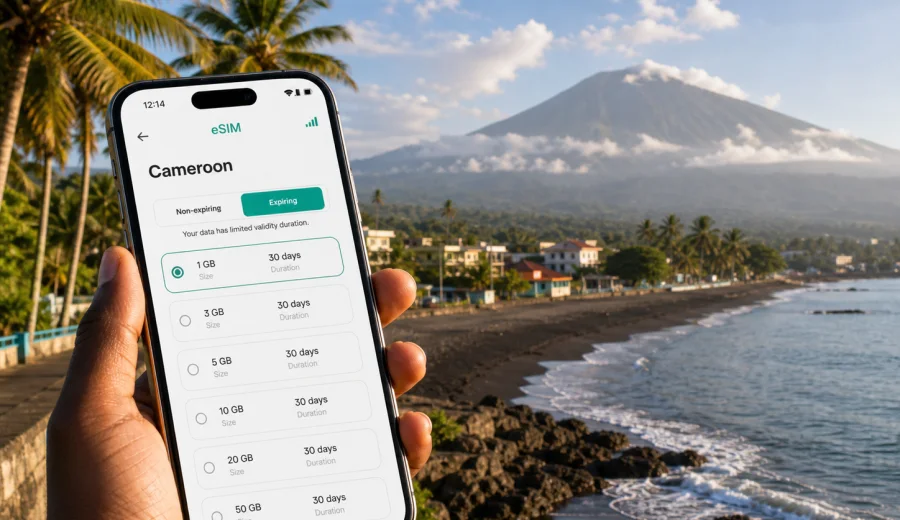
Limbe eSIM guide: mobile connection and internet for your trip
Limbe is a coastal city where a trip can move quickly from airport transfer to beach road, from the Botanic Garden to a hotel check-in, and from a business meeting in town to a weekend route toward Buea or Idenau. Mobile internet matters in each of those moments. You may need maps before you know local landmarks, a ride contact after dark, a message to your host, a payment confirmation, or a weather check before heading toward the coast or Mount Cameroon country.
An eSIM can make this easier because you do not need to find a physical SIM card shop as soon as you arrive. With a compatible phone, you can prepare a digital SIM profile for Cameroon, choose a data package for your trip length, and use mobile data for navigation, messaging, bookings, and work tools. This article focuses on Limbe itself: arrival, movement around the city, beach plans, hotels, business travel, short stopovers, and trips from Limbe to other parts of Cameroon.
Why mobile internet is useful in Limbe
Limbe sits on the Atlantic coast in Cameroon's Southwest Region. The city is compact compared with Douala, but visitors still move through different settings: central Limbe, Down Beach, the Botanic Garden area, the road toward Mile 4, Seme Beach, Bakingili, Bimbia, and routes toward Buea or Douala. Reliable mobile data helps you connect these places without depending only on hotel Wi-Fi or asking for directions at every turn.
Mobile internet is especially practical in Limbe when you need to:
- confirm your hotel address before leaving Douala or Tiko;
- share your live location with a driver or colleague;
- check maps on the coastal road and near beach areas;
- message a host, guide, or meeting contact;
- use translation, currency, and banking apps;
- open booking confirmations at reception;
- check the weather before beach, boat, or mountain-side plans;
- keep work email and messaging tools available during a short business stay.
Limbe is also a city where plans can be spread out. A morning may start at a hotel near the waterfront, continue to the Limbe Wildlife Centre or Botanic Garden, then end at Down Beach or a restaurant along the coast. If you rely only on public Wi-Fi, you may be online in the hotel lobby and offline exactly when you need a route, contact number, or booking detail.
Arrival: getting online before you reach Limbe
Many international visitors reach Limbe through Douala, then continue by road. Others may come from Buea, Tiko, Yaounde, Kribi, or another Cameroonian city. Because Limbe is not usually the first airport stop for international travelers, your first practical connectivity question is often not "where is the SIM counter in Limbe?" but "will I have data during the transfer?"
Preparing an eSIM before you travel can help with the first hours of the trip. You can install the eSIM profile while you still have stable home Wi-Fi, keep your primary SIM for calls or messages if your device supports dual SIM use, and switch mobile data to the eSIM when you are ready to use it. The exact activation moment and data validity depend on the chosen tariff, so check the plan conditions before purchase.
| Travel moment | Why mobile data helps |
|---|---|
| Before departure | Save hotel address, confirm check-in time, message your driver |
| On the way | Follow the route, estimate arrival time, share location |
| At arrival | Contact reception, open booking details, find the correct entrance |
| First evening | Find restaurants, check transport options, stay reachable |
If you are arriving late, mobile data can be more than a convenience. It lets you avoid searching for Wi-Fi after dark, confirm your route without handing your phone to strangers, and keep your contacts updated if the journey takes longer than expected.
Where eSIM helps most inside the city
In central Limbe, mobile internet is useful for walking routes, restaurant searches, payments, and messages with local contacts. Around the Botanic Garden and Limbe Wildlife Centre, it helps with maps, opening saved tickets or booking notes, arranging pickup, and checking details you saved earlier. At Down Beach, Seme Beach, and other coastal spots, data is useful for sharing location, checking weather from your chosen app, and keeping communication open if your group splits up.
For hotels and guesthouses, eSIM is helpful because Wi-Fi quality can vary by property, room location, and occupancy. You might have enough Wi-Fi for basic browsing in the lobby but still prefer mobile data for maps, banking apps, video calls, or work messages. The point is not to replace every local connection option; it is to have a prepared mobile internet layer when Wi-Fi is unavailable, slow, or inconvenient.
For business travelers, the main benefit is continuity. If you are visiting Limbe for meetings connected to the port, local services, education, tourism, NGOs, or regional administration, you may move between hotels, offices, cafes, and cars. A data eSIM helps keep email, calendars, messaging apps, cloud documents, and navigation available during those transitions.
Choosing an eSIM plan for Limbe
For a Limbe trip, choose the eSIM country or regional coverage based on where you will actually use mobile data. If your journey is only within Cameroon, a Cameroon-focused plan is the natural starting point. If Limbe is part of a wider route through several countries, check whether a regional plan better matches your itinerary and compare the details carefully.
The most important plan factors are:
- coverage area: Cameroon only or a broader route;
- data amount: light messaging, daily maps, work use, or heavy media;
- validity period: weekend, one week, two weeks, or longer;
- activation rules: when validity starts and what action triggers it;
- tethering conditions: whether you can share data with a laptop or another device;
- top-up options: whether you can add data if the trip changes.
A short beach weekend may need only a modest data package if you mainly use maps, messengers, restaurant searches, and occasional photos. A week in Limbe with remote work, video calls, cloud documents, and daily navigation needs more room. A longer Cameroon route through Limbe, Buea, Douala, Yaounde, or the coast should be planned around the full trip, not only the first hotel night.
Practical data estimates for common Limbe trips
The right package depends on your device settings and app habits, but these examples can help you estimate your needs.
| Trip style | Typical use | Planning note |
|---|---|---|
| One-night stopover | Maps, messages, hotel check-in, taxi contact | Choose a small package with enough validity for arrival and departure |
| Beach weekend | Navigation, restaurant searches, messaging, photo sharing | Allow extra data for social apps and weather checks |
| Business visit | Email, calendars, messaging, document access, hotspot if allowed | Check tethering and keep video calls under control |
| One-week city stay | Daily maps, bookings, calls through apps, browsing | Choose more data than a weekend plan |
| Cameroon route | Limbe plus Douala, Buea, Yaounde, Kribi, or other stops | Base the plan on the whole route and validity period |
If you are unsure, avoid choosing only for the first day. Limbe trips often expand: a short visit becomes a run to Buea, a beach afternoon becomes a longer stay, or a business meeting adds another day. It is easier to plan a reasonable buffer than to ration data whenever you leave the hotel.
A simple preparation checklist
Before leaving for Limbe, use this checklist:
- Confirm that your phone supports eSIM.
- Check that your device is not locked to one operator.
- Choose a plan for Cameroon or your wider route.
- Read the plan validity, data amount, and activation conditions.
- Install the eSIM while you have stable Wi-Fi.
- Save the installation details and QR code access if provided.
- Turn off automatic app updates and heavy cloud sync on mobile data.
- Download offline map areas for Limbe, Douala, Buea, and your route.
- Keep your hotel address, driver contact, and booking confirmation available offline.
This preparation reduces friction after arrival. Instead of finding a local SIM shop first, you can focus on reaching Limbe, checking in, and using mobile data when you need it.
When you are ready to plan connectivity for Limbe, you can choose a mobile internet option for Cameroon and check which data package fits your stay. Read the plan details, especially validity, data allowance, activation conditions, and tethering information.
How Kaspersky eSIM Store fits into the travel workflow
Kaspersky eSIM Store is an app and website where you can quickly choose, arrange, and activate an eSIM with a suitable data plan for mobile internet during an international trip. For a Limbe visit, that means you can review available options for Cameroon, compare data amount and validity, and prepare the eSIM on a compatible device before or during the journey.
An eSIM plan is for mobile data in travel. It usually does not include a local phone number, standard voice calls, or SMS unless the specific plan conditions say so. For calls and messages, many travelers use internet-based apps. If you need regular voice calls or SMS for a local service, check your requirements before relying only on a data eSIM.
How to install an eSIM before or after arrival
The calmest option is to install the eSIM before departure while your phone is connected to reliable Wi-Fi. You can then activate mobile data for the eSIM when the plan conditions say it is appropriate. If you prefer to wait until arrival, make sure you still have a stable internet connection for the installation process, such as hotel Wi-Fi or another trusted connection.
A practical installation flow looks like this:
1. Check that your smartphone supports eSIM and is not operator-locked.
2. Choose the destination and data package for your Limbe trip.
3. Complete the purchase and open the eSIM details in your account or app.
4. Install the eSIM by following the on-screen steps or using the QR code if offered.
5. Label the eSIM profile clearly, for example "Cameroon travel".
6. When you are ready, set mobile data to the eSIM profile.
7. Turn on data roaming for the eSIM if the instructions or plan conditions require it.
8. Test basic browsing and messaging before you depend on it for navigation.
For device-specific setup, follow the Android installation instructions or the iOS installation instructions. Do not delete an installed eSIM profile unless you are sure you no longer need it; in many cases, an activated eSIM cannot simply be moved to another phone.
Device compatibility matters
Not every phone supports eSIM, and some devices that support eSIM may still be restricted by an operator lock, regional variant, or device setting. Before choosing a plan for Limbe, check your device and confirm that it can install and use an eSIM profile.
Compatibility is especially important if you are traveling with a work phone, a phone bought through a carrier, or an older model. Also check whether your device can keep your regular SIM active while using the travel eSIM for mobile data. Dual SIM behavior can be useful if you want to receive messages on your usual number while routing data through the eSIM.
If your phone is not compatible, plan another option in advance: a physical SIM, a travel companion's hotspot, hotel Wi-Fi, or a separate compatible device. The point of checking early is to avoid discovering the limitation when you are already trying to reach Limbe.
Limbe travel scenarios where data helps
Beach and waterfront days
Beach plans in Limbe can include Down Beach, Seme Beach, hotel beachfronts, or quieter coastal points outside the city center. Mobile data helps you coordinate pickup, save your accommodation location, monitor weather, and message your group if you separate for photos, food, or transport. If you use maps around the waterfront, keep in mind that exact walking paths and access points can vary; combine map guidance with local advice from your hotel or host.
Botanic Garden and wildlife visits
The Limbe Botanic Garden and Limbe Wildlife Centre are common stops for visitors. Data helps with navigation, ride coordination, and opening saved notes about tickets or schedules. If you are traveling with children or a group, having your own connection also makes it easier to regroup, share photos later, and keep messaging available without relying on a single person's phone.
Hotels and business stays
For a business trip, eSIM is useful between Wi-Fi zones: on the road from Douala, in a car between meetings, at a cafe, or while waiting for a colleague. Before using mobile data heavily for work, check your plan size and whether tethering is supported. For video calls, large file transfers, and cloud backups, hotel Wi-Fi may still be more practical when it is stable.
Routes to Buea, Bakingili, Bimbia, and Idenau
Limbe is often part of a route rather than a single-destination stay. You may continue toward Buea, explore beaches beyond town, or travel along the coast. Mobile data helps with route checks and communication, but local terrain, weather, and network conditions can affect performance. Download offline maps and keep key contacts saved, especially if you are going beyond the main city areas.
Using data wisely in Limbe
An eSIM package is easiest to manage when you control background use. Before the trip, review your phone's mobile data settings. Turn off automatic app updates, large photo uploads, and background video downloads. Keep navigation, messaging, email, banking, and travel apps allowed, then restrict the apps that are not essential.
Useful habits include:
- download offline maps before travel;
- save hotel and meeting addresses in notes;
- use lower media quality in social apps;
- send photos on Wi-Fi when possible;
- avoid cloud backup over mobile data;
- check data balance regularly in your profile or app;
- keep a small data buffer for the transfer back to Douala or your next city.
If you use your phone as a hotspot for a laptop, data can disappear much faster than expected. System updates, cloud drives, and email attachments can run in the background. Use hotspot only when your plan supports it and you understand the data impact.
eSIM, roaming, local SIM, and Wi-Fi: what to choose
There is no single best option for every traveler. The practical choice depends on trip length, phone compatibility, budget, and how soon you need data.
| Option | Strong point | Limitation to consider |
|---|---|---|
| Travel eSIM | Can be prepared before arrival, no physical SIM swap, good for data-first travel | Requires a compatible unlocked device and a suitable plan |
| Home operator roaming | Uses your existing number and account | Can be costly or limited depending on your operator |
| Local physical SIM | May suit longer stays or local call needs | Requires in-person purchase and setup time |
| Hotel or cafe Wi-Fi | Useful for large downloads and laptop work | Not available during transfers, walks, beach days, or road trips |
For many visitors, the practical setup is a mix: eSIM for mobile data when moving around Limbe, hotel Wi-Fi for heavy downloads, and internet-based apps for calls and messages. If you need a local number for a specific service, verify that separately before the trip.
FAQ: eSIM for Limbe
Is an eSIM useful for Limbe if my hotel has Wi-Fi?
Yes. Hotel Wi-Fi helps inside the property, but mobile data is useful during transfers, walks, beach visits, restaurant searches, and trips to Buea, Douala, or coastal areas outside central Limbe.
Should I choose a Limbe plan or a Cameroon plan?
For a city article, the relevant destination plan is the country where the city is located. For Limbe, choose a plan that covers Cameroon, unless your route requires a broader regional option.
Can I keep my regular SIM active?
Many compatible phones allow dual SIM use, with your usual SIM kept for calls or messages and the eSIM used for mobile data. Check your device settings and operator conditions before travel.
Does a travel eSIM include calls and SMS?
Usually, eSIM plans for travel are focused on mobile data and do not include a regular local phone number, voice calls, or SMS unless the specific plan says otherwise. You can use messaging and calling apps over mobile internet.
When should I install the eSIM?
Install it before departure if possible, while you have stable Wi-Fi. Then activate or use it according to the plan conditions. If you install after arrival, make sure you have a reliable internet connection for setup.
What if my trip continues from Limbe to another city?
Plan for the full route, not just Limbe. If you continue to Buea, Douala, Yaounde, Kribi, or another destination in Cameroon, check that the validity and data allowance cover the whole trip.
Final checklist before you go
Before you travel to Limbe, confirm three things: your phone supports eSIM, the plan covers Cameroon for the dates you need, and you understand when the data allowance starts. Save your hotel address, download offline maps, keep installation instructions available, and set your phone to avoid unnecessary background data use.
For a smoother arrival and easier movement around the city, prepare an eSIM plan for your trip to Limbe in Cameroon through Kaspersky eSIM Store. Choose the package that fits your route, install it on a compatible device, and keep mobile internet ready for navigation, messages, bookings, and everyday travel tasks in Limbe.