
Travel connectivity guide
eSIM Lithuania: mobile internet for travel
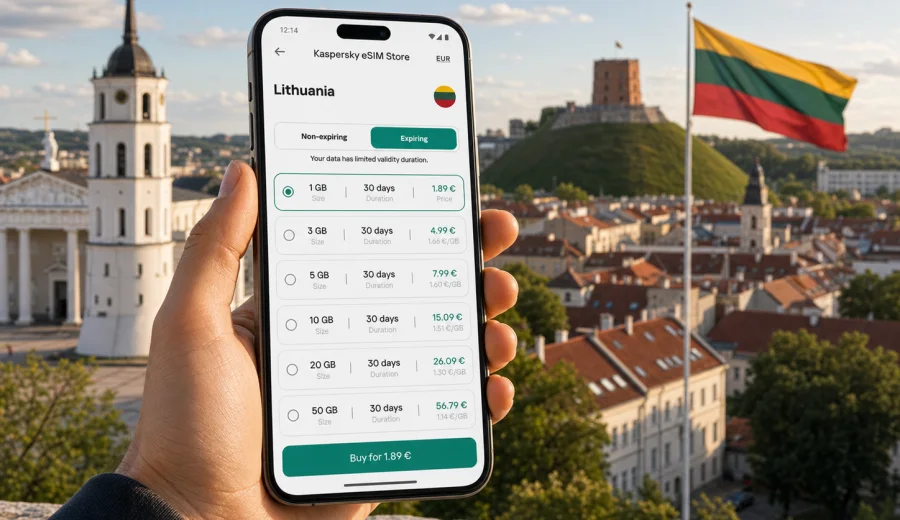
eSIM in Lithuania: mobile connection and internet for travel
Lithuania is an easy country to cross, but it is not a country where you want to improvise your mobile internet at the last minute. A typical trip can move quickly from Vilnius Airport to the Old Town, then to Kaunas, Trakai, Klaipeda, the Curonian Spit or a quiet lakeside town. Each step usually depends on your phone: tickets, maps, hotel messages, ride-hailing, banking confirmations, restaurant bookings and route changes.
An eSIM helps you prepare that connection before you need it. Instead of looking for a physical SIM card after arrival, you can choose a data plan for Lithuania, install the eSIM on a compatible device and use mobile internet while keeping your main SIM for calls or account verification if your phone supports dual SIM use.
This guide explains how to think about eSIM in Lithuania, what to check before buying a plan, how much data different travel styles may need and how to avoid the most common mistakes. The focus is practical: a reliable mobile connection and internet access for travel, not technical theory.
Why mobile internet matters in Lithuania
Lithuania is compact, digital and well connected. That makes a phone useful almost everywhere, but it also means many everyday travel tasks assume that you are online. You may need mobile data before you reach your hotel Wi-Fi, while walking between streets in Vilnius Old Town, comparing train and bus options, or finding the right ferry and route information near the coast.
For many visitors, mobile internet in Lithuania is most useful for:
- navigation in Vilnius, Kaunas, Klaipeda and smaller towns;
- checking public transport routes and intercity travel times;
- messaging accommodation hosts or tour guides;
- using banking apps and payment confirmations;
- translating menus, signs and transport notices;
- booking museums, restaurants, car rental or day trips;
- sharing hotspot access with a laptop for light work;
- staying reachable when airport or hotel Wi-Fi is unavailable.
Public Wi-Fi can help in hotels, airports, cafes and some public places, but it is not a full travel strategy. You still need a connection on the street, in a taxi, on a train platform, at a bus stop or when your plans change outside opening hours. A travel eSIM is useful because it puts the connection on your phone, not only in fixed locations.
What an eSIM does for a trip to Lithuania
An eSIM is a digital SIM profile installed on a compatible smartphone or tablet. For travel, it is usually used for mobile data. It does not require a removable plastic SIM card, and it can sit alongside your regular SIM on many modern devices.
For Lithuania, that means you can prepare mobile internet before departure or shortly after arrival. You select a plan with a data allowance and validity period, install the eSIM profile, then activate mobile data on that line when you are ready to use it. The exact activation moment and validity rules depend on the selected plan, so it is important to read the conditions before payment.
The important point is control. You know the data amount, the duration and the destination before you start using the plan. That is often easier than relying only on standard roaming, especially if your home operator's roaming terms are unclear, expensive for your usage or inconvenient for a multi-country route.
An eSIM for Lithuania is especially practical when:
- you arrive late and do not want to search for a local SIM shop;
- you need maps and messaging immediately after landing;
- you use a phone that supports eSIM and dual SIM;
- you want a prepaid data plan with visible conditions;
- you are visiting Lithuania as part of a Baltic or European itinerary;
- you prefer to keep your home number active for calls or verification codes.
eSIM, roaming and physical SIM cards: what changes
There is no single best option for every traveler. The right choice depends on your device, route, data use and how much time you want to spend on setup. The table below gives a simple comparison.
| Option | Best for | Main advantage | What to check |
|---|---|---|---|
| Travel eSIM | Visitors with compatible phones who need mobile data | Can be prepared in advance, no plastic SIM | Device compatibility, data size, validity, activation rules |
| Standard roaming | Short trips with a strong home operator roaming package | Uses your existing SIM and number | Daily fees, data limits, fair-use policy, speed restrictions |
| Physical local SIM | Longer stays or users without eSIM support | Familiar local SIM format | Store hours, ID requirements if applicable, setup time, language support |
| Public Wi-Fi only | Very light use in fixed places | No mobile plan needed | Availability, security, coverage between locations |
For many tourists and business travelers, eSIM sits between convenience and control. It avoids the need to change a physical card, and it lets you keep your primary SIM in place. At the same time, it is not magic: it still depends on a compatible device, the selected tariff conditions and mobile network availability in the places where you travel.
Travel scenarios across Lithuania
Lithuania has several common travel patterns. Each one creates a different need for mobile internet.
Vilnius city break
A short stay in Vilnius usually involves heavy map use, restaurant searches, museum tickets, taxi apps and messaging. The Old Town is walkable, but it is easy to take side streets, move between viewpoints and change plans based on weather. Even for a weekend, mobile data is useful from the airport to the final hotel checkout.
Vilnius, Kaunas and Trakai
This route adds intercity transport, day-trip planning and more frequent navigation. You may use maps at rail or bus stations, check timetables, coordinate with a host and upload photos from multiple stops. A medium data plan is often more comfortable than the smallest package if you use maps all day.
Baltic coast and Curonian Spit
Klaipeda, Palanga, Nida and the Curonian Spit are popular for beaches, nature and slower travel. Mobile internet helps with ferry information, weather checks, cycling routes and accommodation messages. Coverage and speed can vary by location and network conditions, as in any country, so offline maps are still a good backup.
Business trip
For work, the most important factor is predictable access. You may need email, chat, video calls, document approval and hotspot use. If you expect to tether a laptop or join video meetings, choose more data than you would for a leisure trip. Video calls can consume data quickly, and hotel Wi-Fi quality is not always enough for work.
How much data do you need in Lithuania?
Data use depends more on behavior than on the country. A traveler who mostly uses messaging and maps may need far less than someone who streams video, backs up photos or uses a laptop hotspot. Use the ranges below as planning guidance, then check your own phone's recent mobile data history before choosing a plan.
| Travel style | Typical use | Sensible data range |
|---|---|---|
| Light weekend | Maps, messaging, occasional searches | 1-3 GB |
| Standard city trip | Maps, transport, browsing, social media, bookings | 3-5 GB |
| Active week | Navigation, photo sharing, regular app use | 5-10 GB |
| Work and hotspot | Email, cloud tools, laptop tethering, some calls | 10 GB or more |
| Heavy media use | Streaming, video uploads, large backups | Choose a larger plan and monitor usage |
To keep data use under control, download offline maps before travel, turn off automatic cloud backups on mobile data, update apps on Wi-Fi and reduce video quality when you do not need high resolution. These small changes can save more data than you expect.
Choosing an eSIM plan for Lithuania
Before choosing a plan, look at four details: data allowance, validity period, destination coverage and activation rules. The plan should match the real shape of your trip, not just the number of calendar days.
For example, a three-day trip with heavy navigation and social sharing may need more data than a seven-day work trip where you spend most time on office and hotel Wi-Fi. A one-week route through Vilnius, Kaunas and the coast may also need more flexibility than a single-city stay.
If you want to prepare mobile internet before the trip, you can use Kaspersky eSIM Store to choose an eSIM plan for Lithuania and review the available data amounts and validity periods before installation. Kaspersky eSIM Store is an app and website where you can quickly choose, arrange and activate an eSIM with a suitable data plan for mobile internet abroad; it is not a mobile operator or network owner.
Use this short checklist before payment:
- Check that the destination is Lithuania, or that Lithuania is included in a regional plan if your route crosses borders.
- Compare the data allowance with your expected use, especially maps, video calls and hotspot sharing.
- Check the validity period and when it starts.
- Confirm whether the plan is data-only or includes any additional services.
- Make sure your device supports eSIM and is not locked to another operator.
- Save installation details while you still have a stable connection.
Device compatibility: check before you rely on eSIM
Not every phone supports eSIM, and some compatible models may have regional or operator restrictions. Before you choose a plan, confirm that your exact device model can install an eSIM and use mobile data on it. You should also check that the phone is not locked in a way that prevents another mobile profile from working.
You can start with the compatibility check here: check your device.
The most common compatibility checks are:
- your phone or tablet supports eSIM;
- your device is unlocked for use with another mobile profile;
- your operating system is up to date enough for eSIM installation;
- you have a stable internet connection during installation;
- you can access settings for mobile data, data roaming and default data line;
- you have not reached the maximum number of stored eSIM profiles on the device.
Do this before your departure if possible. It is easier to solve a device issue at home than after landing, when you may already need maps, messaging and transport details.
How to install and activate an eSIM
The exact steps depend on your phone and the selected plan, but the general flow is simple. Choose the plan, receive the installation details, add the eSIM profile to your device and select it for mobile data when you are ready to use it.
For platform-specific setup, use the official installation guides: Android installation guide and iOS installation guide.
A practical installation sequence looks like this:
1. Connect your phone to stable Wi-Fi.
2. Add the eSIM profile using the QR code or manual details provided after purchase.
3. Give the eSIM line a clear label, such as Lithuania data.
4. Keep your primary SIM available for calls or SMS if you need it.
5. Set the eSIM as the mobile data line when you are ready to use it.
6. Turn on data roaming for the eSIM if the plan instructions require it.
7. Open a browser or map app and check that mobile data works.
Do not delete the eSIM profile unless you are sure you no longer need it. In many cases, an installed or activated eSIM profile cannot simply be moved to another phone like a plastic SIM card.
When to activate: before departure or after arrival?
Many travelers install the eSIM before departure and activate mobile data after arrival. This is often the most comfortable approach because installation requires a stable internet connection, while activation is needed only when you want to start using mobile data. Still, plan rules vary, so read the activation and validity details before you decide.
Consider this approach:
- Before departure: check compatibility, choose the plan, install the eSIM profile and save instructions.
- At the airport: keep your main SIM active if you need verification messages.
- After landing in Lithuania: set the eSIM as the mobile data line and test a simple webpage or map.
- During the trip: monitor remaining data and reduce background usage if needed.
If your plan's validity starts at installation, you may prefer to install closer to departure. If validity starts when the eSIM first connects to a supported network, you may be able to install earlier. The only safe rule is to check the wording for the specific plan.
Practical route planning with mobile data
Mobile internet is not only for emergencies. It can make ordinary travel smoother.
In Vilnius, it helps when you move between Cathedral Square, Uzupis, the railway station and viewpoints around the city. In Trakai, it is useful for route timing, restaurant searches and return transport. In Kaunas, it helps with museum opening hours, bus routes and last-minute reservations. Near the coast, it is useful for ferry details, weather changes and navigation through smaller settlements.
For road trips, download offline maps before leaving major cities. Mobile coverage is generally expected in populated areas, but any country can have weaker spots because of terrain, buildings, congestion or network maintenance. Offline maps and saved addresses keep you functional even if the signal drops for a while.
Common mistakes to avoid
The most common eSIM problems are usually preventable. They happen when travelers buy before checking the device, install in a hurry or choose a plan that does not match their real data use.
Avoid these mistakes:
- Buying a plan before confirming that your exact phone supports eSIM.
- Forgetting to check whether the phone is operator locked.
- Installing the eSIM without stable Wi-Fi.
- Deleting the eSIM profile after installation.
- Leaving mobile data on your home SIM and creating roaming charges.
- Choosing the smallest data package while planning to use hotspot or video calls.
- Assuming voice calls and SMS are included when the plan is data-only.
- Waiting until the airport exit to read installation instructions.
The safest habit is to prepare before travel, then make only the final mobile data switch after arrival.
Quick checklist before flying to Lithuania
Use this checklist one or two days before departure:
- Your passport, tickets and accommodation details are saved offline.
- Your phone supports eSIM and is unlocked.
- You have chosen a plan with enough data and the right validity period.
- The eSIM installation details are saved or accessible.
- Offline maps for Lithuania are downloaded.
- App updates and cloud backups over mobile data are disabled.
- Your main SIM remains available if you need SMS verification.
- You know how to switch the default mobile data line on your phone.
- You have checked whether data roaming must be enabled for the eSIM line.
This preparation usually takes only a few minutes, but it reduces stress at the airport and during the first day of travel.
FAQ: eSIM and internet in Lithuania
Can I use eSIM for mobile internet in Lithuania?
Yes, if your device supports eSIM, is not locked against another mobile profile and the selected plan includes Lithuania. You should check compatibility and plan conditions before buying.
Does an eSIM give me a Lithuanian phone number?
Travel eSIM plans are commonly focused on mobile data. They may not include a standard phone number, voice calls or SMS unless this is stated in the plan conditions. For calls and messages, many travelers use internet-based apps over mobile data.
Can I keep my regular SIM active?
On many dual SIM phones, yes. You can keep your regular SIM for calls or SMS and use the eSIM for mobile data. The exact settings depend on the device.
Is eSIM better than roaming?
It depends on your home operator's roaming terms and your usage. eSIM can be a convenient prepaid option with visible data and validity conditions. Roaming may be simpler if your existing plan already includes generous Lithuania or EU data.
Should I choose a Lithuania plan or a Europe plan?
Choose a Lithuania plan if your trip is only in Lithuania. Consider a regional Europe plan if you also visit Latvia, Estonia, Poland or other countries on the same itinerary. Always check that every destination on your route is included.
What if mobile data does not work immediately?
Check that the eSIM is selected for mobile data, data roaming is enabled if required, airplane mode is off and the phone has restarted after setup if the instructions recommend it. Also confirm that you are in the destination covered by the plan.
Final advice for a smoother trip
For Lithuania, the best mobile internet setup is the one you prepare before you urgently need it. Check your device, choose enough data for your travel style, install the eSIM with stable Wi-Fi and keep the activation instructions accessible. This keeps the first moments of the trip focused on transport, accommodation and orientation instead of troubleshooting connectivity.
If you are ready to prepare your phone for the trip, open Kaspersky eSIM Store and choose an eSIM plan for your Lithuania trip. Select the data amount and validity period that fit your route, install the eSIM on a compatible device and use it for mobile internet while you travel.