
Travel connectivity guide
Lubumbashi eSIM for Mobile Internet
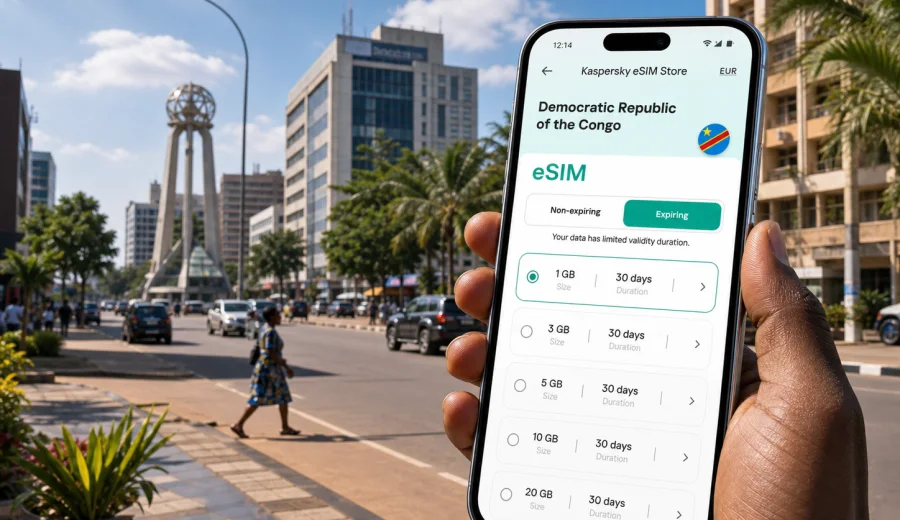
Lubumbashi eSIM: mobile connection and internet for your trip
Lubumbashi is a city where a reliable mobile connection quickly becomes part of the travel plan. You may need maps from the airport, a messenger for a hotel transfer, mobile internet for a meeting, or access to bookings while moving between the city center, business districts, mines, industrial sites, and nearby towns in Haut-Katanga. An eSIM can help you prepare that connection before you look for a local SIM card or depend on public Wi-Fi.
This guide focuses on practical use in Lubumbashi: arrival, transport, hotels, business travel, short stays, and trips from the city to other parts of the Democratic Republic of the Congo. It explains how to choose an eSIM tariff for mobile data, what to check before purchase, and how to keep your phone ready for navigation, messaging, and everyday travel tasks.
Why mobile internet matters in Lubumbashi
Lubumbashi is one of the Democratic Republic of the Congo's main business centers. Many visitors arrive for mining, logistics, construction, trade, academic work, family trips, or regional travel through the southeast of the country. The city is spread out enough that you will often rely on mobile data for route planning, driver coordination, and schedule changes.
An eSIM is useful because it lets you install a digital SIM profile on a compatible phone without handling a physical SIM card. For a traveler, that can mean fewer small decisions after arrival: no need to start the trip by finding a shop, comparing local offers in person, or asking whether a kiosk accepts your payment method.
Typical Lubumbashi travel moments where mobile internet helps:
- checking the address of your hotel before leaving the airport;
- messaging a driver when the arrival hall is crowded;
- opening maps around the city center, Kenya, Ruashi, Bel-Air, or business areas;
- confirming a meeting location with a local partner;
- using translation, banking, or travel apps when Wi-Fi is not available;
- sharing your arrival status with colleagues or family;
- keeping documents, booking references, and tickets accessible on the move.
The key point is control. With an eSIM tariff prepared in advance, you can land with a clear plan for data, validity period, and destination coverage. Activation may still depend on your device and the local network, so it is better to check the setup before the day you travel.
Arrival scenarios: airport, transfer, first hour
Many trips to Lubumbashi start at Lubumbashi International Airport. The first hour can be busy: passport control, baggage, transport, and coordination with the person meeting you. If you are arriving for work, someone may be waiting at a gate, hotel desk, compound, or office. If you are visiting independently, you may need maps, ride coordination, and a way to confirm your route.
Mobile data is most useful when it is ready before you leave the terminal. Public Wi-Fi may not be available where you need it, may require registration, or may not be stable enough for calls and map loading. A working eSIM profile can make the first steps calmer because your phone can use mobile data as soon as the eSIM is active and the device connects to a supported local network.
For a smooth arrival, prepare this before the flight:
1. Check that your phone supports eSIM and is not locked to one carrier.
2. Install the eSIM profile while you still have a stable home or airport connection.
3. Keep your primary SIM active if you need bank SMS, roaming calls, or a familiar number.
4. Download offline maps for the city as a backup.
5. Save the hotel address and local contact details in your phone.
6. Make sure you know which SIM profile is used for mobile data after landing.
This is especially useful if your itinerary includes a late arrival, a long transfer, or a meeting soon after check-in.
Choosing an eSIM tariff for Lubumbashi
For a city trip, the best eSIM tariff is the one that matches your actual route. Lubumbashi is in the Democratic Republic of the Congo, so you should look for a tariff that covers the country, or a regional option if your trip continues across borders. Do not choose a tariff only because the destination name looks close. Check the coverage country, data volume, validity period, and any activation notes.
Use this simple comparison before you decide:
| Trip type in Lubumbashi | Likely data need | What to prioritize |
|---|---|---|
| Overnight stopover | Low to medium | Short validity, enough data for maps and messaging |
| Three-day business visit | Medium | Stable allowance for calls, email, documents, and transport apps |
| One-week city stay | Medium to high | More data, longer validity, easy top-up options if available |
| Field visits from Lubumbashi | High | Destination coverage, longer validity, offline backups |
| Regional route through DRC and nearby countries | Variable | Country or regional coverage that matches the full itinerary |
For messaging and maps, a small data package may be enough. For video calls, cloud files, hotspot use, and frequent navigation, choose a larger allowance. If you plan to use your phone as a modem for a laptop, check whether tethering is allowed under the selected tariff conditions.
Compatibility comes before purchase
Before choosing a tariff, confirm that your device can use eSIM. Many recent iPhone, Samsung Galaxy, Google Pixel, and other flagship models support eSIM, but support varies by model, region, and carrier lock status. Some phones sold in certain markets may have eSIM disabled or limited.
Use this checklist:
- The phone supports eSIM profiles.
- The phone is not locked to a single mobile carrier.
- You can access settings for mobile data and SIM profiles.
- Your operating system is updated enough to install an eSIM profile.
- You have a stable internet connection for installation.
- You understand which line will be used for mobile data after activation.
If you are unsure, check your device before you choose a tariff. It is better to discover a compatibility issue while you still have time to use another device, adjust your roaming setup, or plan a local alternative.
Installing eSIM before travel or after arrival
You can often install an eSIM profile before departure, then activate mobile data for that profile when you reach the destination. The exact flow depends on your phone and the selected tariff. Some tariffs start counting validity when installed, some when connected to a supported network, and some under other conditions shown at purchase. Read the tariff details carefully before you proceed.
General setup flow:
1. Choose the destination and a suitable data tariff.
2. Complete the order in Kaspersky eSIM Store.
3. Open the installation details in your profile, app, or email.
4. Install the eSIM using the QR code or on-screen instructions.
5. Label the eSIM profile clearly, for example "DRC data" or "Travel eSIM".
6. When ready, select the eSIM profile for mobile data.
7. If required by the selected tariff or device, enable data roaming for the eSIM profile.
For detailed setup steps, use the Android installation guide or the iOS installation guide. Keep the instructions accessible before the trip, especially if you will arrive at a time when support from your office, hotel, or travel manager may be limited.
A city-first eSIM plan for different Lubumbashi trips
If you are staying in Lubumbashi for meetings, choose a tariff based on working hours, not just nights in a hotel. Messaging, maps, document access, and calls through internet apps can create steady data use throughout the day.
If you are visiting family or friends, your needs may be lighter, but data still matters for airport coordination, photo sharing, route planning, and staying reachable when you are not near Wi-Fi.
If you are passing through Lubumbashi before going to another city, check whether your tariff covers the full route. A tariff selected for the Democratic Republic of the Congo can be more appropriate for domestic movement than trying to solve connectivity city by city.
Around the middle of your planning, once your route and data needs are clear, you can choose an eSIM tariff for travel to the Democratic Republic of the Congo and then match the data volume and validity period to your Lubumbashi itinerary. This keeps the country coverage aligned with the city you are visiting.
When to prepare your eSIM for Lubumbashi
The most comfortable time is usually before departure, while you have a stable connection and enough time to check settings. This does not mean you must use data before the trip. It means the profile can be ready and clearly labeled, so you only need to switch mobile data to the travel eSIM when appropriate.
Preparation is especially important if:
- you arrive late in the evening;
- you need a driver or hotel pickup;
- your first meeting starts soon after arrival;
- you are carrying multiple devices or managing work calls;
- you will leave the city soon for Likasi, Kolwezi, Kipushi, or another destination;
- you need to keep your home SIM active for calls or banking messages.
If you prefer to install after arrival, make sure you have a reliable connection for the installation itself. An eSIM cannot be installed without internet access, because the phone needs to download the profile.
Practical city use: transport, districts, and hotels
Lubumbashi travel is often practical rather than tourist-only. You may move between the airport, hotels, offices, university areas, industrial zones, and residential districts. Mobile data helps because many small decisions happen while you are already outside: which gate to meet at, whether the driver changed location, which entrance to use, or how long the trip to a meeting will take.
The city scenarios below show where eSIM data can be useful:
| City situation | Why mobile data helps | Preparation tip |
|---|---|---|
| Airport pickup | Messaging and location sharing reduce confusion | Save the driver's number and hotel address |
| Hotel check-in | Booking references and payment apps may be needed | Keep documents available offline too |
| Business meetings | Routes and schedule changes can happen quickly | Pin locations before leaving |
| Restaurant or cafe stop | Wi-Fi may not be available or may require registration | Use mobile data for essential tasks |
| Field visit outside the center | You may need maps and messaging between stops | Download offline maps in advance |
For city movement, do not rely on one tool only. Combine mobile data with saved addresses, offline maps, written contact details, and a charged power bank. This is useful in any destination, but especially important when you are on a schedule.
Business travel checklist
Lubumbashi business trips often involve coordination across several locations and people. Your mobile setup should support punctuality and quick changes, not only casual browsing.
Before departure:
- Save meeting addresses in your calendar and map app.
- Download key documents that you may need without internet.
- Confirm whether your hotel and office locations have private Wi-Fi.
- Decide whether your home SIM or eSIM will handle mobile data.
- Tell colleagues which messaging app you will use while traveling.
- Check if your device allows dual SIM use with your home number and travel eSIM.
On arrival, switch mobile data to the eSIM profile when you are ready, test maps and messaging before a long transfer, and avoid large downloads unless your allowance comfortably covers them. The main benefit is reducing small frictions: finding the right address, updating a colleague, receiving a document, and staying reachable during local movement.
Trips from Lubumbashi to nearby destinations
Lubumbashi is also a starting point for travel across Haut-Katanga and other parts of the southeast. Visitors may continue to Likasi, Kolwezi, Kipushi, mining sites, border areas, or domestic routes toward other cities. In these cases, do not think only about the city center. Think about the full data window from arrival to return.
Questions to ask before you choose a tariff:
- Will you stay only in Lubumbashi, or travel to another city?
- Do you need mobile data during road movement?
- Will your hotel, office, or host provide private Wi-Fi?
- Do you need video calls or only messaging and maps?
- Will you cross into another country during the same trip?
- How many days should the tariff remain valid?
If your route includes Zambia or another country, check whether a separate country tariff or a regional tariff is more appropriate. If your route stays inside the Democratic Republic of the Congo, a DRC-focused tariff is usually the simpler starting point.
What eSIM does and does not replace
An eSIM tariff for travel is mainly about mobile internet. It may not include a local phone number, traditional voice calls, or SMS unless those features are clearly stated in the selected tariff conditions. Many travelers use internet-based calls and messaging apps for everyday communication, while keeping their primary SIM active for banking messages or important calls from home.
This distinction matters in Lubumbashi because travel coordination may involve both online messaging and ordinary phone calls. If your hotel, driver, or local partner expects to call a regular number, confirm the best contact method before arrival. You may keep your main SIM available for calls and use the eSIM profile for mobile data.
Also remember:
- Coverage and speed depend on local mobile networks and conditions.
- Some devices require data roaming to be enabled for the eSIM profile.
- The eSIM profile may not be transferable to another phone after activation.
- Refunds, validity, and top-up options depend on the selected tariff terms.
- A travel eSIM is not a VPN and is not a tool for anonymous access.
Clear expectations prevent confusion and help you use the eSIM for practical mobile data during a trip.
FAQ: eSIM for Lubumbashi
Can I use eSIM for mobile internet in Lubumbashi?
Yes, if your device supports eSIM, the selected tariff covers the Democratic Republic of the Congo, and local network conditions allow connection. Always check the tariff details before purchase.
Should I install the eSIM before I fly?
Installing before departure is often more convenient because you can use a stable connection and fix setup issues early. Check when the selected tariff starts counting validity so you do not activate it earlier than intended.
Will eSIM give me a local phone number?
Usually travel eSIM tariffs are focused on mobile data. Voice calls and SMS are not included unless the tariff conditions say otherwise. You can use internet-based calls and messaging apps through mobile data.
Can I use one eSIM for Lubumbashi and other cities in the DRC?
If the tariff covers the Democratic Republic of the Congo, it is designed around the country rather than one city. Check the details if your route includes several cities, remote areas, or border crossings.
Final preparation before you travel
Use this short checklist the day before departure:
- Your phone supports eSIM and is not carrier-locked.
- The eSIM profile is installed or you know exactly how to install it.
- You have read the tariff conditions: country, data, validity, and activation rules.
- The phone has offline maps and saved hotel or office addresses.
- Your primary SIM settings are clear, especially for calls and banking messages.
- You know how to switch mobile data to the travel eSIM.
- You have the Android or iOS instructions available if setup needs review.
Lubumbashi is easier to navigate when your mobile internet plan is ready before the first transfer. Use Kaspersky eSIM Store to prepare an eSIM tariff for your trip to the Democratic Republic of the Congo, check your device compatibility, and set up the eSIM on your phone before you need maps, messages, or work apps in the city.