
Travel connectivity guide
Lyon eSIM for Mobile Internet in France
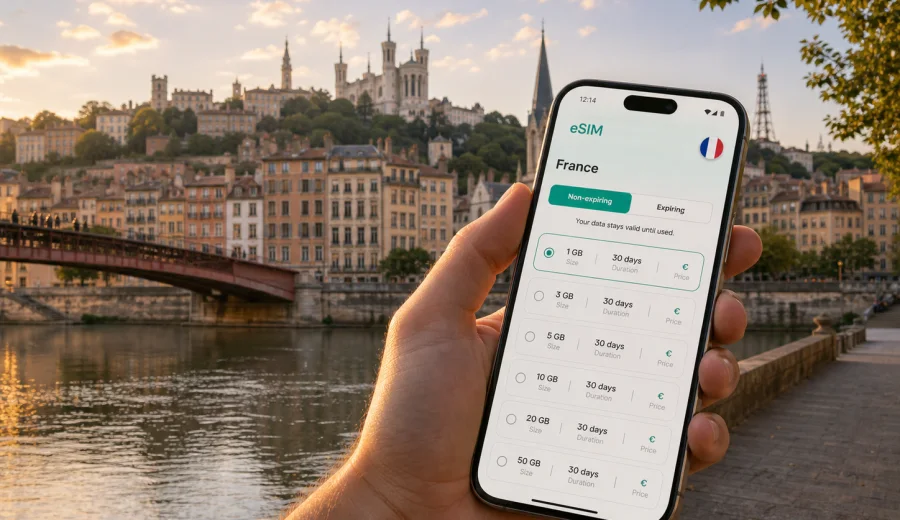
Lyon eSIM: mobile connection and internet for a city trip
Lyon is compact enough for a weekend city break and important enough for business trips, conferences, rail transfers, restaurants, and day trips across eastern France. That mix makes mobile internet useful from the first hour. You may need a map in Vieux Lyon, a hotel message near Part-Dieu, a train update at Perrache, or a video call before the airport.
An eSIM helps you prepare mobile data before the trip without looking for a physical SIM card after arrival. With Kaspersky eSIM Store, you can use the app or website to choose, arrange, install, and activate an eSIM plan with a suitable data allowance for travel. For Lyon, the goal is simple: keep your phone ready for navigation, transport, bookings, messaging, work tools, and local decisions.
This guide focuses on Lyon, not a general France itinerary. It covers arrival, local movement, neighborhoods, hotels, business use, stopovers, day trips, and key eSIM checks.
Why mobile internet matters in Lyon
Lyon spreads across two rivers, several hills, and districts with different travel patterns. A route that looks short on the map can involve a metro transfer, tram, funicular, river bridge, or steep walk. Mobile data gives you live context instead of forcing you to plan every step before leaving the hotel.
You are likely to use mobile internet for:
- route planning from Lyon-Saint Exupery Airport, Part-Dieu, or Perrache;
- walking directions in Vieux Lyon, Croix-Rousse, Fourviere, and the Presqu'ile;
- checking metro, tram, bus, funicular, and train options;
- messaging hotels, apartment hosts, colleagues, drivers, or restaurants;
- opening tickets, booking confirmations, maps, payment apps, and translation tools;
- using cloud documents or work chat during a business trip;
- checking train times for day trips from Lyon to other French cities.
Hotel and cafe Wi-Fi can help, but it does not cover the moments between fixed locations. A prepared eSIM is most useful when you are carrying luggage, arriving late, changing districts, or solving a booking issue outdoors.
Arrival in Lyon: first connection scenarios
Many visitors arrive through the airport or a main rail station. Each arrival point creates a different data need.
| Arrival point | What you may need online | Why eSIM helps |
|---|---|---|
| Lyon-Saint Exupery Airport | Transfer route, ride pickup, hotel message, train or tram check | You can get online before leaving the terminal |
| Lyon Part-Dieu | Platform updates, metro or tram directions, hotel route | The area is busy and timing often matters |
| Lyon Perrache | Local transport, taxi or ride app, route to Presqu'ile or Confluence | The road and station layout can feel layered on arrival |
| Road transfer | Parking, hotel access, maps, traffic | Live navigation helps with river crossings and one-way streets |
If you install the eSIM before departure, you can enable the travel line after arrival according to the plan instructions. If you install it in Lyon, use stable Wi-Fi first.
Where eSIM is useful inside Lyon
Lyon is easier to explore when your phone is online because old streets, hills, rivers, and transport links often appear in one day.
Vieux Lyon and Fourviere
Vieux Lyon is full of narrow streets, courtyards, restaurants, museums, and routes toward Fourviere. Mobile data helps with walking directions, tickets, restaurant confirmations, and decisions about whether to walk uphill or use the funicular.
Presqu'ile, Bellecour, and the riverbanks
The Presqu'ile is central for hotels, shops, squares, restaurants, and culture. Plans here change quickly: you may walk to the Saone, cross toward the Rhone, find a dinner booking, or take the metro after a long day.
Part-Dieu and business districts
Part-Dieu matters for rail connections, offices, shopping, and hotels. Mobile data helps you check train platforms, meeting updates, transfer routes, and traffic when you are moving between the station, a hotel, and an office.
Confluence and Croix-Rousse
Confluence has riverfront walks, modern architecture, shopping, and museum visits. Croix-Rousse has slopes, viewpoints, cafes, and markets. Both areas are rewarding, but not always direct from the classic old-town route.
How much data might you need in Lyon?
Data use depends more on habits than on the number of days. Maps, messaging, browsing, translation, and transport apps are usually manageable. Video calls, streaming, cloud photo backup, and laptop hotspot use can consume data quickly.
| Trip type | Typical use | Data planning note |
|---|---|---|
| One-day stopover | Maps, messages, tickets, station updates | A small package may work if you avoid video |
| Weekend city break | Navigation, restaurants, photos, browsing | Choose enough data for frequent daytime use |
| Business trip | Email, cloud files, calls, hotspot backup | Add a margin for work tools |
| Family trip | Bookings, maps, messages, entertainment | Consider which device needs the main data plan |
| Lyon plus day trips | Trains, maps, hotel changes | Choose a plan for the full France itinerary |
Before the trip, turn off automatic app updates and cloud photo backup over mobile data. Download entertainment and offline map areas on Wi-Fi.
Choosing an eSIM plan for Lyon
For a Lyon article, the correct destination is France, because travelers often use the same mobile data while arriving through another French city or taking a train onward. Check these points before selecting a plan:
- Destination: choose France if your trip is centered on Lyon and other places in France.
- Validity: match the plan duration to your arrival and departure dates.
- Data allowance: include maps, messaging, browsing, work tasks, and day trips.
- Compatibility: make sure your phone or tablet supports eSIM and is not carrier-locked in a way that prevents use with another mobile plan.
- Activation timing: read when the plan starts and when data begins to count.
- Hotspot: if you plan to share data with a laptop or another device, check your plan details and phone settings.
For a Lyon trip, you can choose an eSIM plan for France before you travel and keep the setup ready for arrival. This is useful if your first hour includes a transfer, hotel check-in, or a meeting.
Setup checklist before departure
Use this checklist a day or two before leaving for Lyon:
- Confirm that your phone supports eSIM.
- Check that your device is not restricted to one carrier.
- Save your hotel address and booking number offline.
- Install travel, transport, map, and payment apps before departure.
- Choose a data allowance that covers your full France itinerary.
- Keep your primary SIM active if you need calls or SMS from your usual number.
- Read the installation steps while you still have stable Wi-Fi.
- Decide when to activate the eSIM based on the plan instructions.
If you need to verify support first, use the compatibility window before arranging a plan: check your device. Support can depend on the exact model, region, and carrier restrictions.
How to install an eSIM for Lyon
The general process is straightforward: choose the destination and plan, install the eSIM profile, then select that line for mobile data when you are ready to use it.
For detailed setup steps, use the official guides:
Practical installation tips:
1. Use a stable Wi-Fi connection during installation.
2. Keep the QR code or in-app installation screen available until setup is complete.
3. Label the eSIM line clearly, for example "France travel" or "Lyon data".
4. Set the eSIM line for mobile data when you want to use the travel plan.
5. Keep your home SIM selected for calls or SMS if you still need your usual number.
6. Check whether data roaming must be enabled for the eSIM line.
Do not delete the eSIM profile after installation unless you are sure you no longer need it and understand the plan conditions.
Local movement: transport, walking, and route changes
Lyon often asks travelers to combine metro, tram, bus, funicular, walking, and rail. Mobile data helps you compare choices in real time.
Useful route scenarios include:
- Part-Dieu to Presqu'ile: check whether metro, tram, or walking is fastest.
- Vieux Lyon to Fourviere: compare the funicular with the walking route.
- Bellecour to Confluence: choose between tram, metro transfer, riverside walk, or ride app.
- Croix-Rousse to dinner: check downhill walking time and the last convenient transport option.
- Hotel to early train: verify route timing before leaving your room.
This reduces the risk of missing a booking, arriving late to a meeting, or spending extra time in a station because you guessed the wrong exit.
Business trips and hotel stays
Lyon is a frequent business destination because of its location, rail links, conference venues, universities, medical activity, finance, gastronomy, and regional offices. For work travel, mobile data can be a backup when shared Wi-Fi is crowded or unstable.
Business use cases:
- joining a call from a taxi, station lounge, hotel lobby, or coworking space;
- opening a presentation or document while moving between meetings;
- receiving schedule changes near Part-Dieu, Confluence, Gerland, or the city center;
- using hotspot mode for a laptop if your plan and phone settings allow it;
- checking airport or train timing after a meeting runs late.
Hotels and apartments are another reason to prepare mobile internet. Room Wi-Fi does not help when you are finding the building, opening entry instructions, contacting the host, changing arrival time, or navigating after checkout.
Stopovers and day trips from Lyon
Lyon works well as a stopover because the main sights are reachable in a compact visit. With only a few hours, mobile connection matters because there is less time to recover from wrong turns. Keep data ready for station routes, luggage storage research, restaurant search, and departure updates.
The city is also a strong base for wider travel. Common routes include Lyon to Paris, Annecy, Grenoble, Avignon, Marseille, Burgundy towns, or alpine areas. If the trip remains inside France, a France-focused plan is usually simple. If you cross borders, check whether your selected plan covers the other country or whether a regional option is more suitable.
What to expect from a travel eSIM
Travel eSIM plans are usually focused on mobile internet. They may not include a local phone number, voice calls, or SMS unless the plan terms clearly say so. With mobile data, you can usually use messaging apps, email, maps, hotel apps, train apps, translation tools, online reservations, and internet-based calls.
Keep your primary SIM active if you need bank verification codes, airline messages, or calls to your usual number. On many phones, one line can handle mobile data while another handles calls or SMS.
Avoid common mistakes:
- starting installation outdoors without Wi-Fi;
- choosing a validity period that does not cover arrival and departure;
- forgetting to check device compatibility;
- deleting the eSIM profile while troubleshooting;
- assuming a data-only eSIM includes voice calls and SMS;
- choosing the smallest data package when you need laptop hotspot use.
Quick planning guide
| Traveler type | Best preparation |
|---|---|
| First-time visitor | Install the eSIM before departure, save hotel details, keep data for maps |
| Food-focused traveler | Plan for frequent searches, reservations, translation, and route changes |
| Business traveler | Choose extra data, check hotspot needs, keep primary SIM for verification |
| Family traveler | Save documents offline and decide which phone needs the main data plan |
| Stopover traveler | Make sure data is ready immediately on arrival |
| Multi-city traveler | Choose a plan that fits France travel beyond Lyon |
FAQ: eSIM for Lyon
Is eSIM useful for a short trip to Lyon?
Yes. It is helpful for maps, station transfers, hotel messages, tickets, ride apps, and restaurant information, even on a one-day visit.
Should I choose Lyon or France as the destination?
Choose France for a Lyon trip. Lyon is the city focus, but the mobile data plan should match the country where you will use it.
Can I install the eSIM after arriving in Lyon?
Yes, if you have stable Wi-Fi and your device supports eSIM. Many travelers prefer to install it before departure so mobile data is ready soon after arrival.
Does an eSIM replace my home phone number?
Not necessarily. A travel eSIM is commonly used for mobile data. Keep your regular SIM active if you need your usual number for calls, SMS, or verification messages.
Do I need mobile data if my hotel has Wi-Fi?
Yes, if you want reliable internet between Wi-Fi points. eSIM is useful for walking routes, transport, bookings, ride apps, and messages while moving around Lyon.
Prepare your Lyon mobile internet before departure
Lyon is easier to enjoy when your phone is ready for practical travel tasks: finding the right station exit, checking a tram route, reaching a hotel, confirming dinner, working between meetings, and changing plans when timing changes.
With Kaspersky eSIM Store, you can use the app or website to choose and set up an eSIM plan with a suitable data allowance for mobile internet during your France trip. Before you go, check your device, review the plan details, and install the eSIM on stable Wi-Fi.
If Lyon is your next destination, prepare an eSIM plan for France before the trip so your mobile internet is ready for arrival, local movement, hotel check-in, business tasks, stopovers, and day trips from the city.