
Travel connectivity guide
Mar del Plata eSIM and mobile internet guide
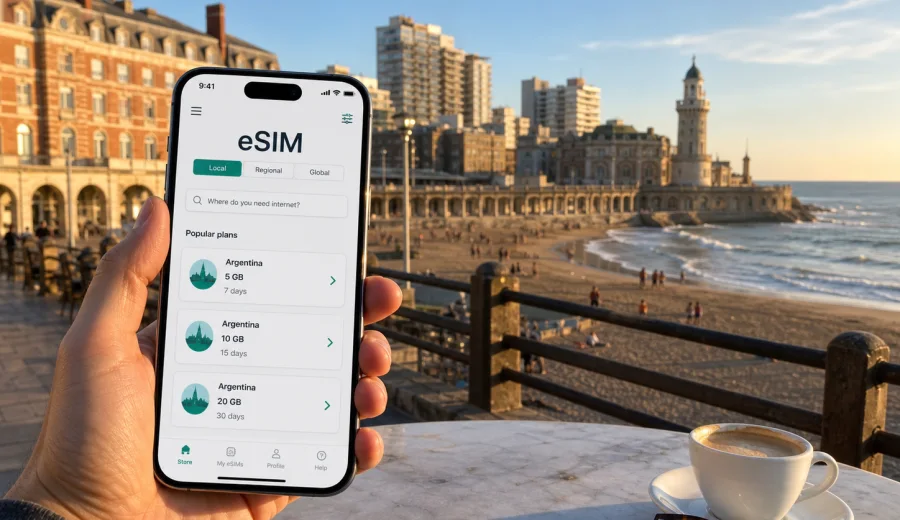
Mar del Plata eSIM: mobile connection and internet for a smoother trip
Mar del Plata is one of Argentina's busiest coastal cities: a beach destination, a conference venue, a weekend escape from Buenos Aires, and a practical base for exploring the Atlantic side of Buenos Aires Province. That mix makes mobile internet more than a convenience. You may need it before you reach your hotel, while ordering a ride from the bus terminal, when checking restaurant hours near Guemes, or when finding the right beach access along Playa Grande, Varese, La Perla, or Punta Mogotes.
An eSIM can make that part of the trip easier. Instead of searching for a physical SIM card after arrival, you can prepare a digital SIM profile on a compatible phone and use mobile data for maps, messaging, travel apps, bookings, and work tools. For Mar del Plata, this is especially useful because visitors often move between very different areas: the central waterfront, residential districts, beach zones, cafes, hotels, event spaces, and day-trip routes outside the city.
This guide focuses on how to plan mobile connection and internet access for Mar del Plata specifically, not just Argentina in general. It covers arrival scenarios, city movement, beach days, hotel stays, business trips, short stopovers, and practical eSIM checks before you travel.
Why mobile internet matters in Mar del Plata
Mar del Plata is easy to enjoy, but it is easier when your phone is ready from the first hour. Distances can feel short on a map, yet traffic, coastal weather, one-way streets, and seasonal crowds can change a simple route. A reliable data plan helps you react without depending on hotel Wi-Fi or asking for directions every time you move.
Common situations where mobile data helps:
- checking the route from Astor Piazzolla International Airport to your hotel;
- comparing rides, taxis, and bus options from the terminal;
- navigating between La Perla, the city center, Varese, Playa Grande, and the port area;
- finding a cafe, pharmacy, supermarket, or ATM while walking;
- using messaging apps with hotel staff, hosts, colleagues, or family;
- checking weather and wind before a beach plan;
- managing restaurant bookings and delivery apps;
- joining video calls during a business trip;
- translating short messages, menus, or service notices;
- keeping boarding passes, maps, and reservation details available.
If you are visiting during the Argentine summer season, mobile data also helps you adapt. Beaches, roads, restaurants, and transport can be busier than expected. If you are visiting outside peak season, data is useful for checking opening hours, because some tourist-facing businesses adjust schedules.
eSIM in simple terms
An eSIM is a digital SIM profile installed on a compatible phone or tablet. For travel, it is commonly used for mobile data in another country without changing your physical SIM card. You choose a destination and a data plan, install the eSIM profile, and activate it according to the plan instructions.
For a trip to Mar del Plata, an eSIM is mainly about internet access. It usually does not replace your regular phone number for traditional calls and SMS unless the selected plan clearly says so. Most travelers use the data connection for maps, messaging apps, ride apps, email, social media, cloud documents, and mobile browser access.
Kaspersky eSIM Store is an app and website where you can quickly choose, arrange, and activate an eSIM with a suitable plan for mobile internet in an international trip. Before paying, review the plan details: destination, data allowance, validity period, price, activation rules, and any limits on hotspot use.
Check your phone before you travel
Before choosing any eSIM plan, confirm that your device supports eSIM and is not locked to a mobile operator. This check matters because eSIM support depends on the exact model, market version, and carrier lock status. A phone name alone is not always enough.
Use this quick checklist:
- your phone or tablet supports eSIM;
- the device is not locked to one operator;
- the operating system is updated enough for eSIM setup;
- you know where the cellular or mobile data settings are;
- you can receive the installation details before departure;
- you have a stable Wi-Fi connection available during installation;
- you understand when the plan validity starts.
If you are unsure, check your device before buying a plan. This is the simplest way to avoid arriving in Mar del Plata with a plan that your device cannot install.
Arrival in Mar del Plata: where eSIM helps first
Some visitors arrive by air through Astor Piazzolla International Airport. Others come by long-distance bus from Buenos Aires, La Plata, Tandil, Bahia Blanca, or other Argentine cities. Some arrive by rental car. Each arrival point creates a slightly different connectivity need, but the first tasks are similar: confirm your route, contact your accommodation, and avoid wasting time at the start of the trip.
At the airport, mobile data helps you check ride options and share your location. At the bus terminal, it helps you confirm whether your hotel is closer to the center, La Perla, Guemes, Playa Grande, or the port side. If you are driving, data supports navigation through the city grid and helps you avoid confusing turns near the coastline and busy avenues.
For a first afternoon in Mar del Plata, you might use mobile internet to:
1. Message the hotel or apartment host.
2. Open an offline-saved booking confirmation.
3. Search the safest walking route with luggage.
4. Check whether your room is near a bus line or better reached by ride app.
5. Find a nearby place to eat before check-in.
6. Share your arrival status with family or colleagues.
Without mobile data, each of these steps depends on public Wi-Fi, which may not be available exactly when you need it.
City districts and mobile data needs
Mar del Plata is not one single travel zone. Your mobile internet habits may change depending on where you stay and what you plan to do.
| Area or route | Why you may need data | Practical tip |
|---|---|---|
| City center | Hotels, shopping, offices, restaurants, theaters | Keep maps and payment apps ready for short moves |
| La Perla | Beach walks, family hotels, waterfront access | Save your hotel location before going out |
| Guemes and shopping streets | Cafes, boutiques, dining, nightlife | Use data for reservations and ride pickup points |
| Playa Grande | Beach clubs, restaurants, surfing, evening plans | Check traffic and meeting points before sunset |
| Varese and Torreon del Monje | Scenic walks, photos, cafes | Mobile data helps with walking routes along the coast |
| Port area | Seafood restaurants, sea lions, local trips | Check opening times and transport back to your hotel |
| Punta Mogotes | Long beach area, seasonal movement | Confirm bus or ride options before leaving |
| Routes out of the city | Sierra de los Padres, Chapadmalal, Miramar | Download maps and monitor remaining data |
If you plan to work remotely from Mar del Plata, your needs may be different from a beach traveler. You may need a larger data allowance, enough validity for the full stay, and the option to use your phone as a hotspot if the selected plan and device support it.
How much data to plan for Mar del Plata
The right data allowance depends on your habits, trip length, and whether your hotel or apartment has reliable Wi-Fi. Many visitors underestimate map use, messaging, and photo sharing during beach trips. Others overestimate because they forget that video streaming is the main data-heavy activity.
Use this table as a planning guide, not as a guarantee:
| Trip style | Typical mobile data use | What to consider |
|---|---|---|
| Short stopover, 1-2 days | Low to moderate | Maps, messaging, transport, restaurant searches |
| Weekend beach trip | Moderate | Navigation, social sharing, weather, bookings |
| One-week vacation | Moderate to high | Daily maps, photos, messaging, occasional video |
| Business trip | Moderate to high | Email, calls through apps, cloud documents, hotspot use |
| Remote work stay | High | Larger plan, hotel Wi-Fi backup, careful video use |
After you know your arrival date, stay length, and likely data use, you can prepare an eSIM plan for mobile internet in Argentina before you travel to Mar del Plata. This keeps the country selection aligned with the city and avoids searching for a physical SIM card after arrival.
Video calls, cloud backups, app updates, and streaming can consume data quickly. Before you leave for Mar del Plata, disable automatic media downloads and update large apps over home Wi-Fi. During the trip, use hotel Wi-Fi for heavy downloads and keep mobile data for movement, messaging, and essential work.
When to set up your eSIM
The best time to install an eSIM is usually before the trip, while you have stable Wi-Fi and time to read the instructions. Activation rules can vary by plan, so always check whether validity starts at installation, at first network connection, or under another condition described in the plan.
A practical setup flow looks like this:
1. Check that your device supports eSIM and is not locked.
2. Choose Argentina as the destination and compare data allowance and validity.
3. Complete the plan arrangement through the app or website.
4. Install the eSIM profile while connected to Wi-Fi.
5. Keep your primary SIM active if you need your usual number for banking or messages.
6. Name the eSIM clearly, for example "Argentina data".
7. On arrival, select the eSIM for mobile data and follow the activation instructions.
If your article section or checklist mentions installation, it is worth keeping the official setup pages close: use the Android installation guide or the iOS installation guide depending on your device. Install only when you are ready and have read the plan conditions.
Choosing an eSIM plan for Mar del Plata
Mar del Plata does not need a separate city plan. For a city trip, choose the Argentina destination because the city belongs to Argentina. Then match the plan to your route, travel dates, and likely data use.
When comparing plans, pay attention to:
- data volume: enough for maps, messaging, bookings, and work;
- validity period: it should cover your full stay, including arrival and departure days;
- destination: Argentina, not a different country or region unless your route requires it;
- activation rules: when the plan starts and how to begin using it;
- hotspot rules: useful if you need to connect a laptop or another device;
- top-up or replacement options: useful for longer stays;
- support route: know where to ask for help if setup does not go as expected.
Avoid choosing a plan only by price. A very small allowance can be frustrating if you use maps all day, work from cafes, or rely on ride apps. A very large allowance may be unnecessary if your hotel Wi-Fi is stable and you mainly use data while moving.
Transport, navigation, and beach movement
Mar del Plata is a walking city in parts, but not everywhere. The waterfront is long, the beaches are spread out, and hotels can be located in areas that feel close until you try to walk with luggage or beach gear. Mobile internet helps you make these small decisions in real time.
Typical movement scenarios:
- From the bus terminal to La Perla or the center: check the route before choosing to walk or ride.
- From the center to Playa Grande: compare traffic and pickup points, especially in the evening.
- From Guemes to Varese: walking may be pleasant, but weather and time matter.
- From Punta Mogotes back to the hotel: confirm transport before the beach crowds leave.
- From the port area to dinner: use maps to avoid long detours around larger roads.
If you plan to use public buses, data helps you check routes and stop locations. If you prefer taxis or ride apps, data helps you set accurate pickup points, especially near beach entrances where addresses can be less obvious. For walking, data helps with route changes when a street feels too busy, windy, or steep.
Hotels, business trips, and beach days
Hotel and apartment Wi-Fi can reduce mobile data use, but it does not help much while you are arriving, walking between beaches, finding a ride, or checking a venue address. Treat Wi-Fi as a backup for heavy use, such as laptop work, app updates, cloud uploads, and streaming. Use eSIM data for the moments when you are away from a trusted connection.
For business trips, the main risk is lost time. A few minutes without data can affect a call, a calendar change, a document download, or a route to a meeting. Save hotel and venue addresses, keep key files offline, and check hotspot permission if you need to connect a laptop through your phone.
For beach days, data use comes in short bursts: weather, location sharing, restaurant searches, ride pickup points, and photos. Download the local map before leaving the hotel, reduce automatic media uploads, and carry a power bank if you will be out from morning to evening.
Trips from Mar del Plata
Many travelers use Mar del Plata as a base for Sierra de los Padres, Chapadmalal, Miramar, coastal drives, and nearby beaches. Before leaving the city, save the route offline, check remaining data, charge your phone, confirm return options, and keep your hotel address saved. Data availability and speed can vary by location, device, network conditions, and plan, so offline maps are still a useful backup for routes outside the city.
eSIM, roaming, and Wi-Fi compared
| Option | Best use | Main limit |
|---|---|---|
| Travel eSIM | Data prepared before arrival, maps, messaging, city movement | Needs compatible unlocked device |
| Standard roaming | Simple use of your existing operator relationship | Conditions depend on your home operator |
| Public Wi-Fi | Hotels, cafes, venues, large downloads | Not always available during transport or beach time |
| Physical local SIM | Some longer stays | Requires a point of sale and SIM setup time |
For many Mar del Plata visitors, eSIM is useful because it removes one arrival-day task. You can arrive with a data option already prepared and focus on your hotel, route, beach plan, or meeting schedule.
Common mistakes and quick answers
Avoid buying before checking compatibility, installing the profile on the wrong device, assuming a data plan includes voice calls or SMS, using video on mobile data without monitoring usage, or leaving your primary SIM selected for mobile data by mistake. If connection does not start, check the selected data line, data roaming setting for the eSIM if required, airplane mode, device restart, and whether the profile is installed correctly.
Do I need a Mar del Plata-specific eSIM?
No. Choose an Argentina plan because Mar del Plata is in Argentina.
Can I install after arrival?
Yes, if you have Wi-Fi and a compatible device, but installing before travel is usually easier.
Will it give me a local phone number?
Usually travel eSIM plans focus on mobile data. Calls and SMS are included only if the selected plan says so.
Is eSIM useful if my hotel has Wi-Fi?
Yes. Arrival, transport, beach plans, restaurant searches, and day trips happen away from the hotel.
Final pre-trip checklist
Before you leave for Mar del Plata, make sure the connectivity part of your trip is ready:
- your device supports eSIM and is unlocked;
- you have chosen Argentina as the destination;
- the data allowance fits your stay and habits;
- the validity period covers arrival and departure;
- you understand when activation starts;
- installation details are saved;
- your main SIM settings are clear;
- maps and key addresses are available offline;
- automatic backups and large updates are controlled.
Mar del Plata is easier to navigate when your phone is already prepared for the city: the waterfront, hotels, beaches, restaurants, business venues, and routes out of town all depend on quick decisions. Before your trip, use Kaspersky eSIM Store to choose an eSIM plan for mobile internet in Argentina and arrive in Mar del Plata with one less thing to solve after check-in.