
Travel connectivity guide
Mbuji-Mayi eSIM for mobile internet
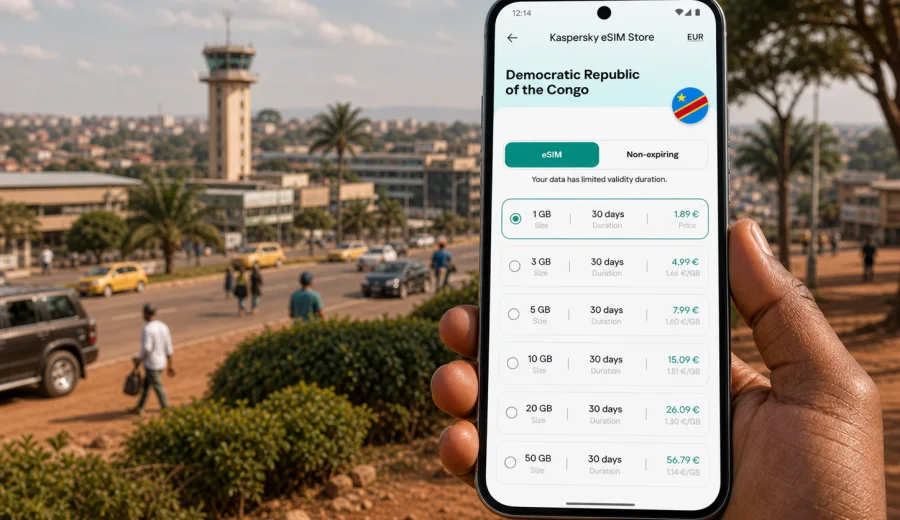
Mbuji-Mayi eSIM: mobile connection and internet for a practical city trip
Mbuji-Mayi is a city where a reliable mobile internet plan can shape the whole trip. The capital of Kasai-Oriental is not a place where most visitors want to improvise every online task after arrival. You may need maps for a transfer from Mbuji-Mayi Airport, messaging for a hotel pickup, translation for a meeting, or mobile data to confirm a flight to Kinshasa, Kananga, or Lubumbashi. An eSIM helps you prepare that part of the journey before your day becomes busy.
For many travelers, Mbuji-Mayi is connected with business, family visits, regional administration, logistics, and the diamond trade. It can also be a stop on a wider itinerary through the Democratic Republic of the Congo. The city is practical rather than touristic in the usual sense: hotels, offices, markets, residential communes, airport movement, and local rides matter more than postcard landmarks. That is exactly why mobile internet deserves planning. When your phone is already ready for data, you spend less time looking for Wi-Fi and more time handling the trip itself.
This guide focuses on using an eSIM in Mbuji-Mayi: arrival, local movement, hotel stays, business schedules, short stopovers, and onward travel. It also explains when to install the eSIM, how to estimate data needs, what to check before purchase, and how Kaspersky eSIM Store can help you choose, arrange, and activate a suitable eSIM plan for mobile internet during an international trip.
Why mobile internet matters in Mbuji-Mayi
Mbuji-Mayi rewards travelers who prepare simple things in advance. Addresses may be given by district, road, nearby landmark, office, hotel, parish, school, or market rather than by the kind of standardized address format visitors may expect elsewhere. A working data connection helps you keep location pins, share live updates, and confirm details by message while moving through the city.
Mobile internet is especially useful for:
- arranging airport pickup before you leave the terminal area;
- sharing your location with a driver, host, colleague, or hotel;
- checking flight updates and onward travel plans;
- using maps when moving between communes such as Bipemba, Dibindi, Diulu, Kanshi, and Muya;
- translating short messages or place names;
- keeping business documents, reservations, and meeting notes available;
- using messenger calls when voice service is not part of the eSIM plan;
- confirming hotel Wi-Fi details without depending on it as your only connection.
An eSIM is not a magic coverage guarantee, and it is not a replacement for local knowledge. It is a practical way to prepare mobile data for a compatible device without handling a physical SIM card. The exact experience still depends on the selected plan, network availability in the area where you are, phone settings, and the conditions shown before purchase.
Arrival scenarios: from the airport to the city
Mbuji-Mayi Airport is a key arrival point for many visitors. Some travelers land for a short business visit; others arrive as part of a longer route across the Democratic Republic of the Congo. In both cases, the first hour often involves the same tasks: finding the right driver, confirming a hotel address, checking whether luggage or equipment has arrived, and messaging people who are waiting for you.
A useful arrival setup looks like this:
1. Install the eSIM before departure, while you still have stable Wi-Fi.
2. Keep the QR code or installation details accessible in your email or app account.
3. Check that mobile data for the eSIM is selected only when you are ready to use it.
4. Keep your primary SIM active for important calls if you need it, but control roaming settings carefully.
5. Save offline copies of hotel names, contact numbers, meeting addresses, and passport or booking references.
If your trip is organized by a company, NGO, project team, or local host, mobile data still matters. The person meeting you may change vehicles, traffic may affect the route, or the meeting point may be easier to confirm by sending a photo or location pin. Public Wi-Fi is not something to build your first-hour plan around.
City movement: districts, rides, and everyday navigation
Mbuji-Mayi is spread across several communes, and trips inside the city can feel different depending on road conditions, time of day, and the purpose of the visit. You might move between a hotel in one area, an office or administrative building in another, and a market or residential address later in the day. Mobile internet helps you keep those movements coordinated.
For local movement, use mobile data mainly for:
| City task | Why mobile internet helps |
|---|---|
| Hotel transfers | You can confirm pickup time, driver identity, and route changes. |
| Business meetings | You can share documents, update arrival times, and locate offices. |
| Market visits | You can message hosts, check prices in your home currency, and keep notes. |
| Family or private visits | You can send location pins and stay reachable between stops. |
| Airport return | You can check schedule updates before leaving the city. |
Do not assume that every driver will use the same map app or follow a digital route exactly. In Mbuji-Mayi, a location pin is often one part of the explanation, not the whole explanation. Combine online navigation with local instructions such as the district name, nearby avenue, recognizable building, church, school, hotel, or junction.
Hotels and accommodation: do not rely on Wi-Fi alone
Hotel Wi-Fi can be useful, but it should not be your only plan for mobile internet in Mbuji-Mayi. Speeds, reliability, passwords, and coverage inside rooms can vary. You may also need data outside the hotel: during rides, at meetings, while checking in, or when power and network conditions change during the day.
Before choosing an eSIM data allowance, think about your hotel routine:
- Will you upload work files or only send messages?
- Do you need video calls, or can you use audio and chat?
- Will you tether a laptop, and does the selected eSIM plan allow hotspot use?
- Will you mostly stay in one hotel, or move between several addresses?
- Do you need data for one short stopover or for a full week?
For a short visit, a modest package may be enough if you use it for maps, messengers, email, and ride coordination. For a business trip with document sharing, cloud access, and frequent calls over the internet, choose more data and check the validity period carefully. If you plan to use your phone as a hotspot, read the conditions of the selected plan before relying on it.
Business trips and project visits
Many Mbuji-Mayi visits are practical: meetings, site visits, regional administration, project coordination, procurement, logistics, mining-related work, healthcare, education, or humanitarian activity. In these situations, mobile internet is part of risk control. It helps you confirm time-sensitive details without waiting to return to the hotel.
A business traveler should prepare three layers of connectivity:
- eSIM mobile data for movement and everyday coordination;
- saved offline files for documents that must be available without a connection;
- a backup contact method through the hotel, host organization, or local colleague.
The eSIM layer is most useful when the day changes. A meeting moves to another office. A driver waits at a different gate. A flight is delayed. A document needs to be resent. A colleague asks for a location. In these moments, the value of mobile internet is not speed for its own sake; it is the ability to keep decisions moving.
Choosing the right eSIM data amount for Mbuji-Mayi
Data needs depend on behavior, not only trip length. A traveler who uses maps and messages lightly may use far less data than someone who joins video calls, backs up photos, and shares a laptop connection.
Use this simple planning table:
| Trip style | Typical mobile data use | Practical choice |
|---|---|---|
| One-day stopover | Messaging, maps, flight checks | Small data package with short validity |
| 2-4 day city visit | Maps, email, messenger calls, hotel coordination | Moderate package with enough validity for the full stay |
| Business week | Documents, route updates, cloud tools, possible hotspot | Larger package and careful plan-condition check |
| Wider DRC route | Mbuji-Mayi plus Kinshasa, Kananga, Lubumbashi, or other stops | Country or regional plan that matches the whole route |
Avoid choosing only by the lowest price. A plan that expires too soon or includes too little data can create extra work during the trip. Also avoid choosing more data than you reasonably need if you will mostly use hotel Wi-Fi for heavy tasks.
When to prepare your eSIM
The best time to prepare an eSIM is usually before you travel, while you have a stable connection and time to read the plan conditions. Installation can often be done before departure, while activation and data use should follow the instructions for the specific plan. Some plans start counting validity after installation; others start after connection to a supported network. Check this before you act.
Before purchasing, check your device for eSIM support and make sure it is not locked to a single mobile operator. Compatibility is essential: an eSIM plan only helps if your phone or tablet can install and use it.
If you are preparing mobile internet for Mbuji-Mayi, you can use Kaspersky eSIM Store to choose an eSIM plan for a trip to the Democratic Republic of the Congo. The site and app help you select the destination, review available data amounts and validity periods, arrange the plan, and activate it on a compatible device.
How to install an eSIM before a Mbuji-Mayi trip
The installation process is straightforward, but it is worth doing calmly. Use Wi-Fi, keep your battery charged, and do not delete the eSIM profile unless you are sure the plan conditions allow reinstallation.
Basic steps:
1. Confirm that your device supports eSIM and is not carrier-locked.
2. Choose the Democratic Republic of the Congo as the destination for your trip.
3. Select a plan with a data amount and validity period that match your stay.
4. Follow the installation instructions shown after purchase.
5. Set the eSIM as the mobile data line when you are ready to use it.
6. Keep your usual SIM available for calls or SMS if you need your regular number.
For device-specific setup, use the Android installation guide or the iOS installation guide. The exact wording in your phone settings may vary by model, operating system version, and mobile operator lock status.
Practical data-saving habits in the city
Mbuji-Mayi travel days can be full: airport movement, meetings, family visits, city rides, and schedule changes. Simple data habits help keep your package available for the parts of the day when you need it most.
Use these settings before you start moving:
- download offline maps for the city and your planned routes;
- turn off automatic cloud backup on mobile data;
- restrict app updates to Wi-Fi;
- lower video quality in streaming and meeting apps;
- disable autoplay in social media apps;
- use audio calls instead of video when the connection is limited;
- save hotel and meeting addresses in notes that work offline.
For work trips, keep documents that matter in offline storage. For personal trips, save screenshots of hotel details, flight information, and key contacts. Mobile data should support your trip, not carry every task that could have been prepared earlier.
Mbuji-Mayi situations where eSIM is especially useful
An eSIM can be helpful throughout the trip, but some local scenarios make it particularly practical.
Airport arrival. You can message your contact, share your location, and confirm luggage or pickup details without waiting for hotel Wi-Fi.
Cross-city errands. Moving between communes or offices often involves several small confirmations. Mobile data keeps those updates quick.
Business meetings. You can open maps, resend files, join a short internet call, or update a calendar invite while moving.
Hotel check-in. If the booking reference, payment confirmation, or contact details are online, you can retrieve them immediately.
Stopovers. A short stay leaves little time to solve connectivity after arrival. Preparing an eSIM before the trip makes the first hour easier.
Onward travel. If you continue to Kinshasa, Kananga, Lubumbashi, or another destination in the Democratic Republic of the Congo, a country plan may be more useful than solving mobile internet separately in each city.
What eSIM can and cannot do
It is important to keep expectations realistic. An eSIM plan for travel is mainly about mobile internet. It may not include a local phone number, standard voice calls, or SMS. If those services matter, check the plan conditions before purchase. For many travelers, internet-based messaging and calling apps cover everyday communication, but that depends on the people you need to reach.
An eSIM also does not remove the need to check local conditions. Network performance can change by area, building, weather, congestion, and device settings. In a hotel room, a courtyard, an office, or a road outside the central area, your experience may differ. Keep key details offline and avoid leaving critical tasks to the last few minutes.
Quick checklist before departure
Use this checklist before traveling to Mbuji-Mayi:
- Your phone supports eSIM.
- Your phone is not locked to one mobile operator.
- You selected the Democratic Republic of the Congo, not a different Congo destination.
- The data amount fits your planned use.
- The validity period covers the full stay.
- You understand when the plan validity starts.
- You saved installation instructions.
- You downloaded offline maps and important documents.
- You know whether hotspot use is allowed for the selected plan.
- You kept your regular SIM settings under control to avoid unwanted roaming.
FAQ: eSIM and mobile internet in Mbuji-Mayi
Is an eSIM useful for a short stop in Mbuji-Mayi?
Yes, especially if you need airport pickup, messaging, maps, or flight updates. A small data package may be enough for a short stop if you avoid heavy video use.
Should I install the eSIM before flying?
It is usually easier to install it before departure over stable Wi-Fi. Check the plan rules first, because the start of validity can depend on the selected plan.
Can I use an eSIM for calls in Mbuji-Mayi?
Travel eSIM plans are commonly focused on mobile data. Standard calls and SMS may not be included unless the plan says so. You can often use internet-based calling apps over mobile data.
Do I need a country plan or a city-specific plan?
For a Mbuji-Mayi city article, the correct selection is normally the Democratic Republic of the Congo as the destination. That is also more practical if you may continue to another city in the country.
Can I keep my regular SIM active?
In many phones, yes. You can keep your regular number for calls or messages and use the eSIM for mobile data. Review roaming settings carefully so your main SIM does not use data unintentionally.
What if my phone does not support eSIM?
Then an eSIM plan will not work on that device. Check compatibility before purchase and consider another compatible phone or a different connectivity option for the trip.
Final preparation for a smoother Mbuji-Mayi trip
The most useful mobile internet plan is the one that matches your actual itinerary. For Mbuji-Mayi, that means thinking about airport arrival, local rides, hotel Wi-Fi limits, business meetings, residential visits, and possible onward travel within the Democratic Republic of the Congo. Prepare the eSIM before the trip, keep essential information offline, and use mobile data for the moments when movement and coordination matter most.
Before you travel, open Kaspersky eSIM Store, review the available data amounts and validity periods, and prepare an eSIM plan for your trip to Mbuji-Mayi. It is a practical way to set up mobile internet for a compatible device before the first transfer, meeting, or city errand begins.