Travel connectivity guide
Motorola Edge 70 256GB 5G eSIM
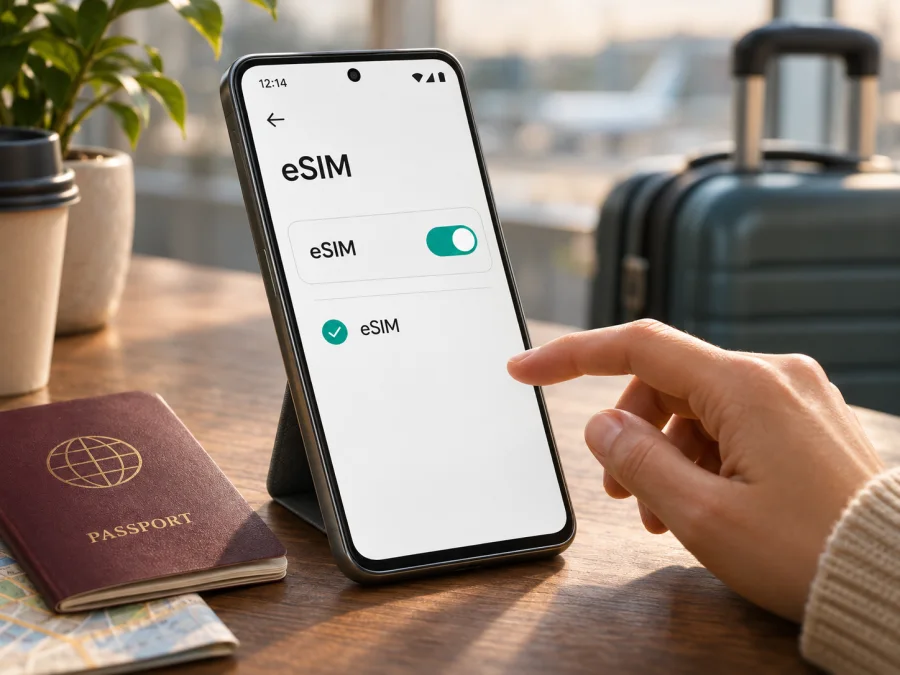
Motorola Edge 70 256GB 5G eSIM: compatibility and setup
Short answer: do not assume that every Motorola Edge 70 256GB 5G supports eSIM. Motorola’s published US specification for an Edge 70 with 256GB storage lists two physical nano-SIMs. Motorola’s support guide says an Edge 70 might support eSIM, and official specifications for some other market configurations list one nano-SIM plus eSIM. That is a genuine regional difference, not proof that every handset with this name has the same SIM hardware. Check the individual phone before buying a travel plan.
This guide keeps Motorola Edge 70 256GB 5G intact and does not treat other Edge 70 editions as the same device. “5G” describes network capability; it does not confirm eSIM. Use the phone’s model code and settings for the final check.
Quick compatibility summary
| Item | What to know |
|---|---|
| Device covered here | Motorola Edge 70 256GB 5G |
| eSIM answer | Market-dependent; not safe to confirm from the retail name alone |
| Published 256GB example | Motorola’s US specification lists dual SIM as 1 nano-SIM + 1 nano-SIM |
| Other Edge 70 configuration | Motorola’s official specifications for some markets list 1 nano-SIM + eSIM, with a different 512GB configuration |
| Decisive checks | EID in About phone, an eSIM download/add option in SIM settings, and confirmation of the exact model code from Motorola or the seller |
| Before choosing a travel plan | Confirm eSIM support and that the handset is unlocked for use with another provider |
For Motorola Edge 70 256GB 5G, treat eSIM support as unconfirmed until you check the exact unit. The published US 256GB specification lists two physical nano-SIMs. An EID and an eSIM setup option on your phone indicate eSIM support; without them, do not buy a plan expecting it to work.
Does Motorola Edge 70 256GB 5G support eSIM?
There is no single yes-or-no answer that can be safely applied to every phone carrying the Edge 70 name. Motorola’s US support specification for the 256GB version lists “Dual SIM (1 Nano SIM + 1 Nano SIM).” In contrast, official Motorola specifications in other markets describe an Edge 70 configuration with “1 Nano SIM + eSIM”; the published page for that configuration lists 512GB storage. Motorola’s support guide also uses conditional wording: the phone might support eSIM, and customers should check with their carrier.
These records show why “all Edge 70 phones support eSIM” is unreliable, but they do not establish a universal storage-based rule. Retail listings may omit the regional code or group memory options together. “5G” is not a SIM-format guarantee.
For the 256GB phone in your hand, use a three-part test:
- Find the full model or SKU code in Settings → About phone and compare it with the label on the box or purchase record. Ask Motorola support or the seller which market configuration that code identifies.
- Look for an EID in the phone’s status or SIM information. An EID is an identifier associated with an embedded SIM. Its presence is strong evidence that the specific handset has eSIM hardware. Do not share the full identifier publicly.
- Check for Download a SIM, Add eSIM, or similarly named setup under Settings → Network & internet → SIMs & mobile network. A working add/download option is useful confirmation. If the option is missing and there is no EID, treat the handset as not eSIM-compatible unless Motorola confirms otherwise for that exact code.
If your device has an eSIM option but activation is rejected, the issue may instead be a carrier restriction, a software build, or an account provisioning requirement. Conversely, seeing two SIM entries is not enough on its own: Motorola’s 256GB US specification explicitly describes two physical nano-SIM slots. Confirm the type shown in system settings and the manufacturer record for the precise device code.
Why regional and operator versions can differ
A phone family can have different SIM configurations in different markets. Motorola notes that specifications may vary by market and advises checking with the carrier. An imported handset may therefore differ from a locally sold one even when the retail name matches.
Motorola’s US 256GB entry lists two nano-SIMs, while official 512GB entries in other markets list one nano-SIM plus eSIM. These examples are market-specific, not a capacity rule. Match the model identifier, sales region, and SIM menu on your handset.
A carrier-sold phone may be locked or limited by activation rules. Even with eSIM hardware, it can reject another provider’s profile. Ask the seller whether it is unlocked for a travel eSIM, especially if it is still under contract.
Check the phone before you buy a plan
Use this checklist before checkout:
- [ ] The model code on the phone and packaging matches the seller’s stated regional version.
- [ ] Settings → About phone shows an EID, or SIM settings display an option to add or download an eSIM.
- [ ] Motorola support or the seller confirms eSIM for that exact model code and market, not merely the Edge family name.
- [ ] The phone is unlocked and can accept a profile from a provider other than the original carrier.
- [ ] Android is up to date, and you can connect to Wi-Fi during installation if needed.
- [ ] The eSIM plan covers the destination or route, and its data allowance and validity period suit your trip.
- [ ] You understand whether the selected plan starts when installed, when activated, or when it first connects; check its own conditions.
How to find EID and the eSIM menu
Menu labels can vary slightly by Android version and regional firmware. On the Edge 70, start with Motorola’s documented path: Settings → Network & internet → SIMs & mobile network. If eSIM is enabled for your unit, look for an option such as Download a SIM, Add eSIM, or Set up eSIM. The phone may ask you to connect to Wi-Fi before downloading a profile.
To find an EID, open Settings → About phone → Device details or Status information, then review SIM or device identifiers. On some builds, the EID appears under Settings → Network & internet → SIMs after opening an eSIM setup screen. You can also search Settings for “EID” or “SIM”. Menu paths can change, so use Settings search if the label differs. The EID is a long device identifier; you can use it to confirm eSIM capability with Motorola or the seller, but do not post it in a public forum.
A missing EID does not become a positive compatibility result just because a QR code was supplied. A QR code contains activation information for a profile; it cannot add eSIM hardware to a phone that lacks it. If the phone’s menus show only physical SIM slots and Motorola’s exact specification lists two nano-SIMs, stop before scanning a paid plan and ask the seller or plan provider to verify the device.
Check whether your device is compatible before completing a purchase. Compatibility depends on the exact phone, its market version, network lock status, and the requirements of the selected plan. If your check is inconclusive, ask the seller for the model code or choose a connection method that the device is confirmed to support, such as a physical SIM where available.
How to install and activate an eSIM
Proceed only after confirming that this exact handset supports eSIM and is unlocked. Connect to Wi-Fi and follow the setup method supplied with your plan; it may use an in-app flow, a QR code, or manual details. Activation timing varies, so check when the plan’s validity begins.
- Prepare the phone. Connect to Wi-Fi, update Android if needed, and keep the confirmation or QR code available on another screen.
- Open SIM settings. Go to Settings → Network & internet → SIMs & mobile network and choose Download a SIM, Add eSIM, or the matching option. If no option appears, stop and verify the model again.
- Add the profile. Scan the plan’s QR code or follow its direct installation instructions. Enter manual details only when supplied. Do not assume a QR code can be reused; many are single-use.
- Finish installation. Keep Wi-Fi connected while the profile downloads. Installation does not always start the plan’s validity, so check its conditions.
- Enable and label the line. Name it “Travel data” and turn it on. Keep your regular number active only as needed and review that SIM’s roaming settings.
- Select data settings. Choose the travel eSIM for mobile data. Enable data roaming for that profile if the plan requires it; only enter an APN when the provider supplies one. Keep calls and messages on the preferred line.
- Test the connection. Turn Wi-Fi off briefly and load a webpage. If you are not in the destination yet, the plan may not register on a local network.
Installation, activation, and the start of validity are separate events. Check the plan’s activation trigger before installing in advance. If a profile has installed, do not delete it as a troubleshooting shortcut: some providers cannot reuse its original activation code.
For Android screen examples, see the Android eSIM installation instructions. The guide uses Samsung examples, so Motorola menu names may differ. The iOS eSIM installation instructions apply to iPhones, not this Android phone.
Using Motorola Edge 70 256GB 5G for mobile data abroad
Before departure, choose a plan that explicitly includes every country on your itinerary. Check the data allowance, validity period, permitted tethering, network selection rules, and the activation trigger. For a multi-country trip, confirm whether the plan covers each stop or only a particular country. Coverage and speed depend on the local network and location; 5G branding on the handset does not guarantee 5G access in every destination or on every plan.
Install the eSIM while you have reliable Wi-Fi if your plan allows advance installation. Save the activation details and support instructions somewhere accessible offline. On arrival, turn on the travel eSIM, select it for mobile data, and enable data roaming for that profile if its instructions require it. Leave your home SIM configured according to your calling and messaging needs, and disable roaming data on that line if you want to avoid using its data service. The phone’s dual-SIM menu lets you select a preferred data line; check that the automatic data switching setting will not move data back to your home SIM unexpectedly.
A travel eSIM for mobile internet may not include a conventional phone number, voice calls, or SMS. Keep your regular number available for verification codes if your provider allows it, and use apps over data for internet calls and messages. If an app relies on SMS verification, arrange account access before leaving or confirm that your regular SIM can still receive messages under its normal terms.
Kaspersky eSIM Store is an app and website where you can choose, arrange, and activate an eSIM with a plan for mobile internet on an international trip. It is not a mobile operator and does not own or provide the local network. After you confirm that this exact phone accepts eSIM, you can browse current travel plans and review the destination, data amount, validity, and activation conditions shown for each option. The homepage is a general place to browse; it is not a country-specific tariff page.
Practical travel scenarios
One-country trip: choose a plan that names the destination and fits your expected use. Maps, messaging, browsing, video streaming, and photo uploads consume different amounts of data; monitor use and reserve Wi-Fi for large downloads if needed.
Multi-country route: verify that every stop appears in the plan’s coverage details. Do not assume neighboring countries are included. Review the plan if the itinerary changes.
Keep your usual number: where both lines are supported, keep the physical SIM for calls or texts and assign data to the travel eSIM. Set the lines for calls, messages, and data separately. Disable data roaming on the home SIM if you want to avoid its data charges.
Install before departure: do this only if the plan permits advance installation. Check whether validity starts at installation, a scheduled time, or first connection in the destination, and follow the plan’s own instructions.
Common problems and what to check
There is no “Add eSIM” option
Search Settings for “eSIM” or “Download a SIM”, check for an EID, and confirm the full model code with Motorola or the seller. If both the EID and eSIM option are absent, the handset may be a physical-SIM-only regional variant. A QR code cannot add eSIM hardware.
The QR code will not scan or the profile will not download
Use a clear code on a second screen, connect to stable Wi-Fi, and check whether the code was already used or expired. Use manual entry only if the provider supplied those details. Contact the provider before deleting a profile or requesting a replacement.
The profile installs but has no signal
Confirm the plan is active and that you are in a covered destination. Turn on the eSIM, select it for mobile data, turn airplane mode off, and enable data roaming on that line if required. Wait for registration, then restart or briefly toggle airplane mode. Coverage depends on the local network and your location.
Signal appears, but data does not work
Turn Wi-Fi off while testing. Check that mobile data is enabled and the travel eSIM is selected; review the allowance, validity, roaming setting, and APN instructions. Enter an APN only when the provider specifies its value. Temporarily turn off automatic switching to another SIM while diagnosing.
The phone says “network locked” or “incompatible”
Ask the original carrier or seller to confirm the phone is unlocked. Confirm the plan supports the handset’s market version and that any account or activation-region requirements are met. 5G support does not guarantee every carrier band or eSIM profile is compatible.
You are concerned about home-SIM charges
Review the home carrier’s roaming terms, disable data roaming on that SIM, and select the travel eSIM for mobile data. Voice and SMS settings are separate, so decide which home services you still need and check their charges.
For persistent errors, note the model code, Android version, destination, and message. Contact the plan provider about profile or activation issues; contact Motorola or the original carrier about firmware, device, or lock questions. Never post your full EID, QR code, or activation code publicly.
Frequently asked questions
Is Motorola Edge 70 256GB 5G eSIM-compatible?
The retail name alone does not settle it. Motorola’s US 256GB specification lists two nano-SIMs, while official specifications for some other market configurations list nano-SIM plus eSIM. Check the model code, EID, and SIM menu on your exact handset before buying a plan.
Does 5G mean that the phone has eSIM?
No. 5G refers to mobile network technology; eSIM is a separate SIM capability. A 5G phone may use physical SIM cards only.
Can storage size identify eSIM support?
No. The published 256GB and 512GB examples illustrate a regional difference, not a universal capacity rule. Check the market code and the phone itself.
Can I use a travel eSIM on a carrier-locked phone?
It may be rejected. Confirm that the device is unlocked for another provider’s eSIM before purchase.
Does a travel eSIM replace my phone number?
A data-only travel plan normally provides mobile data, not standard calls, SMS, or a separate number. If supported, you can keep your physical SIM for your usual number and assign data to the eSIM.
Should I delete a profile that will not connect?
Not before checking the plan status, selected data line, roaming and APN settings, and destination coverage. Ask the provider first because the profile or QR code may not be reusable.
Can I install it after landing?
Usually, if you have Wi-Fi or another connection and the plan allows it. Check the activation timing and keep the setup details available.
Final check before your trip
For Motorola Edge 70 256GB 5G, the safest answer is to verify the individual handset rather than trust the family name or a generic listing. Match its model code to the right regional specification, look for an EID and an eSIM download option, and confirm that the phone is unlocked. Motorola’s official 256GB US listing describes two physical nano-SIMs, while some other market configurations list eSIM; this means that uncertainty is real and should be resolved on the device you plan to carry.
Once compatibility is confirmed, choose a travel plan that covers your route, fits your expected data use, and has activation timing that matches your departure. Install and activate it according to the provider’s instructions, select the eSIM for mobile data, and review roaming settings for both lines. Before checkout, check your device compatibility and browse current travel plans to compare the options shown for your destination. The homepage is for browsing available travel plans; confirm the coverage and conditions on the specific plan before choosing it.


