
Travel connectivity guide
Namur eSIM Guide for Mobile Internet
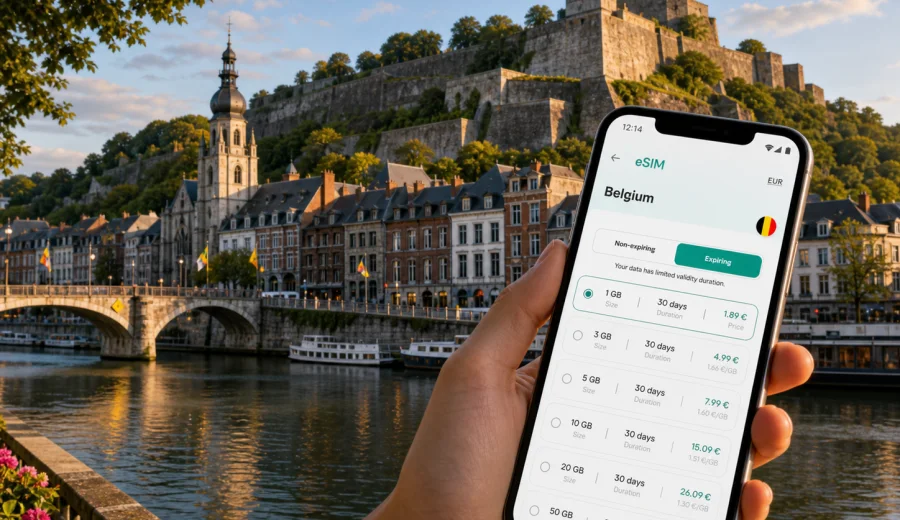
Namur eSIM guide: mobile connection and internet for your trip
Namur is compact enough to explore on foot, yet it is not a city where mobile internet feels optional. You may arrive by train from Brussels, by car from Charleroi Airport, or as part of a Wallonia route that also includes Dinant, Liège, or the Meuse valley. In each case, your phone becomes the practical center of the trip: maps, train platforms, hotel messages, restaurant bookings, taxi apps, translation, banking confirmation, and quick route changes.
An eSIM can make that routine simpler because you do not need to look for a physical SIM card after arrival. With a compatible phone, you can prepare a mobile data plan before the trip or set it up when you already know how long you will stay in Belgium. For Namur, this is especially useful if your schedule mixes a quiet historic center with short regional journeys, business meetings, and outdoor viewpoints around the Citadel.
This guide explains how to think about eSIM, mobile connection, and internet use in Namur: when you will need data most, what to check before buying a plan, how much traffic different travelers usually need, and how to keep your primary phone number available while using eSIM for mobile data.
Why mobile internet matters in Namur
Namur is the capital of Wallonia, but the travel rhythm is more relaxed than in Brussels. The city center sits around the meeting point of the Sambre and Meuse rivers. The Citadel rises above the old town, the train station is a practical arrival point, and many hotels, offices, restaurants, and cultural venues are within a walkable area. That sounds simple until you need to move between them with luggage, check the last train, or find the right pedestrian route up to a viewpoint.
Mobile data is useful in Namur for everyday travel tasks:
- checking train times between Namur, Brussels, Charleroi, Dinant, Liège, and Luxembourg routes;
- finding the correct exit from Namur station and walking to your hotel;
- using map navigation near the Citadel, riverbanks, and old town streets;
- messaging your hotel or host about arrival time;
- translating menus, museum information, or local notices;
- booking a taxi or checking public transport options when walking is not convenient;
- joining video calls or sending files during a business trip;
- using internet-based calls when your eSIM plan is data only.
Public Wi-Fi can help in hotels, cafés, and some offices, but it should not be your only plan. You may need data before check-in, during a walk along the river, at the station, or when you are deciding whether to continue toward Dinant or return to Brussels. A prepared eSIM gives you a separate mobile data option without changing your physical SIM card.
Arrival scenarios: where eSIM helps first
Most international visitors do not fly directly into Namur. The city is usually reached by train or road from another Belgian hub. That makes the first hour of connectivity more important than it looks, because you may need mobile internet before you have reached the hotel.
| Arrival route | Typical mobile data needs | Practical eSIM benefit |
|---|---|---|
| Brussels Airport to Namur | Train route checks, platform changes, ticket app, messaging | Use maps and transport information before you reach the city |
| Charleroi Airport to Namur | Bus or car transfer, taxi coordination, arrival updates | Stay reachable during the airport-to-city transfer |
| Brussels city to Namur by train | Timetables, delays, hotel directions from the station | Keep navigation ready from platform to accommodation |
| Car trip through Wallonia | Navigation, parking search, day-trip planning | Use data across the route, not only inside Namur |
| Stopover in Namur | Fast route decisions, luggage storage search, restaurant lookup | Avoid losing time looking for Wi-Fi |
If you arrive late, mobile data becomes even more useful. Namur is easy to navigate in the daytime, but at night you may prefer a direct route to your hotel, a quick ride, or confirmation that the restaurant kitchen is still open. An eSIM will not replace local planning, but it can reduce friction at the exact moment when you are tired and carrying bags.
City areas where connection is especially useful
Namur’s center is manageable, but your phone will still work hard during a normal day. The city combines riverside walks, steep paths, historic streets, and transport links that branch out toward nearby towns. Different areas create different internet needs.
Around Namur station. This is the practical starting point for many visitors. You may need to check a hotel address, confirm a meeting time, find a taxi pickup point, or compare walking routes. If you are connecting onward, data helps you monitor platform information and delays.
Old town and shopping streets. The historic center has cafés, restaurants, small shops, and cultural stops. Mobile internet helps with opening hours, reservations, translation, card payment confirmations, and route checks through narrow streets.
The Citadel of Namur. The Citadel is one of the city’s main reasons to visit. When you move between viewpoints, visitor areas, terraces, and walking paths, online maps can be more practical than relying on memory. Battery and data planning also matter here because you may take photos, upload them, and use navigation at the same time.
The Meuse and Sambre riverbanks. Riverside walks are pleasant but can stretch your route. Data helps you check bridges, return routes, nearby cafés, and onward transport if the weather changes.
Business and administrative districts. Namur hosts regional institutions and business meetings. If you are visiting for work, mobile data is often needed for calendars, files, two-factor authentication, messaging apps, and backup connectivity when venue Wi-Fi is limited.
Trips from Namur. Dinant, Brussels, Liège, and Luxembourg-facing rail routes can all be part of a Namur-based trip. A Belgium eSIM plan can be more convenient than treating Namur as a one-day offline stop.
How much data do you need for Namur?
The right eSIM plan depends less on the city and more on your behavior. Namur itself does not require heavy data use, but travel days, maps, video, and business calls can change the calculation quickly.
| Traveler type | Typical stay | Data behavior | Practical plan logic |
|---|---|---|---|
| Short stopover visitor | Half day to 1 day | Maps, messages, restaurant search, train checks | A small data package may be enough |
| Weekend traveler | 2-3 days | Navigation, photos, messaging, light browsing | Choose enough data for daily city use and transfers |
| Business visitor | 1-4 days | Email, calendars, file access, calls through apps | Prioritize stable data allowance and plan duration |
| Wallonia route traveler | 4-10 days | Namur plus Dinant, Liège, Brussels, car or rail navigation | Pick a plan for Belgium-wide movement |
| Remote worker | Several days or more | Messaging, cloud documents, occasional hotspot | Check data volume and hotspot conditions before relying on it |
For light use, maps, messaging, and occasional searches do not consume much data. Video streaming, cloud backup, social media uploads, and video calls are different. If you plan to work from a hotel or café, use fixed Wi-Fi for large downloads and keep eSIM data for movement, calls, and backup access.
A practical way to estimate data is to divide your trip into travel moments rather than calendar days:
1. Arrival transfer and first navigation to the hotel.
2. Daily movement around the old town, Citadel, riverfront, and restaurants.
3. Transport checks for side trips or return travel.
4. Work tasks, if the trip includes meetings or remote work.
5. Emergency reserve for delays, weather changes, or missed connections.
This approach keeps the plan realistic. You do not need to overbuild for a quiet weekend, but you should avoid choosing a data amount that only covers the first day.
Before buying: device and plan checks
Before you choose any eSIM plan, confirm that your phone or tablet supports eSIM and is not locked to a carrier in a way that prevents using another mobile data profile. You can use the compatibility check here: check your device.
Also review the plan details before payment:
- destination: Belgium or a wider regional plan if your trip crosses borders;
- data amount: enough for maps, messaging, transport, and any work needs;
- validity period: long enough for the full trip, including arrival and departure days;
- activation rules: when the plan starts and how the validity period is counted;
- hotspot availability: important if you want to share data with a laptop;
- voice and SMS: many travel eSIM plans are data only unless stated otherwise.
If you need standard phone calls or SMS, do not assume they are included. Many travelers keep their primary SIM active for calls and banking messages, then set the eSIM as the mobile data line. For internet calls and messages, apps can use the eSIM data connection.
A practical eSIM setup for Namur
For a city trip, the simplest setup is usually this: keep your usual SIM for your normal number, and use the eSIM for mobile data in Belgium. This lets you continue receiving important messages while routing maps, search, transport apps, and internet calls through the travel data plan.
Kaspersky eSIM Store is an app and website where you can quickly choose, arrange, and activate an eSIM with a suitable mobile data plan for an international trip. For a Namur itinerary, the relevant destination is Belgium, because the city uses the country plan rather than a separate city page. When you are ready, you can choose a mobile data plan for your trip to Namur and compare the data amount and validity period before you travel.
After you receive the eSIM details, follow the installation flow for your device. If you need step-by-step help, use the Android installation guide or the iOS installation guide. Install the eSIM when you have a stable connection, such as home Wi-Fi or hotel Wi-Fi, and read the activation instructions carefully before turning on data roaming for the eSIM line.
The exact settings can vary by device, but the checklist is usually straightforward:
- install the eSIM profile on the compatible device you will carry in Namur;
- label the line clearly, for example Belgium data or Travel eSIM;
- keep your primary number available if you need calls or SMS;
- set the eSIM as the mobile data line when you want to use the plan;
- check whether data roaming must be enabled for the eSIM;
- avoid deleting the eSIM profile unless you are sure it is no longer needed.
Namur itinerary planning with mobile data
Mobile internet is most useful when it supports real decisions during the day. In Namur, those decisions often involve hills, bridges, train times, and weather.
Morning arrival. Check your route from the station to your hotel or meeting place. If your room is not ready, use data to find luggage options, a café, or a walking route through the center.
Citadel visit. Use maps before you start climbing or taking transport up the hill. Save battery by checking the route first, then keep the map open only when needed. If you plan to share photos from the viewpoint, remember that uploads can use more data than navigation.
Lunch and old town walk. Restaurant hours can change by day of week. Mobile data helps you compare nearby options, translate menus, and reserve a table without returning to hotel Wi-Fi.
Afternoon by the river. Weather shifts can affect whether you continue walking along the Meuse or turn back toward the center. Online maps and forecasts help you choose a realistic route.
Evening return. Check train times, taxi options, or walking routes before the streets get quieter. If you are heading back to Brussels or another city, keep enough battery and data for platform changes.
eSIM for trips from Namur
Namur is a good base for wider movement through Wallonia. If you travel beyond the city, your data needs may grow because you will use maps and transport checks more often.
Popular route ideas include:
- Dinant: a scenic Meuse valley trip where navigation, train times, and photo uploads are common.
- Brussels: useful for international rail, flights, museums, and business connections.
- Liège: another major Walloon city with a larger urban transport pattern.
- Charleroi: relevant for airport transfers and some onward routes.
- Luxembourg-facing travel: check whether your plan is Belgium-only or suitable for cross-border movement if you leave the country.
For Belgium-only travel, a Belgium destination plan is usually the natural fit. If your itinerary crosses borders, compare the destination coverage and validity before choosing. Do not assume that a plan for one country automatically covers neighboring countries unless the plan details say so.
Quick planning checklist
Use this checklist before you leave for Namur:
- Confirm your phone supports eSIM and is not locked.
- Choose a data amount based on your real itinerary.
- Check the validity period against arrival and departure dates.
- Install the eSIM on stable Wi-Fi.
- Save the installation instructions in case you need them later.
- Download offline maps for Namur and any day-trip towns.
- Keep your primary SIM active if you need calls or SMS.
- Set the eSIM as the mobile data line when you are ready to use it.
- Monitor data use during photo uploads, video calls, and hotspot sessions.
FAQ
Is eSIM useful for a short visit to Namur?
Yes, especially if you arrive by train or airport transfer and need maps, messages, restaurant searches, and transport updates before you reach hotel Wi-Fi. For a very short stop, choose a data amount that matches light city use.
Can I use eSIM for regular phone calls in Namur?
Many travel eSIM plans focus on mobile data and do not include a standard phone number, voice calls, or SMS unless the plan says otherwise. You can usually keep your primary SIM for calls and use internet-based calling apps over eSIM data.
Should I install eSIM before arriving in Belgium?
It is often easier to install the eSIM before departure while you have stable Wi-Fi. Activation timing depends on the plan rules, so read the instructions before turning on the eSIM for data.
Will I need data at the Citadel of Namur?
Data is useful there for maps, route checks, weather, tickets or opening information, and photo sharing. If you want to save data and battery, check the route before climbing and limit background uploads.
Is a Belgium eSIM plan enough for Namur?
For a trip focused on Namur and other Belgian cities, a Belgium destination plan is the relevant choice. If you plan to cross into another country, check whether your selected plan covers that route.
Choose mobile internet for your Namur trip
Namur is easy to enjoy when the practical details stay in the background. With mobile data ready, you can move from the station to the old town, climb toward the Citadel, check train times for Dinant, message your hotel, and handle work tasks without searching for a SIM shop or relying only on public Wi-Fi.
Before you travel, check device compatibility, decide how much data your itinerary needs, and review the plan validity. Then use Kaspersky eSIM Store to prepare an eSIM plan for Belgium so your mobile internet is ready for Namur and the rest of your route.