Travel connectivity guide
Nantes eSIM: Mobile Internet for a City Trip
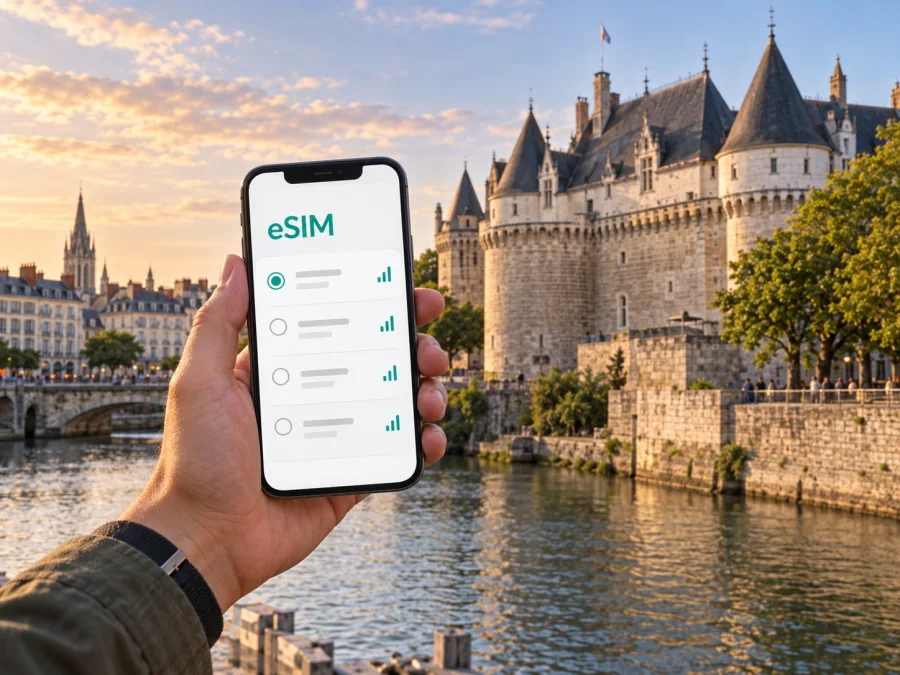
Nantes eSIM: a practical guide to mobile connection and internet
In Nantes, a day can move between the railway station, the historic centre, the Loire and Île de Nantes. A mobile connection helps with tram routes, hotel entrances, messages and changing plans. An eSIM can make mobile internet easier to prepare, especially if you want to keep your usual physical SIM in your phone.
Plan around where you will go, how long you will stay and whether you will travel beyond the centre. A weekend visit has different data needs from a work trip with a day excursion, so match the allowance to your own habits.
Before you arrive: decide what your phone needs to do
Think through the moments when you will reach for your phone. In Nantes, they often come in short bursts: confirming a train platform, opening a map after leaving a tram, checking a restaurant booking, translating a menu, or sending a message when a meeting runs late. These tasks use data, but the total depends more on your habits than on the city itself.
A quick needs check can make your choice clearer:
- Light use: maps, messaging, transport information and occasional browsing, with downloads prepared on Wi-Fi.
- Regular use: frequent route searches, photos shared during the day, restaurant research and email.
- High use: video calls, cloud uploads, remote work or streaming away from Wi-Fi.
These are planning categories, not fixed promises. Offline maps can reduce repeated downloads; photo backups and video can use data in the background, so review device settings. Before choosing a tariff, check destination coverage, allowance, validity, activation conditions and what happens when data runs out. A travel data eSIM is not automatically a local phone number or SMS service; check the terms. Internet calls and messages work through compatible apps when both parties can use them.
From Nantes Atlantique to the centre
Nantes Atlantique Airport is southwest of the city, in Bouguenais. A direct airport shuttle links it with central Nantes and the railway station, with stops including Gare Sud, Le Lieu Unique and Hôtel Dieu. Its journey time is an estimate affected by traffic, so allow margin before a train. Bus-and-tram combinations are also available; check the current Naolib journey planner for the stop and interchange that suit your destination. Keep your accommodation address saved offline as a fallback.
Before leaving the terminal, confirm your accommodation address, compare the transfer options against your arrival time and luggage, and identify the relevant stop. If you are meeting a host or colleague, agree on a precise landmark such as the station entrance; “near the station” can mean several places. Data is useful for checking a live route or messaging if plans change, while an offline copy of the address is a reliable fallback.
Finding your way through central Nantes
The historic centre is compact enough for many visits to combine walking with tram or bus journeys. Place du Commerce is a useful orientation point, with routes radiating toward the shopping streets, the old town and the river. The Château des ducs de Bretagne and the cathedral area are prominent landmarks, while the Bouffay quarter has narrow streets where a map can help you find a particular entrance or meeting place.
The Loire and the Erdre shape the way the city is experienced. A short route may involve a bridge or a change of riverbank, so compare walking with public transport and allow time to orient yourself after leaving a stop. In a dense central area, check the street name and a nearby landmark if your map location is slow to settle.
Nantes’ tram network connects central districts with outlying stops, while buses and river shuttles serve additional corridors. Check a current transport map and ticket validity before boarding; service arrangements can change, and a phone connection does not replace a valid ticket.
Districts and the kind of data each visit uses
| Part of Nantes | What brings visitors there | When mobile data is useful |
|---|---|---|
| Bouffay and the medieval centre | Historic streets, cafés and evening plans | Pinpointing an address among narrow streets and sharing a meeting point |
| Graslin and Place Royale | Shops, restaurants and cultural venues | Checking opening details, reservations and walking routes |
| Around Gare de Nantes | Rail connections, hotels and business stays | Rechecking departures, finding the right station side and coordinating arrivals |
| Île de Nantes | Contemporary architecture, events and Les Machines de l’Île | Looking up venue access, opening information and the route across a bridge |
| Along the Erdre or Loire | Riverside walks and neighbourhood outings | Adjusting a walk, checking weather and finding a return connection |
This is a practical orientation, not a ranking of neighbourhoods. Your hotel location can change the best route substantially. Save its address, entrance details and booking reference before you leave home; an accommodation pin alone may not show which side of a block or courtyard contains the entrance.
Choose a tariff around your itinerary
A useful estimate begins with the length and pattern of the trip. Count the days when you expect to use data away from Wi-Fi, then consider whether you will work remotely, upload media, use video frequently or make excursions outside Nantes. A short city break with offline maps and modest messaging usually has a different profile from a work visit with regular calls and document access.
| Travel pattern | What to account for | Preparation that can reduce surprises |
|---|---|---|
| One or two nights in the centre | Arrival directions, local journeys and return to the station or airport | Download maps and bookings; use hotel Wi-Fi for large updates |
| Several days with meetings | Email, calendar changes, venue directions and shared files | Check the tariff validity against the full schedule and keep meeting addresses available offline |
| Nantes plus regional travel | Navigation beyond the city and longer periods away from Wi-Fi | Confirm the tariff’s coverage and validity for the full itinerary, not just the city name |
| A longer stay with frequent uploads | Photos, work calls and cloud services | Review background data use and estimate your normal weekly consumption |
Do not choose solely by the largest allowance. The tariff should fit the number of days you need it, the covered destination and your everyday use. It is also useful to check whether activation begins when you install the eSIM, when you connect to a supported network, or at another point stated in the terms. That detail matters if you install at home but will not travel for several days.
Kaspersky eSIM Store is an app and website where you can select, arrange and activate an eSIM with a suitable tariff for mobile internet on an international trip. To review the destination options before travelling, choose an eSIM tariff for a trip to France. Compare the listed allowance and validity with your actual plans in Nantes, and read the tariff conditions before confirming your selection.
eSIM preparation: a calm checklist
An eSIM is a digital SIM profile installed on a compatible device. It can be useful for travel because it avoids handling a second physical SIM, while many phones let you keep the home line available and select which line uses mobile data. The exact settings and labels differ between devices, and the home carrier may charge for roaming if its line remains enabled for data or calls. Check your own plan and phone settings rather than assuming that keeping a line active is cost-free.
Before selecting a tariff, check whether your device supports eSIM and whether it is unlocked for use with other providers. Compatibility depends on the specific model and, in some cases, the version sold in a particular market. If you are unsure, verify the full model number in the device settings or manufacturer documentation.
A straightforward preparation sequence is:
- Confirm device support. Check eSIM compatibility and make sure the phone is not restricted by a carrier lock.
- Choose the destination and tariff. Match the destination, data allowance and validity period to the days and activities in your itinerary.
- Read activation instructions. Follow the instructions shown for the selected eSIM; keep access to a stable Wi-Fi connection during installation if required.
- Install before departure when practical. Name the new line clearly, such as “Travel data”, so it is easy to identify later. Avoid deleting an installed eSIM unless the instructions say it is safe to do so.
- Set data preferences. Choose the intended line for mobile data and review data roaming settings as directed by the eSIM instructions. Keep your regular line’s roaming settings in mind.
- Check the connection after arrival. Allow the phone to register according to the tariff instructions. If data does not start, review the selected data line, activation status and any required network settings.
For step-by-step guidance, use the Android eSIM installation instructions or the iOS eSIM installation instructions. Follow the version that matches your phone. Installation steps can differ across software versions, so the directions displayed for your device should take priority over a generic memory of where a setting used to be.
Using mobile internet for a day in Nantes
Imagine arriving at Gare de Nantes with an afternoon check-in and dinner in Bouffay. A connection can help you compare walking with a tram while carrying luggage, message your host if delayed, and navigate the final streets. Keep the booking address and check-in instructions available offline too; a pin alone may not identify an entrance or courtyard.
For Île de Nantes, check the venue address and access details before leaving the centre. Bridges connect the island to the rest of the city, so your starting riverbank matters. If visiting Les Machines de l’Île, confirm opening and ticket details close to the date. A business traveller can use the same preparation: save meeting addresses, verify the entrance and allow time for the final walk from a stop. For video calls, check venue Wi-Fi in advance and keep mobile data as a contingency within the tariff allowance.
A short stopover: keep the plan simple
With only a few hours between trains or flights, avoid building an itinerary that depends on several tightly timed transfers. Choose one or two central areas, check the luggage arrangements and station or airport transfer first, then keep a return buffer. The historic centre, a riverside walk or a single Île de Nantes visit can each make sense depending on where you start and how much time remains.
Use mobile data to confirm the next departure and locate the return route, but download essential tickets and booking confirmations in advance. If plans change, compare the actual journey time from your current position rather than assuming you can reach the airport or station in a fixed number of minutes. For a transfer through Nantes, a phone connection is particularly helpful for live updates, while an offline copy of the onward ticket protects against a low battery or a brief loss of signal.
When you leave Nantes
If Nantes is a base for western France, check each regional train or road leg before departure and confirm that your tariff covers every destination. Save tickets and the next address offline, check the station and platform information on the day, and align tariff validity with the full itinerary rather than the city stay alone.
Common questions about Nantes and eSIM
Will one eSIM cover my entire stay?
Check the tariff’s destination coverage, validity and conditions, especially if Nantes is one stop on a wider route through France.
Can I use a travel eSIM as my usual phone number?
A travel data eSIM is intended for mobile internet. Unless its terms say otherwise, it does not include a standard voice number or SMS. Check your home operator’s charges if you keep your usual line active.
Should I install the eSIM before arriving?
Many travellers prepare it before departure using a stable internet connection. Whether installation starts the tariff’s validity depends on its terms, so read them first and follow the instructions for your device.
What should I save offline?
Keep your accommodation address, booking details, event tickets, return journey and a map of central Nantes available without data. These remain useful if your phone battery runs low or service is temporarily unavailable.
A practical plan for staying connected
For a visit centred on Nantes, prepare around your real route: airport or station arrival, accommodation, daily neighbourhoods and any trip beyond the city. Save the information you cannot afford to lose, check the current transport plan on the day, and choose a tariff whose destination, validity and data allowance fit the whole itinerary. Keep your regular SIM settings in view and follow the installation guidance for your specific phone.
When you are ready, use Kaspersky eSIM Store to review the available options, select and activate a suitable eSIM tariff for your international trip. Explore eSIM options for France and compare the terms with your plans for Nantes before travelling.