Travel connectivity guide
NATCOM eSIM in Haiti: what to check
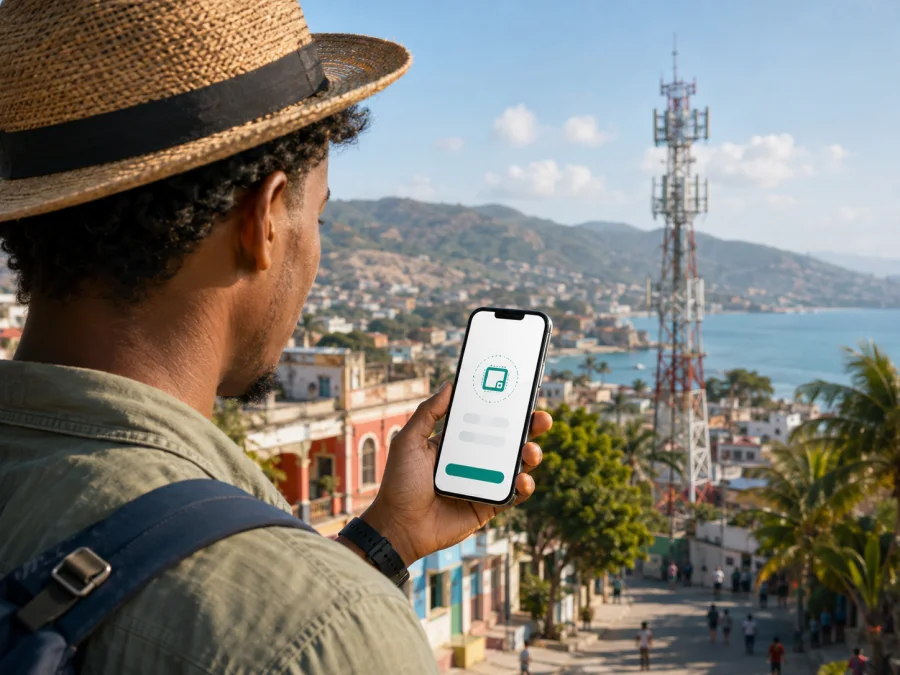
NATCOM eSIM in Haiti: what travelers should check
If you are looking for a NATCOM eSIM in Haiti, begin by checking what the operator currently confirms. NATCOM is a mobile operator in Haiti with mobile services, mobile internet and customer support. Its public store currently shows a physical-SIM purchase route and mobile-data sections. On September 5, 2026, I did not find a current public NATCOM page confirming eSIM issuance, eSIM activation or a tourist eSIM offer. That does not prove the service is unavailable; it means that a traveler should ask NATCOM for a current answer before relying on it.
NATCOM and the NATCOM name belong to their respective rights holder. Kaspersky eSIM Store is not affiliated with NATCOM and is not its official partner or distributor. Kaspersky eSIM Store is an application and website that helps a user choose, arrange and activate an eSIM plan for mobile internet during an international trip; it is not a mobile operator, network owner or mobile-internet provider.
What is confirmed about NATCOM in Haiti
CONATEL, Haiti's telecommunications regulator, lists NATCOM among the country's telephone operators. The current operator directory was checked on September 5, 2026. NATCOM's own website presents mobile services and mobile internet, a customer-facing store and support channels. These facts establish NATCOM's position in the local market, but they do not establish that a visitor can receive a digital SIM profile.
The current NATCOM mobile-services page labels the visible SIM route “SIM physique”, or physical SIM. It also links to mobile internet and support areas. The public check supports saying that ordinary local mobile-data offerings are present, but it did not separately confirm a prepaid or tourist option for visitors. A physical-SIM catalog is not evidence of eSIM support, and a mobile-data section is not evidence that an eSIM can be ordered remotely. The page opened during this verification did not show an eSIM product or eSIM activation instruction.
If eSIM is essential, contact NATCOM through a current support channel or an authorized point of sale. Ask whether NATCOM issues eSIM to new customers, whether foreign visitors are eligible, whether the process is remote or in person, and whether your exact phone model is supported. Ask separately about a new line, physical-to-eSIM conversion and replacement of a failed profile. Until NATCOM confirms these points, describe its eSIM availability as unconfirmed rather than assume that a search result or reseller listing is current.
Local NATCOM service and travel eSIM are different routes
A local NATCOM SIM is part of the Haitian mobile market. It may suit a traveler who needs a local subscriber relationship, local voice or SMS functions, a local number or in-person operator support. A longer stay can also make local account management more relevant. The exact activation method and available services must come from NATCOM at the time of purchase.
A travel eSIM is a different arrangement. It is a digital profile installed on a compatible phone and intended for mobile data during a trip. It can be prepared before departure, which may reduce the need to search for a physical SIM immediately after arrival. It does not automatically provide a Haitian number, ordinary voice calls or SMS. Unless the selected conditions say otherwise, treat it as a data connection and keep your regular line available for the functions you still need.
The two lines can sometimes be used together. A compatible dual-SIM phone may keep the home SIM installed while the travel eSIM handles mobile data. Before departure, identify the data line, voice line and roaming settings. If the home line remains enabled abroad, make sure it cannot become the unintended data line. Menu names vary by device, so test the arrangement while you still have reliable internet.
Registration and visitor requirements
SIM registration is separate from eSIM capability. CONATEL's public information on SIM-card measures says sellers must request an identity document and an address from buyers. Its public notice also says foreign buyers should present a passport and give an address in their country of origin. A CONATEL circular currently available online instructs users to provide an identity document to the seller and have the identity recorded. These pages were checked on September 5, 2026; they are regulatory notices, not a current NATCOM eSIM guide, so confirm the procedure at the authorized sales point.
For a physical NATCOM purchase, carry the passport used for your trip and be ready to provide the information requested during registration. Do not assume that an unregistered, pre-activated or borrowed SIM is acceptable. CONATEL's public notice says a card can be blocked when registration is refused and directs users to points where identity registration is possible.
Do not automatically apply the physical-SIM rule to a digital profile. The public material checked here does not confirm which documents NATCOM would request for an eSIM, whether remote verification is available or whether a visitor can activate a profile without visiting a store. Ask NATCOM directly and handle identity documents only through the operator's current official process.
Telecom registration is distinct from entry formalities for Haiti. Check current travel and entry requirements with the relevant authorities before departure. A passport sufficient for entry may still need to be recorded during local SIM activation.
Technologies and coverage
The available public technical material supports a careful description of NATCOM's network context. An ITU assessment of telecommunications resilience in Haiti describes the mobile networks as evolving from 2G toward 4G and identifies NATCOM as a mobile operator. CONATEL's published quality-of-service material discusses NATCOM measurements for UMTS, or 3G, and LTE, or 4G. These sources support mentioning 2G, 3G and 4G as relevant technology generations in the Haitian mobile market. They do not promise that every phone, location or service will use one generation.
The same CONATEL material says conditions vary by geographic area. Its assessment covered the Ouest department and describes 3G coverage as generally available in the assessed context while noting that LTE can be weak or absent in many zones. It also reports variation in measured data performance. This is a regulator's published assessment for its stated scope, not a live nationwide map and not a guarantee for a hotel, road, port, airport or rural community.
Coverage depends on site location, terrain, buildings, indoor conditions, local power, backhaul, congestion and temporary outages. A signal in one neighborhood does not prove service at the next stop. Hills, coastlines and dense construction can change radio conditions over a short distance. Download essential maps or travel information in advance and plan for places where the connection may change.
If you choose a travel eSIM for Haiti
The Kaspersky eSIM Store sitemap checked on September 5, 2026 includes “eSIM Haiti” among its destination pages. That listing confirms a Haiti destination in the store's public structure; it does not say that the profile is supplied by NATCOM or that it uses a particular Haitian network. Review the current destination conditions before purchase.
Kaspersky eSIM Store is an app and website for choosing, arranging and activating an eSIM plan for mobile internet during an international trip. Kaspersky's official travel eSIM guide, published June 17, 2025, describes this selection and activation workflow. The product helps with setup, but it is not the local operator, does not own a Haitian network and does not change NATCOM registration rules. The connected network, service area, activation behavior and other conditions must be checked in the current product information.
Before purchase, confirm that the phone supports eSIM and is unlocked. Make sure you will have stable internet during installation. Depending on the instructions, you can prepare the profile at home or after arrival. Installing a profile and starting data use are not always the same event, so read the activation wording carefully. Keep the QR code or in-app profile information private and do not scan it again unless the instructions permit that.
Choose an eSIM plan for Haiti after checking the current destination conditions and device compatibility.
Installation sequence
- Check that the phone supports eSIM and is not operator-locked.
- Connect the phone to a stable internet connection.
- Open mobile-network settings and choose the option to add an eSIM.
- Scan the QR code or use the installation method shown in your Kaspersky eSIM Store account.
- Label the new line so it is distinct from your home SIM.
- Select the travel eSIM as the mobile-data line when you are ready to use it.
- Enable data roaming for that eSIM if the provider's instructions require it.
- Disable data roaming on the home line if you do not want it to handle data abroad.
- Test a simple connection and check which line is carrying the data.
If the add-eSIM option is missing, check the exact model, sales region and operating-system version. If a QR code is rejected, confirm that the phone is online and the profile has not already been installed. If installation succeeds but data does not work, check the selected line, roaming setting and destination conditions before contacting support.
Arrival checklist and troubleshooting
Do not leave every setup step until you are outside the airport. Save installation instructions, important addresses and support details offline. When the phone connects, check the line indicator and mobile-data selection. A roaming icon can be normal for a travel eSIM, while a signal icon does not prove that data is configured. Try a simple connection and verify the intended profile. If there is no data, check airplane mode, the enabled line, data assignment and the required roaming setting, then record the device model, location and error message for support.
Use this decision guide before you choose: do you need a Haitian number or only mobile data; is the exact phone model unlocked and eSIM-compatible; will the route include areas with different coverage; can you complete local identity registration; do you have reliable internet and enough battery for installation; which line will carry data; and have you read the current activation, support, refund and profile-transfer conditions?
An eSIM profile may be intended for one device and may not be transferable after installation. The rules for reinstallation, refunds and activation depend on the provider and selected plan. Read them before scanning the QR code and keep the purchase confirmation private.
NATCOM eSIM in Haiti: frequently asked questions
Does NATCOM offer eSIM in Haiti?
The current public NATCOM pages checked on September 5, 2026 did not confirm eSIM issuance or an eSIM activation flow. They showed a physical-SIM route and mobile-service sections. Ask NATCOM or an authorized point of sale for the current answer for your phone model and visitor status.
Can a tourist buy a NATCOM SIM in Haiti?
CONATEL's public information says buyers must provide identity information and that foreign buyers should present a passport and an address. Carry your passport and confirm the current process with NATCOM before purchase. Do not assume that an unregistered card is permitted.
Does NATCOM support 4G?
Public CONATEL material discusses NATCOM's UMTS 3G and LTE 4G services, while an ITU assessment describes Haiti's mobile networks in a 2G-to-4G context. This does not guarantee 4G at every location. Technology and coverage can vary by area, device and local conditions.
Can I keep my home SIM while using a travel eSIM?
Often, a compatible dual-SIM phone can keep the home line installed while the travel eSIM is selected for data. The exact behavior depends on the phone. Check data-line and roaming settings so the intended profile handles mobile data.
Will a travel eSIM provide a local phone number?
Not necessarily. Travel eSIMs are commonly intended for data, and Kaspersky eSIM Store describes its travel use around mobile-data connectivity. Check the selected conditions if you need voice calls, SMS or a local number. Messaging apps can work over data, but they do not create a traditional local line.
Final guidance
For NATCOM in Haiti, current public facts support describing a local mobile operator with physical-SIM and mobile-data services, a 2G-to-4G technology context and registration requirements relevant to visitors. They do not provide a current public confirmation of NATCOM eSIM. If that exact route matters, verify it directly with NATCOM before departure.
If you only need mobile internet, a separate travel eSIM can be considered after checking device compatibility, unlock status, destination support, activation instructions and coverage expectations. Kaspersky eSIM Store helps the user choose, arrange and activate a travel eSIM plan; it is not NATCOM, a local network or an official NATCOM partner. Keep the choice practical: decide whether you need a local number, prepare the required identity document for a local SIM, install while you have reliable internet, select the correct data line and recheck conditions before travel.
For a current travel-eSIM option to review, choose an eSIM plan for Haiti. Read the current destination conditions before completing a purchase.
Information checked on September 5, 2026. NATCOM's services, eSIM availability, registration process, network coverage, connected technologies and travel-eSIM conditions may change. Confirm current details in the official materials of the relevant service before purchase or activation.


