
Travel connectivity guide
N'Djamena eSIM: mobile internet for your trip
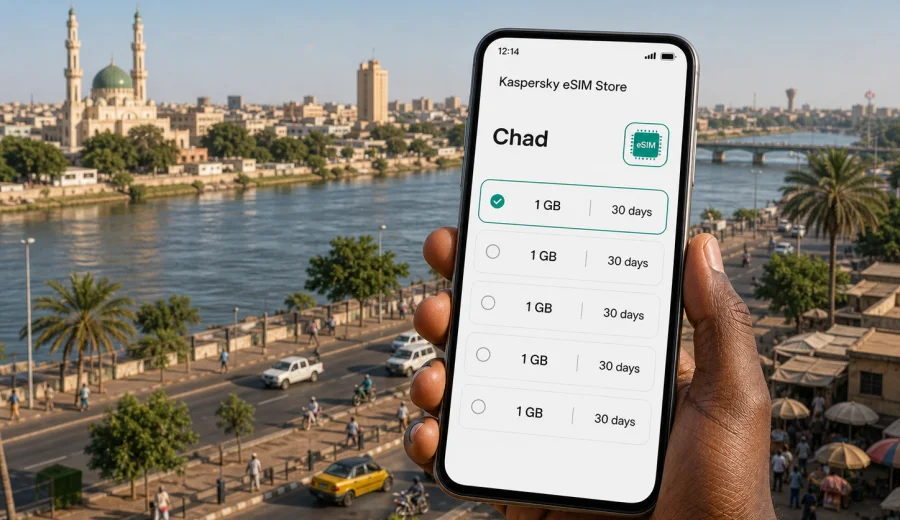
N'Djamena eSIM: mobile connection and internet for your trip
N'Djamena is a city where mobile internet becomes useful almost immediately. You may need a map after landing at N'Djamena International Airport, a messenger to contact your hotel driver, a translation app for a market visit, or email access before a meeting near the ministries and business districts. An eSIM can help you prepare mobile data before you start moving around the capital of Chad, without depending only on airport Wi-Fi, hotel reception desks, or the search for a physical SIM card after arrival.
This guide focuses on practical travel scenarios in N'Djamena: arrival, transfers, local navigation, hotel check-in, business days, short stopovers, and trips from the city to other parts of Chad. It also explains how to choose an eSIM plan for mobile internet, what to check before purchase, and how to avoid common setup mistakes.
Why mobile internet matters in N'Djamena
N'Djamena is spread along the Chari River and functions as the country's main administrative, transport, and business hub. Trips often involve a mix of airport transfers, hotel coordination, meetings, security checkpoints, local drivers, and routes that can change with traffic, weather, or local conditions. In that setting, internet access is not only about browsing. It supports the small tasks that keep the day moving.
You may need mobile data in N'Djamena for:
- checking a route from the airport to your hotel before leaving the terminal;
- confirming a pickup location with a driver or host;
- using offline and online maps together when street names are not enough;
- receiving changes to meeting times, flight schedules, or hotel arrangements;
- translating short phrases in shops, restaurants, or markets;
- sharing your live location with colleagues or relatives;
- checking payment confirmations, booking details, and travel documents;
- using ride, delivery, or local contact apps where available.
Public Wi-Fi can be useful in hotels and some offices, but it is not a complete travel plan. You may arrive outside normal office hours, move between districts, or need a connection before you reach a reliable Wi-Fi network. A prepared eSIM gives you a more controlled way to start using mobile internet when your device connects to a local network supported by the selected plan.
When an eSIM is useful in the city
An eSIM is a digital SIM profile installed on a compatible phone or tablet. For travel, it is commonly used for mobile data in the destination country. It does not require a plastic SIM card, so you can keep your primary SIM in the device and use the travel eSIM for internet access.
For N'Djamena, this can be useful in several city situations:
| Situation in N'Djamena | Why mobile data helps |
|---|---|
| Arrival at the airport | You can message a driver, check maps, and confirm hotel details before leaving the terminal. |
| Hotel transfer | You can follow the route, share your position, and keep documents available in cloud apps. |
| Business meetings | You can receive schedule changes and use email or messaging between offices. |
| Local movement | You can check routes between the city center, Farcha, Moursal, Chagoua, Sabangali, and riverside areas. |
| Short stopover | You can handle essential messages and navigation without spending time on a local SIM purchase. |
| Trips from the capital | You can prepare maps, contacts, tickets, and documents before leaving the city. |
The key advantage is preparation. Instead of making connectivity your first errand in N'Djamena, you can install an eSIM before departure or soon after arrival, then use the selected mobile data profile when you are ready.
Arrival at N'Djamena International Airport
Most international visitors begin their trip at N'Djamena International Airport, close to the city and the Farcha area. The distance to many central hotels is not large, but the first hour after arrival can still be busy: immigration, baggage, a pickup point, local currency, luggage, calls, and route confirmation all compete for attention.
Mobile internet can help you handle that first hour more calmly:
1. Open your hotel booking and save the address before leaving the arrivals area.
2. Message your driver, host, or colleague when you are through formalities.
3. Check the route to your hotel and compare it with the agreed pickup plan.
4. Keep a copy of your passport page, invitation letter, and booking reference available offline and online.
5. Confirm whether you should meet at the terminal exit, parking area, or another point arranged by your host.
If your eSIM is already installed, you can switch mobile data to the travel profile once you are ready to use it. On some devices, the eSIM may need data roaming enabled for that profile. This does not mean you are using standard roaming from your home operator; it is a device setting that may be required for the selected travel eSIM profile to use local network access.
Choosing the right amount of data
The best data allowance depends on your travel style. N'Djamena business trips can be light on data if you mostly use hotel and office Wi-Fi, or heavier if you rely on maps, video calls, cloud files, and hotspot sharing during the day. A short stopover has different needs from a week of meetings or field travel from the capital.
Use this simple planning guide:
| Trip type | Typical use | What to consider |
|---|---|---|
| 1-2 day stopover | Messaging, maps, booking checks, email | A smaller data package may be enough if you avoid video and large file syncs. |
| 3-5 day city trip | Maps, taxi coordination, messenger calls, light work | Choose a plan with enough data for daily movement and backup when Wi-Fi is weak. |
| Business week | Email, cloud documents, messaging, navigation, hotspot in short sessions | Allow extra data for attachments, shared calendars, and route changes. |
| Trip beyond N'Djamena | Maps, contacts, documents, updates before travel | Check that the selected plan covers Chad and fits the whole route. |
Before choosing a plan, estimate your daily habits. Maps, messaging, email, and translation apps are usually moderate. Video calls, streaming, cloud backups, app updates, and using your phone as a hotspot can use data quickly. If you need predictable access for work, choose a data allowance that leaves a buffer instead of planning to use every megabyte.
What to check before you buy
The most important step is device compatibility. Not every phone supports eSIM, and some phones that support it in one region may be different in another region. A device may also be locked by a mobile operator, which can prevent adding or using another SIM profile.
Before you choose a travel eSIM for N'Djamena, check:
- your phone or tablet supports eSIM;
- the device is not locked to a single operator;
- the operating system is up to date enough for eSIM setup;
- you have internet access during installation;
- the selected plan is valid for Chad;
- the plan's data volume and validity period fit your trip dates;
- you understand when the validity period or data use starts;
- you know whether the plan includes data only or also other services.
If you are unsure, check your device before purchasing. This is especially important if you use an older phone, a company device, a dual-SIM setup, or a model bought in a market where eSIM support can vary.
Local movement: districts, hotels, and daily routes
N'Djamena travel is often practical rather than leisurely. A visitor may move between the airport, hotel areas, offices, embassies, ministries, construction or logistics sites, and restaurants used for meetings. Online maps are useful, but so are saved addresses and direct contact with the person expecting you.
Common movement patterns include:
- Airport and Farcha: arrivals, departures, logistics, and nearby accommodation.
- Central N'Djamena: government offices, banks, business meetings, hotels, and restaurants.
- Moursal and Chagoua: residential and commercial movement, local errands, and cross-city trips.
- Sabangali and riverside areas: routes near the Chari River and city center connections.
- Outbound routes: road or air travel from the capital toward other destinations in Chad.
Because local naming, traffic, and access can be less predictable than in highly mapped cities, do not rely only on one app. Save your hotel address, keep a screenshot of the route, and carry a phone number for your host or driver. An eSIM helps by keeping these tools available when you leave a building, change cars, or need to coordinate a pickup.
How Kaspersky eSIM Store fits into the trip
Kaspersky eSIM Store is an app and website where you can choose, arrange, and activate an eSIM with a suitable plan for mobile internet during an international trip. It helps you prepare the data part of your journey before you need it in the city.
The practical scenario is simple:
1. Select the destination country for your trip.
2. Compare available plan details such as data volume, validity period, destination, and cost.
3. Check that your device supports eSIM and is not locked by an operator.
4. Arrange the selected eSIM plan through the site or app.
5. Install the eSIM profile and choose it for mobile data when needed.
For a trip to N'Djamena, use the country page for Chad rather than looking for a separate city plan. When you are ready to compare options, you can choose an eSIM plan for your trip to N'Djamena and check the conditions before you travel.
Installing an eSIM before departure or after arrival
You can often install an eSIM before travel while you still have a stable home or office connection. This is convenient because installation may require a QR code, account access, email, or an in-app setup flow. Activation timing and validity rules depend on the selected plan, so read the plan details before you install or switch it on.
For setup, follow the official steps for your device type:
- use the Android installation guide if you are setting up an eSIM on an Android phone;
- use the iOS installation guide if you are setting up an eSIM on an iPhone.
A careful setup process usually looks like this:
1. Connect to reliable Wi-Fi before installing the eSIM.
2. Open the eSIM details in your profile, app, or email.
3. Add the eSIM profile using the available installation method.
4. Name the profile clearly, for example Travel data or Chad data.
5. Keep your main SIM available for calls if you need it.
6. Choose the eSIM profile for mobile data when you are ready to use it.
7. Enable data roaming for the eSIM profile if the device or plan instructions require it.
8. Wait a few minutes for the phone to register on the local network.
Do not delete an eSIM profile after installation unless you are sure you no longer need it. Some eSIM profiles cannot be transferred or reinstalled after removal, depending on the plan conditions.
Business trips and workdays in N'Djamena
Business travel to N'Djamena often depends on coordination. A day may include meetings with partners, movement between offices, visits to project sites, and late changes to the schedule. Mobile data helps because the working day does not happen entirely inside one Wi-Fi network.
For work trips, prepare the following before arrival:
- save meeting locations in maps and in your calendar;
- keep contact names, phone numbers, and messenger details offline;
- download key documents before flying;
- reduce automatic cloud sync on mobile data;
- set video apps to low data use unless Wi-Fi is available;
- keep a power bank ready if you will be out for several hours;
- decide whether hotspot use is necessary and allowed by your selected plan.
If your employer manages your device, check whether company policies allow adding an eSIM. Some managed phones restrict mobile profile changes or require administrator approval. It is better to check this before your trip than to discover it at the airport or before a meeting.
Short stopovers and first-time visitors
If you are in N'Djamena for a short stopover, the value of mobile internet is speed. You may not want to spend limited time searching for a local SIM card or waiting until hotel Wi-Fi is available. A prepared eSIM helps you contact your pickup, check the route, send an arrival message, translate a phrase, and keep flight or hotel details accessible.
Trips from N'Djamena to other parts of Chad
N'Djamena is often the starting point for travel elsewhere in Chad. Some travelers continue by road, others by domestic flight or organized transfer. Mobile internet planning should happen before leaving the capital, because connectivity, charging options, and support can become less predictable outside the city.
Before leaving N'Djamena:
- download offline maps for the route and destination;
- save important phone numbers in the device, not only in cloud apps;
- check whether your plan is valid for Chad as a country, not only a single city scenario;
- charge your phone and power bank;
- keep essential documents available offline;
- confirm meeting points, departure times, and backup contacts;
- reduce background data use so your package lasts longer.
An eSIM is not a guarantee of coverage in every location, and mobile network availability depends on local operators and conditions. Treat mobile data as one part of a broader travel plan, especially for routes outside the capital.
Practical data-saving tips
Small settings can make a data package last longer. This is useful in N'Djamena if you are balancing hotel Wi-Fi, office Wi-Fi, and mobile data during the day.
Try this checklist:
- download offline maps before arrival;
- pause automatic app updates on mobile data;
- turn off cloud photo and video backup until Wi-Fi is available;
- use messaging instead of video calls when possible;
- send compressed files instead of large originals;
- close navigation when you no longer need the route;
- disable background data for apps you do not need during the trip;
- monitor data use in your phone settings and in the eSIM interface where available.
For many travelers, maps, messaging, email, and translation are the essential services. Prioritize them over streaming and large downloads when your plan has a limited data allowance.
Common mistakes to avoid
Avoid buying a plan before checking eSIM compatibility, installing the profile without reliable Wi-Fi, deleting the eSIM profile after setup, forgetting to select it for mobile data, or choosing a plan that expires before the end of the trip. Also remember that many travel eSIM plans are data-only and do not include a local phone number, voice calls, or SMS unless the plan conditions say otherwise.
Quick answers about eSIM in N'Djamena
Can I use an eSIM for mobile internet in N'Djamena?
Yes, if your device supports eSIM, is not locked by an operator, and you choose a plan that is valid for Chad. Availability and network experience depend on the selected plan and local mobile network conditions.
Does an eSIM include a phone number for calls?
Usually no. Travel eSIM plans are commonly intended for mobile data. Ordinary calls and SMS are not included unless the specific plan conditions say otherwise. You can use messaging and calling apps over mobile internet.
Should I install the eSIM before flying?
Installing before departure can be convenient because you have reliable internet and time to follow the steps carefully. Check the plan conditions so you understand when validity starts and when you should turn the eSIM on for mobile data.
Final preparation before you travel
Before your trip to N'Djamena, make mobile internet part of the same checklist as passport, visa documents, hotel confirmation, and airport transfer. Check your device, choose a data allowance that fits your itinerary, install the eSIM with reliable internet, and save essential information offline.
Kaspersky eSIM Store helps you choose, arrange, and activate an eSIM with a suitable plan for mobile internet in an international trip. If N'Djamena is your destination, you can choose an eSIM plan for Chad before departure and arrive with a clearer plan for maps, messages, work, and local movement.