Travel connectivity guide
NTT Docomo eSIM in Japan: Visitor Guide
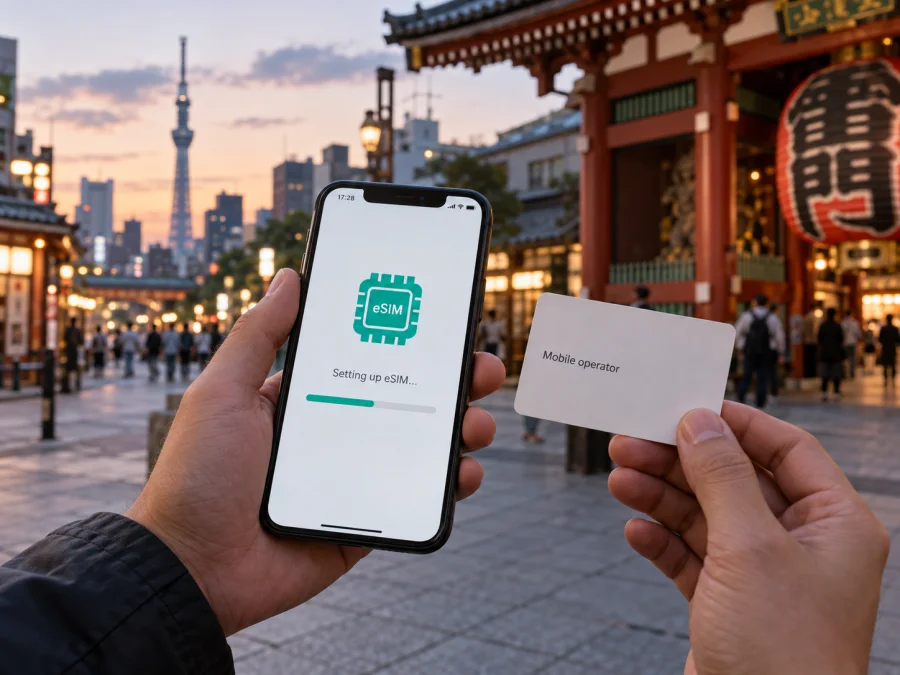
NTT Docomo eSIM in Japan: what travelers should know
Planning a trip to Japan and searching for an NTT Docomo eSIM? The first distinction to make is between eSIM support on a Docomo mobile subscription and a visitor product that can be bought for a short stay. NTT Docomo’s current support pages confirm that it supports eSIM for eligible mobile devices and explains online application and profile activation. That confirms the technology, but it does not by itself establish that a short-term visitor can take out a Docomo line or that Docomo currently sells a dedicated tourist prepaid eSIM.
As of 28 September 2026, I did not find a current official NTT Docomo page confirming a direct prepaid eSIM offer specifically for tourists. Its public eSIM instructions describe regular line contracts and account procedures. A traveler should check the latest eligibility, required documents and sales options directly with NTT Docomo before treating its eSIM support as a ready-to-buy visitor service. This is especially important if you are visiting Japan temporarily and do not have Japanese resident documentation.
This guide explains what Docomo’s confirmed eSIM support means, what a traveler should verify before departure, how to think about coverage and device compatibility, and when a travel eSIM may be a more practical route for mobile data. It focuses on NTT Docomo and Japan; it does not rank networks or compare individual plans.
NTT Docomo’s place in Japan’s mobile market
NTT Docomo is a Japanese mobile network operator with consumer services and customer support across Japan. Its public materials describe mobile subscriptions on its network and support both physical SIM cards and eSIMs. A service sold by another company may use a Japanese network, but the seller, account terms and support remain specific to that product. A network name alone does not show who you contract with or whether a visitor is eligible.
NTT Docomo’s English eSIM support page describes online applications for eligible services, eSIM setup for existing subscribers and a compatible-model guide. The operator notes that some devices purchased elsewhere are not guaranteed to work. Check the exact phone model and the application path for the specific service rather than relying only on a general eSIM-capable label.
Is an NTT Docomo eSIM available to visitors?
The confirmed fact is that NTT Docomo supports eSIM on eligible devices for its mobile services. The separate question—whether a visitor can currently obtain a direct Docomo prepaid or tourist eSIM—needs a more cautious answer. On the verification date above, the current official pages reviewed did not confirm such a dedicated visitor offer. An older Docomo announcement about a visitor prepaid SIM is not evidence that the same offer remains available today, nor does it establish that it was an eSIM.
This distinction matters because a standard mobile subscription can involve account creation, identity verification, payment requirements and an ongoing service relationship. NTT Docomo’s English eSIM page describes electronic identity verification for online contracting. Its identity-document guidance says foreign residents may need to present a residence card and, in relevant cases, a foreign passport; it also gives conditions tied to the residence status and payment method. These are resident-oriented requirements and should not be assumed to fit a short-term visitor arriving for a holiday.
Before trying to sign up, ask Docomo or the authorized seller these practical questions:
- Is there a current direct prepaid or tourist eSIM for a non-resident visiting Japan?
- Can a short-term visitor complete the application, and which identity documents are accepted?
- Is in-person assistance required, or can the whole process be completed online?
- Does the service include a Japanese phone number, or is it intended only for mobile data?
- Which device models and regional variants are accepted?
- What network access and customer-support channel apply to the specific product?
These questions do not assume that a product is or is not available. They help distinguish a regular Docomo contract from a travel-focused service, a partner product, or a physical SIM option. If Docomo’s current pages do not answer them, contact the operator directly and verify the answer close to the date of travel. Product availability, enrollment steps and documentation can change.
What eSIM support means in practice
An eSIM is a digital SIM profile stored in a compatible device. Instead of inserting a removable card, the user downloads or installs a profile and selects it in the phone’s mobile settings. NTT Docomo’s current guidance describes online application, identity verification, profile download and activation. Its procedure varies by device and by whether the customer is starting a new line, changing SIM type or reissuing a profile.
Installing a profile and activating service are separate steps. An application may still need approval and account procedures before the line works. A stable internet connection is commonly needed to download a profile; if the setup uses a QR code, a second screen can make it easier to scan. Follow the instructions attached to the actual service rather than assuming every eSIM follows the same steps. Avoid deleting a working profile to troubleshoot unless the operator or seller tells you to do so.
Before departure, confirm the exact device, unlock status, identity requirements and supported activation method. Save setup instructions and support details offline. Install only with a reliable connection and enough time to complete the process. After setup, select the intended line for mobile data and follow the seller’s guidance about data roaming. Keep your usual SIM available if you need its number for calls or messages.
Device compatibility and dual SIM use
eSIM support depends on the phone’s hardware, software and regional model. Two phones with the same product name can have different SIM configurations. A carrier lock or software restriction can also prevent activation. NTT Docomo publishes a compatible-model guide and warns that operation is not guaranteed for every model bought elsewhere, so check the exact model identifier against its latest information. For a travel product sold by another provider, consult that provider’s device list as well.
A dual-SIM phone may keep a home SIM and travel eSIM installed, but available combinations depend on the handset. Review which line handles data, calls and messages before departure. If you keep your home SIM active for verification texts, check its roaming conditions and choose the data line deliberately. A data-focused travel eSIM should not be assumed to provide a local phone number or ordinary calling unless the product details say so.
Coverage and network technologies in Japan
NTT Docomo’s public coverage resources provide area information for its 5G and LTE services. Check the operator’s current map for places that matter to your trip, such as airports, hotels, rail stations, rural stays or islands. A map is a planning reference rather than a guarantee of uninterrupted service. Buildings, underground spaces, terrain, congestion, device bands and the service arrangement can affect what a traveler experiences.
A 5G-capable phone does not mean every location on a route will use 5G. Service can move between technologies according to location, handset and network conditions. LTE may remain relevant where 5G is unavailable or a device or service does not connect to it. Japan’s older 3G FOMA service ended on 31 March 2026, according to NTT Docomo’s official notice, so older phones and imported models should be checked for current network compatibility. Voice calling can also depend on support for modern voice services and on the chosen product.
For essential navigation or emergency information, keep offline maps and important addresses on the phone. Coverage maps do not capture every indoor condition or temporary service issue.
Local operator service and a travel eSIM
A direct local subscription may suit a person who lives in Japan or otherwise meets an operator’s enrollment conditions and needs an ongoing domestic line. It can involve identity verification, payment setup and account management. A short visit may not meet those conditions. Current official public information reviewed for this article did not confirm a direct NTT Docomo prepaid eSIM specifically for tourists, so check directly before planning around one.
A travel eSIM is arranged for mobile data in a destination or region, often through an app or website before travel. The seller, network access, installation steps and features depend on the product. It can be one way to prepare connectivity before arrival, but do not assume it includes a Japanese number, ordinary calls or SMS. Read the current terms and check the phone before purchase.
Kaspersky eSIM Store is an app and website where travelers can select, arrange and activate an eSIM plan for mobile internet abroad. It can be considered as a travel option for Japan. It is not NTT Docomo, does not own a Japanese mobile network and is not the operator providing radio coverage. The relevant underlying provider and the selected offer determine network access and service conditions; review current product information.
Common questions
Does NTT Docomo support eSIM?
Yes. NTT Docomo’s current support pages describe eSIM for eligible devices and explain new-line applications, changes for existing subscribers, profile download and activation. This confirms eSIM support for Docomo mobile services; it does not establish that every device is supported or that every traveler can contract for a line.
Can tourists buy a direct NTT Docomo eSIM in Japan?
I did not find current official confirmation of a dedicated direct prepaid or tourist eSIM for non-residents when checking on 28 September 2026. Contact NTT Docomo or an authorized seller to confirm the current position, visitor eligibility, documents and activation process before you travel.
What documents may a foreign applicant need?
NTT Docomo’s identity guidance describes document requirements for foreign residents, including a residence card and, in applicable cases, a foreign passport. Requirements depend on the application and payment circumstances. A visitor should not assume that a tourist passport alone will qualify for a standard Docomo contract; ask Docomo about the exact product and current rules.
Can I activate before arriving in Japan?
That depends on the product and the seller’s activation rules. Docomo’s support material describes online steps for its own eligible subscriptions, while travel eSIM processes can differ. Check whether installation, activation or first network connection starts the service, and make sure you have a reliable internet connection for downloading the profile.
Will my phone use 5G?
Only if the device, service, network availability and location support it. Docomo publishes information about 5G and LTE service areas and relevant device considerations. Coverage can vary along a route and inside buildings, so check the current map for your destinations and retain offline information.
Does a data travel eSIM replace my regular phone line?
Not necessarily. A travel eSIM may be intended for data, while your existing number and voice service remain with your regular SIM. The exact features vary by offer. Check the current terms if you need ordinary calls, SMS or a local Japanese number.
Sources and verification date
The operator-specific details in this article were checked on 28 September 2026 against NTT Docomo’s English “About eSIM” and “eSIM Activation” support pages, its “Documents Verifying Identity” guidance, its English “Communications/Areas” page and its official notice that FOMA and i-mode services ended on 31 March 2026. Those pages confirm general eSIM support, online and device-specific setup, identity requirements for Docomo contracts, network-area resources and the end of the legacy 3G service. NTT Docomo’s current public pages reviewed did not confirm a direct visitor-focused prepaid eSIM offer. Service information can change, so confirm current eligibility and conditions with the operator or seller before relying on them.
Kaspersky’s official product article about Kaspersky eSIM Store was also checked for the general description of the app and website as a way to select, arrange and activate travel eSIM service. The product is presented here as a travel option and not as a mobile network operator. This article is independent editorial information; it is not sponsored by, affiliated with, or endorsed by NTT Docomo.