
Travel connectivity guide
Ostend eSIM: Mobile Internet for Belgium Travel
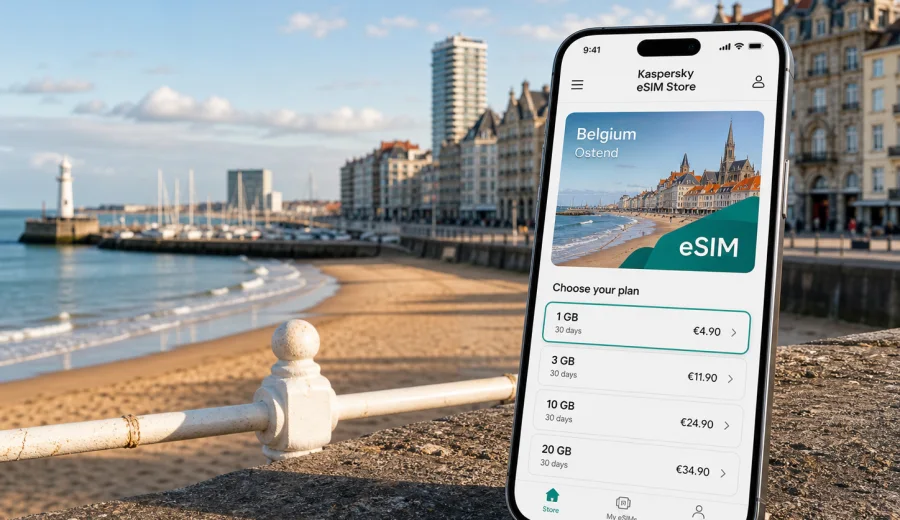
Ostend eSIM: mobile connection and internet for a seaside trip to Belgium
Ostend is a compact Belgian coastal city, but a trip here can still depend heavily on mobile internet. You may need maps after arriving by train, a ride-hailing app or taxi number from the station, hotel messages on the promenade, restaurant bookings near the harbor, and weather updates before deciding whether to walk the beach or head indoors. An eSIM can make that first hour in Ostend easier because you can prepare mobile data before the trip and avoid looking for a physical SIM card after arrival.
This guide focuses on practical mobile connection scenarios in Ostend: arriving from Brussels Airport or another Belgian city, moving between the beach and the center, using public transport along the coast, handling business trips, and planning short excursions from Ostend. The goal is not to replace a full travel guide, but to help you decide how much data you may need, when to install eSIM, and what to check before you rely on mobile internet in Belgium.
Why mobile internet matters in Ostend
Ostend is easy to explore on foot, yet the city has several travel patterns where mobile data is useful. The seafront is long, the marina and central streets can pull you in different directions, and the coast tram connects Ostend with other towns along the Belgian shore. If you arrive tired, in windy weather, or with luggage, being online helps you make small decisions quickly.
Common moments when mobile internet helps in Ostend include:
- checking train connections from Brussels, Bruges, Ghent, or Antwerp;
- navigating from Ostend railway station to a hotel near the beach, marina, or Kursaal area;
- confirming check-in messages and entry codes for apartments;
- using maps around the promenade, Mercator marina, and city center streets;
- checking the coastal tram timetable before a trip toward De Haan, Blankenberge, or Nieuwpoort;
- translating menus, notices, and local transport information;
- staying in touch with colleagues during a business stay or conference visit;
- uploading photos and using cloud backups when hotel Wi-Fi is slow or unavailable.
For many travelers, the main benefit of eSIM is not one dramatic feature. It is the ability to land in Belgium, keep your usual physical SIM in the phone if you want, and use a separate data profile for the trip.
Arrival scenarios: airport, train, and the first hour
Ostend is often reached by train rather than by a direct long-haul flight. Travelers may arrive through Brussels Airport, Brussels South Charleroi Airport, Lille, Amsterdam, Paris, or another European city, then continue by rail. In these routes, mobile internet is useful before you even see the sea.
If you arrive through Brussels Airport, you may need data for train platforms, transfer timing, ticket apps, and messages to your hotel. The rail journey to Ostend usually means moving through Brussels, and delays or platform changes are easier to manage when maps and transport apps are available. If you arrive from Bruges or Ghent, the trip is shorter, but mobile data still helps with final navigation from the station.
The first hour in Ostend usually involves three decisions:
| Moment | Why mobile data helps |
|---|---|
| Leaving the station | You can choose whether to walk, take a tram, or arrange a taxi depending on luggage and weather. |
| Finding accommodation | Maps help distinguish beach hotels, apartments near the center, and places closer to the marina. |
| Adjusting plans | Coastal weather can change quickly, so live weather and transport checks are useful before you commit to a route. |
If you travel with family or colleagues, a working data connection also lets you share location, coordinate meeting points, and avoid relying on public Wi-Fi in busy transport areas.
How eSIM fits a city trip to Ostend
An eSIM is a digital SIM profile that can be installed on a compatible phone or tablet. For a trip to Ostend, it can be used for mobile internet in Belgium without inserting a physical SIM card. Depending on the selected tariff conditions, it can be suitable for a weekend break, a beach holiday, a conference visit, or a longer coastal stay.
Kaspersky eSIM Store is an app and website where you can quickly choose, arrange, and activate an eSIM with a suitable tariff for mobile internet in an international trip. The practical value is the preparation flow: choose the destination, review the data volume and validity period, install eSIM on a compatible device, and manage the profile through the app or site.
For Ostend, eSIM can be especially convenient if:
- you will move between several Belgian cities and want one data setup for the trip;
- you do not want to spend time looking for a local SIM card after arrival;
- you need maps and messaging as soon as you leave the station;
- you are traveling for work and cannot depend only on hotel or venue Wi-Fi;
- you want to keep your main physical SIM active for calls while using eSIM for mobile data.
Remember that eSIM in this context is mainly about mobile internet. A travel eSIM tariff may not include a regular phone number, voice calls, or SMS unless this is clearly stated in the selected tariff terms. For calls and messages, many travelers use internet-based messaging apps.
Choosing data for Ostend: trip length, route, and habits
Before choosing a tariff, think about what you will actually do in Ostend. A light weekend trip with maps, messaging, and restaurant searches needs much less data than a remote-work stay with video calls and frequent cloud sync. The city is small, but your route through Belgium may be broader.
Use this simple planning table:
| Trip type | Typical data use | What to consider |
|---|---|---|
| One-night stopover | Low | Maps, hotel messages, train checks, light browsing. |
| Weekend by the sea | Low to medium | Navigation, weather, bookings, social apps, photo sharing. |
| Family beach trip | Medium | Several people may depend on one main phone for maps, tickets, and bookings. |
| Business visit | Medium to high | Email, calendars, document access, video calls, hotspot use if allowed by the tariff. |
| Belgium route with Ostend | Medium | Data is used in Brussels, Bruges, Ghent, Antwerp, and during transfers, not only in Ostend. |
If your plan includes only Ostend and Bruges, a modest data package may be enough for navigation and communication. If you expect long video calls, mobile hotspot sessions, or frequent uploads, choose more data and check whether tethering is allowed under the selected tariff terms.
For a city article, the country matters because the eSIM tariff must cover the country where the city is located. Ostend is in Belgium, so choose a Belgium-compatible option rather than looking for a separate city-only product. If you are ready to compare available data volumes and validity periods, you can choose an eSIM plan for your trip to Ostend in Kaspersky eSIM Store and then return to this checklist before installation.
Where mobile internet helps inside Ostend
Ostend rewards walking, but the most useful online tasks vary by area. Along the promenade, you may care about weather, restaurant opening hours, and transport back to your hotel. Near the marina, maps help with walking routes and photo spots. Around the station, live train and tram information can save time. In quieter residential streets, mobile data helps when you need a precise address or apartment entrance instructions.
Practical city examples:
- Promenade and beach: check wind, rain, and tide conditions before a long walk or beach plan.
- Mercator marina: use maps for walking loops between the marina, shops, restaurants, and the station.
- City center: translate menus, check opening hours, and navigate narrow streets without guessing.
- Kursaal and event areas: coordinate with colleagues or friends before concerts, meetings, or conferences.
- Hotel districts: message reception, retrieve booking details, or use digital keys where supported.
- Coast tram stops: check the right platform and departure time before leaving for nearby seaside towns.
Ostend can feel straightforward during the day, but after dark, in rain, or with luggage, a reliable data connection becomes more than a convenience. It reduces small frictions: wrong turns, missed trams, late check-in messages, or uncertainty about the last train.
Installation timing: before travel or after arrival
For most travelers, the calmest option is to install eSIM before departure while you still have a stable home connection. You can then activate it according to the selected tariff instructions and device settings. Some travelers prefer to install before travel and turn on the eSIM data line only when they arrive in Belgium. The right timing depends on the tariff terms and when its validity period starts.
Before buying or installing, check your device to confirm that it supports eSIM and is not locked by a mobile operator. Some phone models vary by region of sale, and a locked device may not accept a new eSIM profile for travel.
When you are ready to install, follow the device-specific flow. Kaspersky eSIM Store provides installation guidance, and these internal guides are useful if you want to review the steps in advance: Android installation guide and iOS installation guide. Keep your phone connected to the internet during installation, and allow a few minutes for the eSIM profile to register on a local network after activation.
Basic preparation steps:
1. Confirm that your phone supports eSIM and is not operator-locked.
2. Choose Belgium as the destination for an Ostend trip.
3. Select a data volume and validity period that match your route.
4. Install the eSIM profile while you have a stable connection.
5. Set the eSIM as the mobile data line when you are ready to use it.
6. Check whether data roaming must be enabled for the eSIM profile on your device.
Do not delete the eSIM profile unless you are sure you no longer need it. Depending on the profile and tariff conditions, a deleted or already activated eSIM may not be transferable to another device.
Ostend transport and navigation checklist
Ostend has several movement patterns: walking along the seafront, using local buses or trams, taking the coast tram, and catching trains to other Belgian cities. Mobile internet is useful because these choices often depend on weather, timing, and your exact accommodation location.
Before leaving your hotel or apartment, check:
- your offline backup route in case battery or signal becomes a problem;
- the walking time to the station or coast tram stop;
- live departures for trains and trams;
- the weather for the next two to three hours;
- whether your restaurant, museum, or event booking needs a QR code;
- whether you need enough battery for maps during the return journey.
For short city walks, mobile data usage is usually modest. The heavier data use comes from video, cloud sync, streaming music, and hotspot use. If you are trying to conserve data, download maps offline, limit automatic photo backups, and use hotel Wi-Fi for large app updates.
Business trips and remote work in Ostend
Ostend is not only a beach destination. It also works as a meeting point for regional business travel, conferences, port-related visits, and work trips combined with stays in Bruges, Ghent, or Brussels. In these cases, mobile internet is less about sightseeing and more about continuity.
For business travel, eSIM can help with:
- calendar changes while moving between the station, hotel, and venue;
- email and document access when public Wi-Fi is unreliable;
- secure account verification through data-based apps;
- quick map checks before meetings;
- messaging with colleagues across time zones;
- backup connectivity for a laptop if hotspot use is allowed by the selected tariff.
Plan data more carefully if you expect video calls. A single long video meeting can use more data than a full day of maps and messaging. If your work depends on stable connectivity, keep hotel or venue Wi-Fi as the main option and use eSIM as a practical mobile data layer when you are moving around the city.
Trips from Ostend: why country coverage matters
Many Ostend itineraries include more than the city itself. Bruges is a common day trip. Ghent and Brussels are realistic by train. The coast tram opens up De Haan, Blankenberge, Middelkerke, and Nieuwpoort. If your eSIM tariff covers Belgium, you can keep the same travel data setup across these local movements, subject to the conditions of the selected tariff and local network availability.
This is why city-specific planning should still start with the country. The tariff must match Belgium, the validity period must cover your full stay, and the data volume must reflect your entire route, not only your first hotel night in Ostend.
For a relaxed Belgium route, consider these data moments:
| Route | Mobile internet use |
|---|---|
| Ostend to Bruges | Train times, walking navigation, tickets, restaurant searches. |
| Ostend to Ghent | Longer rail planning, maps, messaging during the day. |
| Ostend to Brussels | More transport changes, meeting points, airport transfers. |
| Ostend along the coast | Coast tram timing, weather, beach stops, return route. |
If you will cross into another country after Belgium, review whether you need a separate country tariff, a regional tariff, or a broader option. Do this before departure so you are not trying to solve connectivity while moving between trains.
Common mistakes to avoid
The most common eSIM mistakes are simple and preventable. Travelers often buy too little data, install in a hurry, forget to switch the mobile data line, or assume that every eSIM includes calls and SMS. A few minutes of preparation can prevent most of these issues.
Avoid these mistakes:
- choosing a tariff without checking whether it covers Belgium;
- ignoring the validity period and when it starts;
- installing eSIM for the first time while rushing through a station;
- forgetting to set the eSIM as the mobile data line;
- leaving data-heavy cloud backups running on mobile data;
- assuming hotspot use is included without checking the tariff terms;
- deleting the eSIM profile before the trip is fully finished;
- relying only on public Wi-Fi for arrival, check-in, and transport changes.
For Ostend specifically, also consider coastal weather. If rain or wind changes your plan, you may suddenly use more maps, booking apps, and transport searches than expected.
Quick answers about eSIM in Ostend
Do I need a city-specific eSIM for Ostend?
No. Ostend is in Belgium, so you should choose an eSIM tariff that covers Belgium. A separate city-only tariff is not necessary.
Can I use eSIM as soon as I arrive at Ostend railway station?
Usually, you can use it after the eSIM is installed, activated according to the tariff instructions, and selected as the mobile data line. Connection may take a few minutes and depends on the device, settings, and local network.
Does eSIM replace hotel Wi-Fi?
Not necessarily. eSIM is useful for mobile internet while you are moving around the city. Hotel Wi-Fi can still be better for large downloads, long video calls, or backups.
Will eSIM include a Belgian phone number?
Not usually. Travel eSIM tariffs for mobile internet may not include a regular phone number, voice calls, or SMS unless the specific tariff says so. Use internet-based apps for calls and messages when appropriate.
Can I keep my usual SIM active?
On many compatible dual-SIM phones, you can keep your main SIM for calls or messages and use eSIM for mobile data. Check your device settings before travel.
Final preparation before you leave for Ostend
A good eSIM setup for Ostend is practical and simple: choose Belgium as the destination, match the data volume to your trip, install the profile on a compatible device, and understand how to switch mobile data to the eSIM line. Keep the tariff terms visible, save key booking details offline, and avoid using mobile data for large updates unless you have planned for it.
For a weekend by the sea, a business visit, or a Belgium route that starts or ends in Ostend, Kaspersky eSIM Store can help you prepare mobile internet before you travel. When your dates and route are clear, choose a suitable eSIM plan for Belgium, install it on your compatible device, and arrive in Ostend ready to use maps, transport apps, messages, and bookings without searching for a physical SIM card.